
PU Leather vs Genuine Leather: FTC Definitions & Lifespan Facts
This post contains affiliate links. As an Amazon Associate, we earn from qualifying purchases.
This post contains affiliate links. As an Amazon Associate, we earn from qualifying purchases.
PU leather is a synthetic material created by coating fabric with a layer of polyurethane plastic. Genuine leather is a legal term defined by the FTC to mean the product is made from the hide of an animal, not a plastic-coated fabric. The term “genuine leather” refers to the lowest commercial grade of animal hide, often a coated split, and does not guarantee durability, repairability, or a natural surface.
That gap between a marketing term and a material’s real-world performance is where most buyers get lost. The label “genuine leather” sounds premium, but in sourcing parlance, it often means a lower split of the hide with an artificial coating applied. PU leather, on the other hand, presents a consistent, affordable, and animal-free surface designed for medium-term use. Neither is “better” in an absolute sense, they solve different problems for different timelines and budgets.
Let’s be clear about one thing: this isn’t a moral debate between real and fake. It’s a practical guide to which construction lasts, which fails first, and what you’re actually signing up for when you buy a bag, a sofa, or a jacket. The rest of this guide lays out the chemistry, the tested lifespan numbers, and the repair potential for each so you can match the material to your expectations.
Key Takeaways
“Genuine Leather” is a legal minimum, not a quality tier. Look for full-grain or top-grain leather. The FTC requires any product labeled “genuine leather” to contain animal hide, but that hide is often a weak, coated lower split with a lifespan of 1-3 years under daily use. – PU leather fails by delamination, not wear. The plastic topcoat peels away from its fabric backing. Once the bond breaks, the item is finished. There is no fix. – Lifespan is measured in years, not decades. High-quality PU (like skai® Pureto EN) can last 3-5 years on a daily-use sofa. A “genuine leather” sofa of similar grade may last 5-8 years before the coating cracks. Neither approaches the 20+ year potential of full-grain leather. – Breathability is a leather-only feature. The fibrous, porous structure of animal hide allows moisture and heat to pass through. Both synthetic PU leather and coated genuine leather seal that structure, trapping heat and sweat. – Only one of these can be professionally repaired. A skilled artisan can re-dye, patch, or re-stitch a cracked genuine leather** item, even a split. A delaminated PU piece is irreparable; the coating cannot be re-bonded to the base fabric.
PU Leather vs Genuine Leather: The Quick Answer
What’s the core difference you can feel and see? It’s in the layers.
Pick up a piece of PU leather. It’s a sandwich. The top is a thin, flexible plastic film, polyurethane, that’s been embossed with a leather-like grain. The bottom is a woven fabric, usually polyester or cotton. The two are glued together. If you could peel the top plastic layer off, you’d be left with a piece of ordinary cloth. This construction is why it feels cool, uniform, and slightly plasticky.
Now, find a piece of cheap genuine leather. Cut it. You’ll see two distinct layers here, too, but they’re both from an animal. The top is a thin, corrected grain surface, often heavily pigmented and finished. The bottom is the “split”, the lower, spongier layer of the hide that’s been split off from the stronger top grain. These two layers are also glued together. The key? Both are organic, fibrous leather, but the lower split has loose, weak fibers that lack structural integrity.
The Federal Trade Commission’s leather labeling guides state that a product can only be called “genuine leather” if it is made from the hide of an animal. However, the guide does not specify which part of the hide, or what level of processing is allowed. This legal opening is why a coated split qualifies.
The immediate consequence is breathability, or the lack of it. A full-thickness hide breathes. A split coated with plastic or heavy pigment does not. A plastic film on fabric breathes even less. For a shoe or a glove, that’s the difference between comfort and a sweaty hand.
The Chemistry of the Choice
Let’s look at the chemistry of that choice. Why does one fail by peeling and the other by cracking? It comes down to what’s holding the surface together.
PU Leather: A Plastic Coating
The performance of any PU leather lives and dies by the adhesive bonding the polyurethane layer to its fabric backing. Polyurethane itself is a versatile plastic, and high-end versions like skai® Pureto EN are engineered for high hydrolysis resistance, meaning they resist breakdown from heat and moisture. The problem isn’t the plastic’s quality; it’s the bond line. Stress that adhesive with flexing, heat, or humidity, and the layers separate. That’s delamination.
Where this goes sideways: Storing a PU bag in a hot car trunk. The adhesive softens at a lower temperature than the plastic itself. Come winter, you open the bag and the once-smooth surface is a network of tiny bubbles. The topcoat is detaching, and the repair bill exceeds the bag’s original cost.
Genuine Leather (Coated Split): A Weak Foundation
A genuine leather split isn’t held together by adhesive; it’s a single, flawed piece of material. The failure point is the split’s own loose fiber network. The plastic or pigment coating on top is just a veneer. As the weak foundation underneath stretches and deforms from use, the brittle coating on top can’t flex with it. It cracks. Once the coating cracks, moisture gets into the loose fibers beneath, which swell and further degrade. The “peeling” you see is often the coating flaking off over a compromised base.
Here’s a straightforward guide to their failure modes:
| Failure Mode | PU Leather | Genuine Leather (Coated Split) |
|---|---|---|
| Primary Cause | Adhesive bond failure | Coating flexibility mismatch with weak substrate |
| Visual Sign | Bubbling, lifting topcoat | Hairline cracks growing into webbing |
| Touch Test | Topcoat feels loose, can be lifted | Cracked areas feel dry, rough |
| Typical Timeline (Daily Use) | 2-4 years (lower grade) to 5+ years (high-end) | 1-3 years |
| Repairable? | No. Cannot re-bond delaminated layers. | Maybe. A technician can fill, sand, and re-dye cracked areas, but the weak substrate remains. |
The timeline is the part most marketing copy avoids. A standard PU leather tote used by a daily commuter sees stress at the strap attachments every single day. The polyurethane leather might look fine for 12 months, but the constant flexing works the adhesive loose. By month 18, the corners at the base start to bubble.
The sound of failure is different, too. Bend a failing PU item, you might hear a faint, papery crinkling from the separating layers. Bend a cracking genuine leather split, it’s a dry, subtle creaking, like stiff paper.
Where Each Material Actually Works Best
So if both have such defined failure points, where do they belong? The answer is in the use case, not in blanket statements. The best-fit application is where the material’s lifespan matches your intended ownership period.
PU Leather’s Sweet Spot
This is for items where hygiene, cleanability, and short- to medium-term use are priorities. Think contract seating for offices, healthcare settings, or public spaces.
- High-Traffic Office Chairs: A fabric like PUxx 1 (Oniro) is designed for this. It’s 100% waterproof, antibacterial, and resistant to blood and urine. It wipes clean with disinfectants. In a 5-year office refurbishment cycle, its lifespan is perfect.
- Trend-Driven Fashion Items: A PU jacket for a few seasons of wear. You get the look without the care commitment or the cost of real leather. Just know it won’t soften with age; it will stiffen.
- Children’s Items or Pet Accessories: Easy to wipe down, affordable to replace when scratched or stained. Durability matters less than cleanability here.
Genuine Leather Split’s Domain
This grade fits the lower mid-market retail tier where the “real leather” claim carries weight but the budget doesn’t allow for full-grain or top-grain.
- Budget-Conscious Branded Goods: A wallet, key fob, or folio where the scent and label of authentic leather matter more than heirloom longevity. It’s a step above faux leather in consumer perception.
- Furniture with Limited Daily Use: An accent chair in a guest room. The coating will hold up for years without the stress of daily sitting, delaying the inevitable cracking.
- High-Volume, Color-Matched Orders: For corporate gifting where you need 500 identical belts, the coated split offers more color consistency than natural leathers, though exact dye lots can still vary.
I’ve used the same conditioner on my own leather goods for a decade because it absorbs without leaving a greasy residue. That deep penetration is only possible with porous, full-thickness hides. Applying that same conditioner to a plastic-coated split or a synthetic PU leather is a waste of product, it sits on the surface and can even degrade synthetic adhesives.
The takeaway? Match the material’s internal clock to your own. Buying a PU leather sofa for a forever home is a mismatch. Buying a genuine leather split briefcase for a 15-year career is optimistic.
Head-to-Head: Durability, Feel, and Care
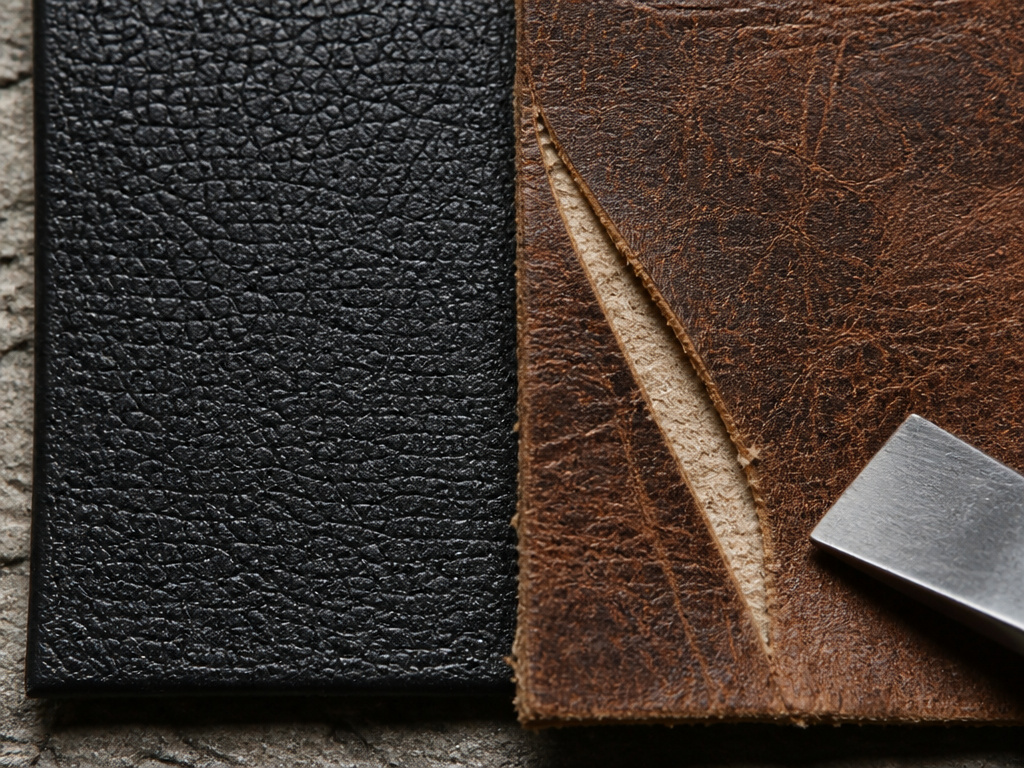 This is where the rubber meets the road, or where the plastic meets the fabric. Let’s compare them across the dimensions that matter day-to-day.
Durability & Lifespan
We have hard numbers here. For synthetic PU leather, a high-quality product like Secretlab PRIME™ 2.0 is rated for over 200,000 Martindale abrasion cycles. That’s impressive for a synthetic. In real-world terms, on a gaming chair used daily, that might translate to 4-6 years before showing significant wear. A lower-grade PU, like that on a fast-fashion handbag, can show corner wear in under a year and delamination within two.
For genuine leather splits, the data from sourcing guides is stark: 1-3 years of daily use. The coating cracks and peels because the loose fibers underneath stretch and deform. It’s not a question of if, but when. A full-grain leather belt might last a lifetime; a genuine leather belt is a consumable item.
Feel & Aesthetics
Run your hand over a new piece of each. PU leather feels consistently smooth, cool, and slightly artificial. Its grain pattern is perfectly, mathematically repeated. Genuine leather split feels drier and stiffer, with a more matte finish from its heavy pigment layer.
Over time, PU leather doesn’t develop a patina, it develops scratches and hazing. The color fades uniformly under UV light. A genuine leather split also won’t patina; the coating blocks the underlying leather from interacting with light and oils. When it fails, it reveals a pale, fuzzy underlayer that looks cheap.
Care & Maintenance
This is a short section because the care is superficial for both.
- PU Leather: Wipe with a damp cloth. Use a mild soap for stains. Never use solvent-based cleaners, alcohol, or oils. They can degrade the plasticizer in the polyurethane or the adhesive.
- Genuine Leather Split: Dust regularly. Use a cream-based polish or conditioner designed for finished leathers to replenish the coating’s flexibility. Avoid saddle soap or heavy oils, they can’t penetrate the coating and will just sit on top, attracting dirt.
The starkest difference is in repairability. A deep scratch in a genuine leather split can sometimes be minimized with a colored cream. A deep scratch in PU leather goes through the colored coating into a neutral or white layer beneath, it’s permanently visible. A torn strap on a genuine leather bag can be stitched. A delaminated strap on a PU bag is trash.
The Sustainability and End-of-Life Reality
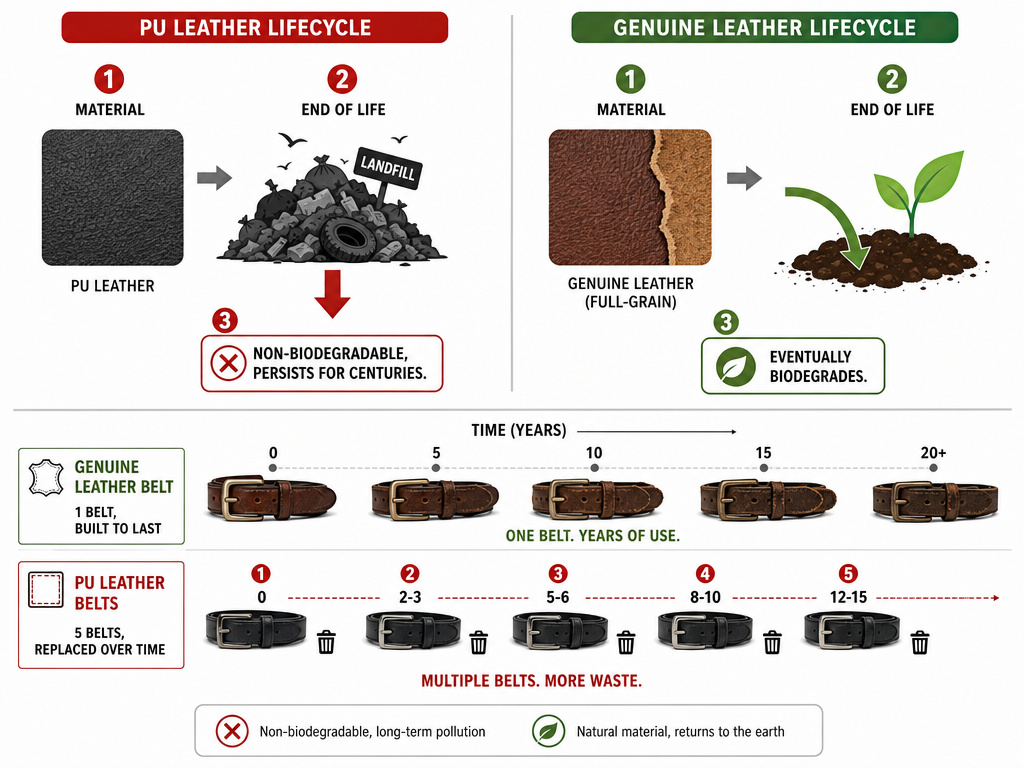 This is the conversation most marketing blurbs dance around. Let’s be direct about the afterlife of these materials.
PU Leather is, at its heart, a plastic fabric laminate. At end-of-life, it is not biodegradable. Mechanical recycling is extremely difficult because separating the plastic coating from the fabric backing is not economically viable at scale. Most of it ends up in landfill, where it will persist for centuries. The “vegan” claim addresses animal welfare, not environmental impact.
Genuine Leather Split, as an organic material, will eventually biodegrade, though its plastic coating will slow that process significantly. Its larger environmental footprint is in its production, the water, energy, and chemicals used in tanning and coating a low-quality hide.
If your primary goal is to minimize long-term waste, the most sustainable choice is often the longest-lasting one. A full-grain leather item cared for over decades has a lower per-year environmental cost than cycling through five synthetic PU leather replacements in the same timeframe. For a true circular approach, materials like vegan leather made from natural fibers (cork, mushroom) or high-performance waxed canvas are worth investigating over petroleum-based plastics.
Frequently Asked Questions
Is PU leather better than genuine leather?
“Better” depends on your needs. PU leather is better for easy cleaning, vegan ethics, and lower upfront cost. Genuine leather (the split) is better if you specifically want an animal-derived product and the associated scent and feel, even if its lifespan is short. For longevity and value, both are outperformed by higher-grade full-grain or top-grain leathers.
How can I tell if it’s real PU leather or a genuine leather split?
Use the hot pin test in an inconspicuous area. PU leather will melt and smell like burning plastic. A genuine leather split will singe and smell like burning hair. Also, examine the edge: PU leather will show a clean fabric edge. A genuine leather split will show a rough, fibrous edge, sometimes with a painted finish.
Does genuine leather last longer than PU?
In most documented cases of daily use, a coated genuine leather split lasts 1-3 years, while a quality synthetic PU leather can last 2-5 years. However, this flips if the genuine leather item is a full-grain or top-grain construction, those can last decades, far outliving any PU product.
Can you repair peeling PU leather?
No. Once the polyurethane topcoat delaminates from its fabric backing, the structural bond is broken. Glues or adhesives applied after the fact won’t restore flexibility or strength, and the bubbling will return. The item is effectively finished.
Why is “genuine leather” so cheap sometimes?
Because the term refers to the lowest grade of animal hide suitable for commercial products, often a coated split with significant correction. The cost reflects the material’s limited lifespan and the fact that it uses parts of the hide that would otherwise be waste. It’s inexpensive to produce compared to premium full-grain leather.
Before You Go
The bottom line isn’t that one material is universally superior. It’s that PU leather and genuine leather (the coated split) occupy similar territory: medium-term solutions with defined, predictable end-of-life failures. PU fails from the outside in, when its adhesive gives up. Genuine leather split fails from the inside out, when its weak foundation can no longer support its shiny veneer.
If your goal is a bag for a two-year college program, a trend-conscious jacket, or an easy-clean office chair on a corporate refresh cycle, PU leather is a legitimate, functional choice. Just maintain it with the right cleaners and understand its plastic nature.
If you must have an animal-derived product and your budget is tight, a genuine leather item will give you that. Just set your expectations for a 2-3 year relationship, not a decade-long companionship.
The real takeaway is to ignore the label poetry. Check the material specifications for full-grain, top-grain, or a specific polyurethane grade and backing. That’s where the real lifespan, feel, and performance are written. Choose based on that clock, not the tag.
