
How to Choose a Leather Watch Strap for Style and Comfort
This post contains affiliate links. As an Amazon Associate, we earn from qualifying purchases.
To choose a leather watch strap, you must match three exact measurements: your watch’s lug width, your wrist circumference, and the strap’s thickness profile. The leather type, prioritize full-grain or shell cordovan, decides its character and lifespan, while the buckle style is a practical choice between easy adjustment (tang) and reduced wear (deployment).
That lug width number is the gatekeeper. Get it wrong by even a millimeter, and the strap either won’t fit or will strain and tear. This isn’t about aesthetics first; it’s about physics. A strap is a consumable component under constant tension and flex, and every choice either accelerates or delays its replacement.
What follows is a breakdown of those three measurements, the leathers that actually age well, and the hardware that makes daily use effortless. By the end, you’ll be able to look past marketing terms and evaluate any strap on its real specs.
Key Takeaways
- Measure your watch’s lug width with calipers, not a ruler; odd sizes like 17mm or 19mm are common and forcing a mismatched strap voids warranties and damages leather.
- For a strap that develops character, choose vegetable-tanned full-grain leather or shell cordovan; avoid straps marketed only as “genuine leather.”
- Always leave a “little finger” gap between the strap and your wrist for the first two weeks to let the leather break in without being set in a shrunken shape.
- A deployment clasp is a worthwhile upgrade for a leather strap, as it drastically reduces the bending stress that causes the buckle end to crack over time.
- Quick-release spring bars are the single best convenience upgrade, making strap changes tool-free and eliminating the risk of scratching your watch lugs.
The Three Non-Negotiable Measurements
Forget style for a moment. If the strap doesn’t fit the watch or your wrist, nothing else matters. This is pure mechanics.
The lug width is the distance between the two horns on your watch case. The most common sizes are 18mm, 20mm, and 22mm. Here’s the catch: you cannot measure this accurately with a ruler. You need digital calipers. A retailer’s sizing guide will emphasize this, and for good reason.
Common mistake: Assuming your watch takes a standard width. Many watches, especially those originally sold with a metal bracelet, have odd lug widths like 17mm, 19mm, 21mm, or 23mm. Jamming a 22mm strap into a 21mm gap stretches and stresses the leather at the lugs, a weak point that will fail first.
The strap length is about your wrist. Standard lengths work for wrists roughly 6.5 to 7.5 inches. If you’re outside that range, you need a short or long specific size. Measure your wrist or, better yet, measure your current well-fitting strap from spring bar tip to spring bar tip.
Thickness is the final spec. A dress watch looks balanced with a 2.0-3.0mm strap. A tool or dive watch can handle 3.5-4.0mm. Go over 4.0mm, and the watch may not sit flat on your wrist. Thickness also affects break-in time, the thicker the leather, the longer it takes to soften.
| Measurement | Tool Needed | Consequence of Error |
|---|---|---|
| Lug Width | Digital Calipers | Strap will not seat, or will stretch and tear at lugs. |
| Strap Length | Soft Tape Measure | Strap will be too tight or have excessive tail. |
| Thickness | Calipers / Visual Match | Watch sits awkwardly; strap feels stiff and uncomfortable. |
Leather Type Dictates Look and Life
The term “genuine leather” is worse than useless here. In leather grading, it denotes the lowest tier, often a split hide with a plastic coating. For a strap, you want to know the top-layer quality and tanning method.
Full-grain leather is the outermost layer of the hide, complete with natural markings and grain. It’s the strongest and most breathable. Vegetable-tanned full-grain is the gold standard for straps that patina. The tannins from tree bark react with light, oils, and time, creating a rich, personal color shift. It’s a living material.
Shell cordovan is not actually leather from a shell; it’s a dense, fibrous membrane from a horse’s rear. It has zero visible grain and takes a high, glossy polish. Its tight structure makes it highly resistant to water spotting and rolling deformation where the buckle sits. It’s a premium, long-wearing choice.
Corrected-grain leather has been sanded or buffed to remove imperfections, then stamped with an artificial grain and coated. It looks uniform and shiny out of the box but won’t develop a natural patina. The coating can crack with flexing. This is what many mass-market straps are made from.
My go-to brands for quality leathers are Colareb for their rustic Italian vegetable-tanned straps, Bulang & Sons for impeccable classic styles, and Veblenist for modern designs with top-tier hides. These makers focus on the types of leather that age with you.
Early on, I bought a strap based on a beautiful picture online. It arrived stiff and plasticky. The seller called it “premium genuine leather.” That was my lesson: the feel of quality leather is unmistakable, it’s supple, has a subtle smell, and the edges are neatly finished and burnished, not painted. A cheap strap feels like a stiff belt and smells like a department store.
The Buckle: Function Over Form
The buckle is where the strap meets reality dozens of times a week. That repetitive stress is what eventually breaks it.
The tang buckle is the classic prong-and-hole design. It’s simple and allows for micro-adjustments. The downside is physics. Every time you put the watch on, you bend the leather sharply back through the buckle loop. Over years, this constant creasing weakens the fibers, leading to cracks. It’s the most common point of failure after the lugs.
A deployment clasp (or deployant clasp) is a folding metal clasp. You never have to bend the strap to put it on. This one change can triple the life of a leather strap by eliminating that stress point. The trade-off is that adjustment requires adding or removing links, which is less flexible than moving a prong to a different hole.
Where this goes sideways: Overtightening a tang buckle on a new strap. Leather needs to break in and conform to your wrist’s shape. If you cinch it tight from day one, it sets in a shrunken state. Later, when you try to take it off, the tight strap has nowhere to go, putting massive tension on the spring bar at the buckle end. That’s how you get a tear.
For most people, my advice is straightforward. If you change straps often or have fluctuating wrist size, a tang buckle’s adjustability is key. If you’ve invested in a single great strap you’ll wear daily for years, spend extra on a deployment clasp. It’s a mechanical guarantee.
Why Quick-Release Bars Are Non-Negotiable
becomes a 30-second, scratch-free task. It encourages you to rotate straps for different occasions, which is better for the leathers anyway. They’re inexpensive, and any quality new strap should come with them pre-installed. If it doesn’t, buy a set and swap them in immediately.
Matching Strap to Watch Style
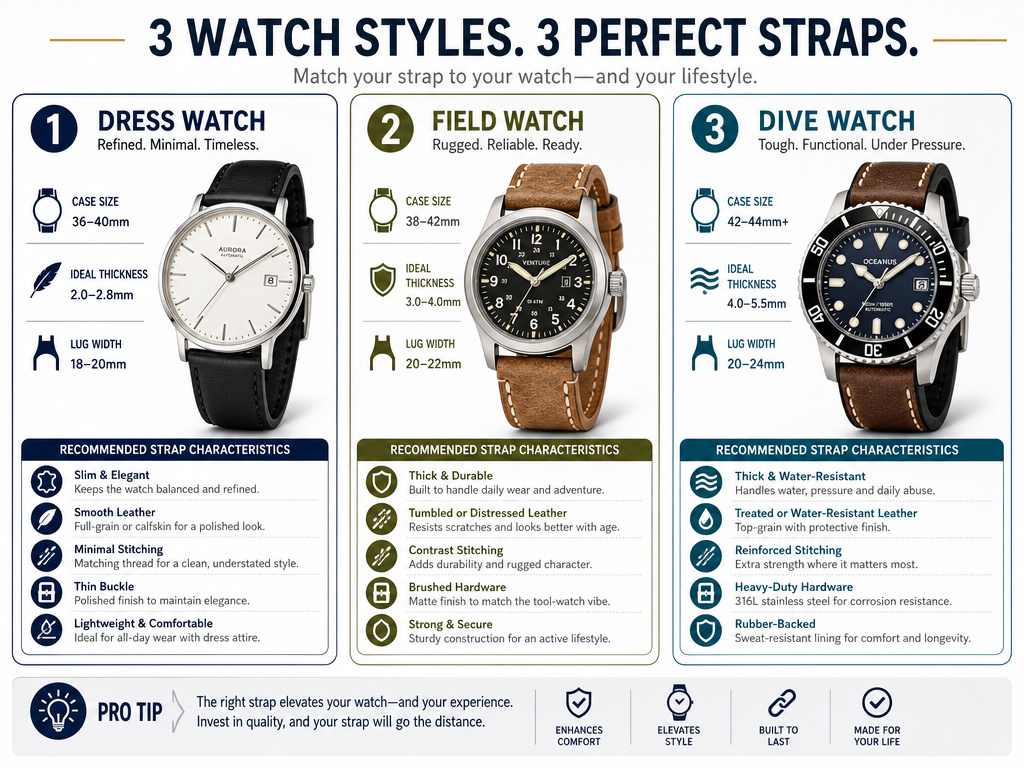 This is the fun part, once the specs are locked down. The goal is visual balance and intended use.
- Dress Watches (thin case, simple dial): Pair with a thin (2.0-3.0mm), smooth or lightly textured leather strap in black, brown, or burgundy. A subtle patina is good. Avoid thick, rugged straps.
- Field / Pilot Watches: These are versatile. A thicker vegetable-tanned strap, suede, or a high-quality nylon NATO works. Earth tones, tan, olive, brown, are classic.
- Dive Watches: While rubber is functional for water, a leather strap makes a dive watch wearable on land. Choose a water-resistant leather like shell cordovan or a rubber-backed leather. Thickness can match the watch’s heft.
The wrong pairing looks off because of proportion. A delicate dress watch drowned by a 4mm-thick leather cuff is a common mismatch. When in doubt, mimic the original strap’s proportions.
How to Break In and Care for Your New Strap
A new leather strap will be stiff. Your goal is to let it soften and form to your wrist naturally, not force it.
Wear it loosely for the first week or two. You should be able to slide a finger between the strap and your wrist comfortably. This allows the leather to warm, flex gently, and begin its molding process without stress. After it starts to feel more pliable, you can adjust to your preferred snugness.
For strap care, less is more. Keep it dry. If it gets wet, pat it dry with a towel and let it air dry away from heat, loosely fastened. Don’t wear it tight while damp, that’s how you get a permanent, misshapen dent.
Conditioning is rarely needed in the first year. When the leather starts to feel dry, use a tiny amount of a dedicated leather cream (like Saphir Médaille d’Or) on the backside only, never the top grain. Let it absorb fully. Most “protector” sprays just clog the pores.
Frequently Asked Questions
Can any watch use a leather strap?
Almost any watch with standard lugs and spring bars can use a leather strap, provided you match the exact lug width. Some integrated-bracelet watches or specific digital models have proprietary attachments and cannot be changed.
How long does a leather watch strap last?
With proper care and rotation, a good quality leather strap can last 2-4 years of daily wear. Shell cordovan often lasts longer, 5+ years, due to its density and resistance to rolling. It’s a consumable item; planning for eventual replacement is realistic.
Is it hard to change a watch strap myself?
With quick-release spring bars, it’s trivial and requires no tools. For standard spring bars, you need a spring bar tool. It requires a steady hand to avoid scratching the lugs. Brands like Breitling provide official video guides for the process. If you’re unsure, a jeweler can do it in minutes for a small fee.
What’s the difference between calfskin and alligator?
Calfskin is cowhide, known for its fine, smooth grain and softness. It’s a versatile, classic choice. Alligator has a distinctive, raised scale pattern and is considered a luxury exotic leather. Brands like OMEGA use CITES-certified alligator to ensure ethical sourcing. Alligator is more fragile and requires more careful handling.
Are expensive straps worth it?
Yes, but with a caveat. A $150 strap from a maker like Bulang & Sons uses better leather, more consistent thickness, hand-finished edges, and better hardware than a $30 generic strap. It will look better, feel better, and last longer. However, a strap over $300 often pays for a brand name or exotic skin, not a proportional increase in durability or comfort.
The Bottom Line
Choosing a strap is a mix of cold measurement and warm preference. Start with the calipers to find your lug width, that’s non-negotiable. Then, invest in a strap made from a specific, quality leather like vegetable-tanned full-grain or shell cordovan from a known brand. Finally, make your life easier with quick-release bars.
The strap that came with your watch isn’t a lifetime commitment. It’s the most personal part of the watch, the piece that touches you. Get the fit and feel right, and even a modest watch feels custom. Get it wrong, and no watch feels comfortable. So measure twice, choose once, and enjoy the break-in. That’s when the strap becomes yours.
