
The Right Way to Size a Leather Watch Strap | Lug Width First
This post contains affiliate links. As an Amazon Associate, we earn from qualifying purchases.
To size a leather watch strap, you need two exact measurements: the lug width (the gap between your watch’s lugs in millimeters) and your wrist circumference. Never measure your old strap, it may be deformed or the wrong size. Match the lug width exactly, especially with quick-release straps, as a 1mm error makes fitting impossible.
Let’s be clear about this. Most people grab a ruler and measure their old band. That’s how you end up with a strap that won’t fit, because a worn strap lies. The real measurement lives on the watch case itself. Getting this wrong doesn’t just mean a return, it can crack a new strap’s edges or strain the spring bars.
What follows is the practical method. We’ll cover how to measure with the right tools, decode strap length codes, pick the correct spring bar size, and fit the strap without tearing the leather in the first week.
Key Takeaways
- Measure the lug gap, not the strap. Use vernier calipers or a digital gauge for accuracy; a standard ruler often fails, especially on odd sizes like 17mm or 19mm.
- Spring bars are consumable. Replace them with 1.8mm stainless steel bars for NATO straps or heavy watches, the standard 1.5mm can fail.
- Fit new straps loose for two weeks. Overtightening a fresh leather strap before it breaks in is the fastest way to tear it at the lug holes.
- Length is two numbers. A 75/120mm strap means a 75mm short end and a 120mm long end; match these to your wrist circumference.
- Clasps prevent stretch damage. A deployant clasp limits the pulling and stretching that happens every time you remove a buckle strap.
The Two Measurements That Matter
You need two numbers. The first is stamped on your watch, metaphorically. The second is on your wrist.
The lug width is the inner distance between the two lugs on your watch case. This is essential. A strap labeled 20mm must go on a watch with a 20mm lug width. Trying to force a 22mm strap onto a 21mm lug, a common odd size, will crush the strap’s shoulders and void any warranty. The reverse, using a 20mm strap on a 21mm gap, leaves a visible space that looks sloppy and lets the watch head wobble.
The lug width is the inner gap between the lugs, not the outer width of the lug tips. Measuring the outside will give you a larger number and the strap will not fit correctly.
So how do you find it? A jewelry ruler or a standard school ruler isn’t accurate enough. You need vernier calipers or a digital caliper. Place the jaws inside the lugs, not on the outside edges, and take the reading. If you don’t have calipers, search for your exact watch model and “lug width” online. For a Rolex, the answer is almost always 20mm. For a vintage piece, it might be 19mm.
Your wrist circumference is the other half. Wrap a soft tape measure around your wrist, right where the watch sits. If you don’t have one, use a strip of paper, mark it, and measure that against a ruler. This number determines the strap length you need.
| Wrist Circumference | Recommended Strap Length (Short/Long) | Category |
|---|---|---|
| Under 160mm (6.3″) | 65mm / 105mm | Short |
| 160mm – 185mm (6.3″–7.3″) | 75mm / 120mm | Standard |
| Over 185mm (7.3″) | 80mm / 130mm | Long |
Why Your Old Strap Is a Liar
Here’s the thing. It’s intuitive to pull off your old, cracked strap and measure its width. Don’t. Leather stretches and deforms with wear. A strap that started at 20mm might have flared to 21mm or compressed to 19mm after years of sweat and pressure. Basing your new purchase on that distorted figure is a guarantee of frustration.
I learned this the hard way with a vintage watch. The old strap was brittle and measured 18mm with my ruler. I ordered an 18mm replacement. It wouldn’t seat. After digging out my calipers, I found the actual lug width was 17mm. The old strap had been slowly destroying itself by being forced into a space too small for it. That’s a common shortcut that creates a long-term problem.
This is why manufacturer guides, like the Seiko bracelet manual, stress understanding the bracelet structure before sizing. The principle is the same: the starting point is the watch, not the accessory. Measuring the watch gives you a clean, unchanging number.
Navigating Odd Lug Sizes
 The watch industry loves round numbers, but your watch might not cooperate. Odd lug widths, 17mm, 19mm, 21mm, 23mm, are common, especially on watches that originally came with a metal bracelet. This is a frequent point of failure.
Common mistake: Assuming your watch is a standard size. Trying to fit, for example, a 22mm strap to a 21mm lug watch may damage the strap and void any warranty.
Your options are simple. First, accept the odd size and buy a strap made for it. Many quality strap makers, like Colareb or Bulang & Sons, offer 19mm and 21mm widths. Second, if you have a quick-release strap, you can sometimes carefully remove the quick-release tabs and use a standard spring bar, allowing a bit more wiggle room. A 20mm strap might fit a 19mm lug, but it will be tight and the quick-release mechanism definitely won’t work. Never try to squeeze a larger strap into a smaller space.
The Spring Bar Detail Everyone Skips
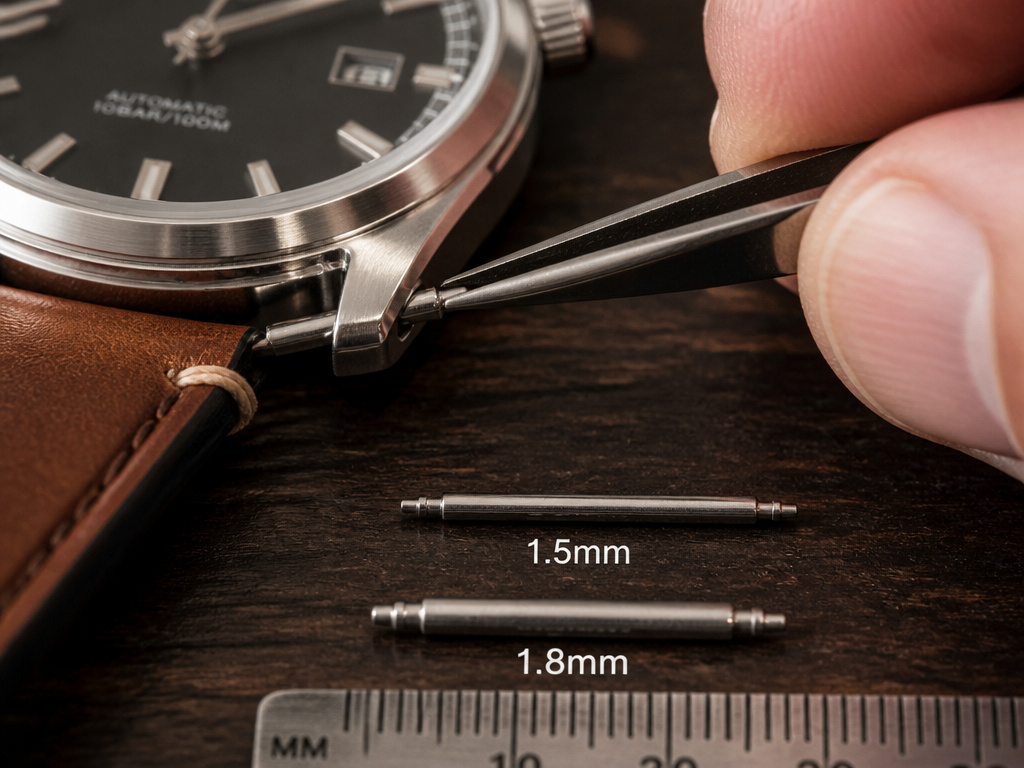 Spring bars are those little cylindrical pins that hold the strap to the watch. Most people never think about them until one fails and their watch hits the floor. They are a consumable part.
The standard diameter is 1.5mm. They work fine for a light dress watch on a leather strap. But if you’re using a NATO strap, where the entire weight of the watch hangs on the bars, or if you have a heavy sport watch, you need an upgrade. Move to 1.8mm stainless steel spring bars. The thicker bar is exponentially stronger. I replace stock bars with 1.8mm versions on any watch I plan to wear regularly. It’s a five-dollar fix for a five-hundred-dollar accident.
The length must match your lug width exactly. A 20mm watch needs 20mm spring bars. The ends of the bar should sit flush or just inside the lug holes when installed. If they protrude, they’ll catch on everything.
Fitting the Strap Without Damage
You have the right strap and the right bars. Now the part where most leather gets torn. New leather is stiff. It needs to break in and mold to the curve of your wrist and lugs. If you fasten it tightly on day one, you’re forcing it.
The correct method is to fit the strap loosely for the first week or two. You should be able to slide a finger between the strap and your wrist. This allows the leather to gradually soften and shape itself. After that break-in period, you can tighten it by one hole if needed.
Overtightening is the enemy. It’s especially risky with buckle straps, because removing the watch requires pulling the strap tight to release the prong. This stretches the leather sharply at its weakest points, the holes near the lugs and the buckle. I’ve seen straps tear clean through at the top hole.
Where this goes sideways: Overtightening a leather strap that uses a buckle may result in breaking or tearing at the lug (the most common place) or spring bar at buckle end.
A deployant clasp solves this. The strap is fixed to the clasp; you open it with a button. There’s no pulling or stretching during removal. It’s the single best upgrade for extending a leather strap’s life. The clasp does add a bit of bulk under the wrist, but the trade-off is worth it for a strap you love.
How to Adjust Strap Length
Sometimes the length is perfect, but the existing holes aren’t in the right spot. You need a new hole. This isn’t complicated, but it requires the right tool, a sharp, rotary leather punch. Don’t use a cheap office punch or, heaven forbid, try to screw an awl through it. You’ll crush the leather fibers.
Mark the spot for the new hole carefully, using the existing holes as a guide for spacing. Place the strap on a hard, sacrificial surface like a scrap of wood. Align the correct size punch (usually 2mm or 3mm) over your mark and apply firm, even pressure. A clean pop means you’ve cut through. If you’re unsure, practice on a scrap piece first. For a complete walkthrough, our guide on punching holes in leather covers the tools and technique.
If you need to shorten the strap significantly, you’ll have to cut it. This is a permanent modification. Measure twice, mark a straight line, and use a very sharp knife or rotary cutter against a metal ruler. You’ll then need to refinish the cut edge with edge paint or gum tragacanth.
Choosing Your Strap Material
Sizing is mechanical, but material choice affects comfort and how the sizing feels. For a daily-wear strap that will handle moisture, vegetable-tanned leather or shell cordovan are my top picks. Both develop a patina from wear and are more resistant to sweat than chrome-tanned leather.
Rubber or silicone straps are zero-maintenance and fully waterproof, but their sizing is less forgiving, they don’t break in or stretch. NATO straps are easy to size because they’re one continuous length, but they add bulk under the watch head.
The thickness matters too. A dress watch looks best with a strap around 2.5mm to 3mm thick. Anything over 3.5mm starts to look clunky and can prevent the watch from sitting flat on your wrist. When you’re choosing a watch strap, consider the thickness as part of the overall fit.
Frequently Asked Questions
Can I use a ruler to measure my lug width?
You can try, but it’s not accurate enough for a measurement within a quarter-inch. Millimeter markings on a standard ruler are too wide, and it’s easy to misread the inner gap. Vernier calipers or a digital gauge are the right tools. An error of just 0.5mm can make a quick-release strap unusable.
What if my wrist is between sizes on the length chart?
Always round up. It’s easy to use a different hole on a strap that’s slightly too long. A strap that’s too short cannot be extended. If you’re between standard and long, choose the long length. You can also look for brands that offer specific “short” or “long” versions of their straps.
How often should I change my spring bars?
Inspect them every time you change your strap. Look for bends, rust, or pitting. The rule from experts is to replace them whenever you fit a new strap. A tired spring bar can look fine but its internal spring can be weakened. It’s cheap insurance.
Do quick-release straps need special spring bars?
Yes, they have integrated bars. You cannot swap them for standard bars without removing the quick-release tabs (which is sometimes possible with pliers). Their convenience is fantastic for easy swaps and prevents tool scratches, but they demand an exact lug width match.
Is sizing a watch strap like sizing a leather belt?
The principle of matching a measurement to your body is similar, but the process is different. A belt wraps around your waist over clothing; a watch strap must fit snugly against bare skin at a specific point on your wrist. For the specifics on that, see our guide on sizing a leather belt.
The Bottom Line
Sizing a leather watch strap comes down to precision, not guesswork. Measure the watch’s lug width with calipers, match it exactly, and choose a length based on your wrist circumference, when in doubt, go longer. Treat spring bars as a wear item and upgrade to 1.8mm for security.
Then, give the leather time. Fit it loose for two weeks. Let it shape itself to you. That patience is the difference between a strap that breaks in beautifully and one that breaks prematurely. After that, regular strap maintenance will keep it comfortable for years. It’s a simple system, but each step matters. Skip one, and the fit fails.
