
How to Choose a Leather Wallet That Lasts & Fits Perfectly
This post contains affiliate links. As an Amazon Associate, we earn from qualifying purchases.
To choose a leather wallet, match three things: your actual card count, your pocket position, and a leather grade that can handle daily mechanical stress. Skip the “max capacity” and look for full-grain or top-grain leather from a maker who specifies it. A wallet for 4-6 cards in your front pocket needs to close under 0.5 inches thick when loaded, or it will bulge and annoy you within a week.
That loaded thickness number is where most wallets bought on autopilot fail. A wallet that’s thin and empty can become a brick when loaded with your real carry. The difference between a comfortable daily companion and a pocket-clogging nuisance isn’t style or brand, it’s the arithmetic of overlapping leather panels, stretched card slots, and where you actually put it.
What follows is a field guide, not a fashion catalog. We’ll walk through the thickness math that determines comfort, the leather grades that dictate lifespan, and the construction details that separate a five-year wallet from a two-year disappointment. By the end, you’ll be able to read any product description and know if the wallet fits your pocket and your habits.
Key Takeaways
- Your wallet’s loaded thickness is the single most important comfort spec. For front pockets, aim for under 0.5 inches; for back pockets, under 0.75 inches.
- Full-grain leather is the durability benchmark, but a well-made top-grain wallet is a legitimate sweet spot for price and appearance. Avoid anything just labelled “genuine leather.”
- Machine lock-stitch seams on card slots often fail within 12-18 months of daily use. Look for saddle-stitching or reinforced machine stitching.
- Count the cards you use weekly, then add two. Buying a wallet with more slots than you need is the most common reason for unwanted bulk.
- Leather “weight” (e.g., 3-4 oz) is a maker’s term for thickness. As a buyer, ignore it and focus on the wallet’s finished, closed dimensions.
The Thickness That Actually Works
Forget how thin a wallet looks in a product photo. The only measurement that matters is how thick it is when it’s in your pocket, fully loaded with your cards and cash. This is a mechanical problem, not an aesthetic one.
A wallet loaded beyond its design capacity creates a cascade of issues. Card slots stretch prematurely, the spine distorts, and the whole profile bulges. For front pocket carry, that bulge is a constant pressure against your leg. For back pocket carry, it can lead to real posture problems if you sit on it for long stretches, like during a commute.
So what’s the right thickness? The numbers from actual use are clear.
| Carry Position | Ideal Loaded Thickness | What Happens If You Exceed It |
|---|---|---|
| Front Trouser Pocket | Under 0.5 inches (13mm) | Creates visible pocket bulge, fabric distortion, and discomfort within a day. |
| Back Trouser Pocket | Under 0.75 inches (19mm) | Causes sitting imbalance, potential back discomfort, and accelerates wear on the wallet’s spine. |
| Jacket / Bag Carry | Less critical, but under 1 inch | Prevents the wallet from becoming a clumsy brick that’s hard to retrieve. |
Where this goes sideways: Choosing a wallet based on its empty dimensions. A “slim” bifold that measures 0.4 inches empty can easily hit 0.7 inches once you add six cards and a few bills, pushing it out of the front-pocket comfort zone.
The math is straightforward. If a wallet has three overlapping layers of leather for its card slots, and each layer is 0.2 mm thicker than it needs to be, you’ve just added 0.6 mm to the local stack. Multiply that across several panels and the bulk adds up fast. This is why quality makers “skive” the leather, they thin it at the seams where layers overlap. It’s an invisible step that makes the difference between a wallet that closes flat and one that doesn’t.
When you’re evaluating a leather wallet, ignore the ounce weight (like 3-4 oz). That’s a maker’s term for leather thickness. As a buyer, your only job is to find the finished, closed dimensions in the spec sheet. If they’re not listed, that’s your first red flag.
Leather Grade: Cutting Through the Marketing Fog
The label on the leather tells you more about how a wallet will age than the brand name does. Let’s be clear about this: the term “genuine leather” is functionally useless. It’s a classification, not a quality grade, and it sits at the bottom of the hierarchy. Marketing uses it because it sounds reassuring, but it often means a split layer with a coated finish that will crack and peel.
You have two proven paths for a daily-use wallet: full-grain or top-grain leather.
Full-grain leather is the top outer layer of the hide, complete with its natural grain and markings. It’s the most durable and develops a rich patina, a personal sheen and color depth, over years of use. Its dense fiber structure handles the friction of going in and out of your pocket better than anything else. Brands like Popov Leather and Ashland Leather build their reputations on it.
Top-grain leather is the same outer layer, but it’s been lightly sanded or buffed to remove surface imperfections. This gives it a more uniform look right out of the box. It’s still excellent leather and often represents a sweet spot between premium quality and price. Don’t let anyone tell you top-grain is “bad.” For many people, it’s the right choice.
The tensile strength of leather is measured by standards like ASTM D2209 and ISO 3376. A high tensile score is good, but it doesn’t automatically translate to seam strength or years of pocket wear. A tensile test measures a uniform strip, not a folded, stitched, and flexed card slot.
Here’s a straightforward rule: if a product description shouts “GENUINE LEATHER!” but doesn’t mention full-grain or top-grain, move on. A quality maker is proud of their materials and will tell you exactly what you’re getting. For more detailed help on selecting the right hide, our guide on how to choose leather for a project breaks down temper, tannage, and more.
Where Lesser Leather Fails (And How Fast)
I want to help you make confident choices, and that means being honest about timelines. A wallet isn’t a lifetime purchase if it’s made from the wrong materials. The difference between a five-year wallet and a two-year wallet isn’t just price, it’s visible within the first 18 months of daily carry.
Lower-grade leathers have a predictable failure path. Bonded leather (reconstituted fibers) and heavily corrected-grain leathers with thick plastic coatings don’t wear in; they wear out. The coating cracks, often along fold lines or at the edges of card slots. Once the coating goes, the fragile material underneath is exposed and starts to peel. You’ll see this as flaking, usually at the corners or along the fold.
The timeline is surprisingly short. While a full-grain leather wallet with proper construction should last five to ten years, lesser leathers often show significant degradation within one to two years. The problem isn’t that it falls apart on day one. It’s that it looks fine for months, convincing you it was a good buy, before the decline starts.
Then there’s the stitching. A machine lock-stitch on a high-stress point like a card slot opening is a common point of failure. The constant insertion and removal of cards work the threads against each other and the leather. On a lower-quality wallet, these seams can begin to unravel or pull loose after twelve to eighteen months.
The fix is to look for saddle-stitching. This is a stronger, two-needle hand-stitching method where the threads interlock along the entire seam. If one thread breaks, the rest of the seam holds. It’s a hallmark of quality craftsmanship. If the wallet is machine-stitched, look for reinforced bar tacks at the ends of slots and seams. Good thread for leather work is also vital, it’s typically a thick, waxed polyester or linen, not standard sewing thread.
The Three Wallet Formats That Matter
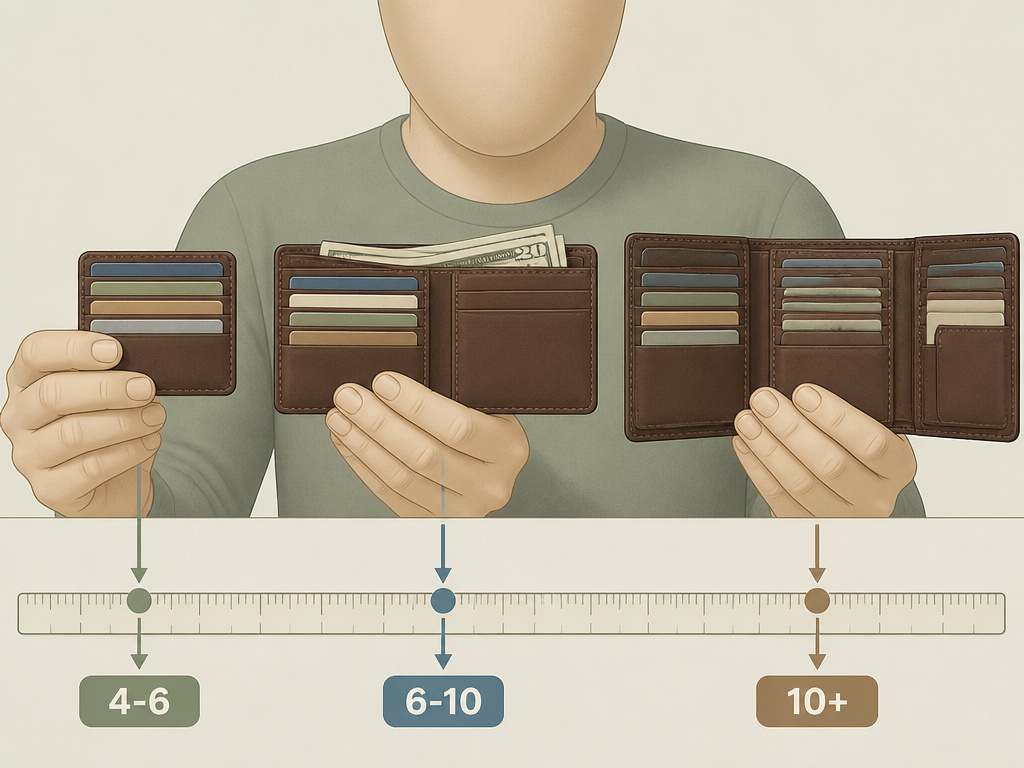
Men’s leather wallets divide into three practical formats. Your card count decides the category; your pocket preference picks the winner.
The Slim Wallet or Cardholder (4-6 cards)
This is for the minimalist. It holds your daily essentials, license, a couple of credit cards, maybe a debit card. It has no bill compartment, or a simple single-fold slot. Its entire job is to disappear in your front pocket. If you’re sick of sitting on a fat bifold, this is your exit. The best ones are a single, sleek piece of leather that molds to your cards.
The Bifold (6-10 cards)
The classic. It offers a balanced capacity with multiple card slots and a divided bill compartment. It’s designed for back-pocket carry, though a well-made, thin-profile bifold can work in a front pocket if you keep the card count down. This is the default for a reason. It works.
The Trifold (10+ cards)
This is for the carrier who genuinely needs a lot of slots. It folds twice, typically offering more card pockets than a bifold. The trade-off is bulk. When loaded, a trifold can be quite thick. Before you choose this, do an honest audit. Are you carrying ten cards you use weekly, or are you using your wallet as a filing cabinet?
Common mistake: Buying a format based on “max capacity” rather than your “typical carry.” A bifold that holds eight cards but only ever carries four is just a thicker, heavier version of a slim wallet. Every empty slot is wasted space and added bulk.
Your pocket dictates the final choice. A front pocket demands a slim profile. A back pocket has more tolerance, but even there, thickness matters. If you feel your wallet when you sit down in the car, it’s too thick for back-pocket carry.
Construction: The Details You Can’t See (But Will Feel)
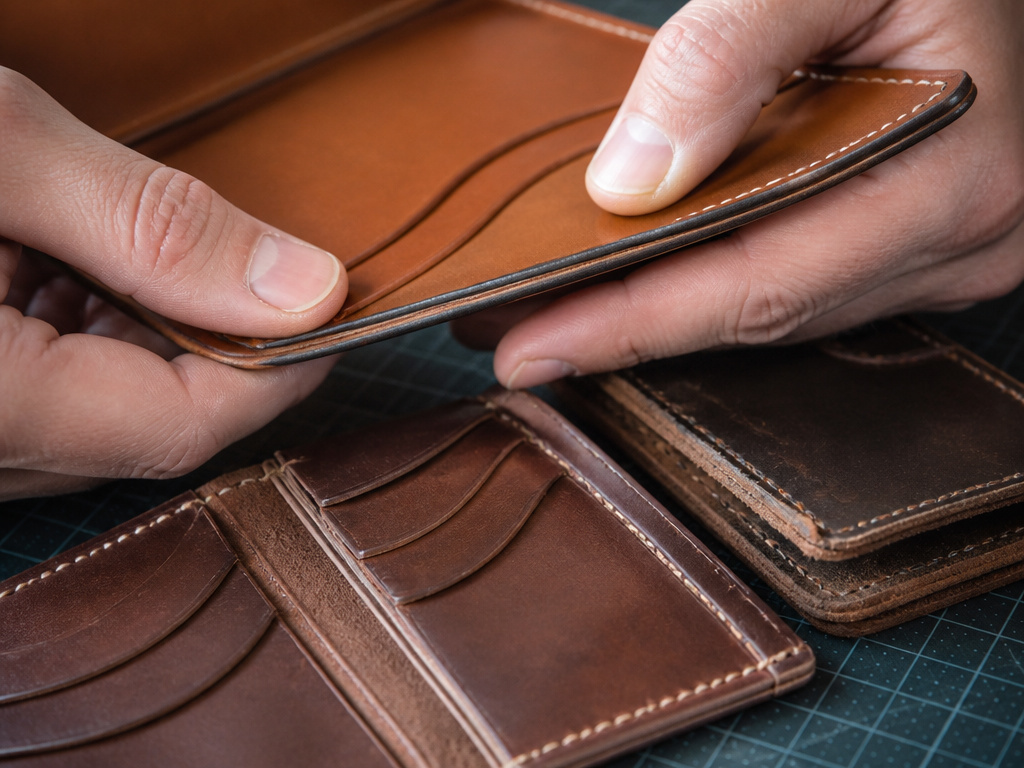
The difference between a wallet that lasts two years and one that lasts ten is often in the details the camera doesn’t show. You don’t need to be an expert to spot them.
Edges: Look at the cut edges of the leather. Are they rough and fuzzy, or are they smooth and polished? Quality wallets have burnished edges. This means the edge has been sanded smooth, had a bit of wax or dye applied, and then been polished with a wooden tool or cloth until it’s glassy. Painted edges are a cheaper alternative; they look clean at first but can crack and peel with repeated flexing. A burnished edge ages with the rest of the wallet.
Skiving: As mentioned, this is the thinning of leather at seams. You can check for it by feeling where layers overlap. The transition should be smooth, not a sudden step. Without skiving, a wallet with four card slots can have eight full layers of leather stacked at the fold. It will never close flat.
Lining: Many wallets are unlined, which is fine. If it is lined, it should be a thin, supple leather or a durable fabric. A thick, stiff lining adds needless bulk and can delaminate over time. It’s often a sign the maker is hiding poor-quality leather on the inside.
Closures: Buttons, snaps, and zippers are points of mechanical failure. A simple fold-over design is the most reliable. If you need a secure closure, a magnetic snap is less likely to fail than a mechanical one. A zipper, like a quality YKK brand one, is secure but adds significant bulk and a hard metal frame.
If you’re ever inspired to make a leather wallet yourself, you’ll quickly learn why these details are essential. They’re what separates a hobbyist project from a professional-grade product.
The Care That Prevents Catastrophe
A good leather wallet needs remarkably little care, but the wrong care can ruin it faster than neglect. People treat full-grain leather like a fussy museum piece; it’s actually the guy who shows up to work with dirt under his nails. It’s tough.
The only mandatory maintenance is occasional conditioning, maybe once or twice a year. Use a tiny amount of a quality leather conditioner (like Huberd’s Shoe Grease or a dedicated leather balm) on a cloth, and rub it in. You’re replenishing the natural oils that dry out over time. Let it fully absorb before using the wallet again.
Skip this if: You’re considering saddle soap. That’s for cleaning actual, filthy saddles. On a wallet, it’s overly aggressive and will dry the leather out, requiring even more conditioner.
Avoid these three things: 1. Heat: Don’t leave it on a radiator or in a hot car. Heat bakes the moisture and oils out, making the leather brittle. 2. Over-stuffing: This is the #1 cause of premature failure. It stretches slots and distorts the shape permanently. 3. “Waterproofing” Sprays: Most commercial sprays clog the leather’s pores. If the leather can’t breathe, trapped moisture can cause mildew or rot from the inside. If it gets wet, let it dry naturally at room temperature, away from direct heat.
For a complete routine, from cleaning to storage, see our dedicated guide on how to care for a leather wallet. And when it does eventually need a refresh, here’s how to properly condition a leather wallet.
Frequently Asked Questions
What is the most durable type of leather for a wallet?
Full-grain leather is the most durable for a wallet. It retains the complete, dense fiber structure of the hide’s outer layer, making it highly resistant to the abrasion of daily pocket carry. Top-grain leather is a close second and offers a more uniform appearance at a often lower price point.
How many cards should a wallet hold?
Your wallet should hold the number of cards you use in a typical week, plus one or two extras for occasional use. The average person needs 4-6 cards. Buying a wallet with more slots than you need is the most common cause of unnecessary bulk and thickness.
Can a leather wallet be too thin?
Yes, a leather wallet can be too thin. If the leather is shaved too thin (under 2-3 oz, or about 1mm), it may lack the body to hold its shape, and card slots can become floppy or tear more easily. The goal is the minimum thickness required for structure, not the absolute thinnest possible material.
How long should a quality leather wallet last?
Well-made wallet from full-grain or good top-grain leather, with solid construction like saddle-stitching and burnished edges, should last five to ten years of daily use. Lesser leathers often show significant wear, cracking, or seam failure within one to two years.
Is an RFID-blocking wallet necessary?
For most people, no. The risk of electronic pickpocketing is extremely low. RFID-blocking lining adds a layer of material, making the wallet slightly thicker. It’s a nice-to-have for peace of mind, not a essential security feature for the average person.
Before You Go
One final, practical filter: if you’re deciding between two wallets and both seem to check the boxes, choose the thinner one. Bulk is the enemy of daily comfort in a way that minor differences in leather sheen or stitch color never will be.
The right wallet isn’t a status symbol or a filing cabinet. It’s a simple, elegant tool that holds your essentials and gets out of the way. Find the one that matches your actual card count, fits your chosen pocket, and is built from materials that can handle the job. That’s how you choose a leather wallet you’ll still be happy with years from now.
Everything above assumes a standard daily carry. If your routine involves soaking your wallet (think boat work or ranching), the calculus changes, you’d look at oil-tanned or waxed leathers with different care needs. But for the other 95% of us, the rules are simple. Match your pocket, match your cards, and don’t overcomplicate it.
