How to Choose Thread for Leather: The Ultimate Material Guide
This post contains affiliate links. As an Amazon Associate, we earn from qualifying purchases.
Choose thread for leather by matching three things: the leather’s weight (in ounces or millimeters), your sewing method (hand vs. Machine), and the thread’s material and strength rating (like Tex or thread size #). A 3-5 oz. Leather for a wallet pairs with #92 bonded nylon on a heavy-duty home machine, while hand-saddling a 8-10 oz. Belt demands a thicker, waxed polyester thread like Ritza Tiger 1.0mm.
Get the first variable wrong and the thread either cuts through thin leather or fails to lock in thick hides. The machine itself is the second gatekeeper — a home Singer jams on anything above Tex 70, while an industrial cylinder-arm walks through Tex 135. This is about matching physical limits.
What follows: a breakdown of the three-part system, the specific thread types that work, the machines that can handle them, and the one visual cue that tells you’ve got it wrong before you sew the first stitch.
Key Takeaways
- Leather weight dictates thread diameter. A thick thread on thin leather acts like a saw; a thin thread on thick leather snaps under load. Match ounces to millimeters.
- Your machine is a hard ceiling. Home machines choke above Tex 70; true leather machines like the Sailrite Ultrafeed stop at Tex 90. For heavier threads, you’re hand stitching or investing in industrial gear.
- Bonded nylon is the default for machine sewing, but for heirloom handwork, a waxed polyester like Ritza Tiger Thread lasts longer and looks better. Decorative stitching on soft leathers calls for a lighter #46 or #69 thread.
- Increase stitch density for strength, but know the trade-off. More stitches per inch weaken the leather itself. The strongest seam breaks when both leather and thread fail together.
- If your leather puckers immediately after the first few stitches, your needle is too small for your thread. That friction heats and shrinks the thread, pulling the hide out of shape.
The Core System: Leather Weight, Thread Size, Machine
Think of these three as interlocking gears. Turn one, and the other two have to follow. Ignore the sequence and the project jams, breaks, or looks amateur.
Leather weight comes first because it’s fixed. You can’t change a 4 oz. Shoulder into an 8 oz. Bridle. Weight is measured in ounces per square foot or in millimeters. One ounce is roughly 0.4mm. A wallet might use 3-4 oz. (1.2-1.6mm), a belt 8-10 oz. (3.2-4mm).
That number plugs directly into a thread size. The old system used numbers like #69, #92, #138. The higher the number, the thicker and stronger the thread. A newer, global system uses Tex, which is the weight in grams of 1,000 meters of thread. Tex 30 is fine, Tex 350 is heavy cable.
Here’s the translation for common leather weights, drawing from manufacturer specs like those from Superior Threads.
| Leather Weight | Ounces (approx.) | Thickness (mm) | Recommended Thread Size | Tex Equivalent |
|---|---|---|---|---|
| Soft, garment | 2–3 oz. | 0.8–1.2mm | #46, #69 | Tex 30–40 |
| Light craft | 3–5 oz. | 1.2–2.0mm | #92 | Tex 70 |
| Medium (bags, belts) | 5–8 oz. | 2.0–3.2mm | #138 | Tex 90–135 |
| Heavy (saddles, straps) | 8–12 oz. | 3.2–4.8mm | #207, #277 | Tex 210–270 |
| Very Heavy | 12+ oz. | 4.8mm+ | #346 | Tex 350+ |
These guidelines result from thread breaking strength versus leather tearing strength. A #92 thread on 8 oz. Leather will snap before the leather tears, which is a weak seam.A #346 thread on 3 oz. Leather will act like a garrote, deforming and cutting the hide.
The machine is the final gear. It has a literal physical limit. The needle eye must accommodate the thread, and the tension disks must grip it. A standard home sewing machine, even a heavy-duty model, typically maxes out at Tex 70 or a #92 thread. The needle shaft and hook mechanism can’t handle thicker stuff without bending or skipping.
Common mistake: Assuming your machine can “power through” a thicker thread. The needle eye is the bottleneck. Force a Tex 135 thread through a #18 needle eye, and the thread frays, overheats, and jams the tension disks within ten stitches. The motor might keep going, but the stitch will be garbage.
Industrial machines like the Sailrite Ultrafeed or true cylinder-arm models are built for thicker fare. The Sailrite Ultrafeed is rated for up to Tex 90 thread, which covers most medium leatherwork. For the heavier Tex 135 and above, you’re in industrial territory or back to hand tools.
What Breaks the System: Leather Weight and Thread Size
The chart above gives you the safe corridor. Stray outside it and the failure is mechanical, predictable, and often immediate.
Use a thread that’s too thick for the leather, and the needle hole becomes the problem. A thick thread needs a large needle, which punches a large hole. On thin leather, that hole is a structural defect. The leather can’t support the tension around the oversized perforation, leading to a condition called “puckering” – the leather gathers and wrinkles along the seam line. It looks terrible and weakens the piece.
Use a thread that’s too thin, and the seam fails differently. The thread becomes the weakest link. Under stress, it will snap before the leather gives way. This is a clean, sudden failure. You might get away with it on decorative items, but on a bag strap or a belt, it’s a total loss.
There’s a sweet spot where the leather and the thread have similar breaking points. In an ideal, strong seam, both should fail at roughly the same time. This is the principle behind matched materials. You’re not building a seam where one element is massively over- or under-engineered.
A 2023 textile study noted that increasing stitch density by 50% can increase seam strength by a similar margin, while thread consumption only rises 10-20%. But there’s a ceiling. Too many stitches turn the leather into perforated paper.
This is the why-layer. More stitches per inch spread the load across more anchor points. But each stitch is another hole, another point of weakness. The strongest seam isn’t the one with the most stitches; it’s the one with the right stitches for the material. That’s why a saddle stitch on heavy leather uses 4-5 stitches per inch, while a machine stitch on a garment might use 10-12.
The 3 Types of Leather Thread (And Which One Wins)
You’ve matched weight and machine. Now you pick the thread material. This is where the ‘best’ thread debates rage, but the answer is situational.
Bonded Nylon is the workhorse for machine sewing. The bonding process coats the nylon fibers with a resin, which reduces friction as it passes through the needle and leather. This makes it the default for any powered sewing. It’s strong, consistent, and comes in the full range of sizes. For most machine projects, start here. Superior Threads’ bonded nylon line is the benchmark.
Polyester Thread, particularly a braided, waxed polyester like Ritza Tiger Thread, is the champion of hand stitching. The wax coating allows the thread to glide, reduces friction burn, and helps the thread lay flat and lock in the saddle stitch. It develops a beautiful sheen over time. For any hand-stitched project where appearance and longevity matter, this is my pick.
Linen and Synthetic Corespun threads have their niches. Linen is traditional and looks classic, but it can rot over decades if not protected. Modern synthetic corespun threads wrap a polyester core with a cotton or polyester sheath, offering high strength with a softer hand. They’re excellent for machine-sewn garments where you want strength without the plastic sheen of pure nylon.
Which one wins? – For machine work: Bonded nylon. – For hand saddle stitching: Waxed polyester (Ritza Tiger Thread). – For historical reenactment or a specific matte look: Linen.
Where this goes sideways: Using a standard cotton-wrapped polyester sewing thread from the big box store. It’s not built for leather’s resistance. The cotton sheath shreds in the needle eye, leaving a trail of fuzz in the tension disks and a weak, fuzzy seam. I’ve seen it fail on a simple wallet after six months of gentle use.
Hand Stitching vs. Machine: The Thread Changes

Your sewing method doesn’t just change the tool; it changes the thread’s job description.
When you stitch by hand, especially using the saddle stitch, the thread performs a locking motion inside the hole. Two needles, two threads, they wrap around each other in the middle of the leather. This demands a thread that’s supple enough to twist but tough enough to resist abrasion. A heavily waxed thread is perfect. The wax lubricates the pull, and the braided construction resists sawing.
Machine stitching is a brutal, high-speed process. The thread is yanked through the needle eye at high speed, experiencing intense friction and heat. A bonded nylon thread survives this because the resin coating takes the abrasion, not the nylon fibers underneath. A linen thread would fray and snap.
This is why the hand stitching guide on my site insists on a different toolkit than the sewing machine guide. The principles of a strong seam are the same, but the execution—and therefore the thread—diverges.
If you’re debating methods, our comparison of saddle stitch vs machine breaks down the durability trade-offs. The thread choice is a primary factor in that outcome.
The Needle Is Not an Accessory
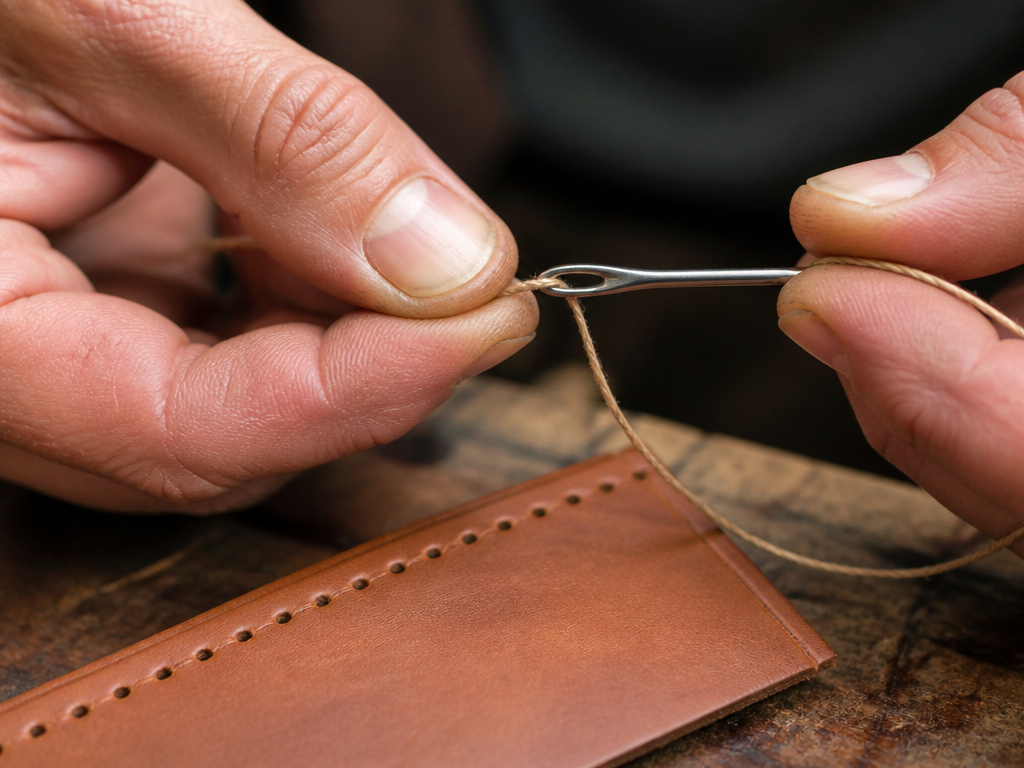
The needle is the thread’s chaperone. A mismatch here is the most common cause of failed stitches, and it’s entirely preventable.
The rule is simple: the thread must pass through the needle eye freely, without force. You should be able to pull a length of thread through the eye and feel only slight resistance. If you have to lick the thread and force it, the eye is too small.
Needles are sized by a number system (e.g., #18, #22) or the European metric (e.g., 110, 125). The larger the number, the thicker the shaft and the larger the eye. Your thread size dictates your needle size. Refer back to the translation chart in the research: a Tex 70 thread needs a #16 or #18 needle.
For hand stitching, you use blunt-tipped harness needles (John James is a reliable brand). Their job is to find the pre-punched hole, not to pierce the leather. The eye is large and oblong to accommodate thick, waxed threads.
For machine sewing, you use leatherpoint needles. They have a slight chisel tip that parts the leather fibers rather than tearing them. Using a universal sharp needle on leather is a mistake—it cuts the fibers, leading to a weaker hole.
The part nobody mentions: Needle heat. On a machine, a needle running through leather at high speed gets hot. Hot enough to slightly melt or glaze a nylon thread, which then breaks more easily. If you see tiny, melted beads on your thread after a long seam, slow down. Your needle is too hot, which is a sign it’s too small for the job or your speed is too high.
A Starter Kit for Common Projects
Let’s get concrete. Here’s what I’d pack for three typical scenarios. This is the named default pick, the one answer for the question you came with.
For a first wallet (3-4 oz. Leather):
- Thread: #92 Bonded Nylon (Superior Threads) or Ritza Tiger Thread 0.8mm if hand stitching.
- Needle: #18 leatherpoint (machine) or Size 2 Harness Needle (hand).
- Machine: A heavy-duty home machine (like a Janome HD3000) can handle this if you go slow.
For a tote bag (5-6 oz. Leather):
- Thread: #138 Bonded Nylon.
- Needle: #20 leatherpoint.
- Machine: This pushes a home machine. A Sailrite Ultrafeed or similar walking-foot machine is better.
For a hand-stitched belt (8-10 oz. Leather):
- Thread: Ritza Tiger Thread 1.0mm or 1.2mm.
- Needle: Size 4 or 5 Harness Needles.
- Tool: You’ll be hand stitching. Use pricking irons to make consistent holes first.
Notice the shift from machine-oriented bonded nylon to hand-oriented waxed polyester as the projects get heavier. That’s not an accident. The machine’s capability is the deciding factor. If you only have a home machine, stick to projects under 5 oz. And use bonded nylon. If you want to work with heavier leather, plan to invest in a sewing machine rated for it, or embrace hand tools.
Your leatherworking tools will include needles and thread, but buying them separately lets you match the exact size.
Frequently Asked Questions
Can I use regular sewing thread on leather?
No. Regular thread (like Gutermann Sew-All) is designed for fabrics. Leather’s resistance will fray and break it quickly. It lacks the tensile strength and abrasion resistance. Your seam will fail.
What is the strongest thread for leather?
For machine sewing, bonded nylon in the correct size (#138, #207) offers the highest tensile strength for its diameter. For hand stitching, a braided, waxed polyester like Ritza Tiger Thread is stronger due to its construction and is more resistant to abrasion over time.
How do I know if my thread is too thick?
The leather will pucker as you sew, or the thread will refuse to pull through the needle eye without force. Before you sew, thread the needle and pull. It should slide with mild resistance. If it fights you, go down a thread size or up a needle size.
Does thread color matter for strength?
No. Color is purely aesthetic. A dyed thread undergoes the same manufacturing process as an undyed one. Choose based on the look you want for the final piece.
Can I use embroidery thread on leather?
Technically, yes, for decorative surface stitching. But for structural seams, no. Embroidery thread (like rayon or stranded cotton) is not strong enough and will fray against the leather. If you want decorative accents, use a lighter weight bonded nylon (#46, #69) instead.
Before You Go
One rule that reframes all the charts: leather is not fabric. You can’t baste it, you can’t easily unpick a seam, and every hole is permanent. Choosing the right thread is the first commitment to that permanence.
The system works because it’s mechanical. Weight, size, machine. Change one variable, and the other two have to answer. If your leather is thicker than expected, you must drop down a project size or upgrade your tools. There’s no “making it work.”
Your first step is measuring your leather with a caliper, writing down the ounces or millimeters, and then consulting the chart. That number leads you to the thread, which leads you to the needle, which tells you if your machine can handle the job.It’s a sequence, not a buffet.
And if you’re still unsure, default to hand stitching with a waxed polyester thread. It’s more forgiving of slight mismatches than a machine, and the finished seam will outlive any machine lockstitch on the same leather. That’s the hill I’ll stand on. Your great-grandkids will appreciate it.
