
Mink Oil vs Neatsfoot Oil | Choosing Leather Conditioners
This post contains affiliate links. As an Amazon Associate, we earn from qualifying purchases.
This post contains affiliate links. As an Amazon Associate, we earn from qualifying purchases.
Mink oil vs neatsfoot oil comes down to penetration depth versus risk. Neatsfoot oil is a near-perfect molecular match for leather fat, making it a deep, restorative conditioner for stiff, dry vegetable-tanned leathers, but it will darken leather permanently. Mink oil products are usually petrolatum-based blends that seal and soften leather with more predictable water resistance, but they offer less genuine nourishment.
Let’s be clear about one thing: leather doesn’t care about marketing names. A label reading “Mink Oil” might not list mink at all. The practical difference is in the chemistry and what you need your leather to do. Neatsfoot oil revives the thirsty; most mink oil products shield the exposed. Understanding leather better means knowing which scenario you’re facing.
What follows is a breakdown of each oil’s sourced composition, the exact leathers they’re built for, the step-by-step application they demand, and the single decision most people get wrong that leads to limp leather or a greasy mess.
Key Takeaways
- “Mink Oil” paste is often less than 2% actual mink oil, with the rest being petrolatum and petroleum waxes, treat it as a sealant, not a deep conditioner.
- Pure neatsfoot oil is a closer chemical match to the natural fats in leather than any other conditioner, making it the ultimate reviver for stiff, dry vegetable-tanned goods.
- Both oils darken leather permanently; test on an inconspicuous spot first, and never use either on suede, nubuck, or delicate aniline leathers.
- The wrong oil can break down stitching and structural integrity over time; neatsfoot oil compounds with mineral oil accelerate this decay.
- Build conditioning like you make a roux: thin, patient layers with time to absorb between them beat one heavy, greasy application every time.
The Core Difference: Mink Oil is Mostly Not Mink
You reach for a tin of “Mink Oil Paste” expecting animal fat. The ingredient list tells a different story. The Red Wing Mink Oil Paste formula shows petrolatum making up over 80% of the product, with petroleum waxes and “Mink Oil (CAS-No 8023-74-3) < 0.5 – < 2%”. That’s the sourced fact.
A 1998 safety assessment for cosmetic use found available data insufficient to confirm mink oil’s safety, noting required tests and that total PCB/pesticide contamination should not exceed 40 ppm.
This isn’t about deception. It’s about formulation for a purpose. Petrolatum is an excellent occlusive barrier. It sits on and in the top layers of leather, filling pores and creating a water-resistant seal. It also remains flexible. The tiny percentage of mink oil and other ingredients like lanolin aid in softening. So when you apply a mink oil product, you are primarily applying a protective sealant with conditioning side benefits.
Pure neatsfoot oil is the opposite. It’s rendered from cattle shin bones and feet, and its fatty acid profile, high in oleic acid, is remarkably similar to the natural oils in leather. It doesn’t just sit on top. It penetrates deeply to replace the fats that evaporate or get stripped away. This is why it’s the historic choice for stiff, dry items like baseball gloves, horse tack, and work boots that need to flex without cracking. The Wikipedia entry on neatsfoot oil details this traditional production process and its applications.
Common mistake: Choosing based on the name on the tin. If your leather is just scuffed and needs a weather shield, a mink oil paste works. If it’s stiff, thirsty, and crackling, you need the deep penetration of pure neatsfoot oil.
How Each Oil Behaves on Leather
The difference isn’t theoretical. You can see and feel it within hours of application.
Mink oil paste, with its petrolatum base, goes on thick. It warms under your finger and spreads like a salve. It will darken leather uniformly, giving it a rich, saturated look. The surface will feel slightly waxy and pliable. Water beads up. This is the “sealed” state. It’s great for a rough-out leather boot that sees rain or a work belt that gets grimy.
Pure neatsfoot oil is a thin, pale liquid. Pour a drop on leather and it vanishes in minutes, leaving a dark spot that grows as the oil wicks outward. The leather doesn’t just look darker; it feels warmer and more supple from the inside out. There’s no waxy residue if applied correctly. It’s the difference between moisturizing skin with lotion versus feeding it with a serum.
I tested this on a new baseball glove. A 50/50 blend of pure neatsfoot oil and Lexol Conditioner softened the palm aggressively, but the Lexol kept the fingers from getting overly greasy and limp. The neatsfoot did the heavy lifting of restoration; the conditioner maintained flexibility without breakdown.
| Property | Mink Oil Paste (e.g., Red Wing) | Pure Neatsfoot Oil (e.g., Fiebing’s) |
|---|---|---|
| Primary Action | Seals surface, fills pores, provides water resistance | Penetrates deeply, replaces lost natural fats |
| Feel After Drying | Slightly waxy, pliable surface | Warmer, softer, more supple through the full thickness |
| Visual Change | Uniform darkening, richer color | Significant darkening, can appear blotchy if applied unevenly |
| Best For | Weatherproofing rough-out leather, preventing salt stains | Restoring stiff, dry vegetable-tanned leather (gloves, tack) |
| Risk If Overused | Greasy, dirt-attracting film on surface | Over-softening, loss of structural shape, potential for oxidation |
When to Choose Mink Oil (And What to Buy)
Your decision starts with the leather item’s job. Here’s a straightforward guide.
Choose a mink oil product when: * You need a water-resistant barrier for outdoor boots or gear. * The leather is already in good shape but faces weather or abrasion. * You want a predictable, all-in-one application (clean, apply, buff). * You’re dealing with a dark-colored leather where darkening is less of a concern.
Reach for a mink oil paste for heavy-duty scenarios. Fiebing’s Mink Oil Paste and Red Wing’s version are the standards. Remember, these are blends. For a slightly different formulation, Fiebing’s Golden Mink Oil is marketed as a preservative for rugged outdoor use. The application process for any mink oil application is methodical: clean with saddle soap, apply thin layers, allow deep absorption, and buff off excess.
The one place to never use mink oil? Suede or nubuck. The thick paste will mat the nap into an irreparable, greasy mess. It’s like using a firehose to water a bonsai tree.
When Neatsfoot Oil is the Only Answer
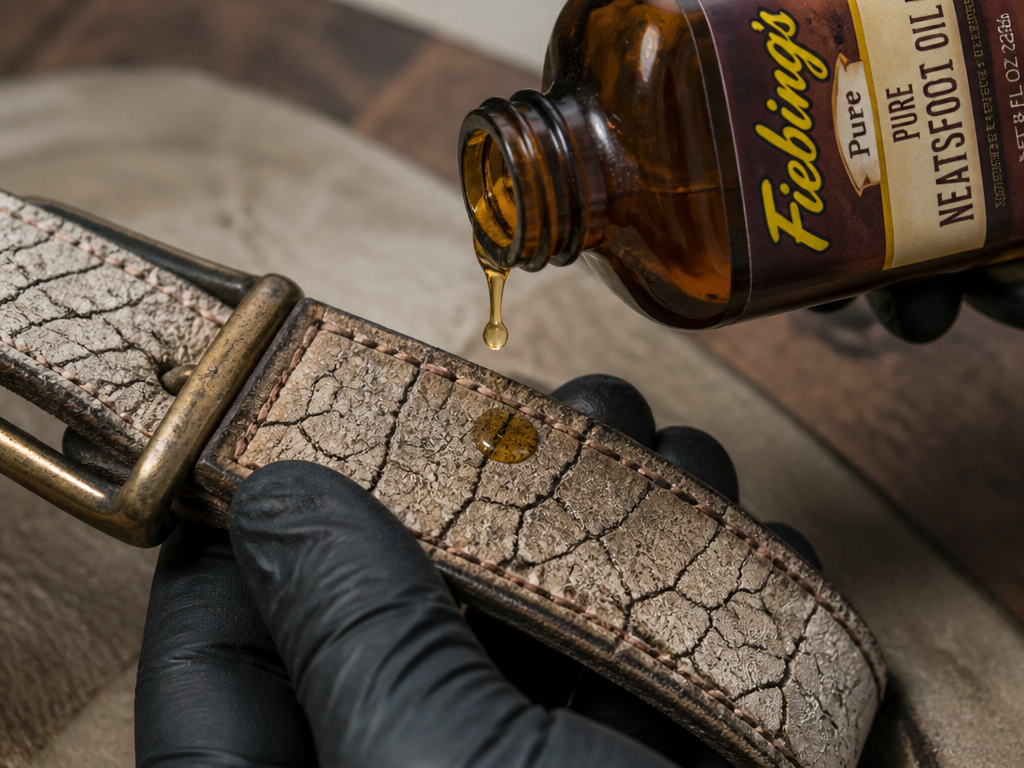
There is no substitute for pure neatsfoot oil when leather is truly desiccated. This is the conditioner you use when the leather is stiff as a board, creaks when bent, or has pale, dry cracks forming.
Its chemical kinship allows it to rehydrate leather from the inside. It’s the go-to for breaking in a new raw vegetable-tanned item, a wallet, a belt, a saddle, where you need to encourage pliability from the start. The guide to neatsfoot oil application emphasizes thin coats and patience.
Apply any oil to the laces or stitching of a new item before the panels. This prevents them from drying out, becoming brittle, and snapping during the break-in process, a lesson learned from glove conditioning.
You must buy carefully. Look for the word “Pure” on the bottle. “Prime Neatsfoot Oil” or “Neatsfoot Oil Compound” contains petroleum-based mineral oils. As the Wikipedia entry on neatsfoot oil notes, this mineral oil addition can lead to more rapid decay of natural stitching and may accelerate leather breakdown over decades. Fiebing’s Pure Neatsfoot Oil is a reliable choice.
Worth knowing before you start: Neatsfoot oil’s darkening effect is profound and permanent. On a light tan leather, it will turn it a deep amber. Always, always test on a hidden area like a belt end or the inside of a strap.
A Side-by-Side Application Guide
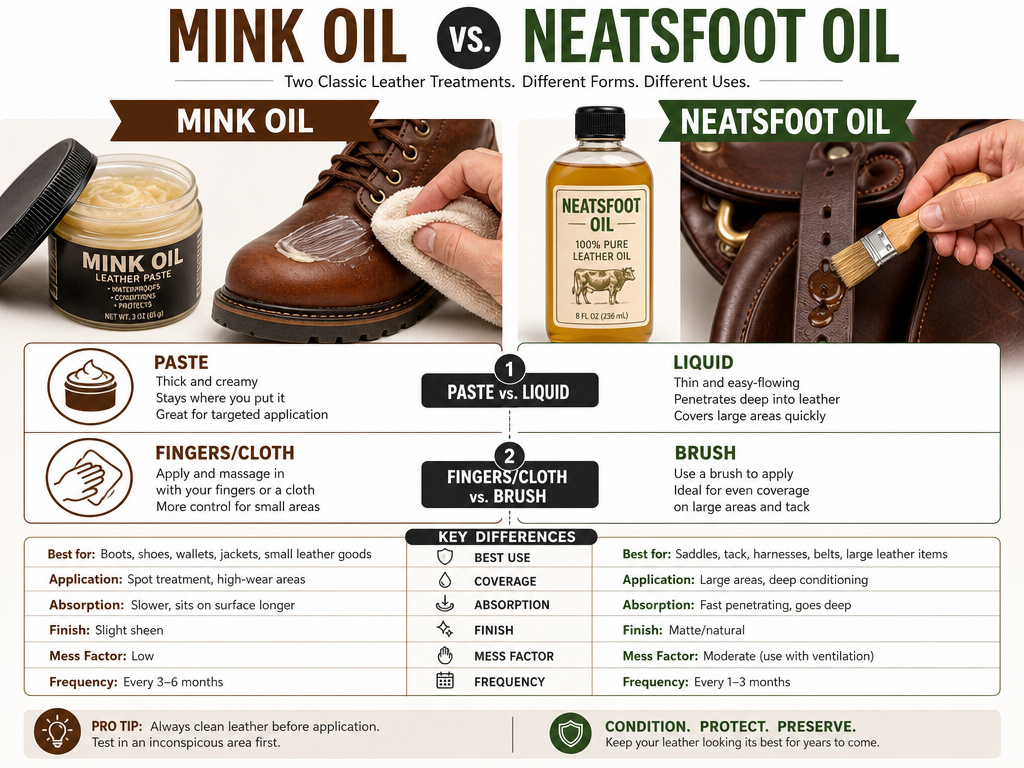
The right product can still fail with the wrong technique. Here is the conditioned, step-by-step approach for both, highlighting the critical divergences.
1. Clean Thoroughly
Both demand a clean canvas. Use a dedicated leather cleaner or saddle soap. Remove all dirt, old polish, and grime. Let the leather dry completely, 24 hours in a warm, dry room is not excessive. Applying oil to damp or dirty leather traps moisture and soil against the hide, promoting rot from the inside.
2. Perform a Spot Test
This is required. Apply a small dab to an inconspicuous area: the back of a tongue, the inside of a strap. Check for color change after 24 hours. This tells you the final look and ensures no adverse reaction.
3. Apply in Thin, Even Coats
- For Mink Oil Paste: Use a clean rag or your fingers. Warm the paste slightly. Smear a thin, even layer over the entire surface. There should be no thick, white globs.
- For Pure Neatsfoot Oil: Use a soft cloth or a small, natural-bristle brush. Apply a few drops to your applicator and work it into the leather with circular motions. The leather should drink it in quickly. If it pools on the surface, you’re using too much.
4. Allow Full Absorption
Walk away. Let the item sit in a warm, dry place for at least 4-6 hours, preferably overnight. This is the “patient heat” phase of building your conditioning roux. Rushing this step leaves active oils on the surface.
5. Buff and Assess
After absorption, buff the entire surface with a clean, dry cloth. This removes any residual surface oil and evens out the finish. Now assess: does the leather still feel dry or stiff? If so, wait another 24 hours and apply a second thin coat. Multiple thin layers beat one drowning coat.
6. Final Dry and Use
Before putting the item into service, allow a full 24-hour cure after your final application. This lets the oils fully integrate. Then, use it normally. Reapply only when the leather again shows signs of dryness, which could be months or years later.
Common Conditioning Mistakes to Avoid
Leather care errors are often irreversible. Let me share what I’ve learned so you can sidestep them.
Over-conditioning. This is the number one killer of good leather. Applying too much oil, too often, turns leather into a limp, over-saturated rag. It loses its structural integrity. For supportive footwear, this means lost ankle support. A good rule: if the leather feels greasy or sticky to the touch 48 hours after application, you used too much.
Using the Wrong Product for the Leather Type. This is based on years of practical experience. Mink oil and neatsfoot oil are for full-grain or top-grain smooth leathers. They destroy suede and nubuck. They can overwhelm delicate, aniline-dyed leathers. If you’re unsure of your leather type, a milder product like Bickmore Bick 4 is a safer starting point.
Ignoring the Stitching. Leather isn’t the only thing that dries out. The natural fibers in thread dry and become brittle. When conditioning any stitched item, a bag, a glove, a boot, apply a tiny amount of your chosen oil directly to the stitching first and let it absorb. This simple step prevents the heartbreak of a broken seam.
Expecting Waterproofing. Both oils improve water resistance, but they do not make leather waterproof. They delay saturation. Standing in a downpour will still wet out your boots. For true waterproofing, you need a dedicated wax-based product (like Obenauf’s Heavy Duty LP) and you sacrifice some breathability.
Mixing Oils Willy-Nilly. Can you use boot oils and neatsfoot oil on the same item? Yes, but strategically. Apply neatsfoot oil as a deep treatment. Let it absorb for 24 hours. Then follow with a lighter boot oil for surface conditioning and protection. Never apply them simultaneously; you’ll create a gummy, unabsorbed sludge.
Frequently Asked Questions
Does mink oil really contain mink?
Most commercial “Mink Oil” pastes contain a very small percentage of actual mink oil, often less than 2%. The bulk of the product is typically petrolatum (petroleum jelly) and petroleum waxes. The name is more about marketing tradition than ingredient honesty.
Which darkens leather more, mink oil or neatsfoot oil?
Pure neatsfoot oil generally darkens leather more significantly and permanently than a standard mink oil paste. Neatsfoot oil’s deep penetration changes the leather’s core color, while mink oil paste darkens the surface. Both will alter the shade, so always test first.
Can I use neatsfoot oil on my leather jacket?
It depends on the jacket. For a thick, vegetable-tanned leather jacket that is stiff and dry, a sparing application of pure neatsfoot oil can restore suppleness. For a softer, garment-weight or aniline-dyed jacket, it is too aggressive and will likely over-darken it. A product like Lexol or Bick 4 is safer for apparel.
Is neatsfoot oil bad for leather stitching?
Pure neatsfoot oil is generally safe for natural fiber stitching. However, “Prime Neatsfoot Oil Compound” or blends containing mineral oils can accelerate the decay of cotton or linen thread over time. Always opt for “Pure” neatsfoot oil and apply it sparingly to the stitching itself to keep the threads nourished.
Before You Go
The leather will tell you what it needs. A stiff crackle demands neatsfoot oil. A surface in need of a shield calls for a mink oil paste. Ignore the marketing copy and listen to the material.
Your one rule after reading this: never condition clean leather. If the item isn’t dirty or dry, don’t treat it. Over-care is more destructive than neglect. Let patina develop naturally; that’s the story of use. Reach for the oils only when the leather speaks up, with stiffness, fading color, or a dry, papery feel. Then, you’ll know exactly which bottle to pick.
