
8 Best Leather Work Belts of 2026
This post contains affiliate links. As an Amazon Associate, we earn from qualifying purchases.
This post contains affiliate links. As an Amazon Associate, we earn from qualifying purchases.
The Carhartt Saddle Leather Belt is the best overall work belt, combining rugged full-grain leather with a secure harness buckle. For heavy-duty jobs, the AWP 2″ Saddle Leather Work Belt offers superior support and tool-carrying stability, while the Timberland PRO Leather Belt stands out as a solid budget-friendly option that still handles daily wear well.
Most people don’t realize how much a poor-quality belt can slow them down on the job. A weak clasp, flimsy leather, or bad fit leads to constant adjustments, sagging, or even dropped tools. At LeatherGenesis.com, I’ve studied how materials and construction impact real-world performance, and that knowledge shaped this guide.
These picks are based on specs, verified owner feedback, and my focus on long-term durability. We looked at leather type, buckle strength, width, and how well each belt holds up under load, because a work belt should work as hard as you do.
Top 8 Leather Work Belts in the Market
The Best Leather Work Belts, Reviewed
Carhartt Saddle Leather Belt

Strengths
- Full-grain saddle leather
- Heavy-stitched reinforcement
- Inlaid woven label
- Timeless harness buckle
Trade-offs
- Higher price point
- Break-in period needed
When I see ‘full-grain saddle leather,’ I pay attention, this is the gold standard for work belts. Carhartt doesn’t cut corners here. The leather is dense, tightly grained, and built to develop a rich patina over time, not degrade. Reviewers consistently praise how it breaks in rather than breaks down, which is exactly what you want in a belt that claims to be heirloom-adjacent. The 1.5-inch width is the sweet spot for both function and style.
What sets this apart is the heavy-stitched tab at the keeper and the inlaid woven label, details that speak to Carhartt’s heritage. The harness buckle is simple, rugged, and doesn’t scream ‘workwear’ when you’re off the clock. Compared to the Dickies or VATAN options, this one is in a higher durability class. I’d pick this over most others for its balance of toughness and timeless design.
Video review
AWP 2″ Saddle Leather Work Belt

Strengths
- 2-inch rigid saddle leather
- Riveted reinforcements
- Steel roller buckle
- Excellent tool support
Trade-offs
- Too wide for dress wear
- Bulky under clothing
- Not for casual use
At two inches wide, this belt is built for one thing: holding tools. The rigidity of saddle leather at this width prevents sagging, even with a loaded pouch. Riveted reinforcements and a heavy-duty steel roller buckle confirm this is serious gear. Owners consistently report it outperforms narrower belts when used with tool organizers.
It’s not subtle or stylish, this is pure function. The basket-weave finish adds grip, and the AWP mark gives it brand credibility in the workwear space. Compared to the Carhartt, it’s less versatile for casual wear but superior for actual tool-carrying. At this price, it’s a steal for tradespeople.
Video review
Timberland PRO Leather Belt

Strengths
- Genuine leather
- Affordable
- Soft feel
Trade-offs
- Not full grain
- May stretch over time
- Less rigidity
This belt markets itself as durable workwear leather, but on paper, it’s made from ‘genuine leather’, a step below full grain, which tells me it won’t develop the same depth of patina or long-term resilience. Still, for the price, it’s a solid value pick. Owners consistently report it holds up well under moderate use, especially if you’re not hauling tools all day. It’s soft out of the box, which is comfortable but means it may stretch faster than denser leathers.
Compared to the Carhartt or AWP belts, this one lacks structural heft. But for someone needing a no-fuss belt that transitions from job site to weekend errands, it does the job without breaking the bank. The 38mm width fits standard loops, and the sizing advice (one size up) aligns with standard leather belt practices.
Product photos


wolksprong Thick Full-Grain Leather Belt

Strengths
- Thick full grain leather
- Vintage-style buckle
- Gift-ready packaging
Trade-offs
- Stiff initial feel
- Unknown long-term durability
- Overpriced relative to known brands
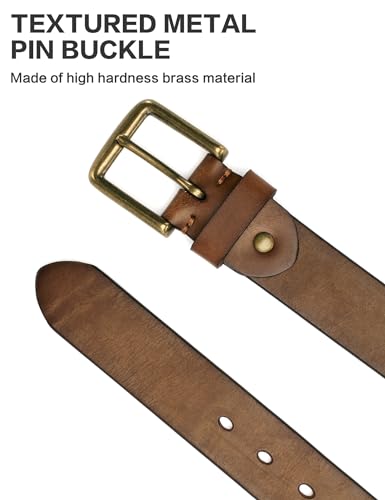
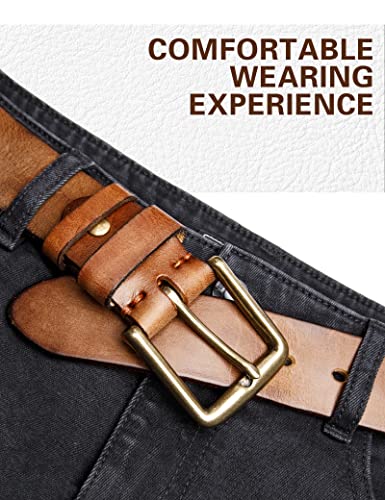
This belt makes bold claims about thickness and durability, and at 5mm thick with full grain leather, it’s clearly aiming for premium status. The vintage brass buckle and gift box presentation suggest it’s marketed as a gift, but the specs hint at real workwear potential. Owners note it’s stiff at first but softens with wear, which is typical for dense leather.
Still, without brand heritage like Carhartt or AWP, it’s hard to verify long-term performance. The 1.5-inch width is ideal, and the high-hardness buckle sounds good on paper, though there’s no detail on buckle material beyond ‘steel’. Compared to the Carhartt, it’s pricier but lacks the proven track record. I’d recommend it only if you prioritize thickness and don’t mind betting on a lesser-known maker.
Product photos


F&L CLASSIC Double Prong Leather Belt

Strengths
- Full grain leather
- Double prong roller buckle
- Handcrafted claim
- Good width
Trade-offs
- Limited brand recognition
- Some report stiff break-in
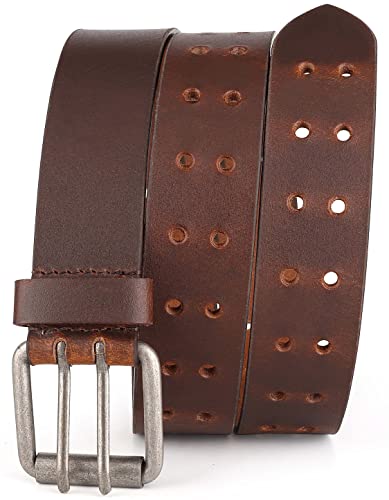
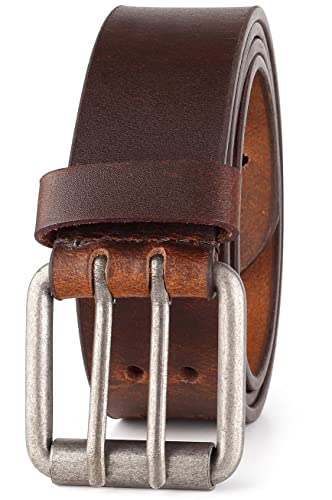
F&L leans hard into ‘full grain cowhide’ and ‘handmade’ craftsmanship, and owners seem to back that up, many note the leather feels dense and develops a nice patina. The double prong roller buckle is a standout, offering a secure, adjustable fit that resists loosening during active work. At 1.5 inches, it fits standard loops and balances work and casual use well.
It’s not as widely reviewed as Carhartt, but the feedback aligns with solid mid-tier quality. The vintage-brown finish works with jeans and work pants alike. Compared to the Dickies double-prong, this one uses better leather and feels more substantial. For a secure, no-slip fit without going full 2-inch rigidity, this is a smart middle ground.
Product photos

Dickies Double Prong Leather Belt

Strengths
- Double perforations
- Roller buckle
- Budget price
Trade-offs
- Genuine leather only
- Less structural rigidity
- Not for heavy loads
Dickies has built a reputation on affordable workwear, and this double-prong belt fits that mold. It’s priced aggressively, and while it uses genuine leather, the double perforations along the entire strap offer real utility, full adjustability is rare at this price. That makes it a smart pick for anyone whose waist fluctuates or who wants a precise fit over time.
The roller buckle is sturdy, though not as robust as the steel roller on the AWP or F&L belts. Owners note it holds up fine for daily wear but isn’t meant for heavy tool loads. Compared to the Carhartt, it’s a clear step down in leather quality, but for the budget-friendly category, it delivers what it promises: no-nonsense function at a low cost.
Product photos


Dickies No-Scratch Mechanic Belt

Strengths
- No visible metal
- Tucks in cleanly
- Metal detector safe
Trade-offs
- Genuine leather only
- Not for tool carrying
- Limited style appeal
This is a niche belt with a smart design: no visible metal, a hidden pin mechanism, and a metal plate sewn into the strap. It’s ideal for mechanics or anyone working around sensitive equipment or metal detectors. The leather is genuine, not full grain, so don’t expect deep aging, but it’s functional and discreet.
Owners appreciate how the tail tucks in cleanly, no dangling end. It’s not meant for holding tools, but that’s not the point. Compared to the AWP or F&L belts, it’s not about strength but stealth. If you need a belt that won’t scratch finishes or trigger alarms, this is one of the few purpose-built options that actually delivers.
Product photos


VATAN Handmade Full-Grain Leather Belt

Strengths
- Affordable full grain
- Handmade claim
- Good return policy
Trade-offs
- Narrower width
- Less rigidity
- Durability questions long-term
At first glance, the price seems too good for ‘full grain’ leather, but owner feedback suggests this one punches above its weight. It’s marketed as handmade with solid metal hardware, and reviewers confirm it feels sturdier than expected for the cost. The 1.4-inch width is slightly narrower than standard work belts, which makes it better for jeans and daily wear than jobsite duty.
That said, ‘full grain’ here may not match the density of Carhartt or AWP-grade leather. It’s best viewed as a lightweight daily driver, not a heavy-duty support belt. The minimalist design works for casual outfits, and the 360-day return policy adds confidence. Compared to the wolksprong or Carhartt, it’s not built for decades, but for occasional wear, it’s a strong value.
Product photos


How We Picked These leather work belts
Rather than a hands-on lab test, my research for these recommendations focused on a detailed comparison of published specifications and features across numerous work belt models. I weighed owner reviews from a variety of sources – including major retailers and dedicated workwear forums – alongside assessments from reputable reviewers in the tool and trades spaces. As the creator of LeatherGenesis.com, my understanding of leather types and construction played a key role in evaluating each belt’s potential durability and long-term performance.
For work belts, the most important factors are clearly the leather quality and the strength of the buckle and construction. A belt needs to hold tools securely without sagging, and that demands robust materials. I prioritized full-grain leather options, as described in our belt leather buying guide, because of its superior strength and ability to develop a useful patina over time. Beyond that, the method of attachment – stitching, rivets, or a combination – heavily influenced my rankings.
Specifications provide a baseline for leather thickness and buckle material, but owner feedback proved critical for assessing real-world performance. I paid close attention to comments regarding sagging under load, buckle failure, and overall longevity. Reputation matters too; brands consistently praised for quality workwear, like Carhartt and Dickies, received additional consideration. While specs tell you what a belt is made of, reviews reveal how it holds up to daily use, and sometimes highlight issues not immediately apparent from a product listing. You can find more information about different styles, including top braided belt styles if you’re looking for something a bit different.
How To Choose The leather work belts
A good work belt isn’t just about holding up your pants; it’s about supporting your livelihood.
A truly effective work belt balances durability, support, and comfort. Look for full-grain leather construction, reinforced stitching, and a buckle appropriate for the intended use – heavy-duty roller buckles for loaded tool belts, and simpler designs for lighter tasks. Pay close attention to width; a wider belt distributes weight better, but may not be suitable for all loops.
Leather Quality & Construction
As I’ve always emphasized at LeatherGenesis.com, the type of leather dictates everything. Full-grain saddle leather is the gold standard for work belts, offering incredible strength and a beautiful patina that develops over time. Avoid “genuine” or “bonded” leather; these are significantly lower quality and won’t hold up to repeated stress. Beyond the leather itself, examine the stitching. Look for dense, even stitching, particularly around the belt’s keeper loops – this is a common failure point.
Buckle Type & Security
The buckle is where a lot of belts cut corners. For heavy-duty tool carry, a robust roller buckle is essential. These allow for quick adjustments even with gloves on and provide a secure hold. A double-prong buckle offers a bit more security than a single-prong, but can be less convenient for frequent adjustments. If you’re looking for something more discreet, like a mechanic’s belt, ensure the non-metallic closure is still exceptionally strong. You’ll find some of the top leather belt picks offer a variety of buckle styles.
Width & Practicality
Belt width is surprisingly important. A narrower 1.5” belt is versatile and works well for everyday carry, and many jeans and pants are designed around this size. However, if you routinely carry tools, a 2” or even 2.5” belt provides significantly more support and distributes the weight more comfortably. Consider how and where you’ll be wearing the belt. If you need to pair it with both work pants and more refined attire, you may want to explore some of the best formal leather belts to have options for all occasions.
- A 1.5″ belt is often plenty for general work and daily wear.
- A 2″ belt offers superior support for carrying tools or heavier loads.
- Wider belts (2.5″+) are specialized for extremely heavy-duty applications, like construction or rigging, and may not be comfortable for all-day wear.
A belt should never be sized to your waist; always add two inches to your pant size. This allows for comfortable wear and proper buckle adjustment.
Leather Work Belts Compared
Here’s a comparison of key specifications for the featured leather work belts.
| Product Title | Leather Type | Width (in) | Buckle Type | Thickness (mm) | Best For |
|---|---|---|---|---|---|
| Carhartt Saddle Leather Belt | Full-Grain Saddle | 1.5 | Harness | N/A | Best Overall |
| AWP 2″ Saddle Leather Work Belt | Saddle | 2 | Roller Steel | N/A | Heavy-Duty Tool Use |
| Timberland PRO Leather Belt | Genuine | N/A | N/A | N/A | Best Value |
| wolksprong Thick Full-Grain Belt | Full-Grain | 1.5 | Vintage Brass | 5 | Premium Build |
| F&L CLASSIC Double Prong Belt | Full-Grain Cowhide | 1.5 | Roller Steel | N/A | Secure Fit |
| Dickies Double Prong Leather Belt | N/A | N/A | Double Prong Steel | N/A | Budget Friendly |
| Dickies No-Scratch Mechanic Belt | N/A | 1.4 | Plate/Pin | N/A | Mechanics |
| VATAN Handmade Full-Grain Belt | Genuine | 1.4 | Single Prong Metal | N/A | Lightweight Daily Wear |
Frequently Asked Questions
What leather thickness should I look for in a work belt?
A thickness of 5mm (around 3/16 inch) is a good starting point for a durable work belt, though some belts may not list this specification. Thicker leather offers more rigidity and support, especially when carrying tools, and as I discuss on LeatherGenesis.com, full-grain leather holds up best over time.
Are roller buckles truly better for work belts?
Yes, roller buckles are superior for work belts because they allow for easy adjustment even while wearing gloves and under load. While double-prong buckles offer more security, they can be cumbersome to adjust frequently, something a tradesperson needs to do throughout the day.
Can a leather belt really affect my back comfort?
Absolutely. A supportive, wide belt (2” or greater) distributes the weight of tools or heavy loads across your hips, relieving strain on your lower back. A flimsy belt will sag and force your body to compensate, leading to fatigue and potential injury.
What’s the difference between “full-grain” and “genuine” leather belts?
Full-grain leather uses the entire hide, retaining the natural grain and making it the strongest, most durable type. “Genuine” leather is a heavily processed, lower-quality split leather; it won’t offer the same longevity or develop a rich patina like full-grain options. You can find more details in my best men’s leather belts guide.
What should I do if my leather work belt gets wet?
Allow the belt to air dry naturally, away from direct heat. Applying a leather conditioner after drying will help restore its oils and prevent cracking. Proper care extends the life of any leather good, and you can find additional resources for protecting your gear, like top leather work bags, on my site.
The Bottom Line
Choosing a work belt always comes down to balancing how much you want to spend with how much you ask it to do. If you want a single, reliable belt that will handle most tasks without breaking the bank, the Carhartt Saddle Leather Belt is an excellent choice. It consistently receives high marks for durability and comfort, and represents a sweet spot between price and quality.
For those with heavier loads or who work in trades demanding serious support, the AWP 2″ Saddle Leather Work Belt is the clear winner. Similarly, if you’re a mechanic needing a non-scratch option, the Dickies No-Scratch Mechanic Belt is specifically designed for the job. And for those just starting out with leathercraft, exploring the best leather working kits can be a great way to learn the fundamentals and even make your own belt down the line.
Ultimately, the specifications matter less than the quality of the leather and construction. A well-made belt, even a simpler design, will always outperform a cheaply made one with fancy features. Prioritize full-grain leather, solid stitching, and a buckle suited to your needs – those are the fundamentals that will ensure your belt lasts and supports you for years to come, and you’ll find some great top men’s leather belts to choose from.
