
Full Grain vs Top Grain Leather Sofas: Which Lasts Longer?
This post contains affiliate links. As an Amazon Associate, we earn from qualifying purchases.
Choosing between a full grain and top grain leather sofa isn’t about picking the “best” leather. It’s about matching the right hide to your life. The long-term choice comes down to three things: your tolerance for natural markings, your commitment to maintenance, and whether you want the leather to tell a story or stay pristine.
The difference between full grain and top grain leather sofas is that full grain uses the hide’s complete, untouched surface, developing a unique patina but showing natural imperfections, while top grain is sanded and finished for a uniform look that’s easier to clean and more stain-resistant. For most households with kids, pets, or high traffic, a protected top-grain leather is the practical default. For a dedicated, low-traffic space where character is prized, full grain delivers unparalleled longevity and beauty.
Let’s be clear about this. The debate often gets framed as “quality vs. Compromise,” but that’s misleading. A top-grain leather sofa from a brand like La-Z-Boy with a kiln-dried hardwood frame will outlast a cheap full-grain sofa with poor construction every time. The leather grade is one spec among many, frame, suspension, and cushion foam often matter more for daily comfort and decade-long durability.
What follows is a breakdown of what each term actually means on a factory spec sheet, how they feel and age in your living room, and the hidden trade-offs that sales tags never mention. By the end, you’ll know which questions to ask before you buy.
Key Takeaways
- Full grain leather is the complete hide, untouched. It’s the strongest and will develop a deep, personal patina, but it requires more care and shows every natural scar and wrinkle.
- Top grain leather is sanded and refinished. It offers superior stain resistance, a more uniform color, and easier cleaning, making it the default for busy households.
- The factory-applied finish (aniline, semi-aniline, pigmented) matters more than the grain for stain resistance and daily care. Most top-grain sofas use a protective pigmented finish.
- Always check the frame, suspension, and foam density specs. A top-grain sofa with an 8-way hand-tied frame and high-density foam will outlive a full-grain sofa on a cheap pine frame.
- “Leather match” is common on the sides and back of both types to control costs. It’s a practical compromise, but verify what percentage is genuine top or full grain.
The Core Difference: What Actually Gets Removed
Think of a leather hide like a plank of wood. Full grain is the whole plank, knots and grain included. Top grain is that plank planed smooth and stained.
Full grain leather comes from the top layer of the hide and includes the entire, natural grain. Nothing is sanded away. This outer layer has the tightest, strongest fiber structure, which is why full grain is exceptionally durable and develops a rich patina, the leather darkens and softens uniquely based on use and exposure to light and oils.
Full grain leather retains the hide’s natural surface, including imperfections like insect bites, scars, and wrinkle patterns. This is not a defect; it’s proof of authenticity and contributes to the unique character that deepens over decades.
Top grain leather starts as the same top layer, but it’s mechanically sanded or buffed to remove those natural imperfections. This creates a smoother, more uniform surface. The sanding process does remove some of the densest fibers, so the leather is slightly less thick and strong than full grain from the same hide. To compensate and add durability, a protective coating or pigment is almost always applied.
Here’s the thing. That coating is what makes top grain the workhorse for furniture. It blocks stains from penetrating and allows for easy cleaning with a damp cloth. For a family sofa, that practicality usually outweighs the purist appeal of untouched leather.
Material & Longevity: A Decade-By-Decade Look
Durability isn’t just about thickness. It’s about how the material responds to stress, sunlight, and spills over a ten-year span. I learned this by comparing a worn-in leather football to a new one, the pebble grain on the heavily used ball was polished smooth in the grip areas, which actually improved its function. The leather adapted.
A full grain leather sofa undergoes a similar transformation. It won’t look new for long, and that’s the point. The natural marks become part of its history, and the patina that develops is a warm, deep gloss that can’t be replicated. The leather itself is incredibly strong, so while the surface tells a story, the structure resists tearing and cracking.
A top grain sofa, with its protective topcoat, is designed to fight that aging process. The finish resists fading from sunlight and creates a barrier against spills. The trade-off is that the aging is less organic. Instead of a patina, you might see subtle creasing in high-wear areas, and if the topcoat is scratched deeply, it can be noticeable.
| Aging Factor | Full Grain Leather Sofa | Top Grain Leather Sofa |
|---|---|---|
| 10-Year Surface Look | Rich, varied patina; scars & wrinkles more pronounced | Uniform color; may show polished wear on armrests |
| Response to Spills | Liquid soaks in quickly; can stain without immediate blotting | Topcoat provides time to wipe away most spills |
| Sunlight Exposure | Naturally darkens and mellows (adds to patina) | Pigmented finish resists fading more effectively |
| Long-Term Feel | Softer, more supple, conforms to the body | Stays firmer; feel is more consistent over time |
So, which lasts longer? Structurally, both can last a lifetime with proper care. The failure point for a sofa with a kiln-dried hardwood frame and eight-way hand-tied suspension is almost never the leather itself, it’s the frame joints, sinking cushions, or failed suspension. The leather just determines what that lifetime looks like.
Feel, Comfort & Maintenance Reality
Sit on them. The difference in hand, the industry term for how leather feels, is immediate.
Full grain feels substantial, often slightly stiff at first. It’s a natural material that needs to break in, like a full-grain leather boot. Over the first year, it will soften and conform to the people who use it most. The temperature is also more responsive; it feels cool in a cold room and warms up as you sit.
Top grain, especially with a pigmented finish, feels smoother and more consistent right out of the box. The finish gives it a slightly synthetic touch that some find less appealing than the raw texture of full grain. It’s also less breathable, which can make it feel warmer in summer.
Maintenance is where the paths truly diverge. This is where most owners form their strong opinion.
Maintaining a full grain sofa is like caring for a wood table with an oil finish. You must be proactive. It needs conditioning once or twice a year with a product like Leather Master’s Vital or a Colourlock Furniture Kit to replenish its natural oils and prevent drying and cracking. Spills are an emergency, blot, never rub, and hope for the best. The leather will mark.
Common mistake: Using saddle soap or heavy waxes on a full grain sofa. These can clog the pores, prevent patina development, and leave a sticky residue that attracts dirt. Stick to pH-balanced leather conditioners.
Maintaining a top grain sofa is simpler. The protective finish handles most threats. Weekly dusting and a quick wipe with a damp microfiber cloth are usually sufficient. Use a mild, leather-specific cleaner for stickier messes. Conditioning is less critical because the finish seals the leather, but a light conditioner once a year can keep the underlying hide supple.
The cleaning code is your guide. Most top-grain sofas have a “W” (water-based) or “S” (solvent-based) code. The Berch Cognac Top-Grain Leather Sofa, for example, has a pigmented finish designed for easy wiping. Check the manufacturer’s tag.
The Hidden Specs: Frame, Fill & Finish
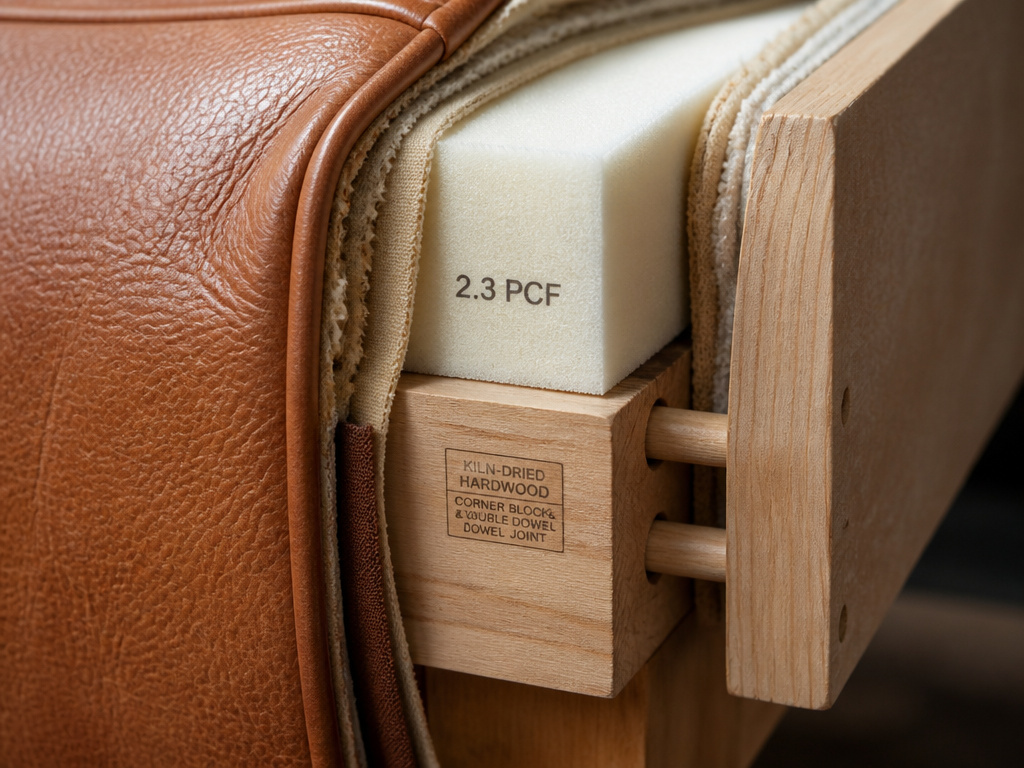 Never buy a sofa for its hide alone. The leather is the skin; the frame and cushions are the bones and muscles. A fantastic hide on a weak frame is a waste.
The Frame: Look for kiln-dried hardwood (oak, maple, ash). Engineered hardwood or plywood is acceptable if corner-blocked and glued. Avoid frames labeled just “solid wood”, it’s often softer, green pine that warps. The Wellington’s Furniture Savoy Leather Sofa advertises a “select solid kiln dried hardwood frame” with double dowels and corner blocks, that’s the language of longevity.
Cushion Fill: This dictates comfort and longevity. High-resiliency (HR) foam is the benchmark. Density is measured in pounds per cubic foot (PCF). * 1.8 PCF: Low density, will break down and sag in a few years. * 2.A sofa with a foam density of 1.8 PCF or higher is the minimum for decent durability. The Abbyson Boyd Top Grain Leather Sofa uses 2.0 density foam. * 2.3 PCF & above: Good to high density. The Berch Cognac Sofa** uses 2.3 PCF foam in its seats. For a sofa that will look good for a decade, aim for 2.0 PCF or higher.
The Finish Type: This is the final, crucial layer. * Aniline: Dyed only, no topcoat. Shows full natural character but is vulnerable. Rare on sofas. * Semi-Aniline: Lightly pigmented with a faint topcoat. A balance of beauty and protection. * Pigmented (Protected): A durable, opaque topcoat. This is what you find on most top-grain sofas and some full-grain pieces. It defines the easy-care nature.
When you look at a model like the Berch Reno Top-Grain Leather Sofa, which uses genuine buffalo leather with a pigmented finish, you’re seeing a spec sheet built for real life, strong hide, practical finish, and foam that meets the baseline for durability.
Full Grain vs Top Grain: Which Sofa Should You Buy?
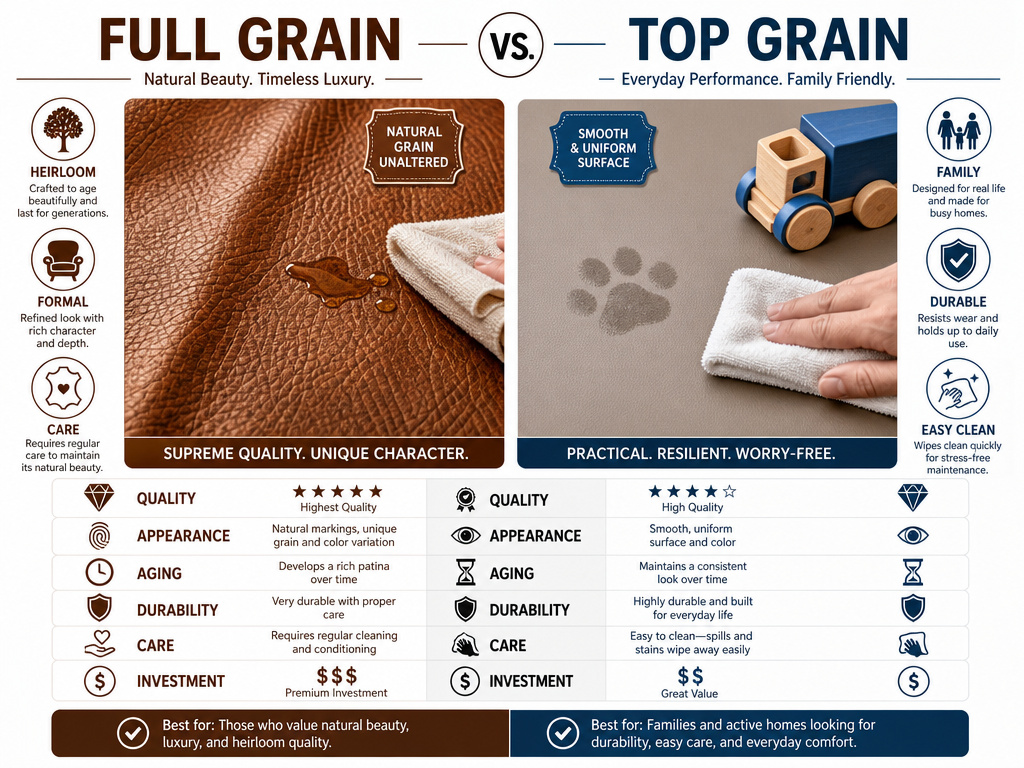 This isn’t a tie. One will be a better fit for your room and routine.
Choose a Full Grain Leather Sofa if:
- You value unique, evolving character over a pristine look.
- The sofa will be in a formal living room or adult-only space with lower traffic.
- You enjoy the ritual of periodic leather care and don’t mind immediate spill response.
- Your budget allows for higher-tier construction to match the premium hide.
- You’re buying an heirloom piece and want it to tell a visual story.
Choose a Top Grain Leather Sofa if:
- You have children, pets, or a high-traffic family room.
- You want uniform color and easy cleaning with minimal maintenance.
- You prefer a sofa that looks “new” for a longer period.
- You need reliable stain resistance for everyday life.
- You’re balancing quality with budget and need durability without the highest leather cost.
For the large majority of households looking for a leather vs fabric sofa, the top grain path is the sane default. It delivers the leather experience, durability, easy cleaning, luxury feel, without the fussiness. It’s the practical choice in the guide to picking a leather couch.
If you’re a purist with a controlled environment, full grain is your canvas. Just be honest about your lifestyle. That stunning, unprotected aniline full-grain sofa is a commitment.
Frequently Asked Questions
Is top grain leather good quality for a sofa?
Yes, top grain leather is very good quality for a sofa. It is the second-highest grade (after full grain) and, when paired with a protective pigmented finish, offers an excellent balance of durability, stain resistance, and ease of maintenance. It’s the most common leather grade used in quality mid-range to high-end furniture because it provides a uniform look and stands up to daily use.
Does full grain leather scratch easily?
Full grain leather can show scuffs and scratches more easily than coated leathers, especially when new. However, these are often superficial marks that blend into the developing patina over time, becoming part of the leather’s character. They rarely compromise the material’s strength. A conditioned full grain hide is very resistant to deep cuts or tears.
How can I tell if my sofa is real top grain leather?
Check the manufacturer’s specifications, phrases like “genuine top-grain leather” or “top-grain cowhide” should be listed. Perform a visual and touch test: top grain will have a consistent grain pattern (no natural scars or wrinkles) and often a slightly smooth, finished feel. The “pinch test” also helps: pinch a hidden area (like under a cushion). Genuine leather will wrinkle like skin; synthetic materials will feel smoother and show less texture.
Which is more expensive, full grain or top grain leather?
Full grain leather is typically more expensive than top grain. The process is less wasteful (no sanding), but the hides must be of exceptional quality with few imperfections to be used. Top grain leather allows manufacturers to use hides with more natural flaws by sanding them away, making the raw material slightly more economical. However, the final sofa price depends heavily on the brand, construction, and finish.
Can you condition a top grain leather sofa?
Yes, but less frequently than full grain. The protective topcoat on most top grain sofas seals the leather, so conditioners can’t penetrate as deeply. Use a light, non-oily conditioner designed for finished leathers once a year to keep the underlying hide from drying out. Over-conditioning can cause a sticky buildup on the surface. Always follow the manufacturer’s care instructions first.
The Bottom Line
Look past the grade name on the tag. The real choice is between character and consistency.
If you want a sofa that ages with you, acquiring a story written in light scratches and softened folds, and you’re willing to care for it, full grain is your material. Start your search with a curated full-grain leather sofa selection.
If you need a sofa that handles Monday morning coffee spills, Friday night movie marathons, and the general chaos of life while still looking pulled together, a protected top-grain leather is the responsible answer. It’s the definition of the best leather for upholstery in an active home.
Finally, never let the leather grade overshadow the construction. A well-made top-grain sofa will outlast a poorly made full-grain one. Let the differences between full-grain and top-grain guide you, but let the frame specs, foam density, and your own daily reality make the final call.
