
Leather vs Fabric Sofa Comparison: A Real-World Wear Test
This post contains affiliate links. As an Amazon Associate, we earn from qualifying purchases.
Choosing between a leather vs fabric sofa hinges on three measurable factors: abrasion resistance (the fabric’s rub count), tensile strength (the leather’s pull force), and your household’s spill-and-scratch reality. A 50,000 double-rub performance fabric outlasts a basic cotton blend, but full-grain leather develops a patina that hides scuffs where fabric pills. The right pick depends on which material lasts longest under your specific conditions.
That durability gap isn’t theoretical. It shows up in the second year, in the armrest that goes shiny or the cushion seam that starts to fray. The specs on a tag, like “30,000 cycles” or “lightfastness 5”, are a direct translation of how many movie nights, pet naps, and juice spills the sofa is engineered to survive before the wear becomes obvious.
What follows is a material breakdown that goes deeper than “leather is tough, fabric is cozy.” We’ll match real-world failure modes to manufacturer test data, compare cleaning rituals, and land on a recommendation for four common households. By the end, you’ll read a sofa’s spec sheet and know exactly what you’re signing up for.
Key Takeaways
- Abrasion resistance is the king spec for fabric. Look for a minimum of 25,000 double rubs (Martindale) for daily use; 50,000+ is considered heavy-duty. A lower number means pilling and threadbare spots arrive within a few years.
- Leather’s weakness is climate, not scuffs. Direct sun and heat dry it out, causing cracks; low humidity can make it stiff. A semi-aniline or protected finish adds crucial UV and stain resistance for a family room.
- The “machine washable” claim is fabric’s biggest advantage, but only if the cover is truly removable without tools. Check the manual, some zippered covers still require professional removal.
- Sofa construction matters as much as material. A high-density foam core (35 kg/m³ or 2.2 lb/cu.ft.) maintains shape. A leather top over a weak foam base will still sag and become uncomfortable.
- Synthetic performance fabrics (e.g., polyester, olefin) now rival mid-tier leather for stain and wear resistance, often at a lower cost, but they lack leather’s natural patina and temperature-regulating feel.
Leather vs Fabric: The 5-Year Durability Forecast
Durability is a race between different failure modes, and the winner depends entirely on your home’s environment. Let’s be clear about this: a sofa that lasts a decade in a quiet sunroom might disintegrate in three years with two kids and a dog.
For fabric, the universal metric is abrasion resistance, measured in double rubs (Martindale test). This simulates someone sitting down and shifting position. IKEA rates its fabrics for home use: 15,000–25,000 cycles is suitable for “less used” furniture, while 50,000+ is for “everyday life.” The Sora Sofa’s performance fabric is tested to 50,000 double rubs, which is the commercial-grade threshold. A basic cotton blend might be rated for only 10,000. The difference is visual: low-rub fabric pills and thins at the arm and seat edges first.
Where this goes sideways: Choosing a low-abrasion fabric for a high-traffic spot. A 10,000-cycle fabric on a primary sofa will show noticeable wear in under two years, with pilling and a threadbare sheen at the seating edge.
Leather wears in, not out. Its durability is measured by tensile strength (resistance to tearing) and finish integrity. A full-aniline leather, while beautiful, has minimal surface protection. A semi-aniline or pigmented leather has a light surface coating that resists stains and scuffs far better, making it the practical choice for most homes. The real threat to leather is neglect. Direct sunlight causes fading and drying; prolonged exposure to heat (like near a radiator) can bake the natural oils out, leading to cracks.
| Material | Primary Wear Mode | Typical Failure Timeline (Active Household) | Key Mitigation |
|---|---|---|---|
| Full-Aniline Leather | Surface scratching, fading from UV light | Scratches visible year 1; color fade year 3–4 | Keep out of direct sun; accept patina. |
| Protected/Semi-Aniline Leather | Finish wear at sharp edges (e.g., seams) | Glossy polish wear on arms year 4–5 | Rotate cushions; clean with pH-neutral cleaner. |
| Performance Fabric (50k+ rubs) | Pilling, seam stress | Minimal pilling year 3; seam check year 6+ | Vacuum regularly; avoid sharp objects. |
| Basic Cotton/Poly Blend (<25k rubs) | Abrasion, pilling, fading | Pilling year 1; fabric thinning year 2–3 | Use throws on high-wear areas; rotate cushions aggressively. |
The frame and fill are the skeleton. You can have the toughest leather stretched over a weak frame and it will still be a terrible sofa. Look for high-resilience foam with a density of at least 35 kg/cu.m (2.2 lb/cu.ft.). The IKEA SÖDERHAMN uses this spec in its seat cushions. Sofas filled with low-density foam will flatten quickly, regardless of their cover. When you’re evaluating any sofa, understanding the types of leather sofas and their construction is half the battle.
The Daily Reality: Cleaning & Stain Resistance
This is where the marketing gloss meets the juice box. The cleaning routine you’ll actually follow dictates the winner.
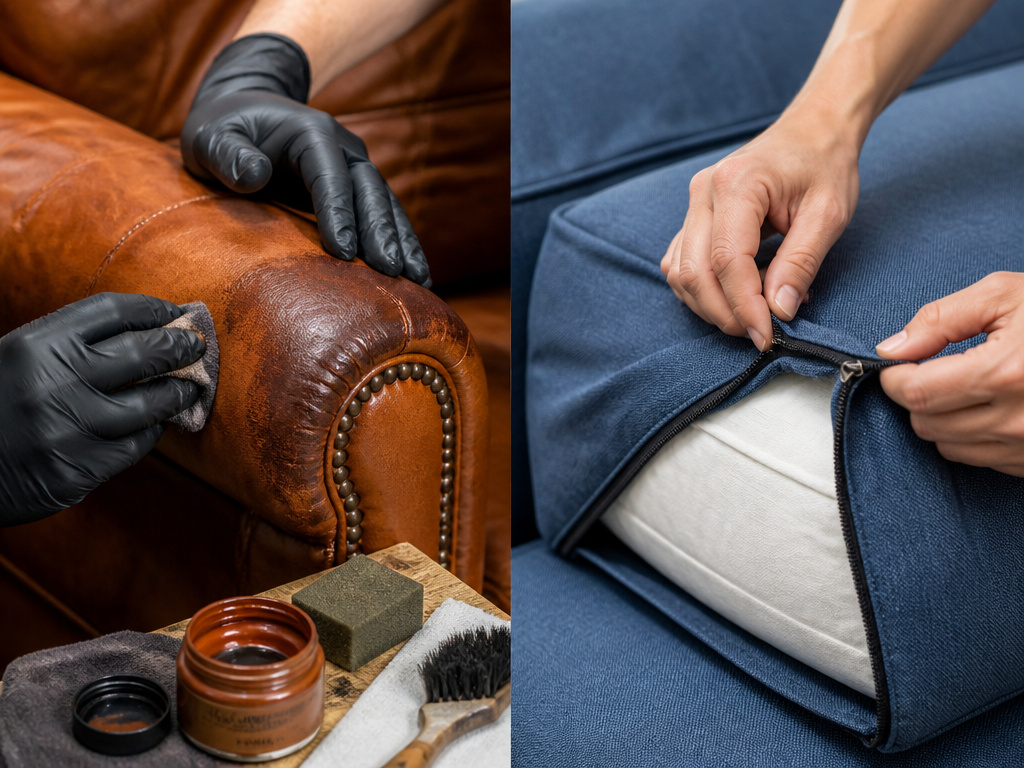
Fabric’s modern advantage is the machine-washable cover. Brands like Sora and Eva build sofas with fully removable, zippered covers designed for the washing machine. This product is highly effective for spills, pet accidents, or thorough cleaning. However, “removable” can be a spectrum. Some covers require disassembling the sofa frame to remove, a task you’ll do never. Always verify the process in the manual before buying.
Common mistake: Using harsh chemicals or stain guards on performance fabrics. Many have built-in stain resistance (like Sora’s PFAS-free shield). Adding a third-party spray can gum up the fibers and void warranties. For daily cleaning, vacuum with a soft brush attachment and blot spills with water.
Leather cleaning is more ritual than rescue. You can’t throw it in the wash. For a spill, you have a 60-second window to blot it up before liquid penetrates the finish. The right toolkit is simple: a soft, damp microfiber cloth and a pH-balanced leather cleaner for periodic wiping. Never use saddle soap, furniture polish, or household cleaners, they strip natural oils and leave a damaging residue.
Here’s the thing about leather stains: a protected finish will buy you time. A semi-aniline leather has pigments and a light topcoat that resist immediate absorption. A full-aniline leather, with its open pores, absorbs almost instantly. That’s why for a family space, I recommend a protected finish. It gives you those crucial seconds to grab a cloth. For detailed steps on maintaining your investment, our guide on how to clean a leather sofa walks through the safe, effective process.
Comfort & Climate: Feel, Temperature, and Aging
Sit on a leather sofa in a cold room. Now sit on it in summer. The material talks back.
Leather is hygroscopic, it absorbs and releases moisture from the air. In a dry room, it can feel stiff and cool. In humidity, it becomes softer and warmer. It doesn’t trap allergens like dust mites, making it a good choice for allergy sufferers. Over years, quality leather softens and forms a personal patina, a creased character that many find appealing. Cheap, corrected-grain leather won’t do this; it will just crack.
Fabric is inherently temperature-neutral and softer to the touch initially. The comfort feel depends on the weave: a tight, smooth weave (like many performance fabrics) can feel slick, while a nubbly wool or textured cotton feels cozier. The downside? Fabric traps dust, pet dander, and allergens deep within its fibers. It requires regular vacuuming with a proper upholstery attachment to maintain a healthy environment.
A 2021 industry analysis from Leather UK technical report notes that leather’s natural structure allows it to adapt to body temperature more effectively than many synthetic materials, contributing to long-term comfort perception.
Consider your regional climate. In a consistently hot, dry, or sunny environment, leather requires more vigilant conditioning and shade. In a damp, humid climate, fabric may hold moisture and develop a musty smell if not properly aired and cleaned. There’s no universal best, only the best for your specific walls.
Cost Analysis & Long-Term Value
 Let’s talk about the decade-long picture, not the price tag. The initial cost is just the entry fee.
A mid-range fabric sofa from a brand like Article or Allform often sits in a lower price bracket than a comparable leather one. However, a high-end, abrasion-resistant performance fabric from a brand like Sora can approach or even exceed the cost of a mid-tier leather sofa. The real divergence happens in years 5–10.
Leather, if properly cared for, can be repaired and refinished. A professional can re-dye worn armrests, repair minor scratches, and refresh the finish. This can extend the sofa’s life for another decade. You cannot do this with fabric. Once the fabric is stained, torn, or worn through, your only option is a full re-upholstery (expensive and complex) or a replacement slipcover (if available).
Fabric’s value lever is modularity and replaceability. Companies like Eva and IKEA sell individual replacement covers for their modular sofas. For a few hundred dollars, you can give a faded sofa a completely new look. This is a powerful advantage for changing styles or recovering from a catastrophic stain. Leather doesn’t offer this; it’s a single, aging skin.
When calculating value, ask: “Am I buying a 10-year appliance or a 20-year heirloom?” For a growing, changing family, the replaceable fabric cover might offer more practical value. For a stable household that values aging character, a quality leather frame is a longer-term investment. To make sense of leather’s price tiers, it helps to understand the fundamental full-grain vs genuine leather quality differences.
The Verdict: Which Sofa Should You Choose?
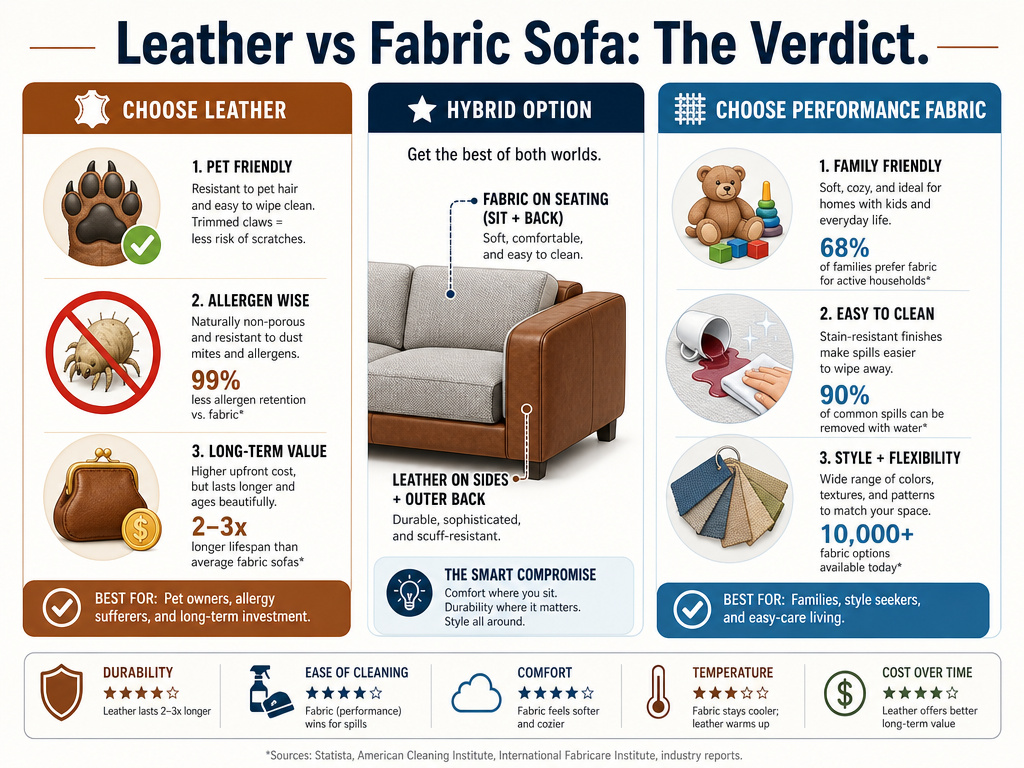 This isn’t a tie. Your household profile dictates a clear winner. Here’s my straightforward advice, drawn from the data and failure modes above.
Choose a Leather Sofa If:
- Your household has older children or no children, and pets with trimmed claws.
- You have allergy sufferers in the home (dust mites don’t thrive on leather).
- You value a temperature-responsive material that develops a unique patina.
- You are prepared for a simple, quarterly cleaning ritual and will keep it out of direct sun.
- You view the sofa as a long-term investment and appreciate the potential for professional repair.
For this group, a semi-aniline leather is the default pick. It offers the best balance of natural look, stain resistance, and durability. Skip the purist full-aniline for a daily driver. Your research should start with understanding the differences in leather sofa finishes.
Choose a Performance Fabric Sofa If:
- Your household has young children, pets, or is a frequent spill zone.
- You crave easy, drastic color changes every few years (via replaceable covers).
- You live in a climate with extreme temperature swings (very hot/cold) where leather might feel uncomfortable.
- You want a softer, consistently cozy feel right out of the box.
- Your budget is more mid-range upfront but you’re comfortable with a potential cover replacement cost later.
For this group, a modular sofa with a 50,000+ double-rub, machine-washable cover is the one to beat. Brands like Sora are engineered for this life. The cleaning advantage is real and massive.
There is a third, often-overlooked path: the fabric-covered sofa with a leather-reclining core. Some manufacturers use high-performance fabric on all contact surfaces but use durable, easy-clean leather on the back and sides. It’s a hybrid approach that merits consideration for specific layouts.
Frequently Asked Questions
Does leather or fabric last longer?
In a controlled environment with proper care, a high-quality leather sofa will typically outlast a fabric one. Leather’s structure allows for repair and refinishing, while fabric succumbs to irreversible abrasion and staining. However, in an active household with poor maintenance, a heavy-duty performance fabric may visibly outlast a neglected leather sofa.
Is a fabric sofa cheaper than leather?
Initially, often yes. You can find fabric sofas at lower entry price points. But when comparing equivalent quality tiers, durable performance fabric versus mid-grade protected leather, the prices often converge. The long-term cost differs: fabric may require costly re-upholstery or replacement; leather may need professional conditioning or repair.
Can you make a fabric sofa pet-friendly?
Yes, with two strategic choices. First, select a tight-weave performance fabric (like a textured polyester or olefin) rated for at least 50,000 double rubs. Second, choose a sofa with truly removable, machine-washable covers. Always keep pet nails trimmed and use a blanket on your pet’s favorite spot to catch hair and oils.
How do I keep my leather sofa from cracking?
Prevention is everything. Keep it out of direct sunlight and away from heat vents. Maintain moderate indoor humidity (40-60%). Clean spills immediately with a damp cloth. Use a light, pH-balanced leather conditioner only once or twice a year, over-conditioning can soften the leather too much and weaken its support over time. The goal is to preserve its natural oils, not drown it.
What is the most durable fabric for a sofa?
The most durable fabrics are synthetic performance weaves: high-density polyester, olefin, or nylon. Look for a Martindale abrasion rating of 50,000 double rubs or higher. These fabrics are often solution-dyed (color penetrates the fiber) for fade resistance and treated with a stain-resistant finish. A peer-reviewed material in the European Journal study on synthetic leathers confirmed microfiber synthetics can achieve tensile strength exceeding some natural leathers.
The Bottom Line
Look past the surface. The leather vs fabric decision closes on three questions you can answer today: What’s your spill-and-scratch reality? What’s the abrasion rating on that fabric tag? Are you willing to follow the 60-second blot rule?
For the quiet sunroom, leather ages with grace. For the family command center, a machine-washable performance fabric is a sanity preserver. The worst mistake is choosing a material for its showroom feel without a plan for its fifth birthday. Pick the one whose failure mode you can live with, and whose care ritual you’ll actually perform. That’s the sofa that earns its place.
