
A Guide on How to Choose Leather Boots for Fit & Durability
This post contains affiliate links. As an Amazon Associate, we earn from qualifying purchases.
To choose leather boots, match three things: your foot’s true measurements, the boot’s construction method, and the leather grade. Ignore your sneaker size. Measure your foot in centimeters, then use the brand’s specific size chart. Prioritize construction. Goodyear welt or Blake stitch, over exotic leathers. A well-built boot in decent leather outlasts a poorly built boot in premium hide.
That measurement step is where most people go wrong first. Sneaker sizing is a suggestion; boot sizing is a specification. The difference isn’t about comfort, it’s about how the last, the mold around which the boot is built, is designed for structure rather than bounce.
What follows is a system. We’ll break down the leather you can see, the construction you often can’t, and the fitting ritual that actually works. By the end, you’ll be able to look at any boot’s product page and know within two minutes whether it’s built to last or built to fail.
Key Takeaways
- Your sneaker size is irrelevant. Measure your foot in centimeters and match it to the manufacturer’s specific size chart, not a generic conversion.
- Construction method is more important than leather grade for longevity. A Goodyear welt or Blake stitch boot can be resoled; a cemented boot is disposable.
- Full-grain leather develops a patina; corrected-grain leather develops cracks. The difference is visible in a thumb-press test, full-grain will darken slightly.
- Never use heat or water to break in boots. These are destructive myths that strip oils and compromise structure.
- Persistent pain after four to six short wear sessions means the boot is the wrong fit. It will not “break in” to comfort.
The Golden Rule of Leather Boot Sizing
Forget the number you think you wear. The first and most critical step is to measure your foot, in centimeters, at the end of a long day. Stand on a piece of paper, mark the heel and longest toe, and measure the distance. That’s your starting point, not a US size 10.
International sizing charts are a minefield. A US 10 might map to a UK 9 or an EU 43, but those conversions ignore the shape of the last, the foot form around which the boot is built. A brand’s last for a rugged work boot is wider and roomier than its last for a sleek Chelsea boot, even if both are labelled size 10. Relying on a conversion chart alone is how you end up with boots that are simultaneously too long and too narrow.
The part nobody mentions: Your instep height matters as much as length and width, especially for pull-on boots. A high instep needs a wider shaft opening or an adjustable design; a low instep will swim in the same boot.
Here’s the straightforward advice: find the brand’s specific size guide, usually in a link near the product description or in the footer. Input your centimeter measurement. If they offer width options (like D for standard, E for wide), your foot tracing will tell you which you need. For work boots you’ll wear with thick socks, sizing up by half from your measured size is standard practice. For dress boots, trust the measurement.
| Sizing Factor | Sneaker World | Boot World |
|---|---|---|
| Primary Reference | Feel & “Size” | Foot length in cm |
| Width Consideration | Often one width fits all | Critical (D, E, EE widths common) |
| Break-in Expectation | Comfort out of box | Snug fit that molds over 1-2 weeks |
| Sock Planning | Thin athletic socks | Worn with intended sock thickness |
This process feels tedious. It is. Doing it once means you’ll never gamble on a wrong size again.
Leather 101: Reading the Hide
When you see “genuine leather,” you’ve learned nothing. It’s a technically true label that encompasses the entire quality spectrum, from robust full-grain to pulped and bonded leftovers. The label to look for is full-grain leather.
Full-grain is the top layer of the hide, with all its natural grain and imperfections intact. It’s the strongest, most breathable, and it ages by developing a patina, a rich, darkening sheen unique to your wear. Corrected-grain leather (often called “top-grain”) has been sanded and coated to hide imperfections. That coating eventually cracks. Here’s a quick test: press your thumb firmly into the leather. Full-grain will darken slightly from the oils in your skin. Coated leather won’t react.
Full-grain leather retains the outermost layer of the hide, making it the most durable and breathable option available. Unlike corrected-grain, it develops a rich patina with wear, each scuff and crease telling a story.
Vegetable-tanned leather is a subset of full-grain, tanned using natural tannins from tree bark. It starts stiff and light, darkening dramatically with exposure to light and use. It’s the hallmark of heritage-quality goods. For most everyday boots, quality chrome-tanned full-grain leather offers a great balance of durability, water resistance, and suppleness right out of the box.
The inside matters as much as the outside. Peel back the tongue. Is the lining a smooth leather or fabric, or is it a rough synthetic that feels like it’ll cause a blister on mile two? A cheap lining is a sure sign the maker cut corners where they thought you wouldn’t look.
Construction: The Hidden Engine of Longevity
This is where your boot earns its price. The way the upper is attached to the sole determines everything: how it flexes, how it handles water, and whether it can be repaired. You can have the finest leather in the world, but if it’s glued to a cheap sole, the boot is doomed the day that bond fails.
Let’s be clear about this: the construction method is often a better predictor of a boot’s life than the leather grade. There are three main types you’ll encounter.
Goodyear Welt: A strip of leather (the welt) is stitched to the upper and the insole. The outsole is then stitched to the welt. This creates a cavity that can be filled with cork, which molds to your foot. It’s water-resistant, incredibly durable, and completely resoleable. This is the gold standard for work and heritage boots.
Blake Stitch: A single stitch runs directly through the insole, upper, and outsole. It creates a sleeker, lighter profile and allows for more immediate flexibility. It’s also resoleable by a skilled cobbler, though the single stitch channel can be a weaker point against moisture than a Goodyear welt.
Cemented Construction: The outsole is glued directly to the upper. It’s lightweight and flexible from day one, and it’s the cheapest method to produce. The critical flaw? It’s not resoleable. When the sole wears out or the adhesive fails, the boot is trash.
| Construction | Resoleable? | Water Resistance | Best For | Lifespan Expectation |
|---|---|---|---|---|
| Goodyear Welt | Yes | High (cork filler seals stitch) | Work, Heritage, Heavy Duty | 10+ years with resoles |
| Blake Stitch | Yes (by specialist) | Moderate | Dress, Casual, Sleeker Styles | 5-10 years |
| Cemented | No | Low (glue line fails) | Fast Fashion, Disposable Fashion | 1-3 seasons |
I want to help you make confident choices. So, if you’re buying boots you hope to wear for years, insist on a Goodyear welt or Blake stitch. Cemented construction has its place for ultra-casual, low-cost options, but recognize it as a consumable, not an heirloom.
The Break-In: What to Expect (And What to Avoid)
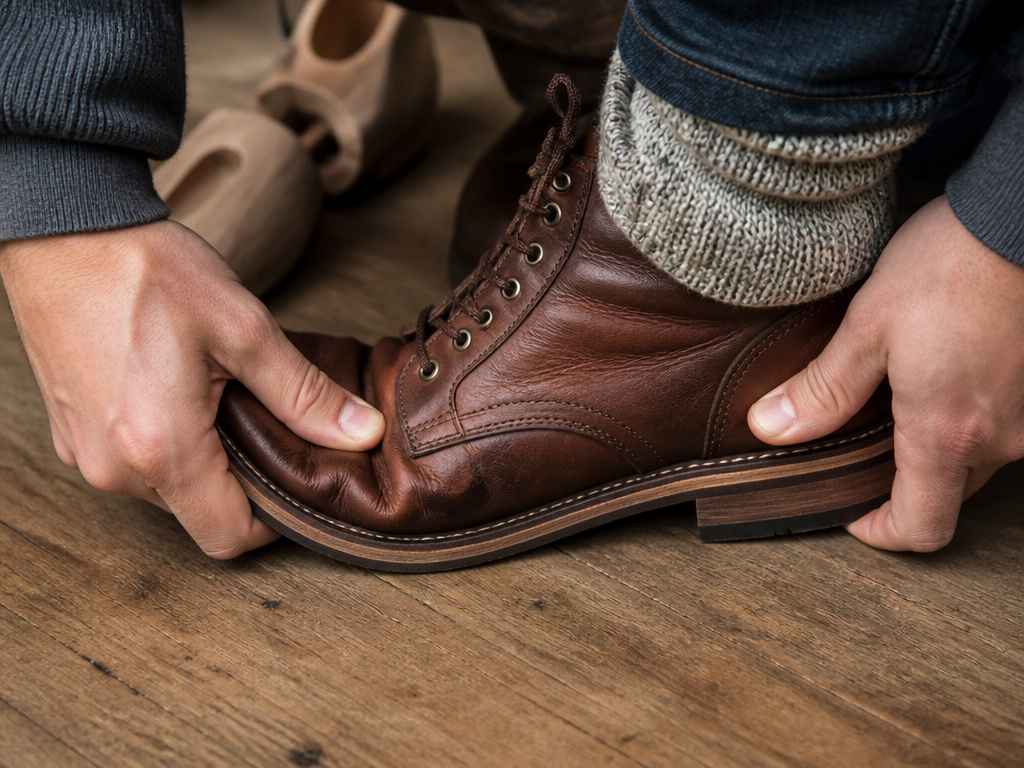
New boots should feel snug, not painful. You should feel the leather hugging your foot, with no pinching or pressure on your bones. A little heel slippage, about a quarter of an inch, is normal in the first few wears as the sole flexes and the heel counter molds.
The break-in process for quality leather boots is a gradual softening, not a battle of attrition. Wear them indoors for 30 to 60 minutes at a time for the first few days. Use thick socks. Walk around. Flex them by hand. After a week or two of short stints, they’ll start to feel like they’re yours.
Common mistake: Using heat or water to speed up the process. Direct heat from a hairdryer strips natural oils, leaving the leather dry and brittle. Soaking boots is an old wives’ tale that compromises structural integrity and can lead to mold. Both methods can melt internal adhesives.
Here’s a realistic timeline from the research: – Days 1-3: Boots feel stiff, firm. Wear indoors only. – Week 1-2: Leather softens noticeably. Minor pressure points may remain. – Week 3-4: Boots should feel comfortable for several hours of continuous wear.
If you feel sharp pain or significant, persistent heel slippage after four to six short wear sessions, stop. The boot is the wrong fit. No amount of breaking in will fix a fundamental mismatch between your foot and the boot’s last. Trying to force it only damages your feet and the boots.
This is a timeless material, but it needs care from the start. After each wear, use boot trees to absorb moisture and hold the shape. It’s the single best thing you can do to extend their life and speed up the break-in by preventing the leather from curling and hardening as it dries.
Matching Boots to Your Actual Life
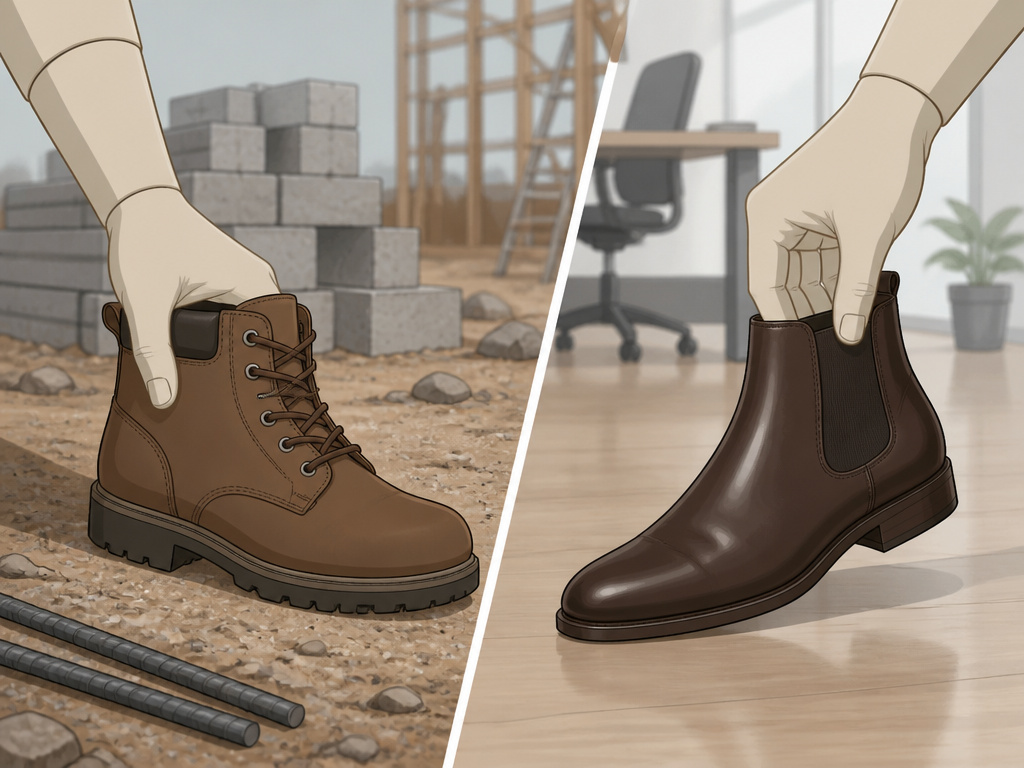
Choosing the right leather boots isn’t about finding the “best” boot in a vacuum. It’s about finding the best boot for the life you actually lead. The priorities for a construction site are different from a city sidewalk.
For leather work boots, prioritize safety features (like a composite toe if needed), aggressive slip-resistant outsoles, and of course, Goodyear welt construction for maximum durability. The leather needs to be tough and often treated for water and abrasion resistance.
For leather hiking boots, the focus shifts to ankle support, lugged Vibram-style outsoles for grip, and waterproof membranes like Gore-Tex if you’ll be in wet conditions. Construction is still key, many quality hiking boots use robust cemented or welded constructions designed for lightweight performance.
For everyday wear, from Chelsea boots to service boots, you have more flexibility. This is where leather quality and aesthetics shine. A Blake-stitched Chelsea boot in suede makes sense for office wear; a Goodyear-welted service boot in rough-out leather is perfect for weekend wear.
The mistake is buying a boot for a life you don’t live. A delicate, leather-soled dress boot will be destroyed by a daily commute on gritty pavement. A massive, insulated work boot is overkill for desk duty. Be honest about where your feet will spend 80% of their time, and let that guide your choice of style, sole, and construction.
How to Spot Quality on a Product Page (Or In Store)
You don’t need to be an expert to spot the red flags. Here’s your five-point checklist for evaluating any boot, online or in person.
- The Leather Claim: Does it say “full-grain leather” specifically? If it only says “genuine leather” or “premium leather,” assume it’s corrected grain until proven otherwise.
- The Construction Disclosure: Reputable brands are proud of their construction. Look for the words “Goodyear welt,” “Blake stitch,” or “resoleable.”” If construction isn’t mentioned, it’s almost certainly cemented.
- The Photo Test: Zoom in on the stitching. Is it straight, even, and tight? Or is it wobbly, with loose threads? Sloppy stitching is a structural warning, not a cosmetic flaw.
- The Sole Identity: Is the sole branded (e.g., Vibram, Dainite) or does it look like anonymous black rubber? Branded soles often indicate a partnership with a manufacturer like Vibram.
- The Interior Glimpse: Can you see a photo of the inside? Check the interior for clean, finished seams and a lining that is not flimsy.
When you’re in a store, pick up the boot. Bend it at the ball of the foot. It should flex there, not in the middle of the arch. Feel the lining. Look at the edge of the sole where it meets the upper, is it a clean junction, or is there gloopy, uneven glue squeeze-out?
These checks take thirty seconds. They separate marketing from craftsmanship.
Frequently Asked Questions
How much should I expect to pay for quality leather boots?
You’re paying for materials and labor. A well-constructed boot (Goodyear welt or Blake stitch) in full-grain leather from a maker like Red Wing represents a significant investment. While prices vary widely, expect to invest accordingly for boots built to last a decade. The long-term cost per wear is far lower than replacing cheap boots every year.
Can I wear the same leather boots every day?
You can, but you shouldn’t. Leather needs 24-48 hours to fully dry out from foot moisture after a day of wear. Rotating between two pairs doubles the lifespan of each by allowing them to properly dry and recover their shape with the aid of boot trees.
How do I clean and maintain my new boots?
Start with a gentle brush to remove dust. For routine care, use a dedicated leather conditioner every few months, apply a thin coat, let it absorb, then buff. Avoid silicone-based “conditioners” that sit on the surface. For deep cleaning or polishing, follow our specific guides on how to clean leather boots and how to polish leather boots.
What if my boots get wet or stained with salt?
Let them air-dry at room temperature, away from direct heat. Stuff them with paper to absorb moisture and maintain shape. Once dry, brush them. For stubborn salt stains off leather boots, a solution of equal parts white vinegar and water, applied with a cloth, can neutralize the salt before you condition the leather.
Are leather boots worth the break-in trouble?
Absolutely. A broken-in leather boot is a custom fit that no sneaker can match. It supports your foot, molds to your stride, and develops a unique character. The initial patience pays off in years of superior comfort, durability, and style that improves with age.
The Bottom Line
Choosing leather boots is a series of intentional decisions, not a guess. Measure your foot. Ignore your sneaker size. Let construction method be your primary filter. Goodyear welt or Blake stitch for longevity. Judge leather by the specific grade, not vague terms.
One rule to walk away with: if a boot causes significant pain after four to six short, indoor wear sessions, it’s the wrong fit. Return it. The myth of “they’ll eventually stretch” leads to a closet of unwearable footwear.
Start with a single, well-chosen pair for your dominant activity. Get the fit and care ritual right. Everything else, the patina, the confidence, the years of service, follows from that first, correct choice.
