
How to Choose Perfect Leather Work Boots Using 3 Key Specs
This post contains affiliate links. As an Amazon Associate, we earn from qualifying purchases.
Choosing leather work boots means matching three specs to your job: the safety toe code (ASTM F2413-24 or EN ISO 20345:2011), the sole’s slip and hazard resistance, and the construction method that dictates lifespan. Ignore the leather grade first; a premium hide on a cheap cemented sole fails in six months.
Let’s be clear about this. A boot is a tool. You wouldn’t pick a hammer because it looks good in the store; you match the head weight and handle length to the nail and your swing. Work boots are the same. The right choice hinges on the hazards underfoot, the materials you handle, and how many hours you stand on them.
What follows is a breakdown of the codes, the construction, and the fit that separates a boot that protects from one that merely exists. By the end, you’ll be able to read any product page in ten seconds and know if it’s built for your workweek.
Key Takeaways
- The safety label (ASTM F2413-24 or EN ISO 20345:2011) is a legal certification, not a marketing suggestion. Match the specific codes (EH for electricians, PR for puncture resistance) to your job’s documented hazards.
- Construction decides lifespan. Goodyear welt boots can be resoled for decades; cemented boots are often disposable after the sole wears thin.
- Fit for work is not the same as street shoe fit. You need a thumb’s width of space ahead of your toes when standing, with a snug heel and no pressure points across the instep.
- Waterproofing is a trade-off. A sealed membrane keeps water out but also traps sweat in. Choose it only if you regularly work in standing water or wet grass.
- According to STIHL’s manual, even premium safety boots have a hard lifespan: replace after two years of regular use or five years of occasional use, regardless of appearance.
The 3 Non-Negotiable Specs on the Label
Forget brand loyalty or aesthetic appeal for a minute. The information printed on the boot’s tag or stamped inside the tongue is a contract. It tells you exactly what the boot is certified to protect against. This isn’t vague marketing; it’s a standardized language.
The two main languages are ASTM F2413, common in North America, and EN ISO 20345, the European standard. Both were updated in recent years. ASTM F2413-24 replaced the 2018 version. If a boot cites an older standard, it’s not necessarily unsafe, but it indicates the model hasn’t been re-certified to the latest testing protocols.
ASTM F2413-24 designations follow a simple code: F2413 identifies the standard, followed by suffixes like I/75 (Impact-resistant toe cap rated for 75 foot-pounds), C/75 (Compression-resistant toe), EH (Electrical Hazard), and PR (Puncture Resistant). A boot marked ASTM F2413-24 I/75 C/75 EH PR covers the core hazards for most trades.
Your employer’s safety assessment should dictate which codes you need. Assuming is the mistake. An electrician needs the EH rating, which insulates against accidental contact with live circuits up to 600V in dry conditions. A worker on a debris-strewn site needs PR (Puncture Resistance). These aren’t optional extras.
| Common Job Hazard | Required ASTM/EN ISO Code | What Happens If You Skip It |
|---|---|---|
| Falling objects (e.g., construction, warehousing) | I/75 (Impact Resistance) | A dropped tool crushes the toe box, leading to immediate fracture. |
| Sharp debris on ground (e.g., demo, recycling) | PR (Puncture Resistance) | A nail penetrates the sole, causing a deep wound and infection risk. |
| Electrical panels, live wires (e.g., electricians, utility) | EH (Electrical Hazard) | Contact with a live 240V circuit can conduct through the boot, resulting in electrocution. |
| Slippery surfaces (e.g., kitchens, oil shops) | SR (Slip Resistance) / ASTM F1677 | A loss of traction leads to a fall, with potential for back injury or head trauma. |
The part nobody mentions? These ratings have conditions. An EH rating is void if the boots are wet inside or out. Puncture resistance doesn’t mean invincibility, it means a steel midsole stopped a specified nail under lab conditions. The certification is your baseline, not a force field.
Anatomy of a Boot That Lasts
Once you’ve matched the safety codes, look at how the boot is put together. This is where your money either buys a disposable product or a renewable asset. The three major construction methods are Goodyear welt, stitchdown, and cemented.
Goodyear welting is the gold standard for repairability. A strip of leather or synthetic material (the welt) is stitched to the upper and the insole. The outsole is then stitched or glued to this welt. The magic is in the separation: when the outsole wears out, a cobbler can cut the stitches, replace the sole, and re-stitch without touching the upper. Brands like Red Wing use this on classics like the Traction Tred 405. The break-in is longer, and the boot is often heavier, but it can last for decades with resoles.
Cemented construction uses adhesive to bond the outsole directly to the upper. It’s lighter, more flexible, and cheaper. It’s also a one-way street. Once that sole is worn through or the adhesive fails, a repair is rarely cost-effective. This is common in athletic-style work footwear.
Stitchdown is a cousin to the Goodyear welt, where the upper leather is flared outward and stitched directly to the sole. It’s robust and stable, but not every model is designed to be taken apart for resoling.
Here’s the thing. A decorative strip on a cemented boot can look like a welt from six feet away. A genuine welt tells you the boot can be resoled, but it doesn’t guarantee the upper leather is high quality. You need to check both. For most workers who want a single boot to last for years, a Goodyear welt is the only logical choice. Our guide to selecting leather boots dives deeper into parsing construction from marketing.
Leather Grades and What They Actually Mean
Now we can talk about the leather. The terms are famously misused, so let’s untangle them. The grade refers to which layer of the hide is used and how much correction (sanding, buffing) has been applied to the surface.
Full-grain leather is the outermost layer of the hide, with all its natural grain and imperfections intact. It’s the strongest, most breathable, and develops a patina over time. When you see “oil-tanned full-grain,” that’s the workhorse, the oils give it inherent water resistance and suppleness. This is the material you’ll find on serious boots like the Red Wing 405.
Top-grain leather is full-grain that’s been sanded or buffed to remove surface imperfections. It’s thinner and more uniform but less durable. It’s often used in dressier work boots where a pristine look is desired.
Genuine leather is a bottom-tier classification. It’s not a specific grade but a term that means the product contains some layer of real leather, often the fibrous leftovers bonded together. It tells you nothing about strength or longevity. A boot marketed primarily on its “genuine leather” upper is a red flag.
Common mistake: Polishing boots with a wax or silicone-based product. If too much polish with a high animal fat content is used, it can actually reverse the leather’s natural waterproofing. This isn’t scare talk, it’s a specific warning from STIHL’s safety boot manual.
The lining matters, too. A breathable, moisture-wicking mesh lining is crucial if your feet sweat. A waterproof Gore-Tex or similar membrane will trap that sweat if you’re not actually in wet conditions, making a hot day miserable. Choose the feature you truly need.
The Fit That Works for 10-Hour Days
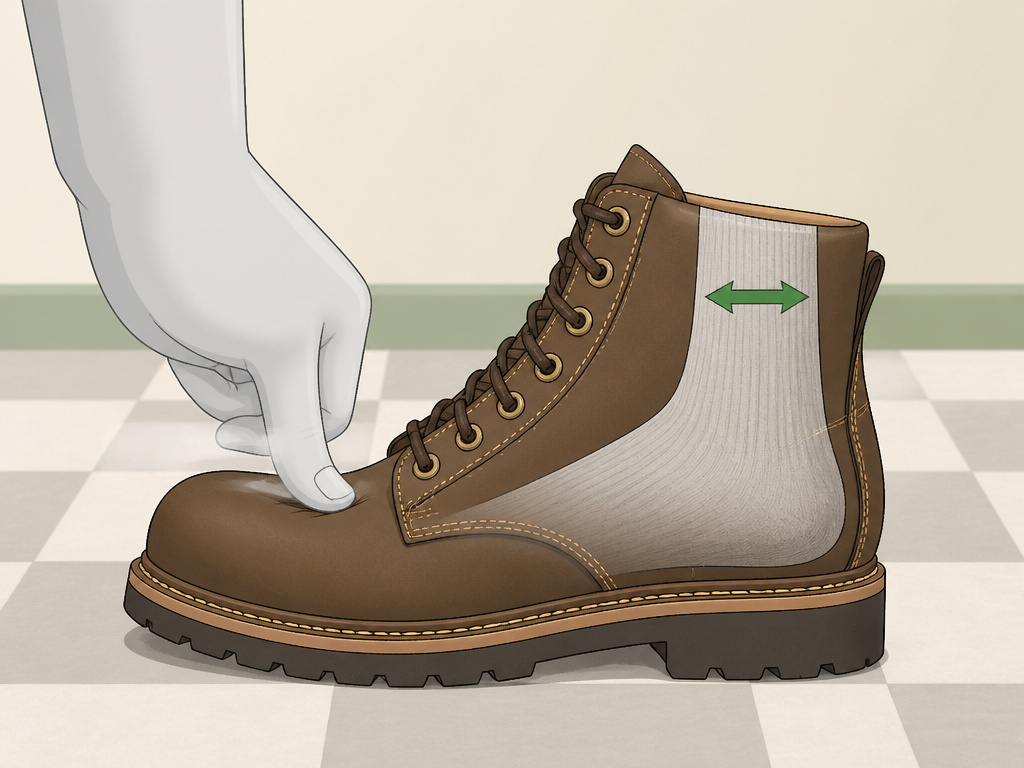 A work boot must fit differently than a sneaker. In the afternoon, after miles of walking and standing, your feet will swell. The fit must accommodate that.
When trying on boots, wear the exact work socks you’ll use on the job. Lace them up fully and stand on a hard surface. You should have about a thumb’s width of space between your longest toe and the end of the boot. Your heel should be snug, with minimal lift when you walk. The boot should grip your instep firmly without pinching.
There should be no breaking-in of width. Length might accommodate swelling, but the boot should not be painfully tight across the ball of your foot with the expectation it will “stretch.” That’s a path to blisters and foot pain. If you need extra arch support, invest in quality aftermarket insoles immediately; don’t wait for the factory footbed to collapse.
A recurring issue I see is boots stored in damp places like basements developing mold, which ruins the leather and liner. If your boots get wet, dry them slowly at room temperature, never by a heater. For long-term health, a consistent cleaning and conditioning routine is essential. The process is outlined in our article on how to care for leather boots.
Waterproof vs. Water-Resistant vs. Breathable
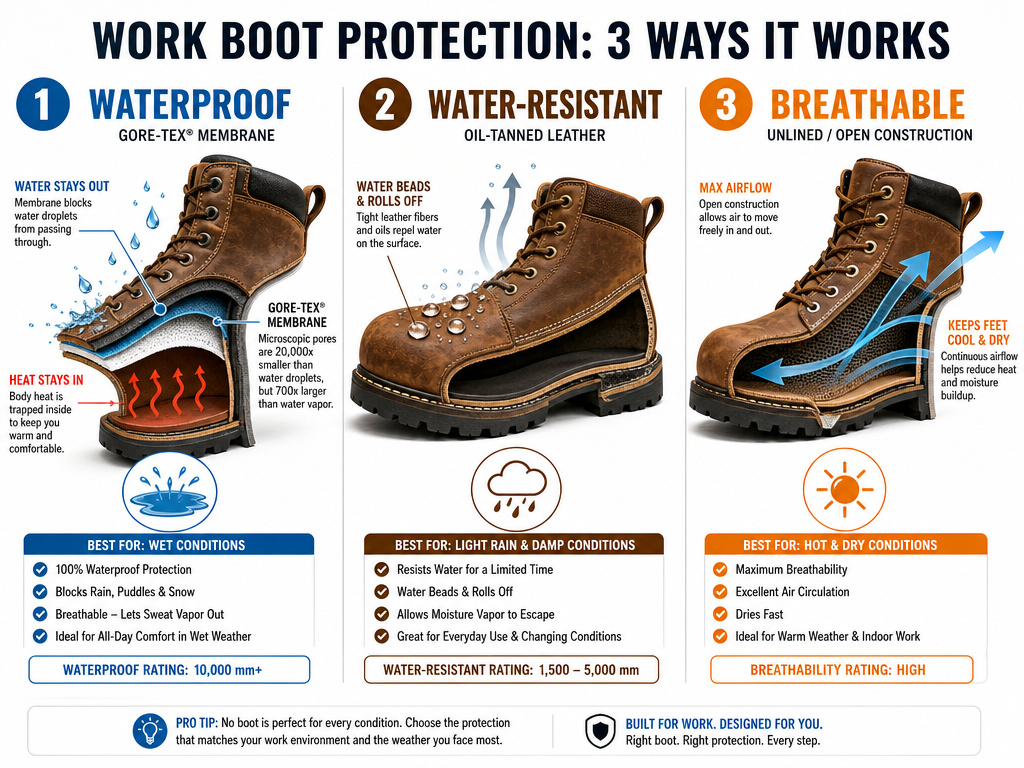 This is a classic trade-off, and most people get it wrong. You must match the boot’s water management to your actual environment, not a hypothetical one.
- Waterproof (e.g., Gore-Tex bootie): A sealed membrane keeps liquid water out. It also traps vapor in. Choose this only if you regularly stand in puddles, wet grass, or slush. For indoor work or dry climates, it will make your feet sweat profusely.
- Water-Resistant (e.g., oil-tanned leather): The leather itself, treated with oils and waxes, sheds light rain and moisture. It still breathes, allowing sweat vapor to escape. This is the ideal choice for most outdoor workers who encounter occasional wetness but not standing water.
- Breathable (unlined or mesh-lined): Maximizes airflow for comfort in hot, dry conditions. Offers no real protection against external water.
Your goal isn’t the most protection on paper. It’s the right balance for your climate and activity level. A welder in a dry shop needs breathability; a landscaper in the Pacific Northwest needs waterproofing. For a focused look at the top options built for wet conditions, see our reviews of the best waterproof leather boots.
The Lifespan and When to Retire Them
Work boots are PPE, and PPE has a service life. Relying on a boot long past its prime is a safety risk, not just a style choice.
Manufacturers provide guidelines. The STIHL safety boot manual is brutally clear: replace boots in regular use (several times a month) after a maximum of two years. For occasional use, the limit is five years. This accounts for material degradation from UV exposure, moisture cycles, and the constant flexing that fatigues leather and composites, even if the soles look okay.
You also have visual and tactile checks: * Sole wear: If the tread depth is below 4mm (about the thickness of a quarter), traction is compromised. * Upper cracks: Deep cracks in the leather, especially around flex points like the toe box, indicate the material is failing. * Compressed cushioning: If the midsole feels completely flat and offers no shock absorption, your joints are taking the impact. * Damaged safety features: A dented toe cap, a compromised puncture plate, or separated stitching all mean the boot’s protective contract is void.
A repairable boot only saves money if you actually get it repaired before the damage is too great. Sending a Goodyear welt boot in for a resole when the heel is half-worn is smart economics. Waiting until the sole is smooth and the leather is cracked is too late.
Frequently Asked Questions
What is the difference between steel toe and composite toe?
Steel toe is a solid piece of steel, offering maximum impact protection at a lower cost but more weight and less insulation from cold. A composite toe is made from materials like fiberglass or plastic; it’s lighter, doesn’t conduct temperature, and is metal-detector safe, but can be bulkier. Both meet the same ASTM I/75 impact standard if properly certified.
How long does it take to break in leather work boots?
Quality, stiff leather boot with a Goodyear welt requires a real break-in period of 4-5 days to several weeks of gradual wear. Wear them for 2-4 hours a day initially. The cork footbed molds to your foot, and the leather softens at specific flex points. Avoid the “tough it out for a 12-hour shift” method, that’s how you get blisters that sideline you. We have a dedicated guide on how to break in leather work boots with proven techniques.
Are expensive work boots worth it?
They can be, but price alone isn’t the answer. A $300 Goodyear welt boot you resole twice over ten years is far cheaper than buying three $150 cemented boots in the same period. The value is in total cost of ownership and consistent protection. Expensive boots should offer better materials, more durable construction, and often, more fitting options (like multiple widths). For a curated list of models that deliver on that promise, check our roundup of the best leather work boots.
Can I make my work boots waterproof?
You can enhance the water resistance of leather boots with dedicated products like oils or wax-based conditioners. However, you cannot make a non-waterproof boot truly waterproof if it lacks a sealed membrane. Treatments help the leather repel water, but they won’t stop water from seeping in through seams or the sole attachment over prolonged exposure. For the most effective products and methods, see our review of the best waterproofing for leather work boots.
How should leather work boots fit?
They should fit snugly around the heel and instep to prevent slipping, with about a thumb’s width of space (roughly 1/2 inch) between your longest toe and the boot’s end when standing. Your toes should have room to wiggle, and there should be no pinching or pressure points across the top of your foot. Always try boots on with the socks you plan to wear for work.
The Bottom Line
Choosing leather work boots is a process of elimination. Start with the safety codes mandated by your job. Then, pick the construction that matches your budget and desire for longevity. Goodyear welt for the long haul, cemented for a lighter, shorter-term solution. Finally, get the fit right in the store, with your work socks on.
The one rule most guides skip is the hard replacement timeline. Even the best boots are consumable safety gear. Mark your calendar two years from your purchase date. When that date arrives, inspect the soles, the toe cap, and the leather. If you’ve worn them regularly, it’s time to shop again. That’s not a sales pitch; it’s the manual’s instruction. Your feet carry you through every shift. Give them a foundation that’s built for the load.
