
Expert Tips on How to Choose Quality Leather Dress Shoes
This post contains affiliate links. As an Amazon Associate, we earn from qualifying purchases.
To choose leather dress shoes, focus on three essential elements: the shoe last (the form that shapes it), the construction method (how it’s put together), and a precise fit with about 1–1.5 cm of space in the toe box.5 cm of toe room. A Goodyear welted shoe in full-grain leather can last 15 years and be resoled repeatedly, while a poor fit ruins even the best materials.**
Let’s be clear about this. The difference between a shoe you donate in a year and one that becomes a companion for a decade isn’t just about spending more. It’s about understanding the mechanics underneath the polish. A beautiful upper on a weak foundation is a short-term relationship.
What follows is a breakdown of those mechanics. We’ll walk through how to decode a shoe’s last, why construction dictates its lifespan, the leathers that offer immediate comfort versus those that need patience, and the exact measurements for a fit that works from morning to night.
Key Takeaways
- The shoe last, the form the shoe is built around, determines its fundamental shape and fit more than the brand name on the box. Finding a last that matches your foot shape is the first, non-negotiable step.
- Goodyear welted construction is the gold standard for longevity, allowing a quality shoe to be resoled 5 to 15 times over a potential 15-year lifespan. Cemented shoes are essentially disposable once the sole wears thin.
- Fit requires 1–1.5 cm (about a thumb’s width) of space beyond your longest toe. Shop in the late afternoon when feet are naturally swollen, and always size for your larger foot.
- For immediate comfort, choose softer, pliable leathers like deerskin or tumbled calfskin. Stiff, high-shine leathers required for formal wear need a significant break-in period and will crease sharply.
- Rotate your shoes and use cedar shoe trees every single time you take them off. This 24-hour rest cycle wicks moisture and preserves the shoe’s shape, dramatically extending its life.
The Last Is the Map, Not the Destination
You can love a shoe’s design in a picture. The last tells you if it will love your foot back. This is the three-dimensional form, traditionally carved from wood, around which the entire shoe is constructed. It dictates the toe shape, the instep height, the heel cup, and the overall volume.
Think of it this way. Two shoes from the same brand, even the same size, can fit completely differently if they’re built on different lasts. One might be narrow and elegant, the other roomy and rounded. This is why online shopping is a minefield. You’re not just buying a size 10; you’re buying a size 10 on a specific last that may or may not work for you.
The fit of a dress shoe is dictated by its last, the carved form that gives the shoe its shape. A last defines toe box volume, instep height, and heel width. Finding a last that aligns with your foot’s contours is more critical than the brand name or even the stated size.
The best practice is to try shoes from a brand known for a range of lasts. Tell the salesperson what usually goes wrong, pinched pinky toe, slipping heel, tight instep, and ask to try different last shapes in your size. It’s the only way to map your foot to its perfect match.
Construction: The Three Methods That Dictate Lifespan
Here’s the thing about construction: it’s the single biggest predictor of how long your shoe will last and whether you can save it when the sole wears out. This is where you separate a long-term investment from a short-term expense.
Let’s untangle the three main methods. Your choice here has more impact on the shoe’s life than almost any other factor.
| Construction Method | How It Works | Lifespan & Repairability | Best For |
|---|---|---|---|
| Goodyear Welt | A strip of leather (the welt) is stitched to the upper and the sole, creating a waterproof barrier and a resoleable platform. | 15+ years. Can be resoled 5-15 times. The gold standard for durability. | Daily wear, investment pieces, wet climates. |
| Blake Stitch | The sole is stitched directly to the insole through the upper. Creates a sleeker, more flexible profile. | 5-10 years. Can be resoled 2-3 times, but offers less water resistance. | Sleeker, Italian-style shoes; drier climates. |
| Cemented (Glued) | The sole is attached with strong adhesive. No stitching involved. | 6 months – 3 years. Not resolable. Sole wear-through means the shoe is trash. | Disposable fashion shoes, infrequent wear. |
I always recommend Goodyear welted construction for a first serious pair. The upfront cost is higher, but the cost-per-wear over 15 years is a fraction of replacing cheap cemented shoes every year. It’s the definition of buying once, crying once.
Leather 101: From Stiff Formality to Instant Comfort
All leather is not created equal. The type of hide and its finish determine the shoe’s character, break-in period, and how it ages. This is where your priorities, immediate comfort versus formal shine, direct the choice.
- Full-Grain Leather: The top layer of the hide, untouched. This is the most durable and will develop a rich patina over time. It’s breathable and long-lasting, but often requires a break-in period.
- Calfskin: A type of full-grain from young animals. It has a fine, tight grain and is the standard for high-end dress shoes. It’s supple but still needs breaking in.
- Top-Grain Leather: The surface has been sanded to remove imperfections, then coated. It’s more uniform but won’t develop the same character as full-grain. Common in mid-range shoes.
- “Genuine Leather”: A misleading term. It’s a lower-grade leather made from the inner layers of the hide after the top is split off. Less durable, prone to cracking.
The finish matters just as much. A high-shine patent leather or a stiff, polished calfskin for a tuxedo has a coating that makes it rigid. Those first creases will be sharp and can hurt. The break-in is real.
If you need comfort from the first wear, look for terms like “tumbled leather,” “deerskin,” or “soft calf.” These leathers are pliable and forgiving straight out of the box. You’re trading some formal sheen for all-day ease.
How Should a Dress Shoe Fit? (The Three-Point Check)
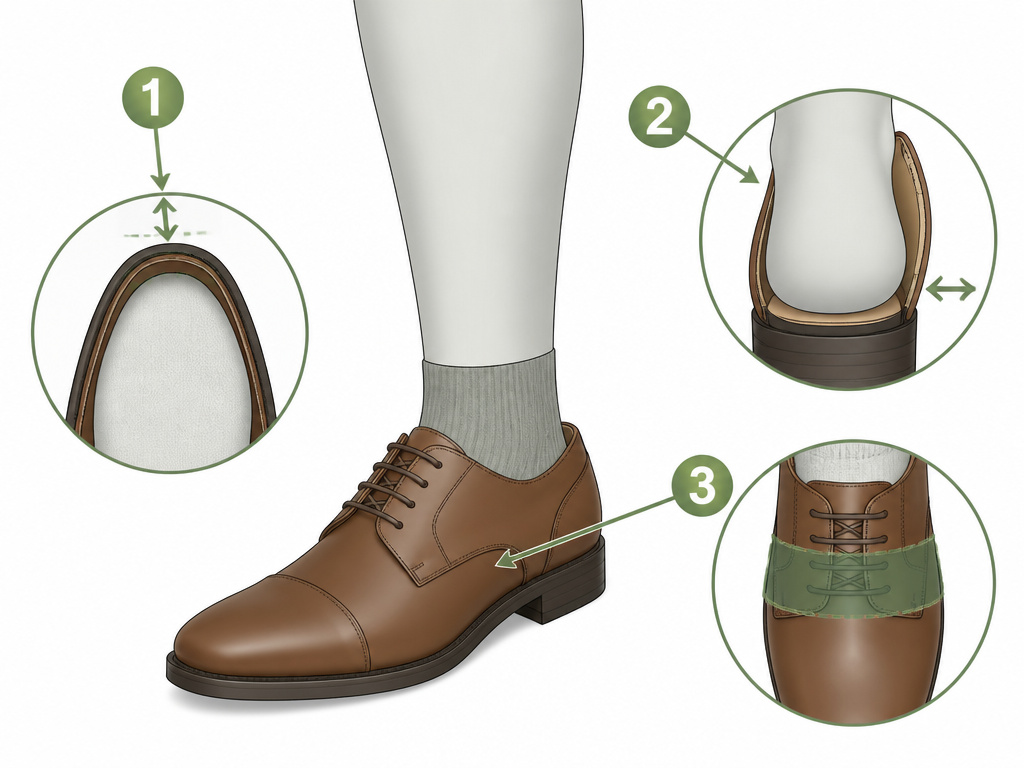 A beautiful shoe that doesn’t fit is a paperweight. The break-in period will only conform leather to your foot; it won’t fix a fundamentally wrong size. Here’s the three-point check to run in the store, preferably in the late afternoon when your feet are at their largest.
1. Toe Room. With the shoe on and your weight settled, press down on the tip. You should have 1–1.5 cm (about a thumb’s width) of space between your longest toe and the end of the shoe. This isn’t optional. It prevents your toes from jamming on every step.
2. Heel Lock. Your heel should be snug in the cup with minimal vertical slippage, no more than 3-5mm. A bit of slip is normal in new, stiff leather and will disappear as the sole flexes. More than that, and you’ll blister.
3. Width & Instep. The widest part of your foot should align with the widest part of the shoe. You shouldn’t feel the sides of your feet spilling over the sole. Across the instep (the top of your foot near the laces), it should feel snug but not pinching. If you have a high instep, avoid Oxfords; a Derby’s open lacing gives more room.
Common mistake: Sizing down because a shoe feels “a little long.” That empty space in front of your toes is necessary. Feet swell during the day, and shoes that are snug in an air-conditioned store become instruments of torture after a hot commute.
Most people have one foot slightly larger than the other. Always size for the larger foot. You can add a thin insole to the smaller shoe, but you can’t stretch the smaller one.
Style, Occasion, and the Right Shoe for the Job
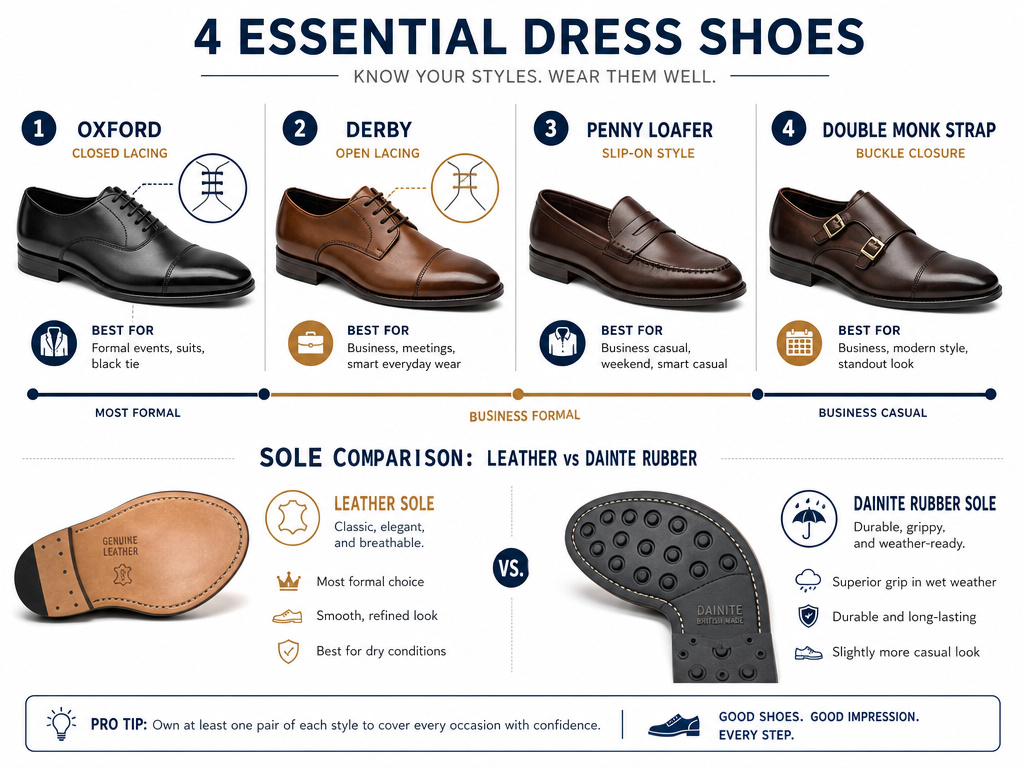 Once fit and construction are locked down, style is about matching the shoe to your wardrobe and its duties. Each classic style has a personality and a typical use case.
- Oxfords (Closed Lacing): The most formal. The eyelet tabs are stitched under the vamp, creating a clean, sleek line. The black cap-toe Oxford is the standard for business suits, interviews, and weddings.
- Derbies (Open Lacing): The eyelet tabs are stitched on top of the vamp. This allows more adjustment and room, making them better for wider feet or higher insteps. Slightly less formal, ideal for business-casual or odd-trouser outfits.
- Loafers: Slip-ons that range from casual penny loafers to dressier tassel or bit loafers. They’re perfect for business casual, warm weather, and sockless looks. Fit is critical, they should slip on with a gentle whoosh of air and hug your foot without gapping.
- Monk Straps: Single or double straps with a buckle. They’re a statement piece that bridges formal and casual, great with tailored trousers and a blazer.
Your climate matters, too. In humid places, suede or unlined loafers breathe better. For rainy cities, a Dainite rubber sole on a Goodyear welted shoe provides grip that a leather sole can’t.
The Care Regimen That Actually Works
A quality shoe is a partnership. You can’t just wear it. You have to look after it. This isn’t about fussiness; it’s about preserving an investment. The regimen is simple, but non-negotiable.
- Cedar Shoe Trees. Insert them immediately after taking the shoes off. Every time. Cedar absorbs moisture from sweat, pulls out creases, and maintains the shape. This one habit can double the shoe’s lifespan.
- Rotation. Never wear the same pair two days in a row. Leather needs a full 24 hours to dry and recover its structure. A two-pair rotation is the bare minimum.
- Brushing. Use a horsehair brush after every wear to remove dust and dirt that act like sandpaper.
- Conditioning. Every 4-6 weeks, apply a thin coat of a quality leather conditioner (like Saphir Renovateur) to replenish oils. Let it absorb fully before buffing.
- Professional Resoling. Don’t wait until you’re wearing through the outsole. A good cobbler can replace a Goodyear welted sole long before it’s thin, keeping the rest of the shoe intact.
For a deep dive on maintaining the finish, our guide on how to polish leather shoes covers the tools and techniques that build a true mirror shine, not just a superficial coat.
Frequently Asked Questions
How many pairs of dress shoes should I own?
Start with three: a black Oxford for formal duties, a brown Derby for business, and a loafer for casual or warm weather. This covers 95% of scenarios. Ideally, build to six to allow for proper rotation, seasonal materials (suede for fall, linen for summer), and different sole types.
Are expensive leather dress shoes worth it?
Practically speaking, yes, if they are well-constructed. A $400 Goodyear welted shoe that lasts 15 years is cheaper per year than a $100 cemented shoe you replace annually. The expensive shoe also looks better, feels better, and can be repaired. The sweet spot for experiencing true quality is in the $200-$400 range for a curated selection of dress shoes.
Can I wear brown shoes with a navy or grey suit?
Absolutely. It’s a classic combination. Dark brown shoes with a navy suit is perhaps the most versatile pairing in menswear. With charcoal grey, oxblood or medium brown works beautifully. The old “black only” rule is largely dead outside of the most formal events.
Why do my new shoes hurt? How long is the break-in period?
They hurt because stiff leather is resisting the flex of your foot. A proper break-in for quality calfskin takes 3-5 wears. Wear them for a few hours at a time indoors first. The pain should lessen each time. If a shoe is genuinely painful from the first minute, it’s the wrong size or last, don’t expect break-in to fix it. For help, see our dedicated guide on breaking in shoes.
What’s the best dress shoe for hot, humid weather?
Loafers are king. They breathe better than enclosed shoes. Look for unlined suede or soft calfskin loafers. Derbies with open lacing are a good second choice. Avoid heavy leathers and rubber soles that don’t breathe. In these climates, your shoe storage becomes even more critical to prevent mold.
How do I know if a shoe is good quality?
Check four things: 1) The leather should be supple and smell like leather, not chemicals (full-grain is best). 2) The lining should be leather, not synthetic. 3) Look for a welt, a strip of leather running around the edge between the upper and sole (sign of Goodyear construction). 4) Examine the stitching; it should be even and tight without loose threads. Brands known for this level of quality dress shoes make the search easier.
Before You Go
So, the one rule that overrides everything else: never compromise on fit for the sake of a design. A shoe that is a half-size too small will never become comfortable. That 1.5 cm of toe room is your insurance policy against a wasted investment.
Start with one excellent pair in a versatile style and color, a brown Derby or a black cap-toe Oxford. Learn its care routine. Feel how proper construction supports your foot through a long day. That experience, more than any guide, will teach you what to look for in every pair that follows. From there, you can explore the world of Italian leather shoes or the perfect leather dress belts to match.
Remember, the goal isn’t to fill a closet with shoes. It’s to build a small collection where every pair is a pleasure to wear and a testament to the fact that you bought thoughtfully. That’s how you choose leather dress shoes.
