
How to Size a Leather Belt: Two Proven Methods Explained
This post contains affiliate links. As an Amazon Associate, we earn from qualifying purchases.
To size a leather belt, measure from the buckle’s fold to the hole you use most on a belt that already fits. That single number is your true belt size. If you don’t have an old belt, measure your waist where the belt will sit and add 2 inches (5 cm). Never use your pant size, it’s a guaranteed path to a belt that’s either too tight or flaps loose.
The “fold to favorite hole” method works because it accounts for the hidden length of the buckle and how you actually wear a belt. Pant sizes are useless here. Brands cut jeans differently, and where you wear your trousers changes the circumference a belt must span. A belt sized to a pant tag will either dig in or leave a comically long tail.
What follows is the breakdown of those two core methods, the specific specs you need to check (width, buckle type, hole spacing), and the common errors that send belts back. By the end, you’ll be able to read any sizing chart and know exactly which number to pick.
Key Takeaways
- Your true belt size is the distance from the buckle fold to your most-used hole, not the pant size on your jeans.
- Always add the buckle’s length to your measurement; a “size 34” belt is often 38+ inches long in total.
- Standard hole spacing is 1 inch (25mm); five holes is the norm, but premium belts sometimes use seven for finer adjustment.
- Full-grain leather will stretch slightly over years; corrected-grain belts can stretch up to 10% and fail within two.
- For online orders, measure a current belt. It’s the single most reliable way to avoid returns.
The Two Core Sizing Methods That Actually Work
Forget the guesswork. You have two proven paths to a correct fit, and one is dramatically more reliable than the other. The first uses a belt you already own. The second measures your body directly. Both require you to know where the buckle’s length hides in the math.
Where this goes sideways: Measuring a belt from the buckle’s tip to the belt’s tip. That includes the “tail” you never use, adding 4-6 inches of useless length and guaranteeing a belt that swims on you.
Here’s the straightforward advice. If you have a belt that fits, use Method One. It bypasses every variable of your body and clothing. If you’re buying a first belt or a gift, use Method Two, but be meticulous with the tape measure.
How to Measure an Existing Belt (The Gold Standard)
This is the method workshops and serious makers use. It translates your personal fit into a single, reproducible number.
- Lay your belt flat. Make sure it’s not twisted.
- Find the buckle fold. This is the exact point where the leather folds around the buckle’s bar. It’s the true start of the belt’s functional length.
- Identify your “favorite hole.” This is the hole you use 90% of the time when the belt is comfortable.
- Measure. Stretch a tape measure from the inside of the buckle fold straight to the center of that favorite hole. Record this number in inches or centimeters.
That’s your belt size. When you order, this is the number you match to the size chart’s “buckle fold to center hole” column.
Why this works: It captures your real-world wearing preference, the exact buckle length, and the belt’s current state (including any stretch). It turns a subjective feel into a objective measurement. This is the first step in any thoughtful process to choose a leather belt.
How to Measure Your Body (The Fallback Plan)
No old belt? You’ll need a soft tailor’s tape and the pants you’ll wear with the new belt.
- Wear your pants. Put on the trousers or jeans you plan to wear with the belt.
- Thread the tape. Run the soft measuring tape through your belt loops, exactly where the belt will sit. Don’t pull it tight against your skin, snug is fine.
- Note the circumference. This is your waist/belt-line measurement.
- **Add 2 inches (5 cm).This addition is required. It provides the length for the buckle to fold back on itself and gives you holes on either side of the perfect fit for adjustment.
The final number is your target belt size. A 34-inch waist means you start looking at a size 36 belt.
| Your Waist Measurement | Add This | Target Belt Size |
|---|---|---|
| 32 inches (81 cm) | +2 in (5 cm) | 34 inches (86 cm) |
| 36 inches (91 cm) | +2 in (5 cm) | 38 inches (96 cm) |
| 40 inches (102 cm) | +2 in (5 cm) | 42 inches (107 cm) |
Remember, this is a fallback. Your actual belt is always a better guide. This method is how you begin to make a leather belt from scratch, starting with a blank piece of hide.
The Specs That Change the Fit (Width, Buckle, Holes)
Size is just the length. Three other specifications determine if a belt will physically work with your clothes and feel right.
Belt Width: This must match your belt loops. A belt that’s too wide won’t feed through; one that’s too narrow slides around. Most dress trousers accept a 1.25-inch (32mm) belt. Denim loops are typically sized for 1.5-inch (38mm) casual belts. Always check.
Buckle Length & Type: This is the hidden variable. A prong buckle adds about an inch. A large western plate or a ratchet buckle mechanism can add 3 inches or more. This length is part of the total but not part of your usable size. When you see a belt’s “total length,” it includes the buckle. Your “size” is the usable portion from the fold to the holes.
Hole Diameter and Spacing: The hole must fit the buckle prong with a little wiggle room. Standard hole diameters are 3.0mm to 4.0mm. The spacing between holes is almost always 1 inch (25mm). Some premium belts, seeking a finer fit, use seven holes spaced 3/4 inch apart. If you need to punch a hole in a leather belt later, match this spacing.
Why “Pant Size + 2” Is a Myth (And What Breaks It)
 The old advice to simply buy a belt two sizes larger than your pants is where most people go wrong. It’s a myth that crumbles under real-world variables.
First, pant sizing is not standardized. A “32 waist” in one brand can be a true 34 inches in another. Second, where you wear your pants, on your hips for jeans, at your natural waist for dress trousers, changes the measurement dramatically. A belt for low-rise jeans needs to be longer than one for high-waisted trousers, even for the same person.
The final breaker is leather type. This is the long-term fit factor nobody mentions upfront.
A full-grain leather belt will stretch and conform to your body over years of use. A bonded leather or corrected-grain belt, packed with plastics and chemicals, can stretch up to 10% in the first 24 months and then deform at the edges.
If you sized a cheap belt tight out of the box, it will be loose and warped in two years. If you sized a full-grain belt with a solid brass buckle too loosely, it will never snug up correctly. This is why the break-in period matters, and why understanding how to break in a leather belt is part of the sizing conversation.
The Leather Type Determines Long-Term Fit
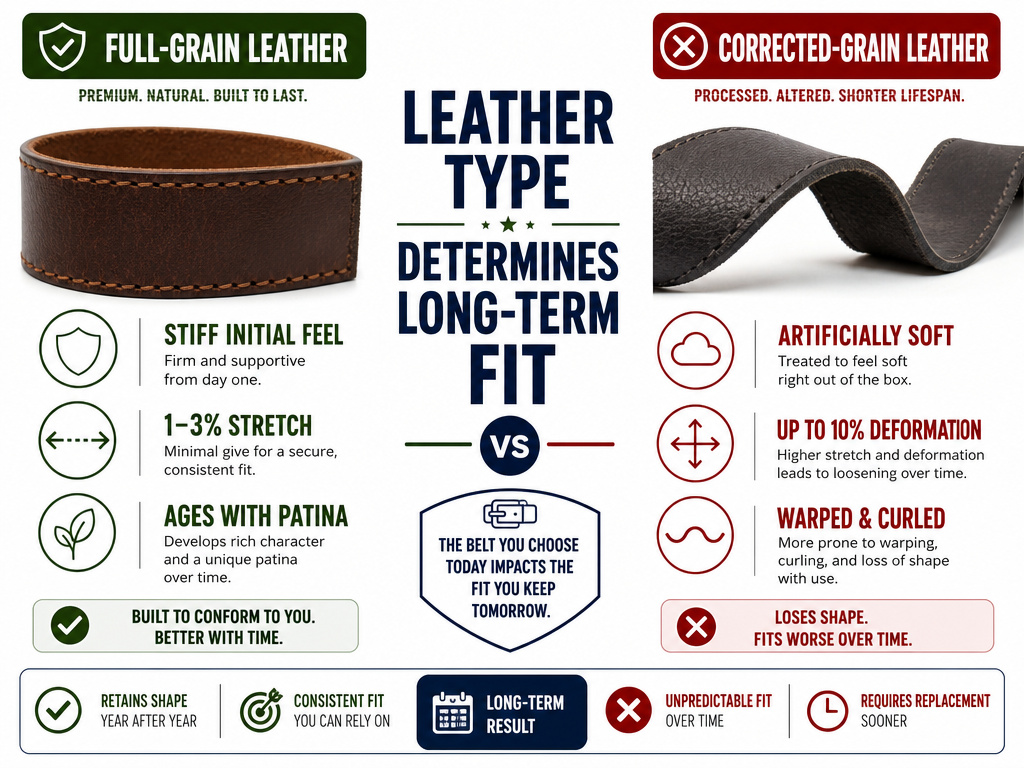 You’re not just sizing for today. You’re sizing for the belt the leather will become.
Full-Grain, Vegetable-Tanned Leather: This is the gold standard. It’s stiff at first but will mold to your body with wear. Expect a minor, permanent stretch of maybe 1-3% over its lifetime. It ages beautifully, developing a patina. When you look at reviews for the best quality leather belts, this is the material they’re using.
Corrected-Grain or Bonded Leather: These are sanded and layered with artificial coatings. They stretch much less initially but then undergo plastic deformation, they stretch where stressed and don’t spring back. The holes tear, the edges curl. They have a short, uncomfortable life.
The feel is different, too. A stiff, high-quality belt might require specific practical belt softening techniques early on. A cheap belt feels artificially soft from day one, which is a warning sign, not a feature.
| Leather Type | Initial Feel | Long-Term Stretch | Result After 2 Years |
|---|---|---|---|
| Full-Grain Veg-Tan | Stiff, firm | 1-3% (molds to body) | Conformed, patina’d, stable |
| Corrected-Grain | Soft, uniform | Up to 10% (deforms) | Warped, stretched holes, curled edges |
How to Choose the Right Size When Shopping Online shopping adds a layer of risk. Mitigate it by becoming a detective.
- Find the brand’s real size chart. Do they list “buckle to middle hole” or just “total length”? Reputable makers like Orion Leather Company or Hanks Belts provide clear, anatomical charts.
- Read the return policy. Even with perfect measuring, fit can be subjective. Know your exit strategy.
- Check for width. A 1.5-inch work belt won’t fit your suit trousers, no matter how perfectly it’s sized.
- Consider the buckle. A massive buckle changes the belt’s balance and where it sits. Visualize it.
When examining different types of leather belts, note that a dress belt and a work belt from the same brand in the same “size” might have different total lengths due to buckle design. The usable length should be the same.
Frequently Asked Questions
What if my belt size falls between two holes?
This is why hole spacing matters. On a standard belt with 1-inch spacing, you’re forced to choose slightly tight or slightly loose. This is the strongest argument for seeking out belts with seven holes at 3/4-inch spacing, or for investing in a ratchet buckle system that offers micro-adjustments. It’s also a common reason people learn to punch a hole in a belt.
How much stretch should I account for?
For a quality full-grain belt, account for almost none in your initial sizing. Buy it to fit perfectly on your favorite hole today. The slight molding that occurs will only improve the fit. If you buy it loose hoping it will stretch, you’ll be disappointed. The break-in process for a stiff belt is about flexibility, not significant length gain.
Can I use a leather conditioner to soften a tight belt?
Yes, but carefully. Conditioner can slightly relax the fibers. The goal is to make it more pliable, not to permanently stretch it. Apply a thin coat, let it absorb fully, and wear the belt. For a stiff belt, proper wear is the best softener. Our guide on how to soften a leather belt covers the safe methods.
How do I care for a belt to maintain its size?
Proper care prevents abnormal stretching and drying that can lead to cracking. Keep it away from extreme heat and moisture. Condition it once a year with a product like Obenauf’s to keep the fibers supple. A well-maintained belt holds its size for decades. The steps for this are outlined in our resource on how to care for a leather belt.
My old belt is stretched out. Can I still measure it?
You can, but you must identify the original favorite hole, the one that shows the least wear and tear, likely in the middle of the row. Measure to that hole, not to the stretched-out one you currently use. This gives you the correct starting size for a replacement that won’t repeat the problem.
Before You Go
Sizing a leather belt isn’t about adding a magic number to your jeans tag. It’s a simple, mechanical process of measuring from a fixed point (the buckle fold) to a functional point (your favorite hole). That’s the entire secret.
Invest the five minutes to measure a belt you already love. That number is your key. If you’re starting from scratch, measure your body through your belt loops and add the two inches. Then, invest in full-grain leather. It’s the difference between a belt that fits perfectly for a season and one that fits perfectly for a lifetime, aging alongside you. The right size is the foundation of that lifetime. Everything else, the patina, the comfort, the durability, builds from there.
