
Compare Leather Dye vs Paint: Which Lasts and Which Peels?
This post contains affiliate links. As an Amazon Associate, we earn from qualifying purchases.
Leather dye soaks color into the fibers; leather paint lays a colored film on the surface. A dye works by penetration (alcohol or oil carrier), while a paint works by adhesion (water-based acrylic or polyurethane binder). The dye ages with the leather; the paint can crack and peel.
That penetration-versus-coating divide decides everything: which leather it works on, how it fails, how long it lasts, and what your finished piece feels like. Most arguments over “best” evaporate when you match the tool to the material.
Here’s a straightforward guide to both, stripped of marketing. I’ll cover the chemistry that matters, the specific products that deliver, and when to use one, the other, or neither.
Key Takeaways
- Dye penetrates, paint coats. Dye changes fiber color; paint adds a flexible colored film.
- Match the base to the leather. Veg-tan and aniline leathers absorb penetrating dye. Chrome-tan and finished leathers need paint.
- Alcohol-based dyes dry fast and deep but can be harsh. Water-based paints are softer and more beginner-friendly.
- Paint fails by cracking; dye fails by fading. A thick paint coat cracks on a flexing piece. Dye fades with UV exposure over years.
- Always seal a dye. An unsealed alcohol-based dye will bleed onto clothes. Paint often has built-in protection.
The Core Mechanical Difference: Penetration vs. Coating
What happens at the molecular level tells you how each will age.
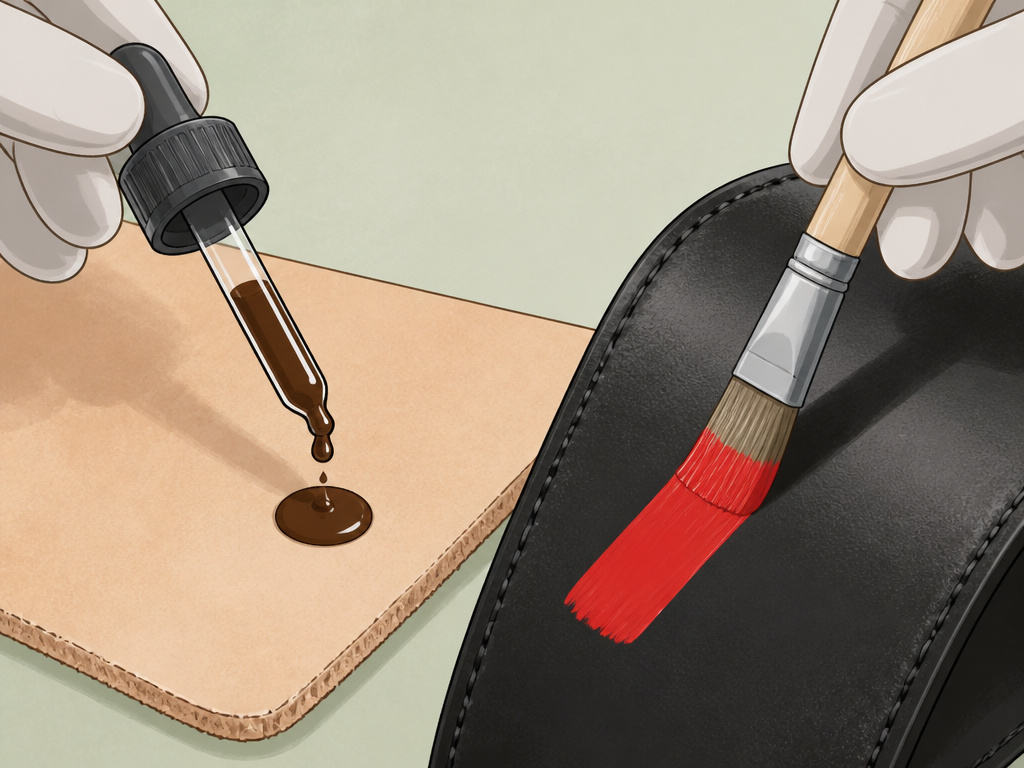
Leather dye is a solute, color dissolved in a carrier solvent (alcohol, oil, water) designed to be absorbed. Leather paint is a suspension, pigment particles held in a binder (acrylic, polyurethane) designed to form a film.
Pour dye on a dry sponge and it disappears inside. That’s penetration. Smear paint on that same sponge and it sits on top, filling the pores. That’s coating.
A dye’s job is to wick into the leather’s collagen network and stain it. An alcohol carrier evaporates in minutes, leaving the pigment behind deep in the fiber. The color becomes part of the leather. Scratch it, and you see more of the same color underneath, the piece is colored all the way through.
A paint’s job is to stick. A water-based acrylic binder flows into the leather’s surface texture, then dries into a flexible, colored skin. It bridges over the top. Scratch it hard, and you might reveal a different color beneath, the leather’s original shade or a primer layer.
The feel changes accordingly. A well-dyed and sealed veg-tan panel stays supple; you feel the leather’s grain. A painted piece, no matter how flexible the formula, adds a slight tackiness or a coated hand. It’s subtle, but it’s there.
This is based on years of practical experience. I used to believe a “dye” was just a thinner paint. Then I watched a Fiebing’s Pro Dye bottle soak into a belt blank in seconds, while an Angelus acrylic pooled on the surface until I brushed it out. One vanished; the other stayed. That visual lesson, the dye disappearing, the paint sitting, is the whole difference.
When You Must Use Dye (and When You Must Not)
Penetrating dye is the only choice for projects where the leather itself needs to become the color. Think of a natural veg-tan wallet you want to be chestnut brown, or a saddle you’re coloring from scratch. The dye soaks in, and subsequent oiling, conditioning, and burnishing work with that embedded color.
The Three Dye Carriers and Their Personalities
| Carrier Type | Best For | Drying Time / Feel | Biggest Watch-Out |
|---|---|---|---|
| Alcohol-Based (Fiebing’s Leather Dye) | Edge dyeing, fast work, deep saturation on veg-tan. | Dries in 1-2 minutes. Can dry out leather if over-applied. | High fumes, requires immediate top-coating to prevent rub-off. |
| Oil-Based (Fiebing’s Pro Dye) | Large veg-tan panels, belts, sheaths. Most even finish. | Dries in 10-15 minutes. Leaves leather supple. | Longer dry time means more chance for drips or pooling if you’re not careful. |
| Water-Based (LeTech Leather Aniline Dye) | Low-odor projects, suede/nubuck, color restoration. | Dries in 5-10 minutes. Minimal odor. | Can raise the grain on some leathers, creating a slightly fuzzy surface. |
A water-based dye like LeTech Leather Aniline Dye is the gentle option. It’s designed for color restoration on absorbent leathers like suede, where you need penetration without harsh chemicals. The trade-off is that it doesn’t bite as aggressively into tight-grained veg-tan as an alcohol-based dye does.
The rule of thumb is simple: use dye on any leather that is unfinished and absorbent. That means: – Vegetable-tanned leather – Aniline leather (full-grain, no topcoat) – Suede and nubuck – Pull-up leather
Where this goes sideways: Using dye on chrome-tanned or finished leather. The surface is sealed. The dye will bead up, streak, and wipe off, leaving a blotchy, sticky mess. That mistake wastes a bottle and ruins the piece.
Here’s the practical takeaway. For your first dye project, pick an oil-based dye for a veg-tan key fob or cardholder. The longer open time lets you fix mistakes, and the result will be even and professional. Alcohol-based is for speed when you know your technique; water-based is for delicate materials.
When Paint Is the Only Answer
Paint exists for the leathers dye cannot touch. If the surface is sealed, painted, corrected-grain, or plastic-coated, your only path to a new color is to coat it.
Paint Formulations: From Furniture to Footwear
| Paint Type / Product | Designed For | Key Property | Not For |
|---|---|---|---|
| Acrylic Leather Paint (Angelus) | Shoes, accessories, chrome-tan. Opaque color. | Flexible, water-based. Dries to a painted finish. | Large, highly flexing areas like sofa seats (may crack). |
| Polyurethane Colourant (LeTech Leather Colourant) | Automotive interiors, furniture, bags. High abrasion resistance. | Water-based polyurethane. Excellent elasticity. | Suede or nubuck (will clog the nap). |
| Elastomeric Coating (ColorBond LVP) | Automotive, vinyl, plastic. OEM color matching. | “Molecular bond,” dries in 45 seconds. Aerosol or liquid. | Projects requiring a totally natural leather feel. |
Acrylic paint, like Angelus Leather Paint, is the default for footwear and small accessories. It’s opaque. You can paint white over black. It bonds to the slick surface of a patent leather shoe or a vinyl jacket.
A product like ColorBond LVP takes it a step further for automotive interiors. Its claim is a molecular bond that dries incredibly fast and flexes without cracking. It’s a specific solution for a specific problem: recoloring a car seat without replacing it.
Common mistake: Applying paint too thick. The Mipa WBC 2K-Lederlack technical sheet states it plainly: “Too high a paint film thickness leads to brittleness of the leather surfaces and increases the risk of adhesion problems.” Two thin coats always beat one globby one.
Paint is also the tool for total transformation. Changing a black couch to cream? That’s a leather recolor job for a heavy-duty polyurethane colourant, not a dye. The existing finish must be sealed and topped with a protective coat.
So, use paint when: – The leather is chrome-tanned or has a factory finish. – You need opaque coverage (light over dark). – You’re working on vinyl or plastic as well. – The item is a car interior, furniture, or something that needs color matching.
Which Leather Type Gets Which Treatment?
Your leather’s tanning and finish lock in your choice before you open a bottle.
Decision Matrix: Dye or Paint?
| Your Leather Is… | Use… | Why? | Example Project |
|---|---|---|---|
| Natural Vegetable-Tanned | Oil-based or alcohol-based dye. | Unfinished, highly absorbent. Takes dye deep and evenly. | Tooling a belt, making a wallet. |
| Aniline or Semi-Aniline | Water-based aniline dye or thin acrylic paint. | Some surface penetration possible, but may have light finish. | Restoring a faded leather jacket. |
| Chrome-Tanned or Finished | Acrylic leather paint or polyurethane colourant. | Surface is sealed; dye cannot penetrate. | Painting sneakers, recoloring a handbag. |
| Suede or Nubuck | Water-based aniline dye ONLY. | Nap must remain raised; paint would mat it down. | Refreshing faded suede shoes. |
| Bonded or Faux Leather | Acrylic or specialty vinyl paint. | No natural fibers to penetrate; needs surface adhesion. | Changing the color of a faux leather chair. |
Let me share what I’ve learned about veg-tan. I used to think it was all stiff and for tooling. A surprisingly supple veg-tan belt blank changed my mind. That same blank took a dye beautifully and evenly, because the tannage was open and absorbent. A stiff, waxy-finished belt blank might have resisted. The lesson: even within “veg-tan,” the finish affects absorbency. Test a scrap first.
For dyeing furniture, the calculus shifts. A large, stationary piece like a couch back can sometimes accept a dye if it’s aniline. But most modern furniture is protected with a pigmented topcoat. That means paint. The process involves cleaning, prepping, and applying a flexible paint for sofas designed for high flex areas.
Head-to-Head: Durability, Aging, and Failure
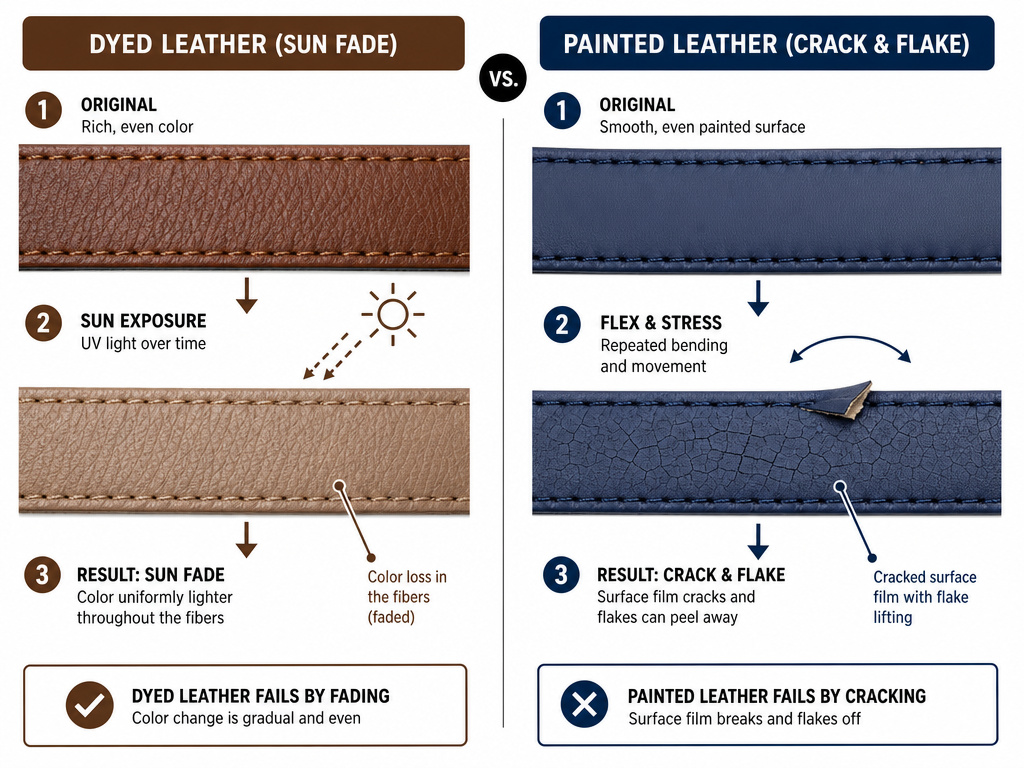
How do they hold up? Dye and paint fail in opposite ways.
A dye’s color is locked inside the fibers. It can’t chip or peel. It can, however, fade with prolonged UV exposure. The failure is gradual lightening. A topcoat with UV inhibitors (like an acrylic resolene) slows this down dramatically.
A paint’s color is in the surface film. It can’t fade the same way, but it can crack if the film becomes too brittle or thick for the leather’s flex. The failure is physical delamination, cracks, flakes, chips. A high-quality paint like LeTech’s boasts 100,000 flex cycles, but that assumes correct, thin application.
A study in the Journal of the American Leather Chemists Association (JALCA) examined dye stability, noting that certain sulfur dyes exhibited poor resistance to acid and perspiration. This kind of peer-reviewed leather coloring research article gives us the why behind fading, it’s not just sunlight, but pH and chemistry.
The feel over time diverges too. A dyed piece, properly sealed, continues to patina. Oils and handling darken the embedded color uniformly. A painted piece maintains its applied color; the patina is on the paint film itself, which might develop a slight sheen in high-wear spots.
For restoring faded leather, your first question is: is the color faded, or is the coating worn? If the leather itself looks lighter, a dye may revive it. If the surface is scratched through to a different color, you need a color restorer that’s essentially a pigmented coating.
The Step-by-Step Reality Check
The processes are different, and each has a make-or-break step people skip.
For Dye (Oil-Based on Veg-Tan):
- Degrease and sand. Any oil or finish blocks penetration. Lightly sand with 400-grit to open pores.
- Apply thin, even coats with a wool dauper. Let each dry 10 minutes. Two coats are better than one thick one.
- Let it dry fully. Overnight is safe. The surface will look dry, but the core may still be wet.
- **Seal it.This is essential. Use an acrylic finisher like Fiebing’s Resolene. Unsealed dye bleeds forever.
- Condition. After the sealer dries, apply a light conditioner to replace lost oils.
For Paint (Acrylic on Chrome-Tan):
- Clean and deglaze. Use alcohol or a dedicated leather prep to strip any wax or silicone.
- Prime if needed. On slick surfaces, a light adhesion promoter helps.
- Apply multiple thin coats. Use a soft brush or airbrush. Dry between coats with a hair dryer on low.
- Heat set. Once fully dry, a careful pass with a heat gun can improve adhesion and durability.
- Topcoat. A flexible acrylic finisher protects the paint from scuffs and adds a consistent sheen.
The part nobody mentions? Dry time is environmental. A “10-minute dry time” assumes 70°F and 50% humidity. In a damp basement, double it. Rushing a second coat is the fastest way to a gummy, wrinkled finish in either process.
So, Which One Should You Buy?
It’s not a debate. It’s a diagnosis.
For 90% of hobbyists starting out: Get a bottle of Fiebing’s Pro Dye (oil-based) in brown or black and a small bottle of Angelus Leather Paint in white. This covers dyeing natural veg-tan projects and painting/patching mistakes on finished items. Add a can of acrylic finisher.
If you’re restoring a specific item: Match the material. For a faded aniline leather couch, a penetrating best dye like a water-based aniline dye is the first test. For a scuffed car seat, a dedicated paint for shoes or automotive colourant is the only path.
The leather will tell you what it needs. A drop of water absorbs instantly? Think dye. A drop of water beads on the surface? Think paint. All the marketing copy in the world can’t override that simple test.
Frequently Asked Questions
Can I mix dye and paint?
You can layer them, but in one direction only: dye first, then paint on top. Painting creates a sealed surface; dye cannot penetrate it afterwards. A common technique is to dye a base color, then paint decorative details on top.
Which lasts longer, dye or paint?
Properly applied and sealed, a dye job often outlasts a paint job because it isn’t a separate layer subject to mechanical failure. However, a high-quality paint system on a stable surface (like a car dashboard) can last for many years without issue.
Is leather paint waterproof?
Most quality leather paints are water-resistant once fully cured (24-48 hours) and topped with a protective sealant. They are not typically waterproof submersible, but will resist spills and rain. Dye alone is not water-resistant; it requires a sealer.
Can I use fabric dye on leather?
No. Fabric dye is formulated for cellulose or protein fibers (cotton, wool). It will not bond properly to leather’s collagen structure and will result in poor, blotchy color with terrible rub-off.
Why did my dye come out streaky?
Streaking on veg-tan is almost always due to uneven surface preparation (oil or dirt blocking absorption) or applying too much dye at once, causing pooling. The fix is to degrease thoroughly and apply multiple whisper-thin coats with a dauber.
The Bottom Line
Forget “vs.” Think “for.” Dye is for coloring leather from the inside. Paint is for coating leather from the outside.
If your goal is a natural-looking piece that ages with depth and character, you’re in dye territory. Your prep must be flawless, and you must commit to the sealing step. If your goal is to change a color completely, cover imperfections, or work on a non-absorbent material, paint is your tool. Your success hinges on thin, even layers.
One final, contrarian stance: most people reach for paint because it seems easier. It’s not. The margin for error is thinner, literally. A bad dye job can often be sanded out and redone. A bad paint job that’s cracked or peeled means stripping everything back to raw leather. Start with dye on a small veg-tan project. Master that penetration logic. Then, and only then, open a can of paint.
