
Understanding Full Grain vs Genuine Leather & Label Truths
This post contains affiliate links. As an Amazon Associate, we earn from qualifying purchases.
Full grain leather comes from the outermost, tightest layer of a hide and retains its natural surface, offering the highest durability and ability to develop a patina. Genuine leather is made from the fibrous lower split of the hide, which is coated and embossed to mimic a grain surface; it is the lowest grade that can legally be called leather, known for cracking and delamination within 1-3 years.
The difference is the practical gap between a material that ages with you and one that ages on you. That distinction turns on a single, often-misunderstood event: the splitting of the hide.
This is based on years of practical experience. I’ll break down the details for you, cut through the marketing fog, and show you exactly what to look for, and what to avoid, when your money is on the line.
Key Takeaways
- “Genuine leather” is a legal minimum, not a quality endorsement. It only confirms animal hide is present, not which part or how it’s processed.
- Full-grain’s edge won’t fuzz. Examine the cut edge of a strap or gusset; a tight, consistent cross-section signals the dense fiber structure of the top hide layer.
- Delamination is the telltale failure. A coated split (genuine) leather will show its plastic-like coating peeling away from the fuzzy base within 6-18 months of regular flexing.
- Price is a material signal, not a vanity. The raw material cost and waste from cutting around natural flaws in full-grain hides dictate a higher price floor; a $50 “full-grain” bag is a fantasy.
- Your nose knows. High-quality leather smells organic, like warm earth or a tannery. A chemical or plasticky scent is the signature of heavy coatings on lower-grade splits.
Full Grain, Top Grain, Genuine. What Do They Actually Mean?
Let’s be clear about one thing: these terms describe where the leather comes from in the hide’s vertical stack. Think of a cowhide as a layered cake. The tannery runs it through a band-knife splitter, slicing it horizontally.
Full-grain leather is the untouched top slice. It includes the dense, tight fiber structure of the grain layer and all its natural markings, every scar, insect bite, and wrinkle from the animal’s life remains visible. Top-grain leather comes from that same top slice, but the surface has been lightly sanded or buffed to remove those natural imperfections, then refinished. Genuine leather, in the trade sense, comes from a lower slice, the loose, fibrous split layer that remains after the top grain is removed.
This isn’t opinion; it’s anatomy. The confusion arises because “genuine leather” is also the broadest legal term for anything containing animal hide. Under the FTC’s leather labeling guides, the term sets a floor, not a ceiling. A manufacturer can legally label a heavily processed split leather as “genuine leather” without specifying its inferior origin. That’s the linguistic sleight of hand.
Here’s the practical takeaway: when you see “genuine leather,” you must ask, “Genuine what?” Is it genuine full-grain, genuine top-grain, or, most commonly, genuine split? The label alone won’t tell you. The burden of proof shifts to you.
| Leather Grade | Source Layer | Surface Treatment | Core Characteristic |
|---|---|---|---|
| Full-Grain | Outermost grain layer | None; natural grain intact | Highest durability, develops patina |
| Top-Grain | Outermost grain layer | Sanded/buffed, then refinished | Uniform appearance, good durability |
| Genuine (Split) | Lower split layer | Coated & embossed to mimic grain | Lowest durability, prone to delamination |
The Anatomy of Deception: How Split Leather Becomes ‘Genuine’
So what happens to that lower split layer? It has no natural grain pattern, just a fuzzy, open fiber network. To make it salable, manufacturers do three things: sand it flat, apply a thick polyurethane or acrylic coating, and then emboss that coating with an artificial grain pattern. The result looks uniform and clean.
The problem is structural. The coating is the wearing surface. The loose split fibers underneath provide almost no support. When you flex the material, like the fold of a wallet or the bend of a bag strap, the rigid coating cracks. Once it cracks, moisture gets in, the coating starts to peel away from the fuzzy base, and you get delamination. This is the predictable outcome.
Where this goes sideways: Buying a “genuine leather” bag for daily use. The coating cracks at stress points within the first year, and full delamination, the coating peeling off in sheets, usually follows within 6 to 18 months. The bag isn’t repairable; it’s trash.
I abandoned using certain materials because of waste and poor results. That lesson applies here. Using a product destined to fail is the most expensive choice of all. For daily carry, you want the durability and character of full-grain leather, not the scheduled breakdown of coated split.
How to Spot Full-Grain vs. Genuine Leather: A Field Guide
You can’t trust the stamp. You have to read the leather itself. Here’s a straightforward guide to what your senses can tell you.
Look at the edges. This is the single fastest test. Find a cut edge, like the side of a strap or the inside of a gusset. – Full-Grain: The edge looks solid, compact, and slightly polished. You might see a tight, consistent fibrous texture, but it won’t be fluffy. – Genuine (Coated Split): The edge often looks fuzzy, layered, or has a painted-over look. Manufacturers sometimes paint the edge black or brown to hide this, so look for a color that doesn’t match the surface or a suspiciously perfect, sealed line.
Feel the surface and the temper.
- Full-Grain: The surface has a variable, organic texture. You’ll feel subtle pores, wrinkles, and a slight give. The leather has a supportive stiffness (its temper) but remains pliable.
- Genuine (Coated Split): The surface feels uniformly smooth, often slick or plasticky. Bend it; it may feel stiff and cardboard-like, or oddly limp, because the coating and the weak base layer are fighting each other.
Do the pinch test. Gently pinch a non-visible area (like an inside flap). – Full-Grain: The leather will compress slightly and spring back, showing a temporary crease that slowly relaxes, demonstrating fiber resilience. – Genuine (Coated Split): The coating may resist creasing, or the material may fold stiffly. You might even hear a faint crackling sound from the coating.
Understanding these physical signs helps you identify full-grain leather on sight and touch, moving you past the label.
The Performance Gap: Durability, Patina, and Care

Let’s talk about what happens over time. This is where the choice between full grain and genuine leather stops being about cost and starts being about ownership.
Durability Lifespan
A full-grain leather belt or bag, with basic care, can last 15 years or more. The tight grain-layer fibers resist tearing and abrasion. A genuine leather item made from coated split has a functional lifespan of 1-3 years with daily use. The coating fails, and the weak split layer underneath offers no second line of defense. This is why understanding the pros and cons of genuine leather is crucial, its main “pro” (low upfront cost) is quickly negated by its primary “con” (short service life).
The Patina Conversation
Patina is the holy grail for leather enthusiasts, the rich, dark, personal sheen that develops from oils, sunlight, and handling. Full-grain leather is built for this. Its open pores absorb oils and react to the environment. The leather tells the story of its use.
Genuine leather, with its sealed plastic coating, cannot develop a patina. The coating determines the color and sheen permanently. When it scuffs, you see the lighter color of the coating itself or the fuzzy layer beneath, not a deepening of tone. It doesn’t age; it degrades.
Care Regimens Diverge
- Caring for Full-Grain: Less is more. Occasional cleaning with a damp cloth and feeding with a light, natural oil or conditioner (like pure neatsfoot or a simple beeswax blend) every 6-12 months is plenty. The leather breathes.
- “Caring” for Genuine (Coated Split): You’re maintaining the coating. Harsh chemicals or abrasive cleaners will strip it faster. Many conditioners can’t penetrate the plastic layer and just sit on top, creating a greasy film. Often, the best advice is to avoid getting it dirty in the first place.
Full Grain vs. Genuine Leather: Which Should You Choose?
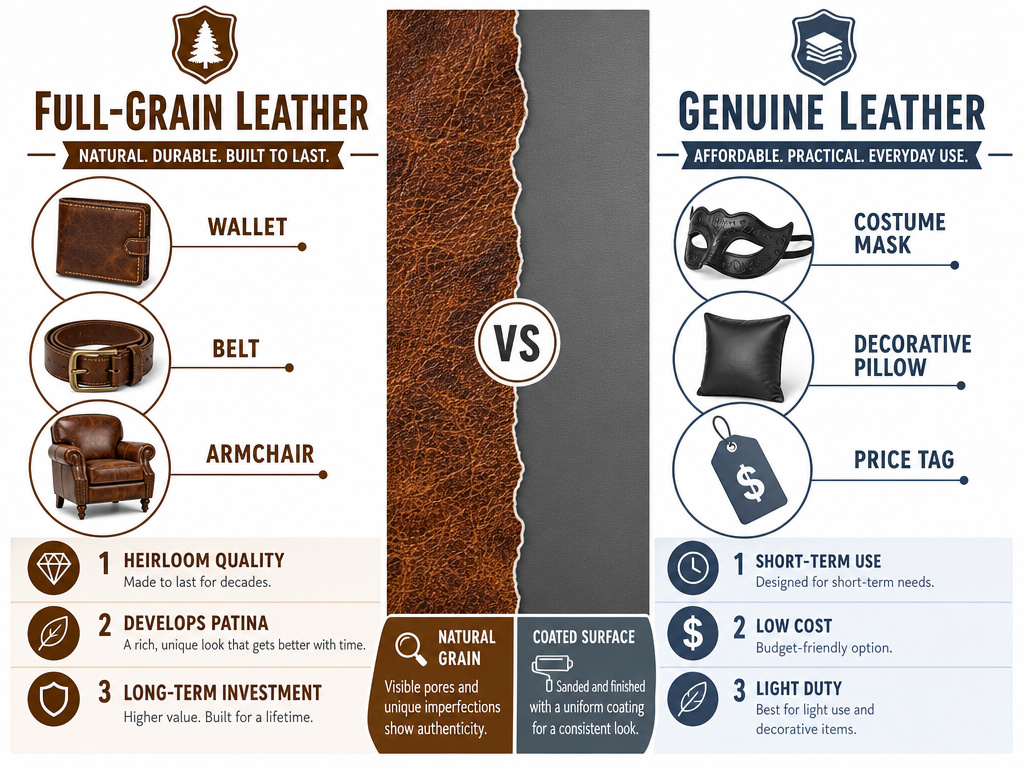
It’s not that genuine leather is always bad. It’s that it serves a specific, temporary purpose. Here’s the breakdown of when each material makes sense.
Choose Full-Grain Leather When:
- You’re buying a heirloom item, a briefcase, a wallet, a good belt, furniture you’ll keep for decades.
- You value authenticity and character over uniform perfection.
- You want the item to look better with age, developing a personal patina.
- Your budget allows for the true cost of longevity. You’re investing, not spending.
Choose Genuine (Coated Split) Leather When:
- You need a disposable or short-term item for a specific event, costume, or temporary use.
- Low initial cost is the absolute primary driver, and you accept the item will not last.
- The item will see very infrequent, light use (e.g., a decorative pillow on a guest bed).
- You are exploring a style and aren’t ready to commit financially to the real thing.
For the vast majority of needs between these extremes, like a durable everyday bag or a stylish jacket, the real conversation is between full-grain and top-grain leather. Top-grain offers a excellent balance of durability, a more uniform look, and a lower price point than full-grain, without venturing into the risky territory of split leather.
Corrected Grain and Split: The Other Players
The conversation often overlooks two other key terms that complete the picture: corrected grain and split leather.
Corrected Grain Leather is essentially a top-grain leather that has been sanded more aggressively to remove significant surface defects, then re-embossed with a consistent grain pattern. It’s durable because it’s still from the top layer, but it sacrifices all natural character for uniformity. It’s a workhorse material for mass-market goods where a “leather look” is required. If you’ve ever wondered what corrected grain leather is, it’s this, the ultimate compromise between performance and cosmetic control.
Split Leather is the base material for so-called “genuine leather.” As we’ve discussed, it’s the lower layer. When its surface is sanded, coated, and embossed, it’s called a coated split. When its fuzzy surface is raised by napping, it becomes suede. Understanding the characteristics of split leather is key because it explains why suede is delicate and why coated splits fail. It’s all about the lack of that dense, protective grain layer.
These materials have their place, but that place is rarely in a product marketed for durability or legacy.
The Bottom Line
Ignore the marketing copy. The label “genuine leather” asks you to trust. The material asks you to look.
Before you buy, perform the edge test. Assess the temper. Consider how it looks today and what it will do in two years when the coating on that bargain bag starts to spiderweb with cracks. That moment isn’t a defect; it’s the material behaving exactly as its anatomy dictates.
Invest in full-grain for the things that matter, the items you carry, sit on, and use daily. For everything else, understand you’re buying a temporary commodity, not a lasting good. The leather will tell you what it needs; your job is to listen from the start.
Frequently Asked Questions
Is genuine leather real leather?
Yes, genuine leather is made from real animal hide. However, the term refers to the lowest grade of leather, typically made from the split layer (the lower, fibrous part of the hide). It is heavily processed, coated, and embossed to mimic the look of higher-grade leathers, but it lacks their durability and natural characteristics.
Does full-grain leather scratch?
Yes, full-grain leather can show scuffs and scratches. This is part of its character. The tight grain-layer fibers prevent these from becoming deep, damaging gouges. Over time, these minor marks blend into the patina, adding to the leather’s unique story. A light application of conditioner can often minimize the appearance of fresh scratches.
Which is better, genuine leather or PU leather?
This compares two different material categories. PU (polyurethane) leather is a plastic-coated fabric with no animal hide. Genuine leather contains hide, but it’s a low-grade split. PU leather often has more consistent coloring and may resist initial staining better, but both materials suffer from coating failure and delamination. For longevity, a good full-grain or top-grain leather is superior to both. The differences between PU and genuine leather are largely in feel and initial perception, not long-term performance.
Can you repair genuine leather?
Repairing genuine leather, especially coated split, is extremely difficult. Once the coating cracks and peels, the structural integrity of the fuzzy base layer is compromised. You cannot simply re-coat it. Professional repairs are often more expensive than replacing the item. Full-grain leather, in contrast, can be sanded, re-dyed, and refinished by a skilled craftsperson, often extending its life for decades.
How can I tell if my furniture is full-grain leather?
Use the edge test first. Look at the back of a cushion or an unexposed seam for an unfinished edge. A tight, fibrous edge suggests top-layer leather. Then, feel the surface. Full-grain will have natural, inconsistent pores and texture. Look for a manufacturer’s tag specifying “full-grain,” “top-grain,” or “corrected grain.” Be wary of tags that only say “genuine leather” or “made with real leather.”
