
Vegetable Tanned vs Chrome Tanned Leather: Key Differences
This post contains affiliate links. As an Amazon Associate, we earn from qualifying purchases.
Vegetable tanned leather uses natural tannins from tree bark, develops a patina, and is stiff, ideal for tooling and structure. Chrome tanned leather uses chromium salts, remains soft and colorfast, offers better water resistance, and is common in fashion and footwear. The choice hinges on whether you want a piece that ages with you or one that stays consistent.
Let’s be clear about one thing: neither tanning method is inherently “better.” One isn’t a premium upgrade over the other. The chemistry of each process creates leather with fundamentally different properties, making each suited for specific jobs. Choosing between them means deciding what you value more: a stiff, evolving heirloom or a soft, resilient workhorse.
What follows: a breakdown of the chemistry that creates these differences, a side-by-side look at their real-world performance, and a straightforward guide to matching the leather type to the project in your hands. By the end, you’ll understand leather better to make confident choices.
Key Takeaways
- Chrome tanning excels at water and stain resistance and softness from day one, making it the default for shoes, bags, and garments that face the elements.
- Vegetable tanning creates a denser, stiffer leather that develops a personal patina, making it the preferred choice for tooling, molding, and structural items like belts and holsters.
- The common belief that veg-tan is always stronger is a myth; chrome-tanned leather often has higher tensile strength, but veg-tan resists stretching better under load.
- Your maintenance approach differs: veg-tan needs occasional conditioning to stay supple, while quality chrome-tan often requires little more than wiping down.
- For large projects where weight matters, chrome-tanned leather “cuts down on the overall weight and fatigue the user experiences,” as noted in practical guides, making it ideal for bag panels and gussets.
Key Differences at a Glance (with Table)
The core distinction is chemical. Vegetable tanning immerses hides in vats of water infused with tannins from sources like quebracho, chestnut, and mimosa bark. These natural polyphenols bond slowly with the hide’s collagen fibers over weeks. Chrome tanning uses a bath of basic chromium sulfate salts, a much faster process that typically concludes in a day or two.
This speed and chemical difference dictate nearly everything that comes after: the leather’s color, feel, reaction to water, and how it ages. A quick comparison sets the stage.
| Characteristic | Vegetable Tanned Leather | Chrome Tanned Leather |
|---|---|---|
| Primary Agent | Natural tree tannins (e.g., Quebracho, Chestnut) | Chromium (III) sulfate salts |
| Process Duration | Several weeks to months | 24-48 hours |
| Initial Feel | Firm, stiff, obedient | Soft, pliable, supple |
| Aging Behavior | Develops a darkening patina from oils, light, and use | Color remains stable; shows creases but not patina |
| Water Resistance | Low; absorbs water, can stain | High; beads water, resists stains |
| Best For | Tooling, molding, belts, structural components | Shoes, garments, bags, upholstery, anywhere softness is key |
Technical Snippet: Vegetable tanning relies on polyphenolic compounds to cross-link collagen fibrils via hydrogen bonding and hydrophobic interactions, resulting in a dense, hydrophilic structure. Chrome tanning utilizes coordination bonds between chromium cations and collagen carboxyl groups, creating a more flexible, hydrophobic matrix with superior thermal stability.
The leather will tell you what it needs. A veg-tan belt will mold to your waist; a chrome-tan jacket will soften with wear but keep its shape. Ignoring these inherent traits is how projects fail. A veg-tan bag meant for heavy daily carry will feel like a brick, while a chrome-tan belt will stretch like an old sock without proper reinforcement.
The Anatomy of Vegetable Tanned Leather
Six months into using a beautiful veg-tan portfolio, every corner had darkened to a rich honey brown where my hands rested, while the spine remained a lighter tan. That’s patina—not dirt, but the material recording its life.
This evolution is veg-tan’s signature. The process is slow and resource-intensive. Hides move through a series of pits or drums with increasingly concentrated tannin solutions. Tanners might use a specific mix of chestnut and mimosa to target a certain warmth or firmness. The result is a leather that starts anywhere from a pale cream to a light tan, often described as the “crust” stage, ready for further dyeing or finishing.
What It Feels Like & Why It Matters
Pick up a side of veg-tan. It feels substantial, with a firm temper. It has a dry, almost chalky feel before finishing. This stiffness isn’t a flaw; it’s the feature that allows for wet molding and deep tooling. You can soak a piece, stretch it over a form, and as it dries, it hardens into that shape permanently—think of a leather helmet or a contoured knife sheath.
Its dense, predictable structure also makes it a dream to cut and stitch for beginners. It doesn’t flop around under the needle. That’s why I always recommend 3-4 oz vegetable tanned leather for someone’s first stitching practice. The feedback is immediate and honest.
The Patina Paradox: Love It or Leave It
Common mistake: Trying to keep vegetable tanned leather looking “new.” Fighting its natural darkening with aggressive cleaners strips the oils and dries out the fibers, leading to premature cracking.
The patina is the point. As the leather absorbs oils from your hands and encounters light and air, the tannins oxidize. Colors deepen, minor scuffs blend into a overall glow, and the surface develops a sheen that can’t be replicated. This is why the vachetta trim on a classic Louis Vuitton bag is so coveted after years of use. A veg-tan piece is a blank canvas when you buy it. Its story gets written with every use.
The short version: Think of vegetable tanned leather as the raw ingredient. It’s the craftsman’s choice because it accepts tooling, molding, dye, and burnishing. It asks for a bit of care and rewards you with a one-of-a-kind, evolving finish. For a detailed look at its history and craft applications, our guide on vegetable tanned leather covers the essentials.
The Reality of Chrome Tanned Leather
Here’s the practical takeaway: over 80% of the world’s leather is chrome tanned. It’s not a conspiracy to make inferior goods; it’s a brilliant method for creating leather with a specific, highly useful set of properties. The process is fast and efficient. Hides submerged in the chromium sulfate solution emerge with a pale blueish tint, hence the term “wet blue” leather.
This method gives tanners incredible control over softness and drape. The chromium ions form stable complexes with the collagen, resulting in a leather that is highly resistant to heat, mildew, and water from the get-go.
Debunking the Strength Myth
A persistent piece of bad advice claims chrome-tanned leather is weaker. Let’s look at the chemistry of that. While veg-tan is denser and more resistant to stretching under constant tension (why it’s better for belts), chrome-tan often wins in pure tensile strength—the force needed to tear it.
Research, like the comparative wear study from the NIST sole leather wear study, has shown chrome-tanned sole leather can outperform vegetable-tanned in abrasive wear tests. A peer-reviewed analysis in the Leather and Footwear Journal also noted that in wet conditions, chrome-tanned leather can demonstrate higher tensile strength and elongation at break. Its strength is in its flexibility; it absorbs impact and resists scratching because it gives slightly.
The Workhorse of Modern Leather Goods
Your leather jacket, your everyday shoes, the seats in your car—chances are they’re chrome tanned. Why? * Softness: It’s wearable and comfortable immediately, no break-in required. * Water & Stain Resistance: Spills bead up and can be wiped away before they penetrate. This is an essential feature for footwear. * Color Consistency: It accepts dyes evenly and holds them fast. You get vibrant, uniform colors that won’t change dramatically over time. If you want a bright red bag that stays bright red, this is your process. * Lightweight: The fiber structure is less dense, so for a given thickness, chrome-tan is lighter. This is critical for reducing fatigue in a bag or making a comfortable garment.
Where this goes sideways: Using chrome-tanned leather for a load-bearing strap without a non-stretch liner. It will elongate over time, much like a woven belt. For structural parts, it often needs to be paired with or replaced by something firmer.
For anyone making a bag, I often use both. Chrome-tan for the main panels and gussets to save weight, and veg-tan for the handle, strap attachments, and base where rigidity is an asset. This hybrid approach marries the best of both worlds. You can explore other hybrid finishes, like the popular pull up leather, which uses oils and waxes over either tannage to create a dynamic color-shift effect.
What Each Type Is Actually Good For
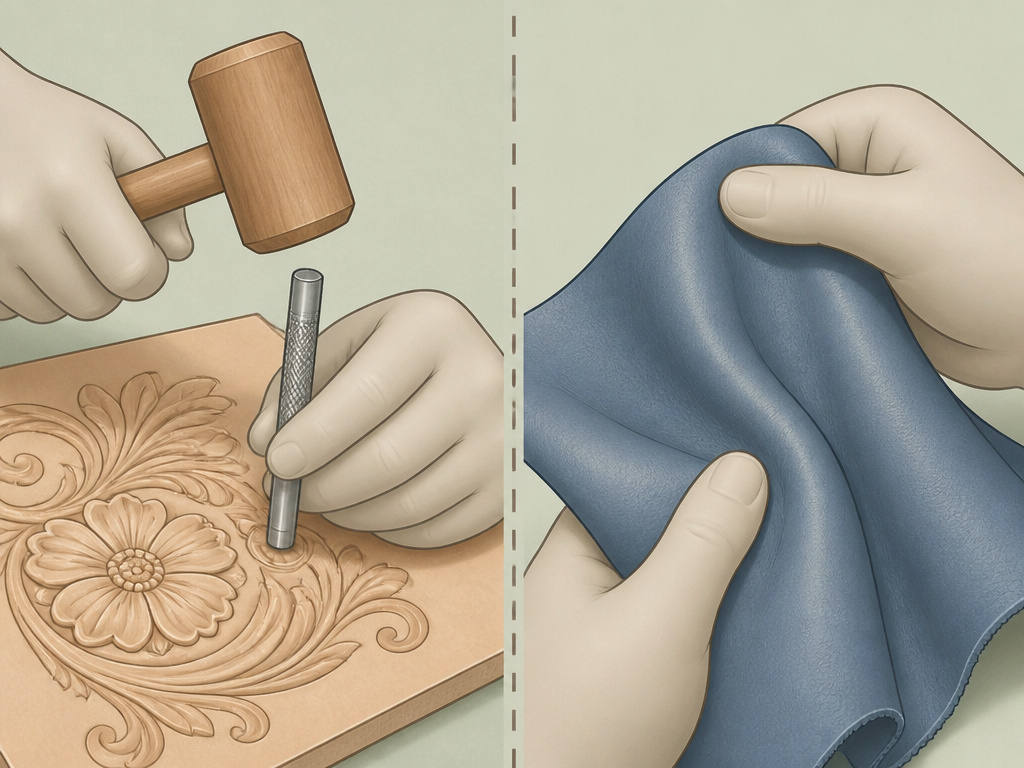
Choosing leather isn’t about picking a winner. It’s about matching material to mission. Think of it like selecting flour: you wouldn’t use cake flour to bake a crusty sourdough. Here’s how the strengths of each tannage translate to real-world projects.
Vegetable Tanning: The Craftsman’s Canvas
- Tooling & Embossing: Its firm, predictable surface holds intricate stamp impressions perfectly. This is the only choice for traditional leather carving.
- Molding & Structural Items: Belts, holsters, sheaths, and saddle components rely on its ability to be wet-formed and its resistance to stretching under load.
- Heirloom Goods & Patina-Driven Items: Wallets, journals, and bags where the aging story is part of the value. Think of a passport cover that darkens with each trip.
- Where Stiffness is a Feature: As reinforcements in bags (handles, bases), for solid leather watch straps, or in any leather tooling project.
Chrome Tanning: The Daily Driver
- Footwear (Uppers & Linings): Its water resistance, softness, and consistent dyeing are essential. Studies comparing leather for shoe uppers confirm chrome-tan meets all critical hygienic and durability parameters.
- Garments & Gloves: Jackets, pants, and gloves need drape, softness, and flexibility that veg-tan simply cannot provide without extensive (and often less durable) softening processes.
- Upholstery & Automotive Interiors: Needs to withstand sunlight, friction, and varying humidity without becoming brittle or staining.
- Fashion Accessories & Lightweight Bags: Where color fidelity, a soft hand, and minimal weight are priorities over developing a patina.
The Combination Tanning Option
Many high-quality leathers you encounter are retanned. A common method is to chrome-tan first for stability and speed, then vegetable-retan for surface character, firmness, and aniline dye absorption. This “best of both” approach is underrated. It yields leather with excellent durability, a rich finish, and better molding qualities than pure chrome-tan, often used in fine shoes and bags.
Caring for Each Type: A Practical Guide
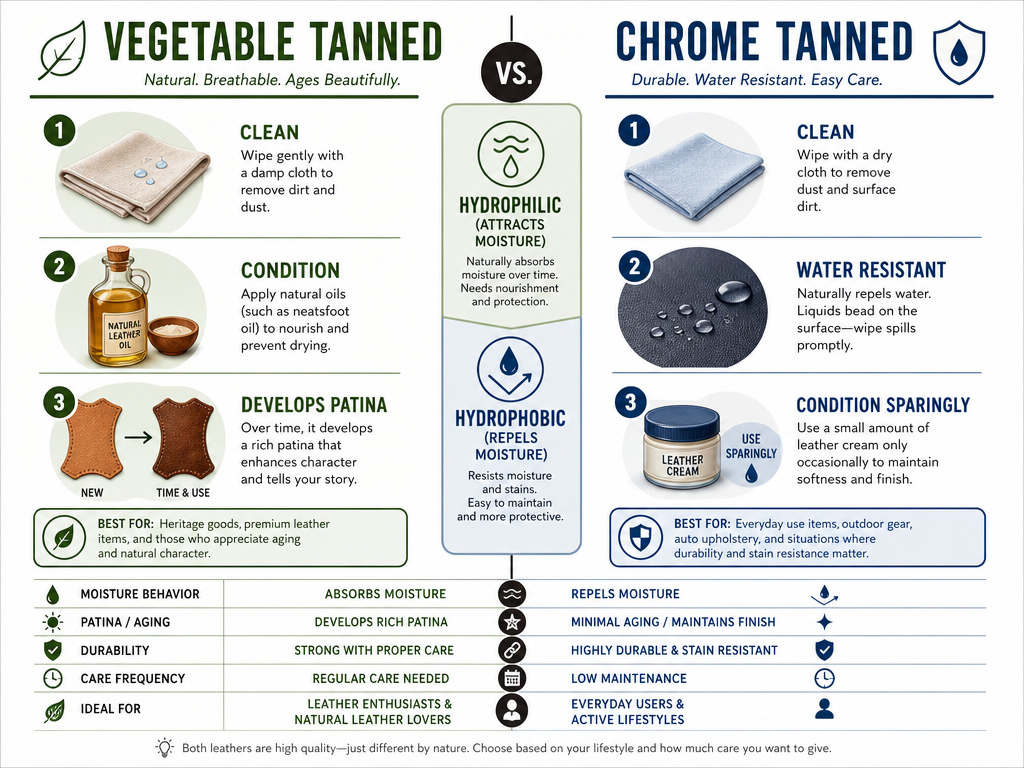 Maintenance diverges because the materials are different at a molecular level. Using the wrong product is like using a firehose to water a bonsai tree.
For Vegetable Tanned Leather:
It’s hydrophilic—it attracts moisture. This includes both water and nourishing oils. Your goal is to replace the natural oils that evaporate over time. 1. Clean with a barely damp cloth. Avoid saddle soap for anything other than heavy work gear; it’s too drying. 2. Condition sparingly every 6-12 months with a natural oil or cream (like pure neatsfoot oil or a simple leather balm). Apply a tiny amount, let it absorb overnight, and buff. 3. Accept the patina. Scuffs and darkening are features, not bugs.
For Chrome Tanned Leather:
It’s hydrophobic—it repels moisture. Conditioning is rarely about adding oil, more about cleaning and protecting the surface. 1. Wipe down regularly with a dry cloth to remove dust and salt. 2. For spills, a slightly damp cloth is usually sufficient. Its stain resistance is a built-in feature. 3. Condition only if it looks dry or stiff, which may be years apart. Use a light, silicone-free leather cream. Most commercial conditioners are overkill for chrome-tan and can leave a greasy residue.
Easy to miss: The biggest enemy of veg-tan is prolonged moisture, which can cause stains and stiffness. The biggest enemy of chrome-tan is harsh chemical cleaners, which can strip its protective topcoat.
Frequently Asked Questions
Does vegetable tanned leather last longer?
It can last generations with proper care, but “longevity” depends on the use. For soles against asphalt, a chrome-tanned leather alternatives research shows it can be more durable. For a belt or wallet, veg-tan’s stretch resistance gives it a longevity edge. It’s more accurate to say each type lasts a very long time when used for its intended purpose.
Can you tell the difference by looking?
Often, yes. Fresh veg-tan is typically a uniform pale tan or brown with a more matte, porous look. Chrome-tan comes in every color imaginable, often with a more uniform, slightly plastic-like or waxy surface sheen. The boiling water test (a small scrap curls in boiling water if it’s veg-tan) is a definitive but destructive method.
Is chrome tanned leather safe?
The finished product is safe. Modern regulations strictly control the process. The chromium used is trivalent chromium (Cr-III), a stable, essential nutrient. The environmental and health concerns, well-documented in publications like the Collagen and Leather journal article, are primarily about industrial wastewater from poorly regulated tanneries and the rare potential for allergic contact dermatitis, not about handling the final leather good.
Which is more environmentally friendly?
This is complex. Vegetable tanning uses renewable plant materials but is water and time-intensive. Modern chrome tanning in regulated facilities can be highly efficient with closed-loop water systems. The most eco-friendly choice is often a high-quality leather of either type that you keep and use for decades, not a disposable alternative.
Which one should I choose for my project?
Ask three questions: 1. Do I need it soft now, or stiff? (Chrome for soft, Veg for stiff) 2. Do I want the color to change or stay the same? (Veg for change, Chrome for stable) 3. Will it get wet? (Chrome for high resistance, Veg for low)
For a structured belt, tooled notebook, or holster: vegetable tanned. For a soft bag, shoes, or jacket: chrome tanned. For a deeper understanding of the leather selection process, including weight and grain, we have a dedicated guide.
Before You Go
The debate shouldn’t be about good versus bad. It’s about understanding that the leather tanning process is a toolset. Vegetable tanning gives you a material that is a participant in its own life, changing with you. Chrome tanning gives you a resilient, consistent performer.
If you want one answer for a general-purpose project where you’re unsure: for small, structured items you’ll handle daily (like a wallet or key fob), lean towards vegetable tanned. For larger items needing drape and weather resistance (like a tote or jacket), lean towards chrome tanned.
Most importantly, now you can ignore the marketing copy. You know that “full-grain” can apply to both, that “genuine leather” tells you nothing about the tanning method, and that the right choice is the one that matches the leather’s inherent properties to the job it has to do. That knowledge is the real foundation for making confident, lasting choices.
