
What Is Vegetable Tanned Leather? Chemistry & Patina Guide
This post contains affiliate links. As an Amazon Associate, we earn from qualifying purchases.
Vegetable tanned leather is hide stabilized by plant-based tannins through a chemical process that forms millions of hydrogen bonds between the tannin molecules and the skin’s collagen proteins. This method, which can take weeks, yields a firm, natural material renowned for developing a rich patina over decades of use.
That bond, between the hydroxy groups in the tannins and the carbonyl groups in the collagen, is what makes leather, leather. It’s not just a coating; it’s a transformation at the molecular level. Skip understanding that, and you’re just shopping for a color and a thickness.
What follows is the breakdown of how plant chemistry turns skin into a heirloom material: the types of tannins used, the slow penetration that prevents case hardening, the international standards that verify its stability, and the exact reasons it behaves differently from every other leather on your shelf.
Key Takeaways
- The process relies on hydrogen bonds between plant tannins and collagen, not the covalent bonds used in chrome tanning, which changes how the leather ages and feels.
- True stabilization requires the tannins to penetrate fully to the hide’s center, a process that historically took weeks; modern shortcuts risk “case hardening” where the surface seals and the interior rots.
- Independent certifications, like the Italian “PELLE CONCIATA AL VEGETALE” mark, enforce strict limits on contaminants like Chromium VI (≤3 ppm) and Free Formaldehyde (≤75 ppm), verifying purity beyond marketing claims.
- Its high shrinkage temperature (a minimum of 75°C per IULTCS/IUP 16) confirms hydrothermal stability, meaning it won’t degrade or shrink dramatically when exposed to heat and moisture.
- The natural finish and absence of heavy top-coats are why it develops a patina, but also why it requires more thoughtful care than coated leathers.
From Bark to Bond: Defining Vegetable Tanning
Forget the idea of leather being “soaked” in tea. Vegetable tanning is a specific chemical reaction. You start with a cleaned animal hide, its collagen structure open and ready. You introduce tannins, bitter, astringent compounds extracted from tree bark, wood, leaves, or fruits. These tannins don’t just sit there. They travel into the hide’s matrix and form a vast network of hydrogen bonds with the collagen strands.
This bond is weaker individually than the covalent bonds formed in chrome tanning, but there are millions of them. Collectively, they lock the collagen fibers in place, preventing them from sliding back into a gelatinous mess when wet and making the material resistant to bacterial decay. The hide is no longer skin. It’s leather. The amount of tannin absorbed is critical; research notes it can range from 15% to 40% of the hide’s dry weight depending on the leather type being produced. That’s the difference between a stiff saddle skirt and a pliable bag leather.
The slow, traditional method involved packing hides into pits with ground bark, a process that could take a year. The “bag tanning” method, used for finer leathers, sewed the hide into a sack filled with tannin and liquid, speeding it up to two or three weeks. Today, rotating drums are the norm, but the principle, and the patience required, remains. Rushing it by using excessively strong tannin solutions is the quickest path to a manufacturing defect called case hardening, where the surface seals and the interior never properly tans.
Common mistake: Assuming vegetable tanning is just a natural dye. The tannins are a structural component, not a surface colorant. A piece tanned with chestnut extract will have that tannin integrated into its very fibers, contributing to its color, smell, and aging behavior.
The Chemical Process Behind the Patina
Let’s look at the chemistry of that bond. Vegetable tannins are polyphenols, molecules rich in hydroxyl (-OH) groups. Collagen, the protein making up the hide, has carbonyl (C=O) groups along its amino acid chain. When they meet in the tanning liquor, these groups form hydrogen bonds. It’s a precise, electrical attraction.
Think of it like building a stone wall without mortar. Each hydrogen bond is a single, carefully placed stone. Alone, it’s weak. But stack thousands upon thousands of them in a tight, interlocking matrix, and you create a stable, resilient structure. This is distinct from chrome tanning, where trivalent chromium ions form strong, direct covalent cross-links between collagen chains, like using steel rebar. One method creates a material that breaks in gracefully; the other creates one that is uniformly pliable from day one.
This hydrogen-bond network is also why vegetable tanned leather reacts to heat and water the way it does. The bonds can temporarily break and reform. This is the basis of “casing” leather for tooling, dampening it makes it malleable for stamping. It’s also why the material has a measurable thermal stability point, called the shrinkage temperature (Ts). According to the ISO 3380:2015 (IULTCS/IUP 16) standard, genuine tanned leather must withstand a temperature of at least 75°C before the collagen structure starts to collapse. A properly vegetable-tanned hide will meet or exceed this, a direct result of that millions-strong bond network.
A 2023 comparative study published in a peer-reviewed journal found that while chrome-tanned leather had the highest shrinkage temperature, vegetable-tanned and other modern alternatives like starch-based tanning showed “comparable Ts values,” demonstrating that the hydrogen-bond network provides “reasonable capability… To stabilize the collagen structure with good efficiency.”
This same study, a comparative leather tanning study, used advanced techniques like instrumented indentation to show how these different bonds affect the final hand-feel. The hydrogen-bonded structure of veg-tan tends toward a firmer, more sculptural quality compared to the elastic plasticity of chrome-tan.
How It’s Made: A Modern Timeline
The contemporary vegetable tanning process is a sequenced dance of chemistry and time. It’s a subset of the broader leather production pipeline, but with its own unique rhythm.
First, the raw hide is prepared through beamhouse operations: soaking, liming to remove hair, fleshing, and deliming. This leaves a pure collagen substrate, the blank canvas. Then comes the actual tanning process. The hides are loaded into large, rotating drums. A “float” or liquor of water and vegetable tannin extract is added. The drum rotation ensures even exposure, but the tanner carefully controls the concentration, pH, and temperature.
| Process Stage | Key Action | Purpose & Risk If Rushed |
|---|---|---|
| Initial Penetration | Hides drummed in weak tannin liquor. | Allows slow, even penetration to the core. Starting too strong causes surface seal (case hardening). |
| Strengthening | Tannin concentration gradually increased over days/weeks. | Builds the bond network density for final firmness and stability. Skipping steps yields weak, spongy leather. |
| Sampling & Testing | A sliver is cut from the hide edge to check for complete penetration. | Verifies the tanning is center-deep. Assuming it’s done by time alone risks an un-tanned core that will spoil. |
| Washing & Drying | Tannin-laden hides are washed and slowly dried. | Removes excess surface tannin and sets the final moisture content. Fast, hot drying can cause brittleness and cracks. |
The entire drum cycle can take several weeks. The tanner isn’t just waiting; they’re monitoring, adjusting, and testing. After drumming, the “crust” leather is dried, graded for quality, and often undergoes additional processes like fatliquoring (adding oils for suppleness) or dyeing. These subsequent steps must use finishing chemicals compatible with the particular tannin used to avoid spewing or staining, a detail many mass producers overlook.
Tannins & Terroir: The Raw Materials
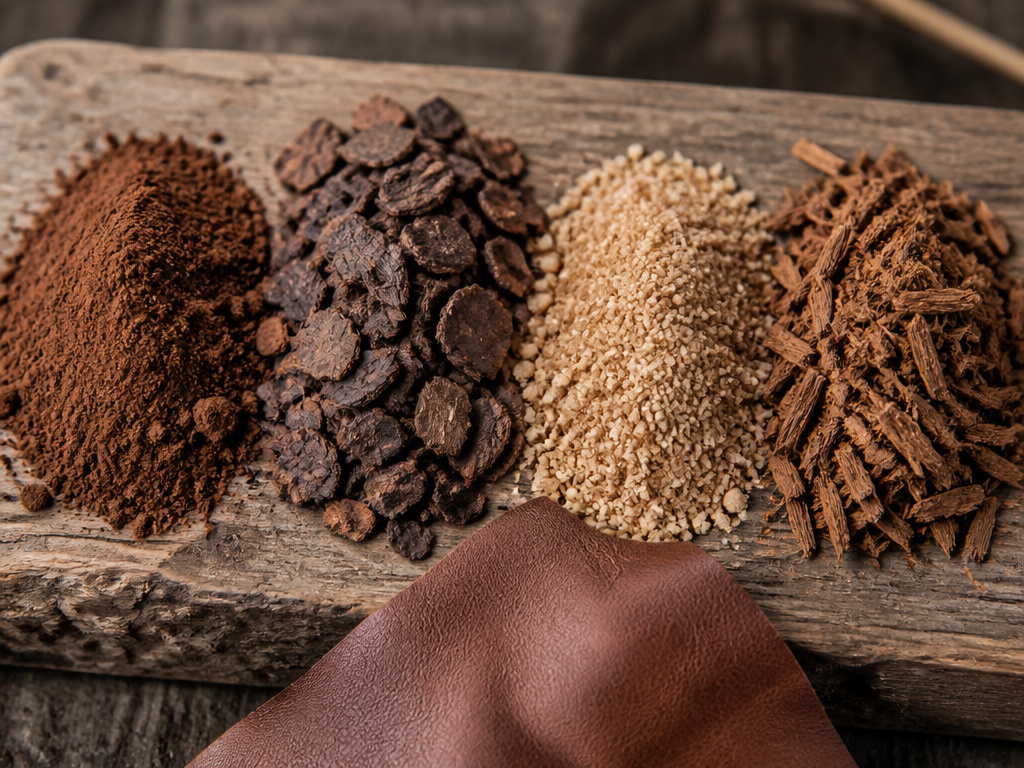 Not all vegetable tannins are the same. The source plant dictates the color, texture, and even the smell of the final leather. This is the “terroir” of the craft.
- Mimosa (Acacia mearnsii): Produces a warm, reddish-brown color and a relatively soft leather. It’s a condensed tannin, very common in modern production.
- Quebracho (Schinopsis spp.): From South America, yields a deep, cool brown. Very astringent and produces a firm, durable leather historically used for belts and industrial applications.
- Chestnut (Castanea sativa): A hydrolysable tannin common in Europe. Gives a pale, yellowish-beige color that darkens to a golden tan over time. Imparts a distinctive, sweet-woody scent.
- Oak (Quercus spp.): The classic European tannin, used for centuries. Offers a range of tan-to-brown shades and develops a highly prized, complex patina.
The choice of tannin isn’t just about color. As noted in a scientific paper on historic leathers, the specific chemical profile of each plant extract influences the leather’s mechanical properties, its tensile strength, tear resistance, and flexibility. A study on Cassia singueana extract, for example, reported a tensile strength of 15.6 N/mm², which outperformed standard Mimosa tannin in that specific test. This variability is why a master tanner’s recipe is so guarded; it’s the alchemy of turning specific bark into predictable, premium leather.
Recognizing Quality: Certifications and Specifications
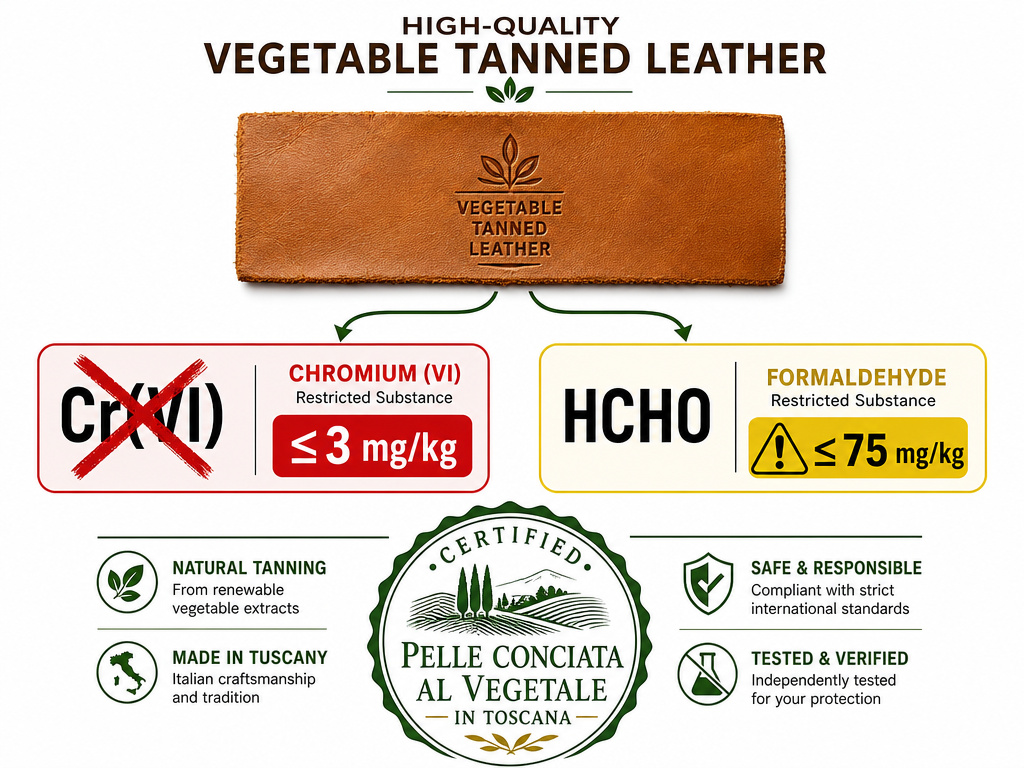 When you buy vegetable tanned leather, how do you know you’re getting the real, well-made article? Marketing copy is cheap. Independent certifications and published specifications are not.
The most rigorous standard comes from Italy’s “Consorzio Vera Pelle Italiana Conciata al Vegetale.” Their “PELLE CONCIATA AL VEGETALE IN TOSCANA – Made in Italy” certification is a legal contract with the tanneries. The technical specifications document lays out hard limits that must be verified by third-party labs: * Chromium VI: Must be absent, with a method detection limit of ≤ 3 mg/kg (ppm). * Free Formaldehyde: Must be ≤ 75 mg/kg (ppm).
These aren’t arbitrary numbers. They prove the leather was tanned without chrome salts and with minimal synthetic aldehyde use, backing up the “vegetable-tanned” claim with analytical chemistry. A label that just says “Vegetable Tanned” with no supporting certification could still be a blend or a poorly executed batch. The certification is your guarantee of purity and process integrity, a crucial step in choosing leather for a project meant to last.
Vegetable Tanned vs. Other Leather Types
Understanding what vegetable tanned leather is also means knowing what it isn’t. It occupies a specific niche in the leather ecosystem.
| Leather Type | Primary Agent | Key Characteristics | Best For |
|---|---|---|---|
| Vegetable Tanned | Plant polyphenols (tannins) | Firm hand, develops patina, natural appearance, breathable. Ages and changes with use. | Heirloom goods, belts, bags, leather tooling, leather carving. |
| Chrome-Tanned | Chromium III salts | Very soft, pliable, and water-resistant from the start. Often has a uniform, dyed-through color with a plastic-like feel. | Shoes, garments, upholstery, any item requiring high flexibility and water resistance. |
| Oil-Tanned | Fish or synthetic oils, often after chrome tanning. | Extremely water-resistant, waxy feel, develops a pull-up finish where lighter areas appear when bent. | Work boots, outdoor gear, items exposed to heavy moisture. |
| Alum/Brain Tanned | Aluminum salts or animal brains. | Exceptionally soft, almost cloth-like, but not very water-resistant. Historically used for gloves and garments. | Reenactment clothing, ultra-soft pouches, specialty applications. |
The choice between chrome tanning and vegetable tanning isn’t about good vs. Bad. It’s about matching the material to the object’s purpose. You wouldn’t want a stiff, veg-tan leather for a soft ballet flat, nor would you want a thin, chrome-tanned leather for a belt that needs to hold its shape for decades.
Practical Care and Long-Term Behavior
Vegetable tanned leather’s care regimen follows directly from its chemistry. Since it lacks the heavy polymeric top-coats of many chrome-tanned hides, its surface is more porous and receptive. This is what allows patina to form, but it also makes it more susceptible to drying out and staining.
Here’s a straightforward guide. First, protect it from prolonged moisture and direct heat. The hydrogen bonds can handle a brief wetting, but a soaked, forced-dry cycle will stress them. Second, clean with a dry brush first to lift dust. Only use a damp cloth on stubborn marks, and always test in an inconspicuous spot. I learned this the hard way on a dry, unfinished piece, a damp cloth raised the grain uncomfortably, creating a rough patch. A dry brush first, then a barely-damp cloth, worked infinitely better.
Conditioning is where most mistakes happen. You’re replenishing the natural oils that keep the collagen-tannin matrix supple. Use a pure, natural oil or wax-based conditioner sparingly. Over-conditioning, especially with products high in silicone, can clog the pores, prevent patina formation, and lead to a greasy, darkened finish. Apply a thin coat, let it absorb fully (overnight), and buff off the excess. Repeat only when the leather feels dry to the touch, often once or twice a year is plenty for most items.
Where this goes sideways: Using a universal “leather cleaner/conditioner” spray on a fine veg-tan bag. The cleaners can strip its natural oils, and the conditioners often contain silicones that sit on top, creating a fake shine and blocking the patina process. Within a few months, the leather looks artificially shiny yet feels dry underneath.
Its aging is its glory. Sunlight, oils from your hands, and minor scuffs don’t ruin it; they personalize it. The color deepens and warms, scratches become softer highlights, and the surface develops a glow no factory finish can replicate. This makes it the preferred choice for leather for laser engraving and other personalized goods, as the mark becomes part of the material’s evolving story.
Frequently Asked Questions
Is vegetable tanned leather eco-friendly?
It can be, but it’s not automatically so. The tannins are renewable and biodegradable, which is a major point in its favor. However, the tanning process itself is water and time-intensive, and the wastewater, rich in organic tannins, requires proper treatment to avoid polluting waterways. Look for tanneries with environmental certifications for a clearer picture.
Does vegetable tanned leather scratch easily?
Yes, more easily than heavily finished leathers. A fingernail or a key can leave a visible mark on its natural surface. But here’s the nuance: on quality vegetable tanned leather, these are often “scuffs” rather than cuts. Many can be lessened with a gentle rub of your finger, as the oils and warmth smooth the fibers. They become part of the patina, not a defect.
Can vegetable tanned leather get wet?
It can withstand light rain or a spill if dried properly at room temperature. Soaking it, however, is problematic. The water can temporarily break some hydrogen bonds, causing the leather to stiffen as it dries. It can also draw out water-soluble tannins, leading to discoloration or dark water spots. For regular wet conditions, an oil-tanned leather is a better choice.
Why is vegetable tanned leather more expensive?
The cost comes from the raw materials (quality tannin extracts are not cheap), the extended production time (weeks in drums versus days for chrome tanning), and the skilled labor required to manage the slow, variable process. You’re paying for the material’s longevity and the artisan’s time, not for a fast-fashion turnover.
How can I tell if it’s real vegetable tanned leather?
Check the label for specific certifications (like the Italian consortium mark). Smell it, real veg-tan has a distinctive, earthy, woody scent, not a chemical or plastic odor. Look at the edges; they are often raw and natural, not painted or sealed. And feel it; it should feel firm and substantial, not floppy or coated with a plastic-like film.
Before You Go
Vegetable tanned leather isn’t a commodity. It’s the result of a specific, slow chemical marriage between plant and protein. That marriage produces a material that breaks all the fast-fashion rules: it gets better with time, it tells a story, and it asks for your engagement in return.
If you take one thing from this, let it be this: the next time you see a rich, caramel-brown belt or a bag with a glowing, worn-in sheen, you’re not just looking at an accessory. You’re looking at millions of hydrogen bonds, weeks of patient drumming, and decades of potential. That understanding changes how you buy, how you care, and what you ultimately value. The leather will tell you what it needs, your job is to know enough to listen.
