
What Is a Bomber Jacket? From Military Gear to Style Icon
This post contains affiliate links. As an Amazon Associate, we earn from qualifying purchases.
A bomber jacket is a short, waist-length jacket originally designed for military pilots, characterized by a front zipper, a ribbed knit collar, ribbed cuffs, and a ribbed waistband. Its design prioritizes warmth, mobility, and streamlined function, evolving from heavy leather flight jackets to the lightweight nylon MA-1 that became a global fashion icon.
That definition covers the basics, but it misses the real story. The bomber jacket isn’t just a style, it’s a document. Every feature, from the fabric choice to the color of the lining, traces back to a specific military need, a dated specification, or a failure in the field. To understand what you’re wearing is to understand why it looks the way it does.
What follows is a breakdown of that design language. We’ll look at the anatomy that defines a true bomber, trace its evolution from cockpit to catwalk, and separate the timeless military specs from the fashion-world reinterpretations.
Key Takeaways
- The iconic sage green MA-1 with orange lining is the direct descendant of U.S. Air Force specifications (Mil-J-8279 series) designed for jet-age pilots.
- The bright orange lining was a survival feature, intended to be reversed for high visibility if a pilot was downed, not a fashion choice.
- Nylon replaced leather as the primary material post-WWII because it wouldn’t freeze when wet, a critical flaw of leather at high altitudes.
- The traditional wool knit collar is vulnerable to moth damage in civilian storage, leading most modern reproductions to use acrylic blends.
- True military-issue flight jackets for aircrew today are fire-resistant Nomex models (CWU-45P/CWU-36P), not the classic nylon MA-1.
The Core Design: Anatomy of a Bomber Jacket
Forget the vague fashion descriptions. A real bomber jacket is a collection of solutions to specific problems. Let’s be clear about one thing: if it’s missing these core components, you’re looking at a bomber-inspired jacket, not the real article.
The silhouette is defined by its waist-length cut. This wasn’t for style; it prevented bulkiness in cramped cockpit seats and ensured the jacket wouldn’t ride up and expose the wearer’s back when reaching for controls. The front closure is almost always a heavy-duty zipper, allowing for quick sealing against the cold.
The ribbed knit collar, cuffs, and waistband are the signature trio. They create a seal against the elements, trapping warm air inside the jacket’s core. This design also allows for a surprisingly wide range of motion, the knit stretches as you move your arms or torso, something a stiff, sewn-in hem would never allow.
A true MA-1 or L-2B flight jacket, as defined by U.S. Military specifications MIL-J-8279, utilizes a lightweight nylon shell, a polyester insulation layer, a front zipper with a wind flap, two slanted hand-warmer pockets, two internal pockets, and a knit collar, cuffs, and waistband. The orange lining is a mandatory safety feature in later models.
Common mistake: Storing a vintage or wool-collared bomber on a wire hanger. The knit collar and shoulder material will distort over time, developing permanent “ears” at the shoulders. A broad, padded hanger is essential.
The Devil in the Details: Pockets, Linings, and Labels
The pocket placement tells you its purpose. The standard two slanted flap pockets on the hips are angled so a seated pilot can access them without fighting against a safety harness. The MA-1 often includes a zippered pocket on the left sleeve, originally designed for maps or pens.
Then there’s the lining. Early MA-1 models had a sage green lining. The switch to the blazing safety orange lining is one of the most famous functional details. Its job wasn’t to look cool. If a pilot went down, he could reverse the jacket, turning it into a high-visibility signal for rescue teams. That orange isn’t a fashion statement; it’s a contingency plan.
The materials themselves evolved to solve field problems. The original WWII flight jackets were leather, which is warm but has a fatal flaw. If it got wet from rain or sweat on the ground, that moisture would freeze solid at high altitude, making the jacket a cold, rigid shell. The post-war shift to water-resistant nylon was a direct, pragmatic fix.
Even the wool knit collar had a civilian-life flaw. In a home closet, pure wool is a moth magnet. I’ve seen vintage jackets where the collar looks moth-eaten after a single season of storage. That’s why most modern production jackets, even high-quality reproductions from brands like Alpha Industries or Schott NYC, swap the wool for an acrylic blend. It’s not that wool is bad; it’s that acrylic is better suited for a life spent hanging next to cotton shirts.
From Cockpits to Catwalks: A Brief History
The bomber jacket’s journey is a masterclass in form following function, then being adopted by subcultures that prized its inherent toughness. It didn’t become cool by accident; it earned it.
The story starts with the A-1 and A-2 leather flight jackets of the 1920s and 30s. These were heavy, button-up or zippered jackets made from horsehide or goatskin, built to withstand the open-cockpit cold of propeller planes. They established the basic short, waist-length silhouette.
The B-15 jacket that followed introduced a fur collar, which was soon replaced by the wool knit collar we recognize today. But the B-15 was merely the blueprint. The need for a jacket suited to the new jet age, lighter, less bulky, and made from non-freezing materials, led directly to the MA-1, first created in 1948 and introduced to the U.S. Military in 1949.
| Jacket Model | Era | Key Material | Defining Feature | Primary Use |
|---|---|---|---|---|
| A-2 | 1930s | Horsehide Leather | Zipper, snap-down collar | Propeller aircraft |
| B-15 | Late 1940s | Nylon/Cotton | Predecessor to MA-1, fur collar | Early jet aircraft |
| MA-1 | 1950s-1990s | Nylon | Wool knit collar, orange lining | Jet-age flight crew |
| L-2B | 1950s | Nylon | Lighter-weight version of MA-1 | Warmer climate flight |
| CWU-45P | 1970s-Present | Nomex | Fire-resistant, current-issue | Modern aircrew |
The MA-1’s military contracts, notably with Alpha Industries from 1963 onward, meant surplus jackets flooded the market after conflicts like Vietnam. This is where its cultural life began. In Britain, it was adopted by Mods and skinheads. In Japan, U.S. Soldiers created souvenir jackets (sukajan), stitching intricate designs onto their bombers and sparking a fashion trend.
By the 1970s and 80s, the bomber was fully entrenched in street culture and Hollywood. Steve McQueen wore one in The Hunter, and Top Gun made the G-1 (a naval variant) a global phenomenon. The jacket’s symbolism had flipped, from a uniform of the military establishment to a uniform of rebellion and cool.
Where this goes sideways: Assuming all “bomber jackets” are created equal. The fashion industry’s take often sacrifices the functional details for aesthetics, using fabrics like satin or suede that have zero connection to the jacket’s rugged origins. For a look that balances authenticity with style, our guide on how to style a leather jacket walks through outfit ideas that respect its heritage.
Bomber Jacket Variants: MA-1, L-2B, and Beyond
When you say “bomber jacket,” most people picture the MA-1. But the military produced a family of related designs, each with its own spec sheet and purpose. Knowing the differences helps you decode what you’re actually looking at.
The MA-1 is the heavyweight champion. Designed as an intermediate-weight jacket for year-round use, its nylon shell and polyester insulation were the gold standard for decades. Its spec, MIL-J-8279, was revised multiple times (from 8279A through 8279G) up until October 1990, when it was finally phased out for aircrew. Those later revisions were for ground crew only, as aircrew moved to fire-resistant Nomex.
The L-2B is the MA-1’s lighter cousin. Think of it as a summer-weight flight jacket. All L-2B models have snap-down epaulets on the shoulders and lack the MA-1’s inside pockets. It’s a cleaner, simpler silhouette meant for warmer conditions where less insulation was needed.
Today, active-duty pilots wear the CWU-45P (for colder weather) or CWU-36P (for warmer weather). These are made from Nomex, a flame-resistant material, and represent the current evolution of the flight jacket for its original, life-saving purpose. The classic nylon MA-1, while iconic, no longer meets the safety specs for flying in modern aircraft.
This family tree matters because it influences the types of leather coats and outerwear styles we see today. The bomber’s DNA is evident in many contemporary designs.
Why the Design Endures: Function Meets Versatility
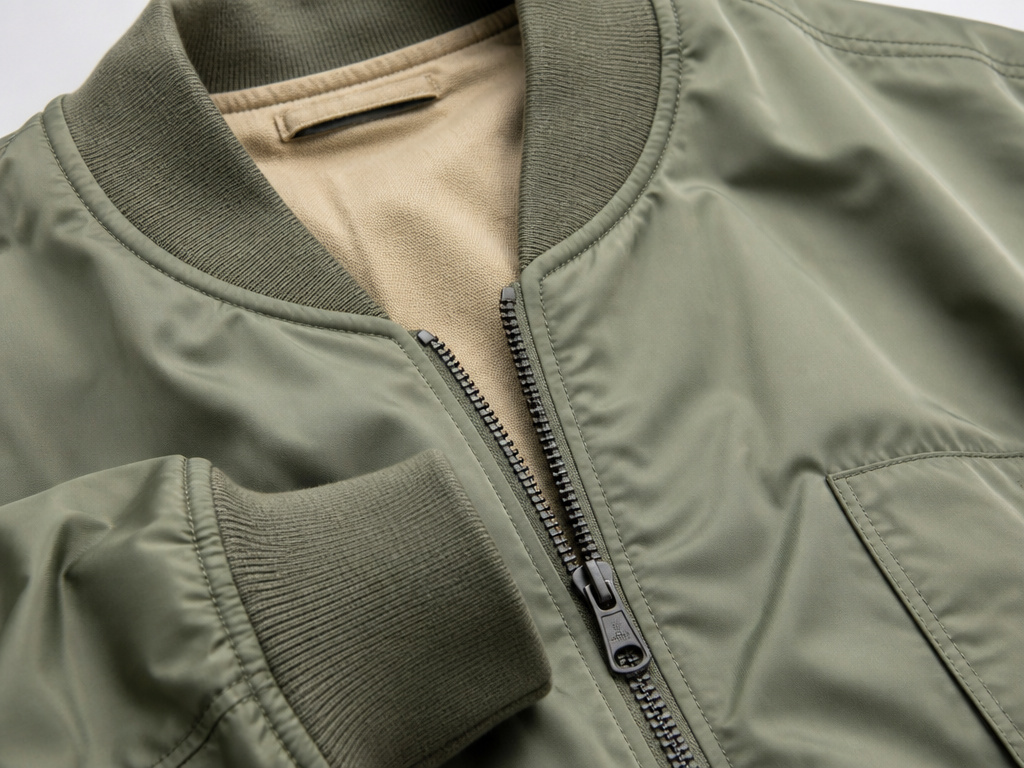 The bomber jacket didn’t survive for 70 years because a marketing team willed it. It survived because its design solved universal problems in an incredibly efficient package. It’s the definition of non-commodity design, every stitch had a job.
The combination of a wind-resistant shell, insulating layer, and elastic seals creates a microclimate of warmth without bulk. You can wear it open over a t-shirt on a cool day or zipped up over a sweater as temperatures drop. This adaptability is why it moved from a military niche to a global wardrobe staple so easily.
Its fit is universally flattering. The tapered waist and ribbed hem provide shape, while the roomy shoulders and sleeves allow for layering. This silhouette works across body types, which is a rare feat in outerwear. It’s also fundamentally gender-neutral in its original form, which explains its broad, lasting appeal.
Finally, it’s a canvas for personal expression. The military issued them in sage green and navy. Today, you can find them in every color, from classic black to vibrant reds, and in materials ranging from polished calfskin to technical synthetics. This versatility is why it appears in everything from high-fashion runways to hip-hop music videos. To learn more about how this iconic piece fits into a modern wardrobe, read our article on how to wear a leather jacket offers practical advice.
Choosing a Bomber Jacket: Military Authenticity vs. Fashion Interpretation
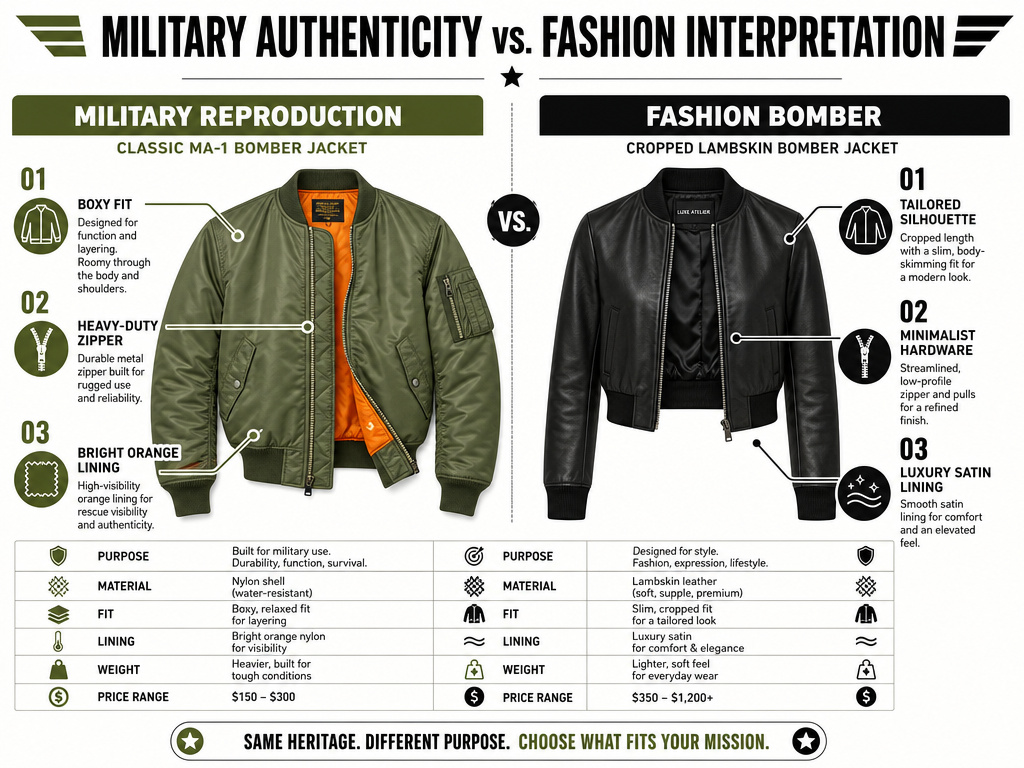 So you want a bomber jacket. Your first decision is the most important: are you buying a historical replica or a fashion piece? Both are valid, but they serve different masters.
A military-spec reproduction aims for accuracy. Brands like Alpha Industries (the original contractor), Buzz Rickson’s, or The Real McCoy’s painstakingly replicate the fabrics, stitches per inch, and labels of specific contract years. You’re paying for historical fidelity. The nylon will have the right sheen, the zipper will be a period-correct brand, and the fit will be boxier, true to how it was worn over a uniform.
A fashion bomber prioritizes contemporary fit and materials. Designers take the silhouette and play with it: using lambskin leather for a dressier look, satin for a luxe feel, or cropped lengths for a modern proportion. The functional details might be minimized or removed. The fit is often slimmer, tailored for a night out, not a cockpit.
Here’s a straightforward guide to the choice:
- Choose a military reproduction if: You value history, durability, and the “story” behind the garment. You don’t mind a looser fit and prefer function-led details.
- Choose a fashion interpretation if: Your priority is current style, a specific material (like leather), and a fit that aligns with modern tailoring. You’re okay with trading some authenticity for aesthetics.
If you lean towards leather, the choice between lambskin vs cowhide leather becomes crucial. Lambskin offers incredible softness and a luxurious drape but marks more easily. Cowhide is tougher, develops a more rugged patina, and is generally more durable for daily wear. This choice will define the jacket’s character and longevity.
Regardless of your path, the principles of how to choose a leather jacket still apply: examine the stitching, feel the weight of the zippers, check the lining quality, and understand the leather type. These factors determine whether your bomber will be a fleeting trend or a decade-long companion.
Frequently Asked Questions
What’s the difference between a bomber jacket and a flight jacket?
The terms are often used interchangeably, but “flight jacket” is the broader category encompassing all jackets designed for aviators. “Bomber jacket” typically refers to the specific waist-length styles with ribbed trim that emerged during WWII and after, like the A-2, G-1, MA-1, and L-2B. All bomber jackets are flight jackets, but not all flight jackets (like longer shearling coats) are bombers.
Why do bomber jackets have orange lining?
The bright orange lining in MA-1 jackets is a survival feature, not a design choice. If a pilot was shot down or crashed, he could reverse the jacket to turn the orange interior into a high-visibility signal, making him easier to spot by search and rescue teams against natural backgrounds.
Are bomber jackets still used by the military?
The classic nylon MA-1 is no longer issued to aircrew for flight duties. Since the late 20th century, the U.S. Military has issued fire-resistant CWU-45P and CWU-36P jackets made from Nomex to aircrew. Older MA-1s may still be used by ground crew, but they are not the current flight standard.
How should a bomber jacket fit?
Traditional military-spec bomber should fit comfortably over a sweater. It should be snug but not tight at the ribbed waist and cuffs, with shoulders that sit naturally without pulling. The body should end at your waistline. For a more modern fashion fit, it can be slightly slimmer, but avoid a fit so tight that it restricts layering or distorts the silhouette. You can find a detailed breakdown in our guide on how a leather jacket should fit.
The Bottom Line
A bomber jacket is more than a piece of clothing. It’s a wearable piece of engineering history. Every element on that sage green nylon shell, the angle of a pocket, the switch from wool to acrylic on the collar, the shock of orange inside, exists because it once solved a real problem for someone in a cockpit.
That’s the real takeaway. When you understand the “why” behind the design, you stop seeing it as just a style and start appreciating it as a tool that was perfected over decades. This knowledge also arms you against poor-quality imitations. You’ll spot a flimsy zipper, a poorly attached knit band, or a useless non-reversible lining from across the room.
Whether you opt for a vintage-inspired MA-1 from Alpha Industries or a sleek leather version from a contemporary brand, that legacy of function is what you’re ultimately buying into. And if you choose to invest in one, remember that its care is part of preserving that story. A simple regimen, outlined in our guide on how to care for a leather jacket, will ensure it develops a rich patina that’s uniquely yours, not just a replica of a military past.
