
What Is Leather Grain? The 3 Layers That Decide Its Strength
This post contains affiliate links. As an Amazon Associate, we earn from qualifying purchases.
Leather grain is the outermost, finished side of a hide, made up of three continuous layers: the visible grain surface, the dense grain layer beneath it, and the thicker corium layer below that. This entire structure, roughly the outer 25–35% of cattle hide, determines the leather’s strength, flexibility, and how it interacts with finishes.
The difference between a tight, durable grain and a loose, wrinkled one hinges on the bond between these layers. A void or gap there doesn’t just look bad; it causes the leather to buckle and weaken under stress, downgrading the hide completely.
This guide breaks down grain’s anatomy using industry standards, shows you what to look for in full-grain versus corrected leather, and explains the one defect, looseness, that turns a premium hide into a reject. By the end, you’ll be able to read the surface of any leather like a map of its internal structure.
Key Takeaways
- Grain is not just the surface pattern; it’s the entire outer third of the hide, consisting of the grain surface, grain layer, and corium layer.
- Full-grain leather has an untouched grain surface, while corrected-grain leather has been sanded and refinished to hide imperfections.
- “Looseness” is a critical defect where the grain separates from the corium, causing wrinkles and drastically reducing strength, it’s a primary reason hides are graded down.
- The grain-to-corium thickness ratio varies by animal: cattle hides are 25–35% grain, goatskins 40–65%, and sheepskins 50–70%.
- Official standards like NBS Letter Circular 97 define grain by layer, not marketing terms, understanding this cuts through industry jargon.
The 3-Layer Anatomy of Leather Grain
Forget the idea of grain as just a pretty pattern stamped on top. In every official standard, grain refers to a specific, three-part zone that forms the hide’s armor. It starts at the hair follicles you can see and goes deep into the hide’s architecture.
The outermost finished side of a hide consists of three layers: the grain surface (where hair emerged), the compact grain layer (a dense network of fine collagen fibers), and the corium (the thicker, looser connective tissue beneath). The bond integrity between the grain layer and corium dictates the leather’s tightness and resistance to flex fatigue.
The journey starts at the skin’s surface. When the hide was on the animal, each hair grew through a follicle, a tiny tunnel in the skin. After unhairing, these follicles leave behind the characteristic pores and texture you see on full-grain leather. Just underneath this surface sits the grain layer proper. This is a dense, compact mat of very fine collagen fibers. Think of it as a tough, woven shield.
Beneath that shield lies the corium. This is the workhorse layer. It’s thicker, with a looser, more open weave of larger collagen fiber bundles. The grain layer and corium are fused, but they’re distinct. The grain gives you surface durability and that prized natural texture; the corium provides bulk, tensile strength, and the flexibility to bend without cracking.
The thickness ratio between the grain and corium isn’t random. It’s a key quality marker that changes with the animal. According to a technical study on leather structure, cattle hides have a grain layer making up 25–35% of the total thickness. Goatskins jump to 40–65%, and sheepskins can be 50–70% grain. A higher grain ratio often means a finer, more supple leather, but it also means less of the robust corium underneath. This is why a thick, sturdy cowhide belt feels different from a delicate lambskin wallet, the very blueprint of their grain is different.
How “Full Grain” and “Corrected Grain” Change the Surface
These terms get thrown around in marketing, but they describe a very physical alteration. The distinction is about whether that top grain surface I just described is left intact or has been sanded down.
Full-grain leather means the natural grain surface hasn’t been touched by abrasives. All those hair follicle openings, natural scars, insect bites, and vein marks are still there. This is the strongest possible configuration because you’re keeping that intact, dense grain layer. It’s also the most breathable and develops the richest patina over time. When you see a standard like the IULTCS grain evaluation method, it defines “full grain” specifically as leather where the natural porous structure is clearly visible after any finish is removed. The finish sits on top of a complete grain surface.
Corrected-grain leather, sometimes called top-grain, has had its surface mechanically altered. Buffing wheels or sanding belts abrade away the very top portion of the grain layer to remove significant blemishes. This creates a smooth, uniform blank canvas. A thick layer of pigment and polymer finish is then applied to create a new, perfect surface, often embossed with an artificial grain pattern like pebble or ostrich. The official corrected grain leather assessment notes that under microscopy, buffed surfaces show damaged hair follicle openings and exposed single leather fibers. The finish often penetrates into the sanded grain, creating a thicker, less permeable top coat.
| Aspect | Full-Grain Leather | Corrected-Grain Leather |
|---|---|---|
| Surface Integrity | Natural, untouched grain surface with pores & markings | Sanded/buffed smooth; original surface removed |
| Finish | Thin, often aniline dye; sits on top of grain | Thick pigment/polymer coat; may penetrate sanded grain |
| Breathability | High | Lower (due to thicker, sealing finish) |
| Aging | Develops unique patina | Color wears uniformly; may crack over finish layer |
| Common Use | High-end goods, belts, footwear, saddlery | Furniture, accessories, fashion items |
Here’s the practical takeaway. A full-grain hide will show its life story. A corrected-grain hide tells a manufactured one. Both have their place, durability versus flawless looks, but their performance and aging are fundamentally different.
Looseness & Tightness: The Grain’s Structural Health
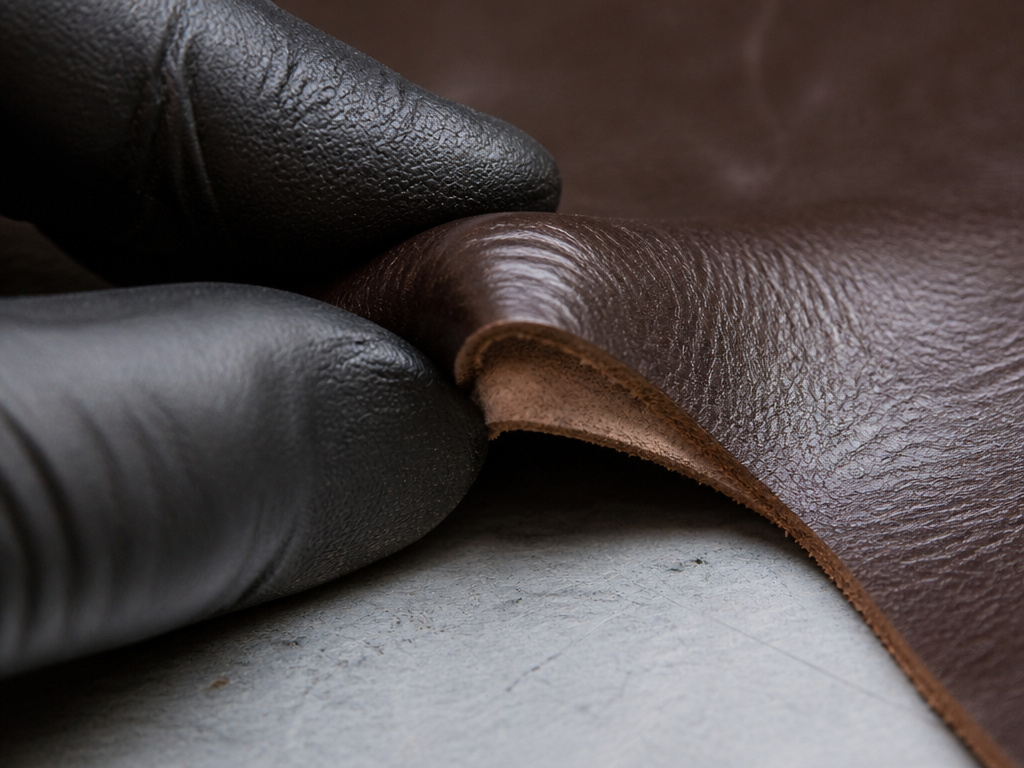
You can have a beautiful, untouched full-grain surface that’s structurally flawed. The real test isn’t the surface; it’s the bond between the grain layer and the corium beneath it. When that bond is weak or separated, you have looseness.
Looseness is a delamination. Microscopic studies show a visible gap can form between the grain layer and the corium. Think of it as a tiny air pocket running inside the leather. When you flex leather with looseness, that pocket collapses and expands, causing the surface to wrinkle or bubble in a coarse, ugly way. It feels puffier, weaker. This isn’t a cosmetic scratch. It’s a failure in the hide’s core architecture that drastically cuts its tensile strength and lifespan.
Where this goes sideways: Assuming a smooth surface means tight leather. Looseness can be hidden under a heavy corrective finish. Flex the leather firmly, if the surface wrinkles deeply instead of creasing smoothly, you’re likely feeling looseness.
So what causes it? The research points to a few culprits: * Bacterial degradation in the raw, salted hide. * Over-stretching or excessive mechanical action during early tannery processing. * Poor fatliquor penetration (the oils that lubricate fibers). * Incorrect drying that stresses the bond between layers.
Industry tests like the GMW14136 standard exist specifically to measure this grain variation. They grade looseness on a scale, often from 1 (very tight) to 8 (very loose). A hide graded 5 or above is often relegated to low-end uses or discarded. When you’re inspecting leather, don’t just look. Flex it. Pinch it. A tight grain will resist and spring back. A loose one will feel like there’s a soft, separate layer under your fingers before the grain finally bends.
Grain Patterns: Natural, Corrected, and Imitated
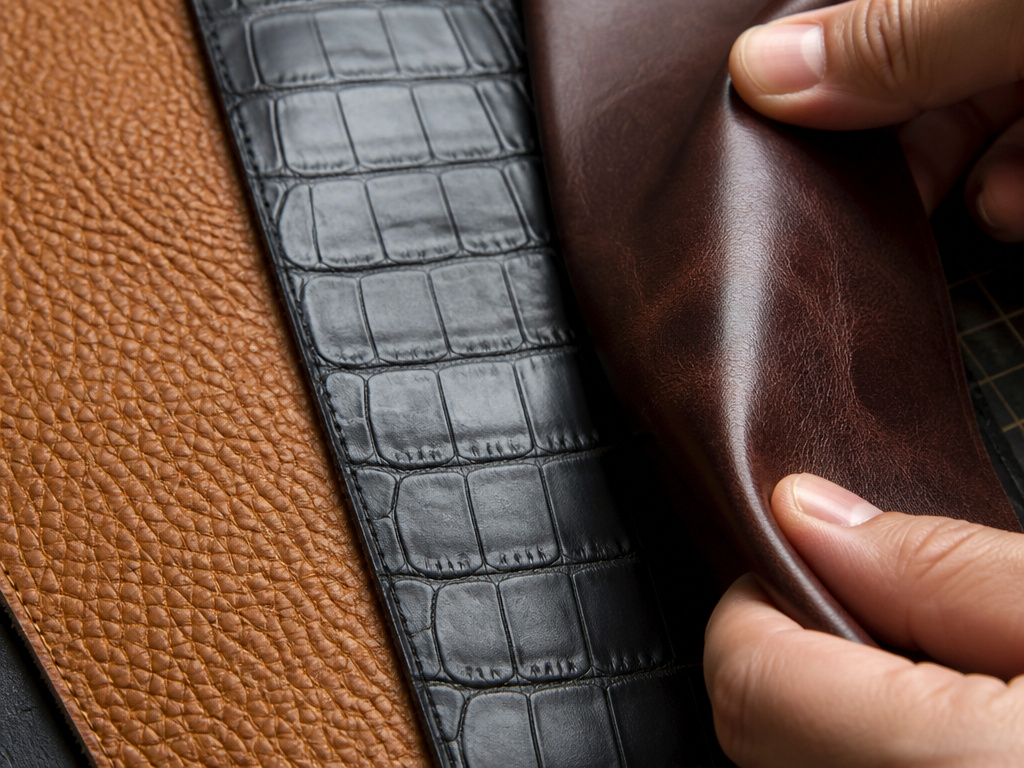
When we talk about the look of leather, we’re usually describing the grain pattern. This falls into three camps: the natural pattern of a full-grain hide, the artificial pattern applied to corrected leather, and the unique textures created by specialized finishing.
Natural Grain Patterns are as varied as the animals and their lives. A pebbled leather texture, like on a football, comes from a specific breed and part of the hide (often the neck). Other hides might show a smoother, tighter grain or long, stretch marks. These patterns are proof of authenticity, but they aren’t uniform. If you need fifty identical chair seats, natural grain won’t deliver.
Embossed Grain Patterns are the solution for uniformity. Once a hide is corrected (sanded smooth), a metal plate with a negative pattern, like alligator, ostrich, or a uniform pebble, is pressed into the surface under heat and pressure. This is embossing leather. It creates a consistent, decorative look. However, that pattern is purely superficial. Bend an embossed leather sharply, and you might see the pattern flatten or distort because it’s stamped into the finish, not grown into the fiber structure.
Specialty Finishes work with the grain in other ways. Nubuck is full-grain leather that’s been lightly sanded on the surface to raise a velvety nap. It feels like suede but comes from the top, grain side, so it’s more durable. Pull-up leather is treated with waxes or oils; bending it pulls the pigments apart, creating a temporary lightening effect that highlights the grain’s contours. Roughout leather is simply turned inside out, making the flesh side the visible surface and the grain side the backing, it’s all about exposing a different, more fibrous texture.
The pattern tells you a story about the hide’s treatment. A natural pattern means an intact surface. An embossed pattern points to correction and a heavy finish. A nubuck or pull-up finish tells you the tanner is using the grain’s natural qualities as a feature.
Inspecting Grain Quality: A Practical Guide
Theories and standards are useful, but your hands and eyes are the final judges. Let me share what I’ve learned about evaluating grain. You don’t need a lab microscope, just a methodical approach.
First, look closely. For full-grain, get good light and look for those hair follicle openings. They should be distinct, like tiny craters. The surface should have a natural, uneven depth, not a perfectly stamped, repeating pattern. For corrected leather, look at the edges and backsides. Does the embossing look crisp and deep, or does it seem to sit on top? A too-perfect pattern is a giveaway.
Second, feel the temper. Bend the leather. A tight, healthy grain will crease smoothly with resistance. It should feel like one solid material. If you feel a soft stage before it creases, or if large, coarse wrinkles appear (not sharp creases), you’re detecting looseness. This is the most important manual test.
Third, check the flesh side. The back of the leather should look uniformly fibrous, like a dense felt. If you see patches that are slick, shiny, or feel like plastic, it might indicate a heavy coating or a bonded leather, where leather fibers are glued to a mesh backing. That’s a different material entirely.
I once over-complicated this by writing a long guide full of technical tests. A reader simply wanted to know if his belt would last. The straightforward answer? Look for pores, bend it firmly, and check the back. If it passes those three steps, you’re holding a well-structured piece of leather. Ignore the marketing copy and let the material speak for itself.
Here’s a quick diagnostic list for your next leather inspection:
- Surface Pores: Can you see natural hair follicle openings? (Indicates full-grain).
- Flex Test: Does it bend with smooth resistance, or does it puff and wrinkle? (Tests for looseness).
- Edge View: Is the color consistent through the edge, or is there a painted-on top layer? (Reveals heavy correction).
- Back Side: Is it a consistent, fibrous suede, or are there non-fibrous patches? (Rules out bonded leather).
- Finish Rub: Rub a damp white cloth firmly on a hidden spot. Does color come off? (Heavy pigment finish may rub off).
The Difference Between Grain, Grade, and Type
This is where confusion sets in. Grain, grade, and type are related but separate ideas. Mixing them up is how buyers get misled.
Grain, as we’ve defined, is the physical structure of the hide’s outer layer. Full-grain and corrected-grain describe what has been done to that grain surface.
Grade (I, II, III) is a classification based on surface defects and hide size. A Grade I hide has minimal scars and bug bites on its surface and comes from the prime, large center section of the animal. A Grade III hide might be smaller and have more marks. Crucially, grading says nothing about whether the grain is corrected or not. You can have a flawless, blemish-free Grade I hide that’s then sanded and corrected because the tanner wants a uniform product. You can also have a character-marked Grade II hide that’s left as beautiful, durable full-grain. Don’t assume a higher grade means “full-grain.” It often just means “cleaner canvas for correction.”
Type refers to the animal and tanning process. Cowhide, goatskin, and calfskin are types. Vegetable-tanned vs. Chrome-tanned are types. The type determines the base material’s properties, its fiber density, softness, and how it reacts to dyes. The grain describes the state of its outer surface. The grade scores its visual cleanliness. They work together: a vegetable-tanned, Grade I, full-grain cowhide is the trifecta for a heirloom-quality bag.
So when you see a label, parse it. “Genuine Leather” is a meaningless term that includes all of this. “Full-Grain Leather” tells you about the grain. “Grade I” tells you about surface defects. “Vegetable-Tanned Cowhide” tells you the type. Understand leather better by pulling these three concepts apart.
Frequently Asked Questions
Is leather grain the same as the pattern?
No. The grain is the entire outer layer structure of the hide (surface, grain layer, corium). The pattern is the visual texture on that surface, which can be natural (like pebbling) or artificially applied via embossing on corrected leather.
Which is better, full-grain or top-grain leather?
Full-grain is the strongest and most breathable, as it retains the intact grain surface. Top-grain (usually meaning corrected-grain) is sanded for a uniform look and is more stain-resistant due to its thicker finish. “Better” depends on your priority: longevity and patina (full-grain) or uniform appearance and easy care (top-grain).
Can you fix loose grain leather?
No. Looseness is a structural separation within the hide’s layers. Conditioners or finishes might temporarily mask the wrinkled look when the leather is flat, but flexing will always reveal the looseness. It’s a permanent defect that significantly reduces the leather’s usable life.
Why does some leather have no visible grain?
If you see no grain pattern at all, it’s almost certainly corrected-grain leather that has been sanded perfectly smooth and coated with a thick, non-porous finish. Alternatively, it could be a synthetic or bonded material that mimics leather but has no natural grain structure.
How does grain affect leather durability?
The grain layer, especially when intact (full-grain), provides tremendous surface abrasion resistance. A tight bond between the grain layer and corium ensures the leather flexes as one strong unit. Loose grain or a heavily corrected/sanded surface compromises this, leading to faster wear, cracking, and failure.
Before You Go
Understand that leather grain isn’t a style choice. It’s the hide’s foundational anatomy. That outer third, from pore to corium, is what you’re actually buying. A full-grain piece is an uncut record of strength. A corrected piece is a polished edit.
The one rule most guides skip: if you pinch leather and feel a soft, separate layer before it bends, put it down. That looseness won’t improve with age; it’s the first sign of a short lifespan. Tight grain bends cleanly. Remember that ratio: in cowhide, that good stuff is only the outer 25–35%. Value it.
Now you can look past the finish. You know to check for pores, test the flex, and feel for that single solid temper. You know that a Grade I stamp doesn’t guarantee an intact grain, and that a perfect pebble pattern might just be a convincing imprint. The leather will tell you what it needs, and what it’s worth, if you know how to read its grain.
