
The Real Definition of Corrected Grain Leather Most Miss
This post contains affiliate links. As an Amazon Associate, we earn from qualifying purchases.
This post contains affiliate links. As an Amazon Associate, we earn from qualifying purchases.
Corrected grain leather is leather where the natural outer surface has been partially removed by buffing or sanding to eliminate imperfections, and a new, uniform surface, often embossed with an artificial grain pattern, is built up with a pigmented finish. This process makes up the majority of leather produced globally.
The word “corrected” isn’t marketing fluff. It’s a precise, industry-defined mechanical process. You can’t turn a flawed hide into a perfect one, but you can shave off the flawed part and create a blank canvas. The result is a material with predictable looks and surprising performance quirks.
Let me share what I’ve learned about what actually happens when leather is corrected, the test a lab uses to prove it, and the tangible trade-offs you make when you choose a corrected piece over a full-grain one.
Key Takeaways
- The official definition, set by bodies like the International Tanners Council, hinges on the partial removal of the grain layer.
- A lab test (FILK-QMA-1201) involves chemically removing the finish to inspect the leather surface underneath for signs of buffing.
- Corrected grain leather often has higher tensile strength but lower flexibility, water absorption, and breathability than its full-grain counterpart.
- The heavy finish applied makes it durable and easy to clean, which is why it dominates markets like automotive upholstery and budget-friendly furniture.
- Understanding the leather grading system helps you see why a “lower-grade” hide is often the raw material for correction.
The Official Definition and Buffing Process
Forget vague descriptions about “treated” leather. The International Tanners Council and the International Union of Leather Technologists and Chemists Societies (IULTCS) have a specific, technical definition. They state corrected grain leather is “Leather from which the grain layer has been partially removed by buffing to a depth governed by the condition of the raw material and upon which a new surface has been built by various finishes.”
Let’s be clear about one thing. “Buffed” doesn’t mean gently polished. It means abraded. Imagine a wide belt sander passing over the leather, skimming off the very top of the natural leather grain. The depth of this cut is a business decision. A hide with a few insect bites might get a light buff. One riddled with barbed wire scars or parasite marks gets a deep cut to reach clean fiber underneath. This is the primary use for hides that don’t make the cut for premium full-grain leather status.
The removal of the grain surface is a physical, irreversible alteration. Once that unique fingerprint of pores and fine textures is sanded away, it’s gone. The new surface is entirely manufactured.
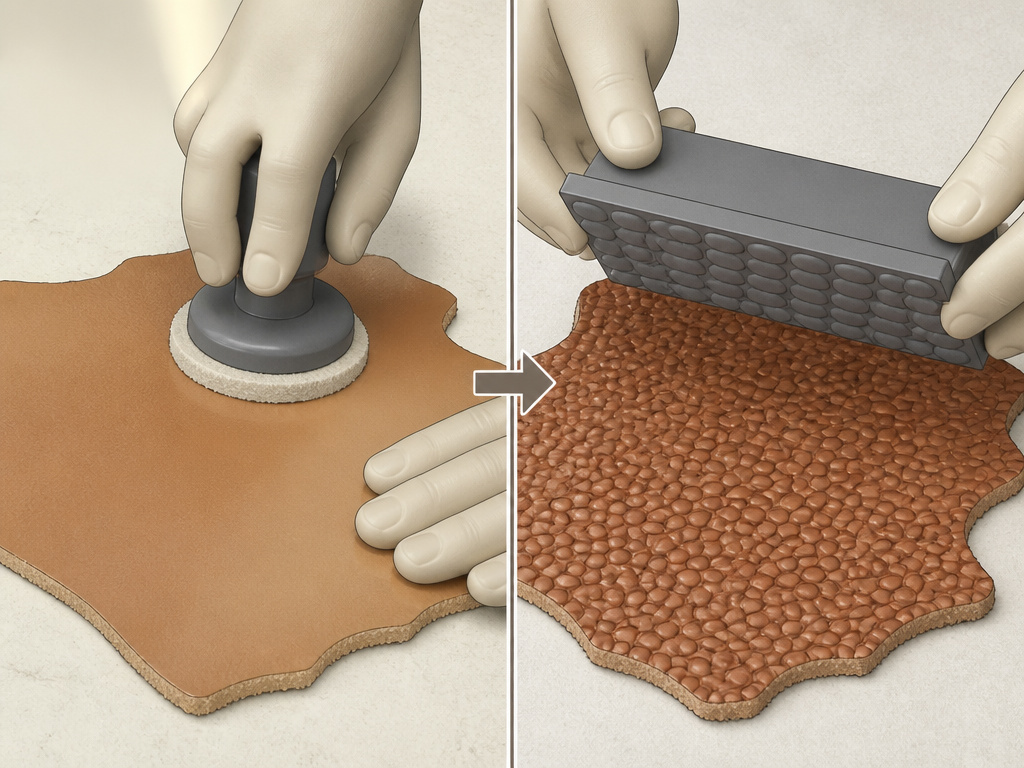
After buffing, you have a uniform, somewhat fuzzy surface. This is where the “finish” comes in. A base coat seals the leather, followed by layers of pigment to add color and a top coat for protection. This finish is thick. It’s what gives corrected leather its consistent, plastic-like feel and makes it highly resistant to stains and scuffs. The final step is often embossing. A heated plate with a pattern, maybe a pebble grain, ostrich, or alligator texture, is pressed into the surface, recreating a look of luxury the original hide never possessed.
How a Lab Proves Leather is Corrected
You can’t always tell by looking. A high-quality emboss on a corrected leather can mimic full grain perfectly to the naked eye. So how do the pros know for sure? They use a method standardized as FILK-QMA-1201.
This lab procedure is fascinating in its simplicity. Technicians carefully remove the finish without damaging the leather surface underneath. They might glue the finish face-down to a plate and use solvents to dissolve the leather away from it, leaving the backside of the finish layer intact for inspection.
Under a microscope, they examine cross-sections and the now-exposed grain surface. The telltale signs of correction are material loss. The top of the grain layer appears sheared off. The finish often penetrates deeper into the grain layer than it would on an uncorrected hide. Most damningly, the openings of the hair follicles, which should be clean, vertical channels, show a tapered shape. That taper is the sandpaper grinding away at the edges of the pore as the surrounding material is removed.
This method, detailed in an IULTCS leather evaluation method, exists because the industry needed to move past guesswork. It formally defines “full grain” as leather where the natural porous structure remains clearly visible after this non-destructive finish removal. Slight scars from the animal’s life don’t count as correction. The line is drawn at deliberate, wholesale removal.
Corrected Grain Leather Performance: The Trade-Offs
A corrected grain leather isn’t a cheap imitation. It’s a different material with a distinct performance profile. Research using tools like a Benchtop Tinius Olsen 5KN Tester to measure tensile strength reveals a clear pattern.
Because the buffing process removes the sometimes weaker, scarred top layer and the heavy finish binds the remaining fibers, corrected grain leather often scores the highest tensile strength in tests. It’s tough. However, this comes at a cost. The same studies show it frequently has the lowest elongation at break, it doesn’t stretch much, and the lowest flex resistance. It’s stiff. The plastic-like finish also drastically reduces water absorption and water vapor permeability. It won’t breathe like an unfinished leather.
| Property | Typical Performance vs. Full Grain | Practical Implication |
|---|---|---|
| Tensile Strength | Often Higher | More resistant to pulling forces; less likely to tear under tension. |
| Elongation / Flexibility | Lower | Less supple; more prone to cracking on a fold line over time. |
| Water Absorption | Much Lower | Spills bead up; easy to wipe clean. Also means conditioners can’t penetrate easily. |
| Breathability | Much Lower | Can feel clammy; not ideal for shoe uppers or garments meant for all-day wear. |
| Surface Consistency | Perfect | Uniform color and texture; hides all natural markings and flaws. |
This profile makes corrected grain a logical choice for specific applications. Its durability and easy-clean surface are perfect for leather for car seats, office chairs, and luggage. The stiff temper works well for structured bags and belts. The aesthetic control is why it’s used for trendy, mass-produced furniture. You’re trading patina development, breathability, and softness for durability, maintenance ease, and a predictable look.
The Relationship with “Top-Grain” and Embossing
Here’s where most consumer confusion lives. “Top-grain” is a location, not a quality grade. It simply means the leather comes from the top layer of the hide after the initial split. This layer contains both full-grain (uncorrected) and corrected-grain leather.
Common mistake: Treating “top-grain” as a premium label. It’s a descriptor. A corrected leather is also a top-grain leather by definition, but it’s been fundamentally altered.
Once that surface is buffed, it’s no longer referred to as top-grain in technical circles; it’s corrected grain. The heavy pigmented leather finish is the final clue. This is a key difference when comparing top-grain and genuine leather, as both can undergo correction, but “genuine leather” is a broader, less specific term.
Embossing is the partner to correction. After you’ve sanded the hide smooth, you have a blank slate. A tannery can then press any pattern into it. This is how you get uniform “pebble grain” briefcases or “crocodile” upholstery. True embossed leather starts with corrected leather. The embossing can be so extreme it further compacts the collagen fibers, decreasing thickness and adding to the stiffness. It’s a cosmetic layer on top of a rebuilt foundation.
How to Identify and Choose Corrected Grain Leather
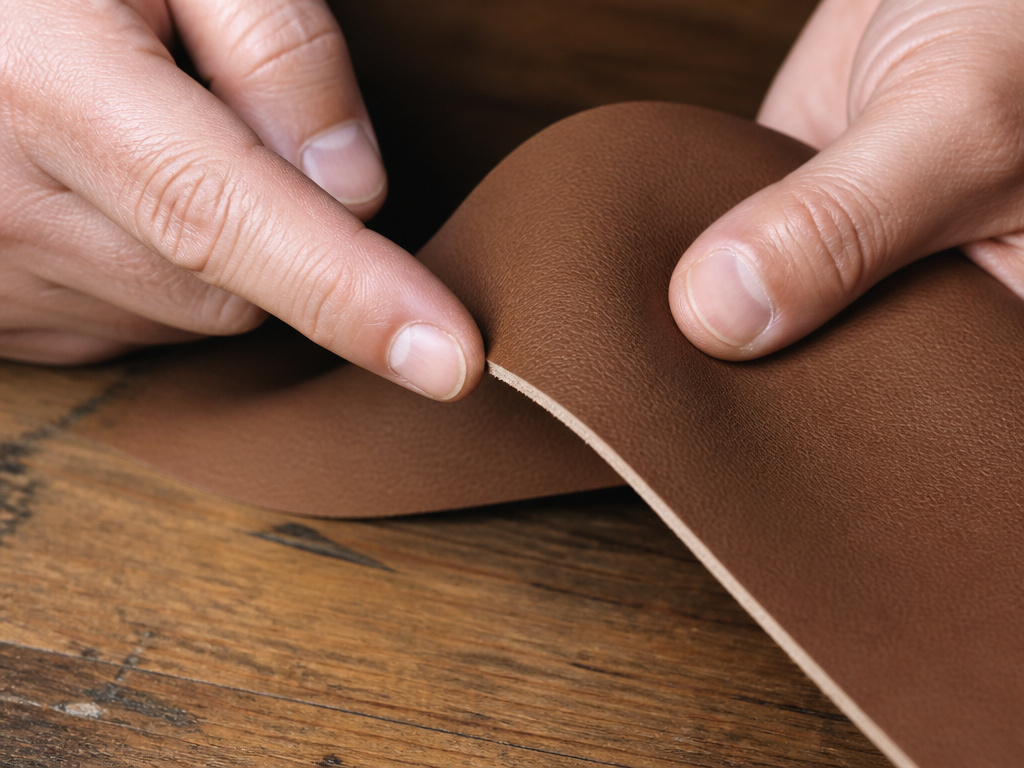
You don’t need a lab microscope. A careful hands-on inspection will tell you most of what you need to know. Start by feeling the surface. Corrected grain often has a uniform, slightly plasticky feel. The temperature is a clue, it may feel cooler and less organic than full grain. Look at an unfinished edge. If you see a stark line where a thick, opaque top layer sits on the lighter leather beneath, that’s your finish.
Then, bend it. Listen and feel. A stiff corrected leather will resist, and you might hear a faint creaking from the finish. A full-grain leather will flex more willingly and silently. Finally, check the back. The flesh side of corrected grain won’t look different from any other leather, so your main evidence comes from the front.
When should you choose it? This is based on years of practical experience. If your priority is a uniform color, high scuff-resistance, easy cleaning, and a lower price point, corrected grain is a solid choice. It’s excellent for items that see rough use or need to look consistently new, like cafe chairs, kids’ furniture, or budget-conscious accessories. For a heirloom-quality bag, a pair of boots that will mold to your feet, or a jacket that needs to breathe, you’re better served by uncorrected leathers.
The leather will tell you what it needs. A corrected grain piece requires almost no conditioning because the finish blocks oil penetration. Cleaning is straightforward, a damp cloth usually suffices. Its failure mode is different: instead of developing a rich patina, the finish itself may eventually crack or wear through at high-stress points, revealing the lighter leather underneath.
Frequently Asked Questions
Is corrected grain leather fake leather?
No, it is 100% real leather. The “correction” refers to the mechanical buffing of the natural surface, not the addition of synthetic materials. It starts with a genuine hide and alters its top layer.
Does corrected grain leather last?
It can last a long time, especially in low-flex applications. Its high tensile strength makes it resistant to tearing. Its main vulnerability is the finish layer cracking with repeated bending, which is why it’s less ideal for very soft, supple items.
What’s the difference between corrected grain and full grain?
Full grain leather retains the original, unaltered outer surface with all its natural markings and pores. Corrected grain has that surface sanded off and replaced with an artificial finish. Full grain breathes, develops a patina, and is generally more supple. Corrected grain is more uniform, stain-resistant, and often stiffer.
Why is corrected grain leather so common?
Supply and demand. Only a small percentage of hides are free of significant scars and imperfections suitable for full-grain leather. Correction allows tanneries to use the vast majority of hides, the ones with bites, scratches, or brands, and turn them into a consistent, salable product. It meets the market’s demand for affordable, durable, and uniform-looking leather.
Can corrected grain leather be high quality?
Yes, within its category. A corrected grain leather from a reputable tannery using good base hides, a durable finish formulation, and precise embossing can be a high-quality material for its intended purpose. The “quality” lies in the execution, not the category itself. It’s about choosing the right tool for the job.
The Bottom Line
Corrected grain leather is the workhorse of the leather world. It’s not trying to be something it’s not. It’s a pragmatic solution for using imperfect hides, offering durability and aesthetic control at a lower cost. Understanding its definition, the deliberate removal of the grain layer, lets you see past marketing and evaluate the material for what it is.
When you’re assessing a leather good, run the simple tests: feel for the plastic-like finish, look for that uniform perfection, and bend it to hear the telltale stiffness. That tells you more than any label ever could. Ignore the marketing copy that tries to blur the lines. Know that for a car seat or a casual bag, corrected grain might be the perfect, practical choice. But for that one piece you want to age with you for decades, you’ll likely want to seek out the untouched, breathable surface of full grain. Your choice should start with the question: what do I need this leather to do?
