
What Is Pebbled Leather? Understanding Its Durable Texture
This post contains affiliate links. As an Amazon Associate, we earn from qualifying purchases.
This post contains affiliate links. As an Amazon Associate, we earn from qualifying purchases.
Pebbled leather is genuine or synthetic leather with a raised, bumpy texture embossed onto its surface. This texture, resembling clusters of tiny stones, doesn’t make the leather more scratch-resistant. It makes scratches less visible by breaking up light reflection, which is why it’s favored for bags, shoes, and furniture that see daily wear.
The texture is just a finish. It tells you nothing about the quality of the material underneath, which could be premium full-grain cowhide or a synthetic plastic laminate. The real question is what part of a piece is pebbled.
Let me share what I’ve learned. This guide explains the history of pebbled leather, the exact mechanical and chemical processes that create it, and the crucial differences between real and fake versions. You’ll learn how to identify quality, care for it properly, and understand why this specific finish is more than just a style choice.
Key Takeaways
- Pebbled leather’s primary function is to hide scratches and minor imperfections, not prevent them.
- The texture can be applied to both genuine leather (full-grain, top-grain, split) and synthetic materials (PU, PVC), so the label “pebbled” alone doesn’t guarantee quality.
- Genuine pebbled leather develops a rich patina over years, while synthetic pebbled leather typically cracks and peels within 1-3 years.
- Conditioners are essential for real pebbled leather but will ruin synthetic versions by creating a sticky, dirt-attracting film.
- The pebbling process is often used by tanneries to upgrade hides with natural scars or insect bites, making them suitable for luxury goods.
What Pebbled Leather Actually Is (And Isn’t)
Pebbled leather is a type of finish, similar to a brushed nickel finish on a faucet.The underlying metal could be solid brass or cheap plated zinc; the finish is just the final look. The pebbled leather texture, a surface covered in small, rounded bumps, can be stamped onto almost any base material.
The process is a form of embossing. A hide, after being tanned and dyed, is pressed under high heat and pressure with metal plates engraved with a reverse pebble pattern. This permanently molds the surface. The technique originated from a practical accident: the “Scotch-grain” legend tells of an 18th-century Scottish tanner who left hides stacked on a pebbled floor, finding the bottom one imprinted with the stone pattern. Today, it’s a deliberate industrial step in the broader leather finishing process.
This mechanical embossing is a controlled form of corrected grain leather treatment. For lower-quality hides, the natural grain is completely sanded away, creating a blank canvas. A uniform pebble pattern is then stamped on, giving a consistent, artificial look. On higher-quality hides, pebbling might be used only on specific sections to blend minor natural flaws into the overall natural grain pattern.
The important distinction is what gets pebbled. Is it the robust, breathable surface of a full-grain leather, or is it a thin layer of plastic? The answer changes everything about durability, care, and lifespan.
The 1864 Machine That Changed Everything
For most of history, creating a pebbled texture was a slow, inconsistent hand process. That changed with a patent. In 1864, C.T. Woodman of Boston patented a machine for mechanically embossing leather with a pebbled pattern. This wasn’t a minor tweak; it standardized the finish, making it fast, repeatable, and economically viable for tanneries.
Woodman’s machine used rollers. Before this, achieving the pattern meant pressing hides by hand with textured boards or relying on the unreliable “stacked-on-stones” method. His invention introduced engraved metal rollers that could consistently transfer the pebble design under even pressure. Modern tanneries use the same principle, just with hydraulic presses instead of 19th-century gear.
This mechanization is why pebbled leather became commonplace on items like men’s Derbies and loafers by the early 1900s, and later on iconic handbags from houses like Chanel. It moved the finish from a rare, artisanal curiosity to an industrial staple. The machine didn’t just make pebbled leather; it made pebbled leather a commercial category.
Pebbled Leather vs. Smooth Leather: What Changes?
The choice between pebbled and smooth involves a trade-off between visible character and visible wear. A scratch applies the same force to both surfaces.The difference is in the aftermath.
On smooth leather, a scratch creates a long, straight, glossy line that catches the light. It’s a clear, contrasting mark. On pebbled leather, that same scratch is broken up as it travels across peaks and valleys. The irregular texture diffuses the light reflection, making the damage blend into the background pattern. It’s not that the scratch is shallower; it’s that your eye has a harder time finding it.
This has a direct impact on patina. A smooth leather bag tells a linear story, every scrape and scuff is a distinct entry in its logbook. A pebbled leather bag tells a more aggregated story; the texture softens the narrative of daily use, creating a more uniform aged appearance over time.
| Aspect | Smooth Leather | Pebbled Leather |
|---|---|---|
| Scratch Visibility | High – creates clear, reflective lines. | Low – scratches break up across texture. |
| Patina Development | Distinct, linear marks that tell a specific story. | Unified, aggregated aging that softens individual events. |
| Light Reflection | Even, creating a uniform shine or matte look. | Diffused, creating a softer, more muted sheen. |
| Best For | Formalwear, items where a pristine look is prioritized. | Daily-use bags, shoes, furniture where wear is expected. |
Real vs. Fake: How to Spot Synthetic Pebbled Leather
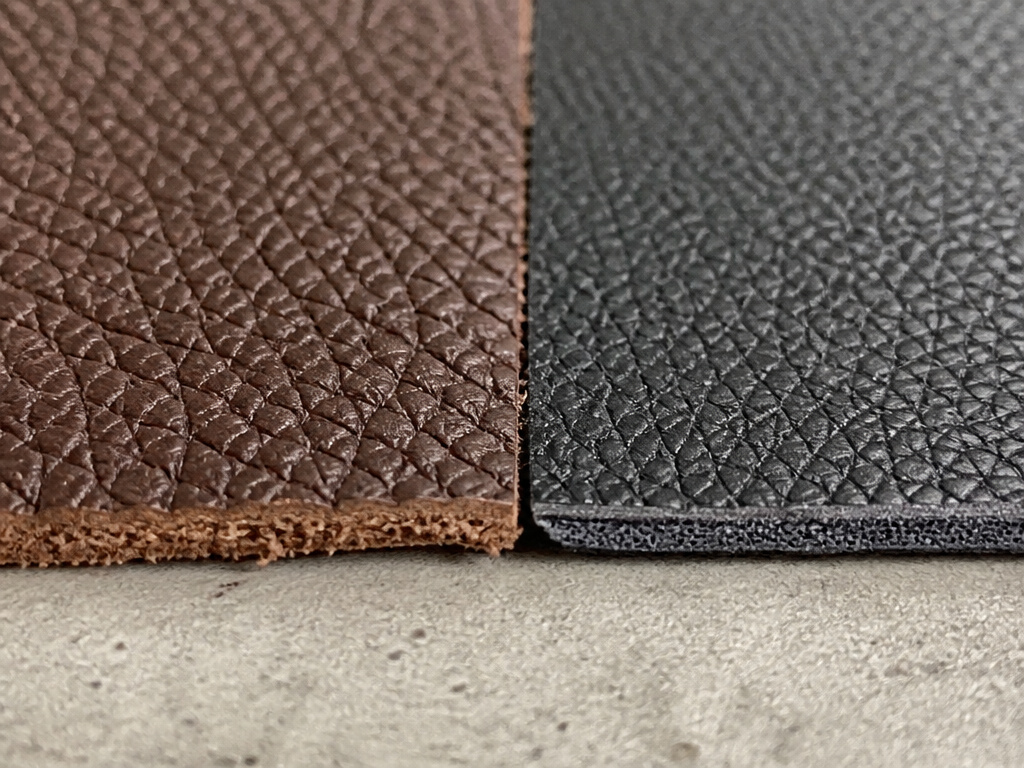
The pebble texture is democratic. It doesn’t care if it’s sitting on top of a $50 square foot of Italian calfskin or a $5 square foot of polyurethane laminate. This is where most buyers get tripped up. Pebbled on a tag is not a certification like the Leather Working Group’s; it’s a texture descriptor.
Genuine pebbled leather uses animal hide. It’s often full-grain or top-grain leather, and the pebbling process is frequently employed to cleverly disguise the natural scars, insect bites, or wrinkle lines that would relegate a hide to a lower grade. This is a smart, sustainable practice, it uses more of the animal and reduces waste. The leather remains breathable, will develop a patina, and can last decades.
Faux pebbled leather is a different material altogether. It’s usually a fabric base coated in polyurethane (PU) or polyvinyl chloride (PVC), then embossed with the pebble pattern. Here’s the practical takeaway: while genuine leather fails slowly, wearing down over years, synthetic leather fails categorically. The plastic coating cracks and peels away from the fabric backing, often within 1 to 3 years of regular use. There’s no reviving it.
How to test leather quality in this context? Your senses are the first tool. 1. Smell it: Real leather has a distinctive, rich, organic smell. Synthetics smell like plastic or chemicals. 2. Feel the edges: Real leather edges are rough, fibrous, and porous. Synthetic edges are often perfectly smooth, laminated, or have a visible fabric layer. 3. Check for uniformity: Genuine leather has natural variations in the pebble pattern. A perfectly identical, repeating pattern across a large area is a hallmark of machine-stamped synthetic material or heavily corrected grain leather.
How Pebbled Leather is Made: From Hide to Texture
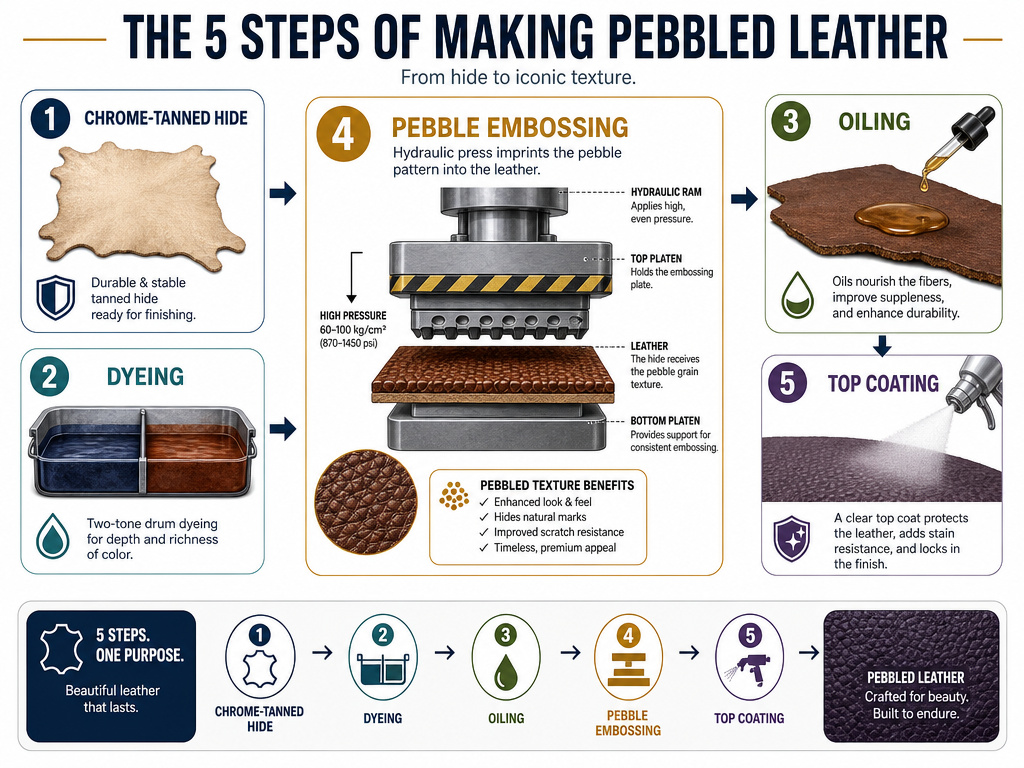
Understanding how leather is made clarifies where pebbling fits in. The pebble texture is almost always the final mechanical step before the final protective coatings are applied.
- Tanning: The raw hide is stabilized through chrome tanning (for softer, more pliable leather common in bags) or vegetable tanning (for firmer, more structured leather).
- Dyeing: The tanned leather is dyed to its base color. For pebbled leather, it’s common to use a two-tone effect, dyeing the “peaks” a different shade than the “valleys” for depth.
- Drying & Conditioning: The hide is dried and treated with oils or fats to restore suppleness.
- Embossing (Pebbling): This is the key stage. The dampish leather is fed through a hydraulic press. Two metal plates, one engraved with the inverse pebble pattern, close on the hide with immense pressure and heat, permanently impressing the texture. This is the embossed pattern you see.
- Top Finishing: A final protective layer, which could be a light wax, a light pigmented finish, or a clear coating, is applied to seal the surface.
The leather’s journey matters. A full-grain leather going through this process retains its strong, dense outer layer, resulting in a durable, breathable product. A split leather (the lower, fibrous layer separated from the top grain) that is then embossed and heavily coated creates a much stiffer, less breathable material that’s often marketed as “genuine leather.”
Caring for Your Pebbled Leather Goods
Care instructions diverge violently based on what’s under the texture. Getting this wrong doesn’t just waste product, it can ruin your item.
For Genuine Pebbled Leather:
The leather will tell you what it needs. When it starts to look dry or feel stiff, it’s time for conditioner. Use a dedicated leather conditioner (not an all-purpose polish or cleaner). Apply a small amount to a clean, soft cloth and work it into the leather in circular motions, focusing on dry areas. Let it absorb fully, overnight is best, before using the item. The pebbled texture hides scratches, but it also traps dirt. Wipe it down with a damp cloth every few weeks to prevent grime buildup in the textured valleys.
I learned the hard way that controlled moisture isn’t the enemy. A client’s pebbled leather briefcase was caught in a sudden downpour. They panicked, thinking it was ruined. I told them to blot it gently with a towel and let it air-dry slowly, away from direct heat. A day later, it looked perfectly fine, the texture even seeming richer. Soaking is bad. A thorough, patient dry after a wetting is just maintenance.
For Synthetic (Faux) Pebbled Leather:
Never use leather conditioner. The plastic surface has no pores to absorb the oils, so the conditioner just sits on top as a sticky film that attracts lint and dirt. Clean with a mild soap-and-water solution on a soft cloth, then wipe dry. That’s it. Any attempt to “nourish” it will backfire.
Storage Rules for Both:
Keep items in a breathable cotton dust bag, never a plastic bag. Plastic traps moisture and leads to mold. Store at room temperature, away from direct heat sources like radiators, which can cause cracking, especially in synthetics.
Pebbled Leather in the Wild: Common Uses & Comparisons
You’ll find pebbled leather wherever durability and discreet aging are valued over a flawless, glossy appearance.
- Bags & Wallets: It’s the default for many commuter backpacks and travel satchels because it hides the scuffs from being shoved under airplane seats or scraped against desk legs. Compare it to Saffiano leather, another popular textured finish. Saffiano has a distinctive cross-hatch pattern and is usually given a harder, scratch-resistant coating, making it stiffer and more formal than the softer, more casual pebbled finish.
- Footwear: Boots, derby shoes, and loafers often use pebbling for a rugged, casual look that doesn’t show every sidewalk scrape.
- Furniture: Sofas and chairs benefit from pebbled hides because they mask the inevitable scratches from pets, belt buckles, or kids’ toys. It’s a more forgiving choice than a smooth aniline-dyed leather for a family room.
- Car Interiors: Door panels, armrests, and gear shift boots use pebbled leather for its wear-resistant qualities and its ability to maintain a consistent look under daily friction.
The common thread is use-case. If an item is meant to be a pristine display piece, smooth leather wins. If an item is meant to be lived in, pebbled leather offers peace of mind.
Frequently Asked Questions
Is pebbled leather good quality?
The pebble texture itself says nothing about quality. The quality depends entirely on the underlying material. Pebbled full-grain leather is high quality. Pebbled split leather or pebbled synthetic leather is lower quality. Always look beyond the texture to the material specifications.
Does pebbled leather scratch easily?
It scratches with the same ease as smooth leather of the same type and thickness. The key difference is that the scratches are far less visible on pebbled leather because the textured surface breaks up the light reflection that makes scratches stand out.
How can you tell if pebbled leather is real?
Use the smell and edge tests. Real leather has a rich, organic smell and rough, fibrous edges. Synthetic leather smells like plastic and has perfectly smooth or fabric-backed edges. Also, examine the pattern: genuine leather will have slight natural variations, while synthetic often has a perfectly uniform, repeating pattern.
Can you use leather conditioner on pebbled leather?
Only if it’s genuine leather. Conditioner is essential for maintaining the suppleness and preventing dryness in real pebbled leather. If the item is synthetic, conditioner will sit on the surface as a sticky residue and attract dirt, damaging the finish.
Is pebbled leather durable?
Genuine pebbled leather is very durable and often outlasts smooth leather equivalents for visual wear because it hides minor damage so well. Synthetic pebbled leather has low durability, typically cracking and peeling within a few years of regular use.
Before You Go
Pebbled leather is a lesson in looking past the surface. That attractive, bumpy texture is a finishing trick, a final layer applied to materials of wildly different pedigrees. Its superpower isn’t armor-plating your belongings; it’s giving wear and tear a place to hide.
So when you’re shopping, don’t stop at “pebbled.” Ask what’s pebbled. Is it a resilient full-grain hide that will age with you for decades, or is it a plastic laminate on a countdown to its first crack? Your nose, your fingers, and a critical eye for the product’s description will give you the real answer. Choose the one that matches the story you want your gear to tell, a story of perfect preservation, or a story of well-lived experience, texture and all.
