
What Is a Moto Jacket? Defining Specs of Real vs Fashion Gear
This post contains affiliate links. As an Amazon Associate, we earn from qualifying purchases.
A moto jacket is a leather outerwear piece inspired by motorcycle gear, characterized by a slim, aerodynamic cut, an asymmetric zipper, snap-down lapels, and often reinforced panels or armor pockets. It is defined by functional engineering for riding, not just style, with cowhide or steerhide leather 1.0-1.4 mm thick being the rider standard.
That definition gets you the silhouette. The difference between a jacket that looks the part and one that can actually handle a slide comes down to three numbers: leather thickness, stitch density, and hardware grade. A fashion copy might use 0.8 mm lambskin and plastic zippers; a real moto jacket starts at 1.0 mm cowhide with metal YKK zippers. That half-millimeter gap is the line between a wardrobe staple and road rash protection.
What follows is a breakdown of the anatomy, the three classic cuts, and how to read a spec sheet so you know exactly what you’re buying, whether you ride or just like the look.
Key Takeaways
- Real moto jackets are engineered, not just styled. Every feature, from the asymmetric zip to the longer back panel, solves a specific problem for a rider in motion. Leather thickness is essential.** For riding, cowhide or steerhide should be 1.0–1.4 mm thick. Anything thinner is fashion-grade and will abrade quickly in a fall.
- Hardware tells the true story. Look for metal zippers (YKK, Talon), heavy-duty snaps, and reinforced stitching at all stress points. Plastic hardware fails first.
- There are three dominant silhouettes: The asymmetric Perfecto for cruisers, the clean Cafe Racer for sport bikes, and the double-breasted Cossack as a collector’s piece.
- Conditioning changes some leathers fundamentally. Applying oil to Schott’s “pull-up” naked cowhide, for instance, darkens it and removes its unique mottled effect, a trade-off between care and original aesthetic.
What Makes a Moto Jacket a Moto Jacket?
Let’s be clear about one thing. A row of zippers on a leather coat does not make it a moto jacket. The original design, patented by Irving Schott in 1928 as the Perfecto, was a list of solutions to problems that didn’t exist in a tailor’s shop. A rider leaning forward at 50 mph needs a jacket that doesn’t ride up, flap in their face, or come apart at the seams. Every line on a real moto jacket exists to meet one of those needs.
Asymmetric zipper. The offset closure allows the jacket to lay flatter across the chest when zipped, reducing bulk and improving aerodynamics. It also creates the signature diagonal line that defines the silhouette.
Snap-down lapel. This is a dual-function piece. Zipped up, you snap the lapel flat so it doesn’t whip into your face. Unsnapped, it falls into a notched collar shape off the bike. A lapel that doesn’t snap is purely decorative.
Longer back panel. The jacket is cut longer in the rear than in the front. This “tail” keeps your lower back covered when you’re hunched over the tank. Fashion versions are even all around because they were designed for someone standing upright.
Reinforced impact zones. Look for double layers of leather or modern padding at the elbows and shoulders. On contemporary riding jackets, these are often pockets for CE-rated armor. A jacket without reinforcement at these points is built for sidewalks, not slides.
A real moto jacket uses leather 1.0-1.4 mm thick, metal zippers, and double-stitching at all stress points. Missing any two of these features means you are holding a fashion derivative, not functional riding gear.
You can feel the difference before you even put it on. Pick it up. A jacket built with 2.75-3.25 oz cowhide, like the Schott Perfecto Model 519, has a substantial heft. The zippers pull with a smooth, heavy glide. The seams lie flat and tight. A fashion jacket feels light, the zippers chatter, and the seams often pucker. The leather will tell you what it needs.
The Three Classic Silhouettes
Not all moto jackets are the same cut. The three main silhouettes were each born from a specific riding culture and posture. Picking one isn’t just about style; it’s about matching the jacket’s engineering to how you’ll actually use it.
The Perfecto (Asymmetric)
This is the original. Marlon Brando wore one in The Wild One, and the silhouette became rebel shorthand before most people even knew what a motorcycle was. The belted waist, epaulets, and asymmetric zip are all hallmarks. It’s designed for an upright or slightly forward riding position, making it the default for cruisers, bobbers, and standard motorcycles. The silhouette also photographs brilliantly off the bike, which is a big part of why it’s endured for a century.
The Cafe Racer
Emerging from 1950s and 60s British bike culture, the Cafe Racer jacket was built for riders tucked into low clip-on handlebars. The cut is minimalist, often a simple center zip, no belt, minimal external hardware. The clean lines prevent bunching at the waist when you’re leaned forward. It’s the natural choice for sport bikes and the go-to for anyone who prefers a stripped-back, modern look both on and off the bike. If the Perfecto is a statement, the Cafe Racer is a whisper.
The Cossack (Double-Breasted)
This is the rarest of the three, mostly a collector’s piece now. Characterized by a center button line, a larger lapel, and a double-breasted closure, it has a more formal, almost military bearing. It’s not optimized for a specific riding tuck, which is part of why it faded from functional use. You’ll see it in vintage collections or as a high-fashion homage, but it’s not what most people picture when they hear “moto jacket.”
| Silhouette | Best For Riding | Key Feature | Off-Bike Vibe |
|---|---|---|---|
| Perfecto (Asymmetric) | Upright cruisers, bobbers | Belted waist, snap-down lapel | Iconic, rebellious, heavy |
| Cafe Racer | Sport bikes, forward tuck | Center zip, clean lines | Minimalist, modern, sleek |
| Cossack | Collecting, fashion | Double-breasted buttons | Formal, vintage, niche |
Leather & Materials: Reading the Spec Sheet
When you look at a product page, the marketing copy will talk about “premium leather” and “timeless design.” Ignore that. Scroll to the specs. The numbers there don’t lie.
Leather Type & Thickness: This is your first filter. For a jacket that could see pavement, you want cowhide or steerhide. Lambskin is for fashion; it’s too soft and thin. The rider standard for thickness is 1.0-1.4 mm. Leather below 1.0 mm is fashion-grade and will abrade quickly. Above 1.4 mm, you’re into heavy, stiff territory meant for track use. A jacket like the GPI Moto Men’s Motorcycle Leather Jacket uses 1.1-1.2mm cow aniline leather, right in the sweet spot.
Tanning & Finish: Most riding jackets use chrome-tanned leather for its water resistance and pliability. Vegetable-tanned leather is stiffer and develops a patina beautifully, but it’s less common in ready-to-wear moto styles. Pay attention to special finishes. Schott’s “pull-up” naked cowhide on the Model 519, for example, develops a unique mottled patina with wear. The manufacturer explicitly notes that applying conditioner will darken it and alter this effect, a direct trade-off between maintenance and preserving the original look.
Hardware: The zippers and snaps are the jacket’s moving parts, and they are the most reliable predictor of long-term durability. YKK is the industry benchmark for metal zippers. Schott uses nickel hardware on many of its Perfecto models, and they still service jackets from the 1970s. Plastic zippers or thin, lightweight snaps are a sure sign of cost-cutting. They’ll fail long before the leather wears out.
Key Features & What They Actually Do
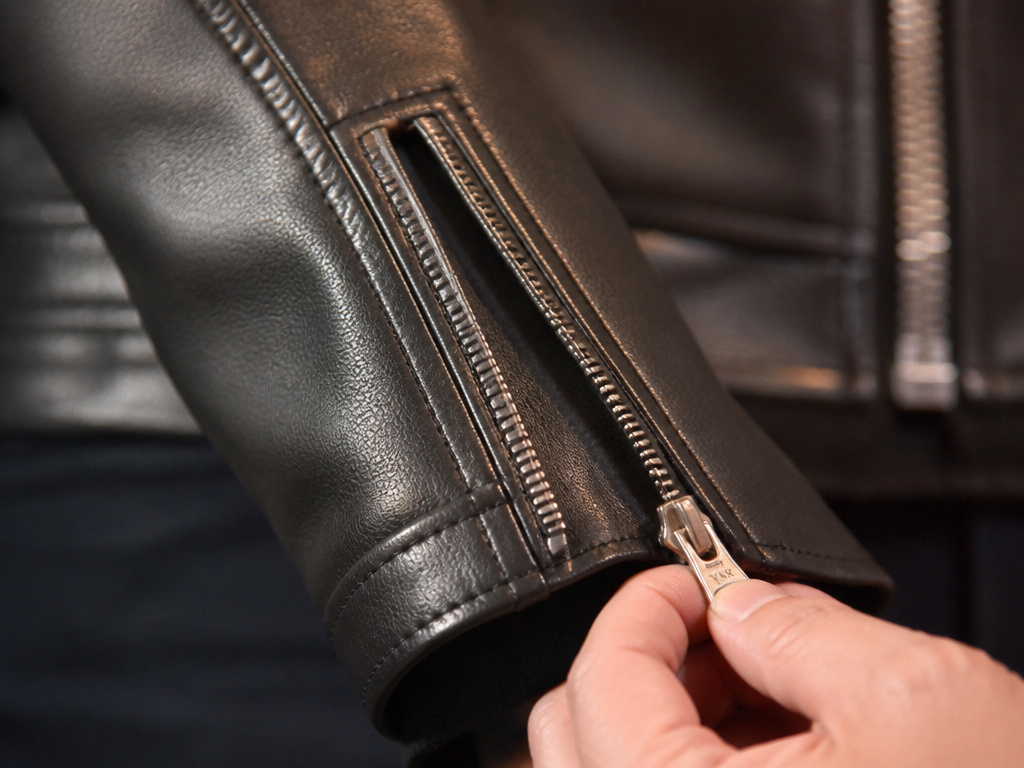
It’s easy to see a row of pockets and stitches as just decoration. On a real moto jacket, they’re not. Let’s break down the common features.
- Zippered Sleeve Cuffs: Adjustable for a tight seal to keep wind out. Often have wind flaps behind the zip for an extra layer of blockage.
- Action Back / Bi-Swing Back: Gussets or pleats across the upper back and underarms. This dramatically increases mobility without stretching the main leather panels, crucial for reaching for handlebars.
- Armor Pockets: Internal slots at the shoulders, elbows, and back for inserting CE-rated protective pads. A telltale sign of a jacket built for actual riding, not just style.
- Removable Liners: A quilted or thermal liner that zips in. Allows you to adapt the jacket to seasonal temperatures. A fixed liner, like the 3oz polyfill in the Schott 519, is simpler but less versatile.
- Stitch Density: This is a hidden spec. Look closely at the stitching, especially at shoulders and side seams. It should be tight, even, and preferably double-needle stitched. Single stitching is a weak point that will fray under stress.
Where this goes sideways: Storing a leather moto jacket on a thin wire hanger. The hard edges distort the shoulder shape into unnatural points over a single season. Always use a wide, padded hanger.
Here’s a practical example of how specs translate. I’ve seen people panic when a white haze appears on a new jacket. This is called “bloom” or wax efflorescence, harmless oils or waxes from the tannery rising to the surface. It buffs off with a soft cloth. The first time I encountered it, a customer was convinced their expensive Schott was molding. Understanding the material’s behavior stops that worry cold. The leather will tell you what it needs, and often it’s just a gentle buffing.
Moto Jacket vs. Biker Jacket: Is There a Difference?
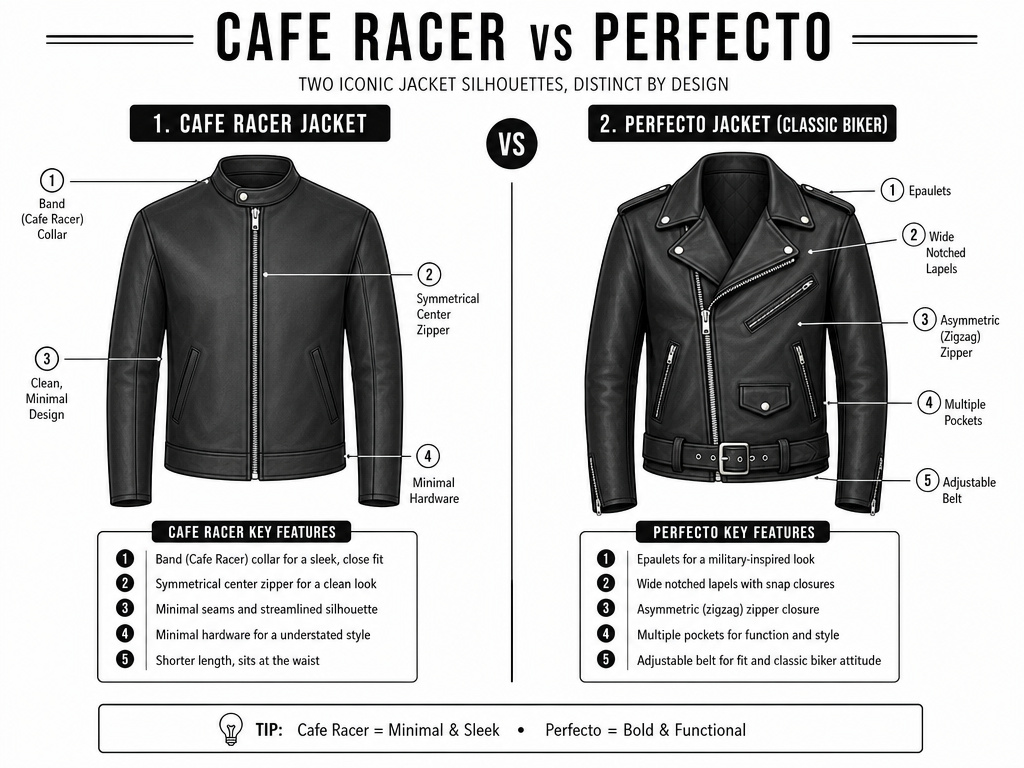
The terms are used interchangeably now, but there is a technical distinction rooted in those original silhouettes. Think of “moto jacket” as the broader category of motorcycle-inspired design. The “biker jacket” is a specific subtype within it: the heavier, more ornamented, belt-and-epaulet style exemplified by the Schott Perfecto.
A moto jacket can be the cleaner, sleeker Cafe Racer. A biker jacket is almost always the asymmetric Perfecto style with more rugged details. In practice, if someone asks for a “biker jacket,” they’re picturing the classic Perfecto. If they ask for a “moto jacket,” they might be open to the Cafe Racer’s cleaner lines. For a detailed look at the iconic style, our guide to the history of the biker jacket covers its evolution from gear to cultural symbol.
Choosing the Right One for You
Your decision hinges on one question: are you buying this for riding, or for style? Your answer dictates everything from budget to leather choice.
For Riding (Function First):
- Leather: Cowhide or steerhide, 1.0-1.4 mm thick.
- Armor: Look for CE-rated armor pockets at minimum at elbows and shoulders. A back protector pocket is a major plus.
- Fit: It should be snug when standing but not restrict movement when you assume a riding tuck. The sleeves should be long enough to cover your wrists when your arms are extended forward.
- Brands: Look at performance-focused brands or the riding-specific lines from heritage makers. The process for how to choose a motorcycle jacket walks through these fit and safety checks step-by-step.
For Style (Form First):
- Leather: You have more flexibility. Lambskin or thinner top-grain cowhide will be softer and break in faster for daily comfort.
- Fit: Go for the silhouette you love. A slimmer fashion fit, like the Schott 519’s tapered arms, is fine here.
- Details: Focus on craftsmanship, quality stitching, nice hardware, a good lining. You’re buying an heirloom, not armor.
- Brands: Heritage brands like Schott NYC or premium fashion-makers like Taylor Stitch, whose Moto Jacket in 3.5-oz steerhide is handmade in San Francisco.
| Priority | Leather | Key Features | Fit |
|---|---|---|---|
| Riding & Protection | 1.0-1.4 mm Cowhide/Steerhide | CE armor pockets, reinforced seams, action back | Snug, riding-position tested |
| Style & Daily Wear | Lambskin, <1.0mm Cowhide | Quality hardware, clean lining, desired silhouette | Tailored, comfortable standing |
Most people fall somewhere in the middle. You might want a jacket that looks authentic and is built well enough for occasional rides. In that case, a mid-weight jacket from a reputable brand is your target. Our curated list of the best leather moto jackets highlights options that balance both worlds.
Frequently Asked Questions
Is a moto jacket only for motorcycle riders?
No. While its DNA is purely functional motorcycle gear, the moto jacket has been a fashion staple for decades. Many people buy them solely for their style, durability, and iconic look, never intending to ride. Just be aware that a fashion-focused jacket may not offer the same protective specs as one built for the road.
What’s the difference between a moto jacket and a bomber jacket?
The cuts and origins are completely different. A moto jacket is defined by its asymmetric zip, snap-down lapel, and longer back, born from motorcycle needs. A bomber jacket has a centered zip, a ribbed hem and cuffs, and a loose fit, originating from military flight jackets. For a full comparison, see our guide on the differences between bomber and biker jackets.
Can you wear a moto jacket in the summer?
It’s challenging but possible. Look for jackets with removable thermal liners and ventilation zippers, like the GPI Moto jacket which has front and rear vents. A jacket made from perforated leather is another option, though rarer. Most often, a moto jacket is a spring, fall, or winter layer.
How should a moto jacket fit?
It should fit snugly but not tight across the shoulders and chest when standing. When you sit or mimic a riding position, there should be no major pulling across the back or shoulders. The sleeves should be long enough to cover your wrists when your arms are stretched out toward handlebars. A jacket that’s too loose will flap and bunch uncomfortably on a bike.
Are more expensive moto jackets always better?
Not always, but there’s a strong correlation. Price often reflects material cost (thicker leather, better hardware), construction (hand-cutting, double-stitching), and brand heritage. A $1500 jacket isn’t automatically better than a $600 one if you’re only using it for casual wear. The trick is to match the jacket’s specs and construction to your actual use case. Sometimes, a solid mid-tier jacket is the most rational choice.
Before You Go
The moto jacket isn’t a trend. It’s a nearly hundred-year-old tool that became a legend. That longevity comes from a simple fact: its design works. Whether you’re buying it as armor or as art, now you can read past the marketing and see the engineering underneath.
Remember the 1.0-1.4 mm rule for riding. Remember that YKK on a zipper pull is a better sign of quality than any adjective in a product title. And if you ever get a jacket with Schott’s “pull-up” leather and wonder about conditioning, know that you’re choosing between preserving its unique, evolving patina and applying oils that will darken it forever. That’s not a flaw; it’s a material telling you its story. Your job is to listen.
