
What Is a Biker Jacket | The 3-Part Test That Defines It
This post contains affiliate links. As an Amazon Associate, we earn from qualifying purchases.
A biker jacket is a short, waist-length jacket defined by three things: a durable outer shell (traditionally leather), a close-fitting waist secured by a belt or snap, and functional hardware, most notably an asymmetric zipper, designed for wind protection and abrasion resistance on a motorcycle. While it’s a fashion icon, its original DNA is wearable armor.
That definition separates it from every other leather outerwear style. The silhouette you know, the one worn by Brando and rock stars, isn’t just for looks. Every stitch, snap, and zip on the original had a job. Today, that template has splintered into purely fashion pieces and serious protective gear, which is where most of the confusion starts.
What follows is a breakdown of that original three-part formula, the materials that make it work, and how to tell a jacket that’s all show from one that’s built to save your skin.
Key Takeaways
- The core biker jacket silhouette, asymmetric zip, belted waist, snap lapels, was solved in 1928 by Schott’s Perfecto for purely functional riding reasons.
- For actual riding protection, look for integrated CE-rated armor (EN 1621-1) at the elbows and shoulders; a back protector pocket alone usually holds just foam.
- Leather at 1.0–1.3mm thickness offers superior abrasion resistance and molds to your body, while modern textiles like Cordura provide better weather sealing and ventilation. A proper riding fit is snug in the torso when standing but must not bind when you reach forward for handlebars; a fashion fit is looser.
- Conditioning leather too often, based on a schedule rather than need, leads to a greasy buildup that clogs the pores and stiffens the jacket instead of softening it.
The 3-Part Test That Defines a Biker Jacket
Forget the cultural baggage for a minute. Let’s look at the jacket on a workbench. You can identify a true biker jacket, one built from the original blueprint, by checking for three specific, required features. If it’s missing one, you’re looking at a different style of leather jacket.
First, the shell is a single, durable material meant to take abuse. Traditionally, that’s thick leather. Second, the waist is close-fitting and secured, almost always by a belt or series of snaps. This stops the jacket from ballooning with air at speed. Third, the hardware is functional, not decorative. The asymmetric zipper is the flagship here, offset so the wind flap lays flat against the chest when you’re leaned forward over the bars.
The classic biker jacket template, exemplified by the 1928 Schott Perfecto, was an engineering solution. The asymmetric zipper managed wind flap, the snap-down lapels became a neck seal, and the belted waist prevented billowing. Nothing was added for style alone.
These features appear on everything from a $200 fashion jacket to a $2,000 riding suit. The difference is in the execution. On a serious protective motorcycle jacket, the stitching is denser (more stitches per inch), the zippers are heavy-duty YKK or Riri, and the leather is a full 1.2mm thick. On a fashion piece, the belt might be faux, the zipper lightweight, and the leather thin and supple for a broken-in feel off the rack. Both pass the three-part test, but only one is meant for a crash.
From Harley-Davidson to High Fashion: A Brief History
Irving Schott designed and sold the first biker jacket to Harley-Davidson dealers in 1928 for $5.50. He named it the Perfecto. The U.S. Military bought them during World War II, which put the design into the hands of thousands of servicemen. Many came home, bought motorcycles, and already had the uniform. The jacket was grafted onto the emerging outlaw biker image in the 1950s after Marlon Brando wore one in The Wild One.
By the 1970s, the Ramones adopted it as a punk uniform. By the 1980s, it was a universal symbol of rebellion worn by people who’d never ridden. This is the rare case where a purely functional item crossed into mainstream fashion without abandoning its original purpose. You can still buy a Schott 618 today, and it still works on a bike. As the Wikipedia entry on motorcycle PPE notes, its evolution from riding gear to cultural icon is well-documented, but its protective DNA remains.
The history matters because it explains the split in the market. Do you want the icon, or do you want the armor? Most people buying a biker jacket style today want the icon. And that’s fine. But understanding that split is the first step to buying intelligently.
Leather, Textile, and the Physics of Protection
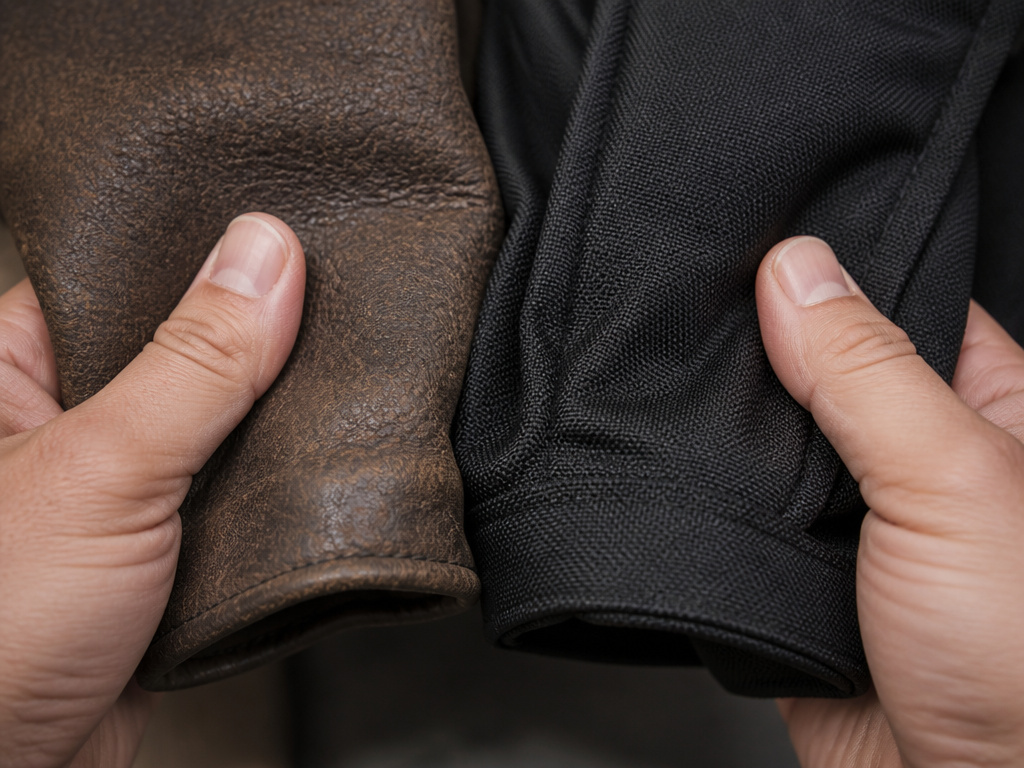
This is where the conversation gets practical. The shell material isn’t an aesthetic choice; it’s a decision about physics. Your jacket needs to resist two things in a slide: abrasion (the grinding away of material) and tear force (the ripping apart at seams).
Leather, specifically cowhide between 1.0 and 1.3mm thick, is the classic benchmark. It’s incredibly abrasion-resistant. When it’s good, it’s very good. But leather also breaks in. It molds to your shoulders and riding posture over months. A textile jacket fits the same on day one and day five hundred; a leather jacket becomes a custom fit. The trade-off? Leather is heavier, hotter, and requires more care. Goatskin is lighter and softer but offers less abrasion resistance. The “horsehide is always better” myth is just that, a myth. It’s often stiffer and heavier than a premium cowhide.
Modern textiles like Cordura (a branded nylon) or blends with Kevlar are the other path. They’re lighter, often include waterproof and breathable membranes, and feature massive ventilation panels. Their abrasion resistance is excellent, but they feel different. They won’t mold to you; they’ll always have that crisp, technical outerwear feel.
| Material | Best For | The Trade-Off |
|---|---|---|
| Cowhide (1.0-1.3mm) | Maximum abrasion resistance, classic look, develops a patina. | Heavy, minimal ventilation, requires breaking in and regular conditioning. |
| Textile (e.g., Cordura) | Weather protection, lightweight, excellent ventilation, often pre-armored. | Lacks the classic look, doesn’t mold to the body, can feel “technical.” |
| Goatskin | A softer, more supple feel from day one with decent protection. | Less abrasion resistance than thick cowhide, more prone to scuffing. |
The shell is just the first layer. The real protection in a modern riding jacket comes from the armor underneath.
The Armor Inside: CE Ratings and Why They Matter
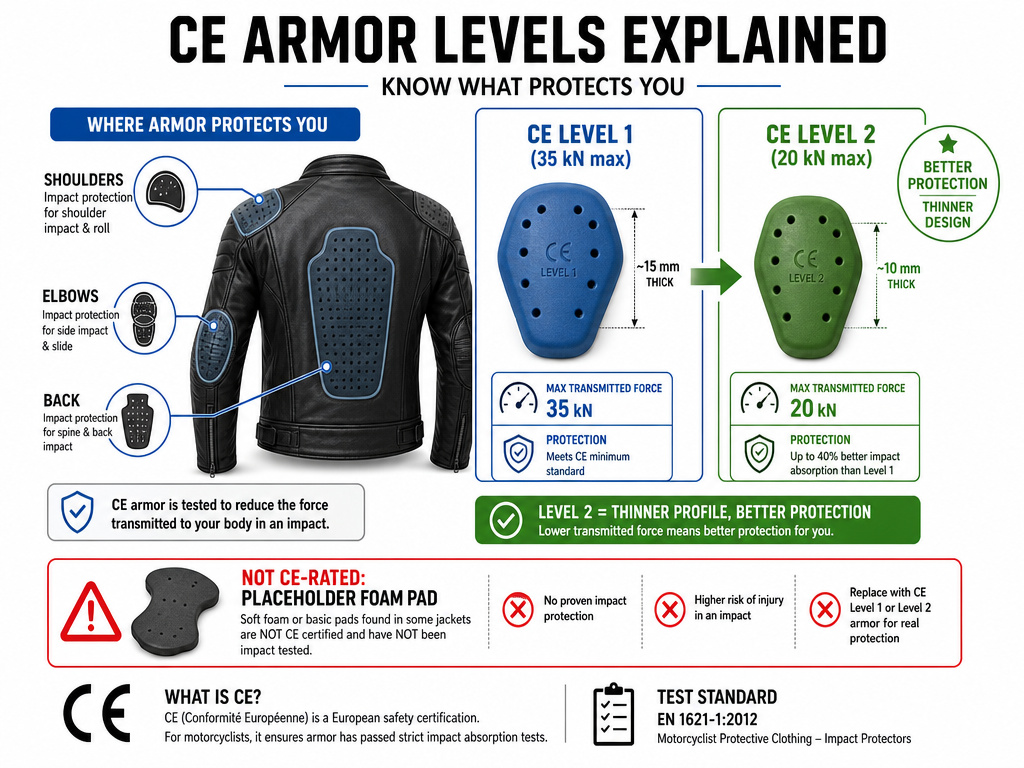
If you’re buying for riding, CE armor is the single most important spec to understand. CE stands for Conformité Européenne, the European safety standard that’s the global benchmark. A jacket with CE-rated armor (tested to EN 1621-1) has hard or soft protectors at the elbows, shoulders, and often the back that are designed to absorb and spread impact energy.
Where this goes sideways: Assuming the foam pad in the back protector pocket is safe. Most jackets ship with a placeholder foam slab that is NOT CE-rated. If the jacket has a back pocket, you must buy a separate CE Level 1 or Level 2 insert.
Here’s the breakdown of the levels: * CE Level 1: Allows a maximum average force transmission of 35 kN during a standardized impact test. This is the baseline. * CE Level 2: Allows a maximum of 20 kN. This is better, thinner, and more expensive armor.
You’ll find this armor in dedicated motorcycle jacket gear from brands like Alpinestars or Dainese. You will almost never find it in a classic-style bomber jacket or a fashion-first biker jacket. This is the bright line between a “biker jacket” as a style and a “motorcycle jacket” as protective equipment. Research, like the 2025 peer-reviewed study on quilted leather jackets, continues to refine these protective systems, integrating armor into designs that don’t sacrifice the classic silhouette.
Biker vs. Bomber vs. Cafe Racer: Silhouette Spotting
The biker jacket has cousins. Knowing them helps you confirm what you’re actually looking at.
The bomber jacket (or flight jacket) is defined by a ribbed knit collar, cuff, and waistband, and a front zipper that’s almost always centered. It’s a roomier, boxier fit originally designed for pilots in open cockpits. The key differences between bomber and biker jackets are profound: the bomber lacks the biker’s defining asymmetric zip, belted waist, and snap lapels.
The cafe racer jacket is the biker jacket’s minimalist sibling. It borrows the same basic torso shape but strips away the belt and the asymmetric zip. It typically has a simple center zip, a standing collar (no lapels), and is often slightly longer. It’s a cleaner, more streamlined look born from 1960s British motorcycle culture. The design features of a cafe racer jacket are all about reduced bulk for speed.
| Jacket Type | Defining Features | Origin & Vibe |
|---|---|---|
| Biker | Asymmetric zip, belted waist, snap lapels, epaulets. | 1928 Schott Perfecto; rebellious, functional, armored. |
| Bomber | Ribbed knit collar/cuff/waist, centered zip, boxy fit. | WWI/WWII flight jackets; casual, military-inspired, versatile. |
| Cafe Racer | Center zip, standing collar, no belt, minimalist hardware. | 1960s British motorcycle scene; sleek, minimalist, retro. |
Fit, Care, and Making It Yours
The right fit depends entirely on the jacket’s purpose. For riding, it must be snug in the torso and arms when you’re standing. Not tight, but with no loose material that can flap or bunch up. Then, you must test the reach. Sit on a bike (or mimic the posture). Can you grip imaginary handlebars without the jacket pulling hard across your back and shoulders? If it binds, it’s too small. A jacket that feels perfect in the store, standing straight, will be too big on the bike.
For a fashion jacket, the rules loosen. You can go for a slightly roomier fit for layering. The most common mistake is storing any leather jacket on a wire hanger. Within a season, the shoulders will develop permanent, pointy deformities. Use a wide, padded hanger.
Care is its own discipline. For leather, use a dedicated leather cleaner and conditioner, not saddle soap, not dish soap, not olive oil. Condition only when the leather feels dry, not on a calendar schedule. Over-conditioning is a real problem. It leads to a greasy buildup that clogs the leather’s pores and can actually attract dirt, making the jacket stiff and dirty. I’ve seen it too many times. Textile jackets are easier: remove all the armor, wash on gentle with a technical cleaner (not detergent), hang dry, and reapply the DWR water-repellent coating if needed.
Frequently Asked Questions
Are all biker jackets made of leather?
No. While leather is the traditional and iconic material, modern biker-style jackets are also made from technical textiles like Cordura, often for better weather protection and ventilation. The silhouette defines the style, not the material.
Can you wear a biker jacket if you don’t ride a motorcycle?
Absolutely. The biker jacket is a foundational fashion item. The key is understanding that a fashion biker jacket and a protective motorcycle jacket are different products. One prioritizes style and comfort for daily wear; the other includes armor and heavier construction for crash protection.
What’s the difference between a biker jacket and a motorcycle jacket?
All motorcycle jackets are designed for riding protection, but not all biker jackets are protective. A “motorcycle jacket” is a functional category that includes armored textiles, racing leathers, and armored biker-style jackets. A “biker jacket” is a style category that includes both fashion replicas and those functional motorcycle jackets that use the classic biker silhouette.
How should a real motorcycle jacket fit?
It should fit snugly, like a second skin, without any bagginess that could flap in the wind or bunch up under armor. The most critical test is the riding position: when you mimic holding handlebars, the jacket should not pull tightly across your back or restrict shoulder movement. It will feel tighter than a fashion jacket.
How do I clean my leather biker jacket?
Use products designed for the type of leather you have. For most cowhide jackets, a damp cloth for dust, followed by a dedicated leather cleaner for grime. After cleaning, apply a light coat of a leather conditioner like Bick 4 or Lexol only if the leather feels dry. Let it absorb fully before wearing.
Before You Go
Let’s be clear about one thing. The biker jacket is a unique object because it carries two parallel histories: one of pure function, one of pure symbol. Your buying decision comes down to which history you want to participate in.
If you want the symbol, buy the jacket that speaks to you. Look for good lambskin vs cowhide comparisons if softness is your priority, and enjoy it. But if you’re buying for the bike, the checklist changes. Ignore the marketing copy about “tough leather.Check for the CE EN 1621-1:2012 label inside the armor pockets, ensure the stitch density is at least 7-8 stitches per inch, and test the fit in a riding crouch. That’s how you find the real thing.
The leather will tell you what it needs. Listen to it, don’t drown it. And throw a leg over. The miles write the best story a jacket can ever tell.
