
What Is a Penny Loafer? The History of a Classic Slip-On Shoe
This post contains affiliate links. As an Amazon Associate, we earn from qualifying purchases.
A penny loafer is a slip-on leather shoe characterized by a low profile, a moccasin-inspired construction, and a distinctive leather strap across the vamp with a diamond-shaped cutout. Historically, that slot was sized to hold a dime or a penny, a practice born from Ivy League students in the 1930s who kept emergency change for payphones. Its journey from Norwegian work shoe to American campus icon to Wall Street boardroom staple is a story of accidental style.
That detail about the slot’s original purpose is the part most people miss. We see the penny as decoration now, but it started as a pragmatic, if slightly superstitious, bit of utility. The shoe’s real genius isn’t the coin slot, it’s the fusion of a soft moccasin upper with a separate, durable sole. That hybrid construction is what let it move from the farmyard to the frat house to the financial district without losing its essential character.
What follows is a breakdown of the loafer’s anatomy, the three key origin stories that shaped it, and the specific construction details that separate a quality pair from a cheap imitation. By the end, you’ll be able to read a loafer’s story in its stitches.
Key Takeaways
- The penny loafer’s defining feature is a leather saddle strap with a diamond cutout, a design addition by G.H. Bass in 1936 that created the “Weejun.”
- True construction is moccasin-based, with a gathered toe stitch and a separate sole, differentiating it from a true soft-soled moccasin.
- The “penny” tradition is functionally obsolete (no payphones, airport security hassles), making the slot a purely stylistic heritage detail.
- Quality is signaled by full-grain or top-grain leather, tight “beef roll” puckering on the strap sides, and a flexible, stitched, not glued, sole.
- Its style trajectory from casual to formal was dramatically accelerated by 1980s airport security, as brokers needed shoes they could slip off quickly.
The Anatomy of a Penny Loafer
Look past the basic slip-on shape. A real penny loafer is a set of specific components working together. The first thing you notice is the leather saddle strap laid across the vamp. This isn’t just decoration; on early models, it added structure to a soft leather upper. The strap’s sides often puff out into what’s called a beef roll, a puckered, rounded edge that indicates quality leather that’s been lasted and sewn under tension, not just glued flat.
The defining technical feature of a penny loafer is the moccasin construction. This involves a single piece of leather (the upper) that wraps under the foot and is sewn to a separate, harder-wearing sole at the “vamp point” near the toe, creating a distinctive gathered seam. This differs from a Blake or Goodyear welted shoe, where the upper is attached to an insole first.
The diamond-shaped slot cut into that strap is precisely that: a slot. Its original dimensions were reportedly sized for a U.S. Dime. The sole is the other critical piece. A true loafer has a separate heel and sole unit stitched or cemented on, providing far more support and durability than a true moccasin, which has a single, flexible leather bottom. This hybrid design is the engineering secret to its longevity.
Three Origin Stories, One Iconic Shoe
The loafer didn’t have a single “eureka” moment. It converged from three separate threads, which explains the subtle variations you see today.
First, the Wildsmith Loafer. In 1926, London bootmaker Raymond Lewis Wildsmith created the “Model 582” for the Duke of Windsor (then Prince Albert, later King George VI) as a comfortable country house shoe. It featured a distinctive serrated seam on the toe and a more structured shape. This is the posh, aristocratic ancestor.
Across the North Sea, Norwegian shoemaker Nils Gregoriussen Tveranger was blending influences. In his hometown of Aurland, he combined the local teser (a fisherman’s slip-on) with Native American moccasin construction he’d seen during an apprenticeship in Boston. The resulting Aurlandskoen (Aurland shoe), debuted around 1930, had the soft, gathered toe we associate most with modern loafers.
The third thread is the one that glued the name “penny” to the shoe forever. American bootmaker G.H. Bass of Wilton, Maine, was introduced to the Aurland design by retailers. Initially, founder John Bass thought it looked “like a house slipper to be worn outdoors.” He was persuaded, and in 1936, Bass launched the “Weejun” (a play on “Norwegian”). The key addition was that signature strap with the slot. College students soon started slipping coins into them, and an icon was born.
Penny Loafer vs. Other Slip-Ons: A Style Map
Not all slip-on leather shoes are penny loafers. The category has siblings and cousins, and knowing the difference saves you from a style misfire.
| Style | Key Identifying Feature | Best For | Common Mistake |
|---|---|---|---|
| Penny Loafer | Leather saddle strap with diamond slot. | Smart casual, business casual, Ivy-style looks. | Wearing with bulky socks; it’s designed for no-shows or bare skin. |
| Tassel Loafer | Leather tassels dangling from a central saddle. | Business formal, trad style. Can be flashier. | Pairing with very casual jeans; the tassels elevate the formality. |
| Gucci Loafer (or Horsebit) | Metal horsebit strap across the vamp. | Fashion-forward business wear, elevated casual. | Assuming all metal-bit loafers are equal; construction quality varies wildly. |
| Moccasin | Soft, single-piece leather upper with a flexible sole. Often no separate heel. | True casual, indoor/outdoor house shoes. | Using as all-day walking shoes; they offer little arch support. |
| Driving Loafer | Nubbed rubber sole (like a car’s pedal grip) and often a more minimalist upper. | Casual summer wear, actual driving (hence the name). | Wearing in wet weather; the thin, soft leather and rubber nubs aren’t built for it. |
The penny loafer sits in the middle of this spectrum. It’s more formal than a moccasin but less ornate than a tassel loafer. Its versatility is its weapon. The wrong move is treating a cheap, plastic-looking “loafer” with a glued sole as if it’s in the same league as a stitched, full-grain leather version. They might look similar from ten feet away, but they’ll age completely differently.
How the “Penny” Went From Practical to Purely Ornamental
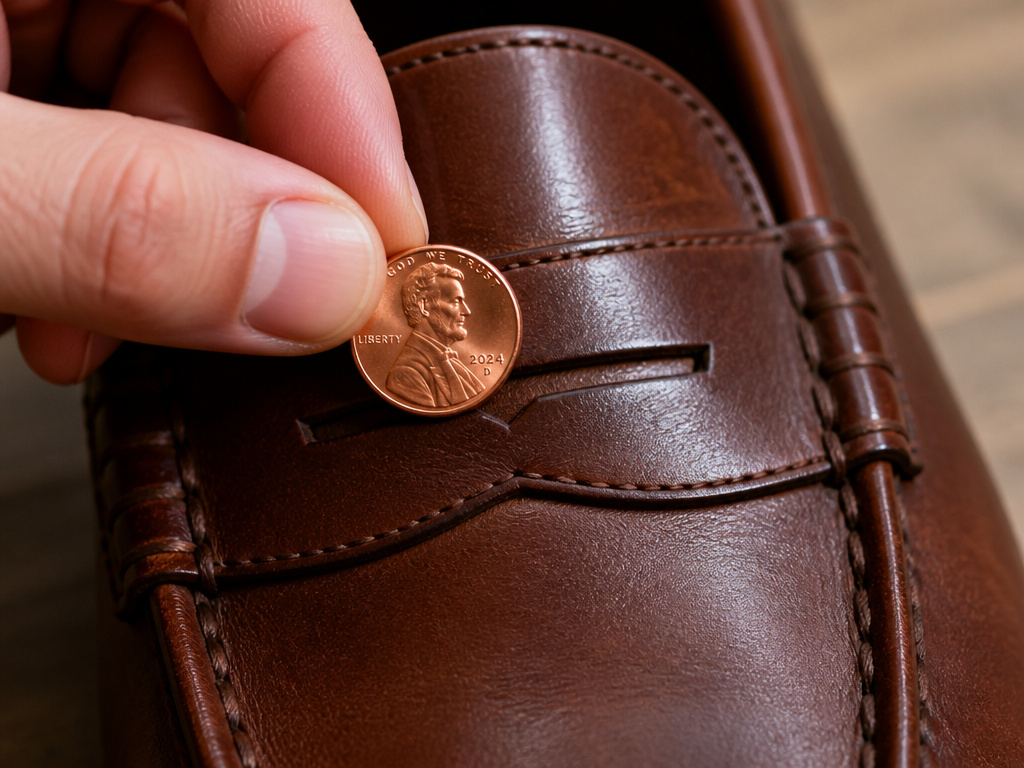 Let’s be clear about the penny. Its original purpose is dead. The romantic story is that Ivy League students in the late 1930s kept a dime (and later a penny) in the slot for emergency phone calls. This was a real practice. But today, it’s a relic for two concrete reasons.
First, the payphone is extinct. The emergency-call utility vanished decades ago. Second, and more practically, putting a coin in your shoe before airport security is a fantastic way to get pulled aside for additional screening. The metal detector will ping, and you’ll be explaining your fashion history to a TSA agent while your flight boards.
So why does the slot persist? It’s pure heritage branding now, a coded nod to the shoe’s history. It’s a design signature, like the stripes on Adidas sneakers. Some purists still pop a shiny new penny in for a classic look, but it’s decoration. The slot itself, however, is fixed. If the shoe doesn’t have it, it’s not a penny loafer; it’s just a plain slip-on.
Where this goes sideways: Assuming a penny must be present. The shoe is defined by the slot’s potential to hold one. A loafer without a coin is still a penny loafer. A shoe without the slot is something else entirely.
Spotting Quality: Construction Over Brand Name
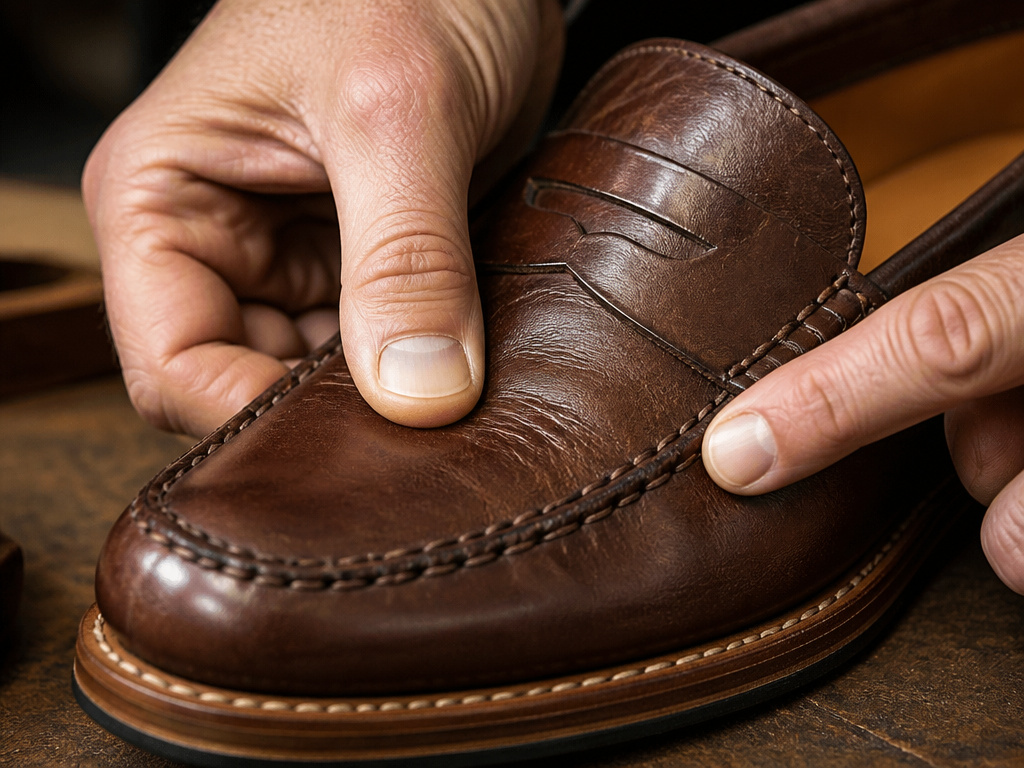 A famous brand doesn’t guarantee a well-made loafer. You have to look at the thing itself. Here’s what separates a lasting investment from a disposable fashion piece.
Leather is everything. Touch it. Quality penny loafers use full-grain or top-grain leather. It should feel supple but substantial, with visible natural grain and pores. Avoid anything with a uniform, plastic-like coating; that’s a corrected grain or bonded leather hiding flaws, and it won’t develop a natural leather patina, it’ll just crack. * The “Pinch Test”: Gently pinch the leather. Good leather will wrinkle naturally and bounce back. Cheap leather will crease stiffly or show a white stress line.
Examine the stitching. The stitching along the moccasin seam and where the strap attaches should be even, tight, and without loose threads. This is a sign of careful leather craftsmanship. On the inside, check the heel lining and insole. Rough, unfinished seams here are a red flag, where you can’t see is where manufacturers cut corners first.
The sole tells the final story. A stitched sole (either Blake or Goodyear welt) is the gold standard, as it can be resoled by a cobbler. Many good loafers use durable cemented construction, but be wary of a sole that feels like lightweight, foamy plastic. It will wear out in a season. A leather sole is dressier but slippery; a thin rubber topy or a Dainite-style sole adds practicality without ruining the profile.
I learned this the hard way with an early pair I bought on price alone. The leather looked fine, but the sole was a single piece of cheap, spongy rubber glued on. Within four months of city walking, the heel wore through to the midsole. The lesson was immediate: the foundation matters as much as the facade.
A Timeline of Surprising Turns
The penny loafer’s path wasn’t a straight line from casual to formal. It was pushed by cultural shifts and pure practicality.
- 1926 & 1930: Aristocratic (Wildsmith) and utilitarian (Aurlandskoen) origins.
- 1936: G.H. Bass commercializes the Weejun, adding the strap and slot.
- Late 1930s – 1950s: Adopted by Ivy League students. The “penny” tradition begins.
- 1960s: Breaches the business-casual barrier, moving from campus to office in America.
- 1980s: The key accelerant. With increased airport security, Wall Street brokers needed shoes they could remove and replace quickly. The slip-on loafer became a uniform, pushing it into full suit territory.
- 1998: A symbolic end of an era. After 122 years, G.H. Bass shuttered its Maine factory, moving Weejun production offshore. The American-made chapter closed.
- 2000s – Present: Cyclical revivals, often in more rugged or minimalist forms. The penny loafer is now a permanent, versatile fixture in the style lexicon.
Its ability to cross class and context lines is unique. Few shoes have been worn by Norwegian fishermen, English royalty, American presidents, and Michael Jackson (whose famous moonwalk was performed in penny loafers).
Frequently Asked Questions
Are penny loafers still in style?
Yes, persistently so. They cycle in and out of high-fashion focus, but as a classic element of American and trad style, they never fully disappear. Their current strength is in smart casual wear, with tailored trousers, jeans, or shorts. A well-made pair is a permanent wardrobe staple, not a trend.
Can you wear penny loafers with a suit?
You can, but context matters. In traditional, conservative business environments (law, finance, certain government roles), they may still be too informal. In modern business-casual, creative, or tech settings, they are perfectly acceptable and even stylish. The key is fit and formality: choose a sleek, unadorned loafer in dark, polished leather, and wear them with no-show socks.
What’s the difference between a loafer and a moccasin?
This is a fundamental construction difference. A moccasin is made from a single piece of leather that forms both the upper and the sole, which is soft and flexible. A loafer uses moccasin construction for the upper (the gathered toe seam) but then attaches that upper to a separate, harder sole and heel unit. All penny loafers are loafers; not all loafers are moccasins. For a deeper dive, our guide on loafers vs moccasins breaks it down.
Why are some penny loafers so expensive?
Price reflects materials, construction, and provenance. A $400+ loafer typically uses premium full-grain leather, is hand-lasted and stitched (often in Italy, the UK, or a small U.S. Workshop), and can be resoled. You’re paying for longevity, comfort that molds to your foot, and superior leather quality. A cheap pair uses corrected leather, glue-based construction, and will need replacing in a year or two.
How should penny loafers fit?
Snugly, but not tight. Your heel should sit firmly in the cup with minimal slip. The sides shouldn’t pinch. Because they are slip-ons with no laces to adjust, the fit must be precise from the start. Leather will stretch widthwise slightly over time, but length won’t change. Always try them on in the afternoon when your feet are naturally slightly larger.
The Bottom Line
A penny loafer is more than a shoe without laces. It’s a specific historical artifact that evolved through a blend of European craftsmanship and American campus culture. The slot is a fossil of a dead utility, but the shoe’s enduring power comes from its hybrid moccasin construction and chameleon-like ability to dress up or down.
When you’re looking for a pair, let the construction lead. Judge the leather, the stitching, and the sole. That’s what determines whether you’re buying a short-term trend or a long-term companion that will age with character. And forget the penny, the only thing that needs to be solid metal is the buckle on your belt, not the change in your shoe.
