
What Is Suede Leather | The Delicate Underside Explained
This post contains affiliate links. As an Amazon Associate, we earn from qualifying purchases.
This post contains affiliate links. As an Amazon Associate, we earn from qualifying purchases.
Suede leather is the soft, napped material created by buffing and raising the fibrous underside (or “flesh side”) of an animal hide. It’s distinct from full-grain leather, which uses the tough outer grain layer, making suede more pliable and breathable but less durable and water-resistant.
That definition is the starting point. The real distinction lies in where the material comes from within the hide and what that means for how it feels, wears, and ultimately, how you should care for it. Full-grain leather is the skin’s tough outer armor; suede is its soft, fibrous underbelly.
What follows is a breakdown of suede’s anatomy, the science behind its feel, and the practical realities of owning it. This explains how it’s made, why it behaves the way it does, and how to separate marketing hype from material truth.
Key Takeaways
- Suede comes from the flesh side of a hide, giving it a soft nap but sacrificing the outer grain’s natural water and abrasion resistance.
- Apparel suede and footwear suede are engineered for different performance: one prioritizes breathability and flexibility, the other insulation and durability.
- Suede’s open pores make it highly susceptible to oil absorption and dye migration (crocking), which dictates a specialized, brush-first care routine.
- Modern tanning can produce water-resistant suede, but this often trades off some of the material’s innate breathability and soft hand-feel.
- The most common care mistake is using a standard leather conditioner, which will mat the nap and create permanent dark spots.
The Anatomy of Suede: Where It Comes From
Forget the idea of suede as a separate animal. It’s a finish, not a species. Every piece of leather has two sides: the grain and the flesh. The grain side is the hide’s outer surface, marked by the animal’s pores and natural markings. It’s dense, tough, and naturally water-shedding. The flesh side, also called the corium or split layer, is the fibrous, spongy underside revealed after the hide is separated from the animal.
Suede is produced by abrading the flesh side of a hide with a sanding wheel or wire brush. This process raises and separates the tiny collagen fibers, creating the characteristic velvety nap. The depth and uniformity of this nap depend on the coarseness of the abrasive and the quality of the underlying split.
Suede can be made from almost any animal hide, lamb, goat, calf, and deer are common, but the source changes the character. Lamb suede is famously soft and lightweight, ideal for shirts and delicate gloves. Goat suede is more resilient with a finer nap, a favorite for high-end jackets. Thicker hides from cows or deer are often split into layers, with the inner splits being sueded. This is the origin of split suede, a more affordable but less robust material.
The takeaway is simple: you’re using the part of the leather that was never exposed to the elements. It lacks the tight, protective fiber structure of the grain. That’s why it feels so soft, and that’s also why it stains so easily.
How Suede Behaves: Breathability vs. Durability
Because its fibers are raised and open, suede acts like a textile. Air moves through it. Moisture vapor escapes. This makes it remarkably comfortable to wear. A suede jacket breathes in a way a full-grain leather jacket never will. But those open fibers also grab onto everything, dust, oil, water.
The science here is specific. A peer-reviewed study in the Journal of Materials Science directly compared apparel suede and footwear suede. The researchers measured properties like tensile strength, elongation, and air permeability according to International Organization for Standardization (ISO) standards. The results aren’t just academic; they explain why your suede boots and suede jacket feel so different.
| Property | Apparel Suede | Footwear Suede | Why It Matters |
|---|---|---|---|
| Air Permeability | Significantly Higher | Lower | Garments stay breathable; boots offer more wind resistance. |
| Tensile Strength & Elongation | Higher | Lower | Clothing needs to stretch and move with the body without tearing. |
| Thermal Resistance | Lower | Higher | Boots are designed to insulate the foot from cold ground. |
| Tactile Sensation | Warmer feel | Cooler feel | The suede leather comfort study linked this to the material’s density and fiber arrangement. |
Footwear suede is often made from thicker splits or is chemically treated to compact the nap, trading some softness for toughness. Apparel suede is buffed to maximize loft and flexibility. They’re two different tools for two different jobs.
The Core Challenges: Oil, Water, and Dye
Suede’s beauty is high-maintenance. Its vulnerabilities are physical and chemical.
First, it’s an oil magnet. Body oils from your wrists, grease from a kitchen counter, even the natural oils from your hair on a headrest, they all get pulled into those open fibers. The oil darkens the leather and causes the nap to clump together into hard, matted spots. This isn’t a surface stain you can blot. The oil wicks into the material’s core.
Second, water behaves unpredictably. A pure water spill can darken suede as the fibers clump, but it often dries and the nap can be resurrected with vigorous brushing. The bigger, hidden threat is dye migration, or “crocking.” Many suedes, especially darker colors, use dyes that are not fully stable.
Where this goes sideways: Getting a water-based liquid (rain, a drink spill) on an unstable dye. The water mobilizes the dye particles, which then flow to the edge of the wet area as it dries. The result is a permanent, dark ring, a concentrated line of dye, around the original spill spot. This is why testing any cleaner on a hidden seam is non-negotiable.
Finally, suede dries out. The oils and fats used in tanning slowly evaporate or dissipate. Without them, the collagen fibers become brittle. The leather doesn’t necessarily crack like a dry riverbed; it first loses its suppleness, the color looks faded and chalky, and the nap feels stiff. Restoring these oils requires specific, non-greasy conditioners meant for napped leathers.
Caring for Suede: A Brush-First Philosophy
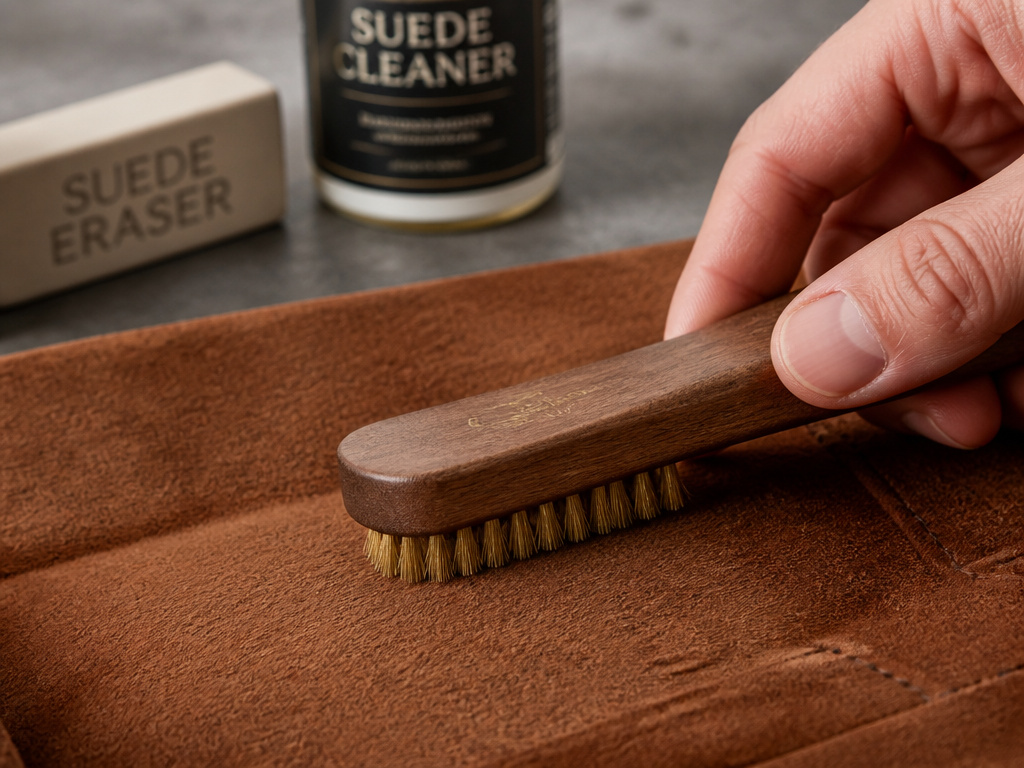 My approach to caring for suede is built on one principle: the less liquid you introduce, the better. The primary tool isn’t a bottle of cleaner; it’s a brush.
A proper suede brush, with brass, gum rubber, or horsehair bristles, is a resurrection tool. Most light soil and surface scuffs are just crushed nap. Systematic brushing, always in one direction following the nap’s natural lie, lifts the fibers back up. It’s the first and last step for routine cleaning suede.
For stains, you escalate methodically. A dry, absorbent powder like cornstarch or specialized suede eraser powder can pull out fresh oil stains. You rub it in, let it sit for hours to absorb the oil, then brush it out. For mud, let it dry completely, then brush and use a gum eraser (like the one in a Kiwi Suede & Nubuck Kit) to rub away the residue.
When you must use a liquid, you need a specialized suede cleaner. I reach for Saphir Omni’Nettoyant Suede. It’s a foam that lifts dirt without soaking the leather. You apply it with a soft brush, agitate, and wipe away with a microfiber cloth. The key is to let the item dry fully away from heat, then brush the nap back to life.
Common mistake: Applying a standard leather conditioner to suede. The oils and waxes in a regular conditioner will saturate and mat the nap, creating a dark, greasy spot that is nearly impossible to reverse. Suede conditioners are spray-on, silicone or fluoropolymer-based products designed to protect without altering the hand.
Protection comes after cleaning. A spray-on protector like Tarrago Nano Protector creates an invisible barrier against water and oil-based stains. It doesn’t make suede waterproof, but it gives you crucial seconds to blot a spill before it soaks in. Reapply it every few months or after a thorough cleaning.
Suede vs. Its Lookalikes: Nubuck and Roughout
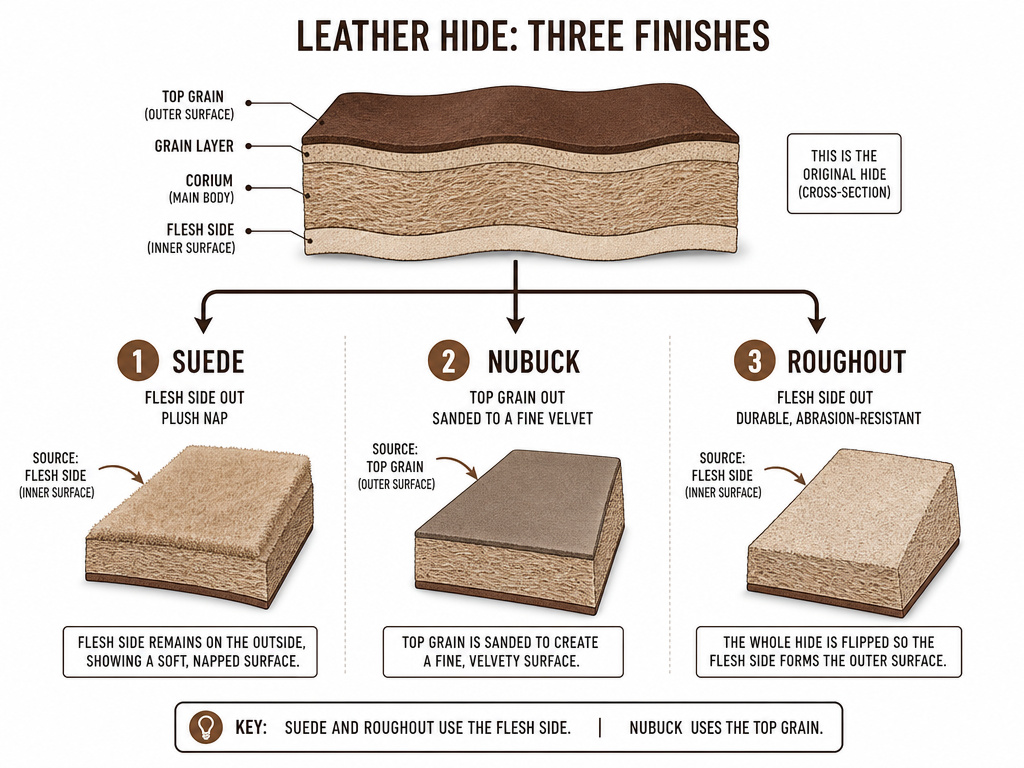 Suede is often confused with its cousins, nubuck and roughout. The difference is foundational.
Nubuck is often called “the aristocrat of suedes.” It starts with high-quality full-grain leather, the top grain side. That top layer is then lightly sanded to create a very fine, velvety nap. Because it uses the dense grain layer, nubuck is more durable and resistant to stretching than suede, but it’s also more expensive. The difference between nubuck and suede is this: suede is the flesh side, nubuck is the sanded grain side.
Roughout leather is the full hide turned inside out. Instead of splitting the hide, the entire piece is used with the tough grain side facing inward and the flesh side facing outward as the wearing surface. This makes roughout incredibly durable, it’s used in work boots and military gear, while still providing the soft, sueded feel against the skin. It’s the most rugged form of a suede finish.
| Material | Source Layer | Durability | Primary Use | Feel |
|---|---|---|---|---|
| Suede | Flesh side (split) | Low to Moderate | Apparel, delicate accessories | Very soft, plush nap |
| Nubuck | Sanded Grain side | High | High-end shoes, bags, jackets | Fine, velvety, smooth |
| Roughout | Whole Hide, flesh side out | Very High | Work boots, outdoor gear, military items | Robust, sueded surface |
Understanding this **[suede vs leather](https://leathergenesis.The suede vs. Leather spectrum helps you check the fill line. Want softness and breathability for a blazer? Choose suede. Need a scuff-resistant finish for boots you’ll actually hike in? Look to nubuck or roughout.
Frequently Asked Questions
Is suede real leather?
Yes, genuine suede is 100% real leather. It is made from the underside (split layer) of an animal hide. The confusion often arises because some synthetic fabrics are marketed as “faux suede” or “ultrasuede,” which are polyester or nylon microfibers.
Can suede get wet?
It can, but you don’t want it to. Water will darken suede and can cause permanent staining if dyes migrate. Modern protectant sprays can improve water resistance, but they are not a guarantee. If suede does get wet, let it air-dry away from direct heat, then brush the nap vigorously to restore its texture.
How do you clean suede at home?
Start with a dedicated suede brush for dry dirt. For oil stains, use an absorbent powder like cornstarch. For overall cleaning, use a foam cleaner like Saphir Omni’Nettoyant, applying with a soft brush and wiping away. Always test any method in a hidden area first due to risks of dye bleeding or darkening.
Why is suede more expensive than some leathers?
While split suede from thicker hides can be affordable, high-quality suede from top-grain splits (like lamb or goat) involves additional labor-intensive buffing and finishing processes. The perceived cost often comes from its association with luxury fashion and the specialized care it requires, not just the raw material.
What’s the difference between suede and velvet?
They feel similar but are completely different materials. Suede is buffed animal leather. Velvet is a woven textile, traditionally made from silk but now often from cotton or synthetic fibers, characterized by a dense, even pile. Velvet is a fabric; suede is a finished leather.
Before You Go
Suede isn’t a “lesser” leather, it’s a specialized one. Its value is in its specific tactile and aesthetic qualities: unparalleled softness, rich matte texture, and superior breathability. Choosing it means accepting a trade-off. You gain comfort and style but take on a commitment to mindful care.
If you remember one thing, let it be this: treat suede like a delicate textile, not a rugged hide. Your first line of defense is always a brush, not a bottle. And when in doubt, professional cleaning for a cherished suede jacket is a smarter investment than a DIY experiment that could set a stain permanently.
That’s the practical takeaway. Understand what you’re buying, respect its nature, and you’ll enjoy a material that ages with a unique, personal character.
