
What is Embossed Leather? Official Definition & Techniques
This post contains affiliate links. As an Amazon Associate, we earn from qualifying purchases.
This post contains affiliate links. As an Amazon Associate, we earn from qualifying purchases.
Embossed leather is leather with a raised, three-dimensional pattern pressed into its grain surface using heat and pressure. The definition rests on the method, not the pattern. It’s created by passing leather through a press where an engraved metal plate or roller physically deforms the leather’s collagen structure, permanently altering its texture.
That permanent deformation is the key. It’s not ink, it’s not a film, and it’s not just a surface scuff. The 1983 legal case Leather’s Best, Inc. V. The United States hinged on this exact point, ruling that embossed leather qualified as “fancy” because the process “accentuated” the original grain. This legal precedent gives us a concrete boundary: embossing changes the leather itself.
What follows is a breakdown of the machine that does the work, the official standards that define it, and the very real differences between embossing and its lookalike cousins like stamping. By the end, you’ll be able to spot the difference on a bag or a sofa and understand exactly what you’re looking at.
Key Takeaways
- Embossing is defined by the permanent deformation of the leather’s collagen structure using heat and pressure, not by the application of color or ink.
- The 1983 court ruling in Leather’s Best, Inc. V. The United States established embossed leather as a legally recognized category of “fancy” leather.
- A rotary roller press, not a manual stamp, is the modern industrial machine behind most embossed leather you encounter.
- Corrected-grain leather is often embossed to hide surface flaws and create a uniform appearance, while full-grain leather is embossed purely for decorative effect.
- Embossing is permanent; the pattern will not rub or wear off because the leather’s structure has been physically altered.
The Official Definition of Embossed Leather
Forget the marketing poetry. The working definition comes from the workshop and the courthouse. Embossing is a mechanical finishing process where the grain side of leather is passed between two rollers or plates. One is engraved with a negative of the desired pattern and is heated; the other applies counter-pressure.
The heat softens the leather’s collagen fibers, and the pressure forces them to take the new, permanent shape of the engraved mold. This isn’t a coating. You can sand off a finish; you cannot sand out an embossed pattern without removing a significant layer of leather. That permanence is the tell.
In Leather’s Best, Inc. V. The United States (1983), the Court of Appeals for the Federal Circuit affirmed that “embossed” leather qualified as “fancy” under customs law, citing testimony that the process created “a more uniform and permanent grain design.” This legal ruling anchors the definition in permanence and structural change.
I learned the importance of precise definitions the hard way. Early on, I once wrote an overly complicated guide about applying conditioner, confusing the core principle with a dozen exceptions. Straightforward, actionable definitions matter. They cut through the noise. So let’s be clear: if the pattern isn’t pressed in with significant heat and pressure, it’s not embossing.
How Embossing Machines Work
The magic isn’t in the design; it’s in the machine. There are two main types, and the difference between them explains why some embossed patterns look perfectly seamless and others can show a faint line.
Plate presses are the older method. Think of a giant, flat, engraved metal plate that closes onto the leather like a waffle iron. The leather sits still, the plate comes down with heat and pressure, and then releases. The problem is alignment. If you need to pattern a large hide, you have to move the leather and press again, risking a visible overlap or seam in the design.
Rotary roller presses are the standard today. Here, the leather flows continuously between two rollers. The top roller is engraved with the pattern and heated internally by an oil circuit to ensure even temperature. The bottom roller is the counter-pressure roller. Its position can be fine-tuned. Lower it for “contact” printing, which applies real pressure for a deep, crisp pattern. Raise it slightly for “thickness” printing, which just kisses the tips of the grain for a softer, more subtle effect.
| Machine Type | How It Works | Best For | Limitation |
|---|---|---|---|
| Plate Press | Flat, engraved plate stamps leather in sections. | Small pieces, custom one-off designs. | Risk of design overlap on large hides. |
| Rotary Roller Press | Leather flows continuously between heated engraved roller and pressure roller. | High-volume, seamless patterns on large hides. | Requires precise calibration of heat, pressure, and roller speed. |
The roller itself is a work of art. Historically engraved by hand, most are now laser-engraved for precision and cost. But even with the same digital file, a roller from one manufacturer can produce a subtly different result than a roller from another. The depth of the cut, the sharpness of the edges—these human and mechanical choices mean every batch of embossed leather is slightly unique.
Why Emboss Leather? Function vs. Decoration
Embossing serves two masters: fixing and decorating. Which one is the goal changes everything about the leather you start with.
On corrected-grain leather, embossing is often a salvage operation. This leather has been sanded down to remove significant natural imperfections—bug bites, scars, deep wrinkles. The resulting surface is flat and featureless. An embossing roller then imparts a new, perfect grain pattern. It might be a classic pebble, a fine hair-cell, or an exotic crocodile texture. The goal is to hide the flaws and create a uniform, blemish-free sheet. You can’t judge the quality of the original hide from an embossed corrected grain; the process has erased that history.
On full-grain or top-grain leather, embossing is purely decorative. The natural grain is already beautiful and intact. Embossing adds a decorative motif—a logo, a geometric pattern, a floral vine. The process doesn’t hide flaws; it enhances a premium material. This is where you see the highest-end craftsmanship, often on luxury bags or bespoke furniture.
The choice of base leather also affects the outcome. A grain side leather decoration study notes that higher humidity in the leather during embossing leads to more permanent deformation of the collagen structure. Vegetable-tanned leathers, with their different tannin compositions, react uniquely to the heat and pressure, a point detailed in research on vegetable-tanned leather research.
Embossed vs. Stamped vs. Tooled Leather
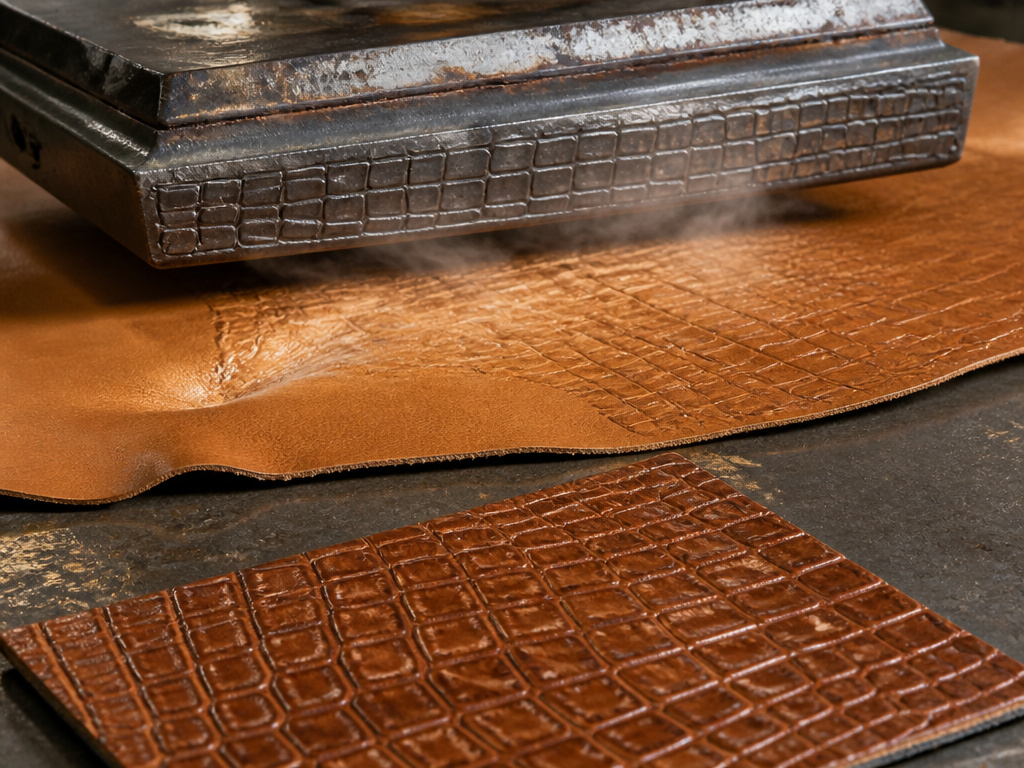
These terms get thrown around interchangeably, but they describe three distinct processes with different tools, pressures, and outcomes. Confusing them is like calling a latte an espresso.
Embossing is an industrial, machine-driven process. High heat (often over 100°C) and hydraulic pressure permanently reset the leather’s structure. It’s fast, consistent, and used for large-scale production. The pattern is uniform across the entire hide.
Stamping is a manual, impact-based technique. You use a handheld metal stamp and a mallet. The force is momentary and much lower than a hydraulic press. While it can create a deep impression, it doesn’t thermally alter the leather’s structure to the same degree. Stamping is for adding singular designs, monograms, or small repeating patterns by hand. It’s the domain of the craftsperson, not the factory floor.
Tooling is a subset of carving and stamping, typically done on vegetable-tanned leather. The leather is dampened (cased), and a craftsperson uses a swivel knife to cut designs into the surface, then uses various stamps to model and texture the background. It’s a slow, artistic process that creates a true bas-relief sculpture in leather.
Common mistake: Calling a hand-stamped monogram “embossed.” The scale, tool, and lack of applied heat give it away. A true embossed pattern feels part of the leather’s flesh, not pressed on top of it.
The 3 Parameters That Control Quality
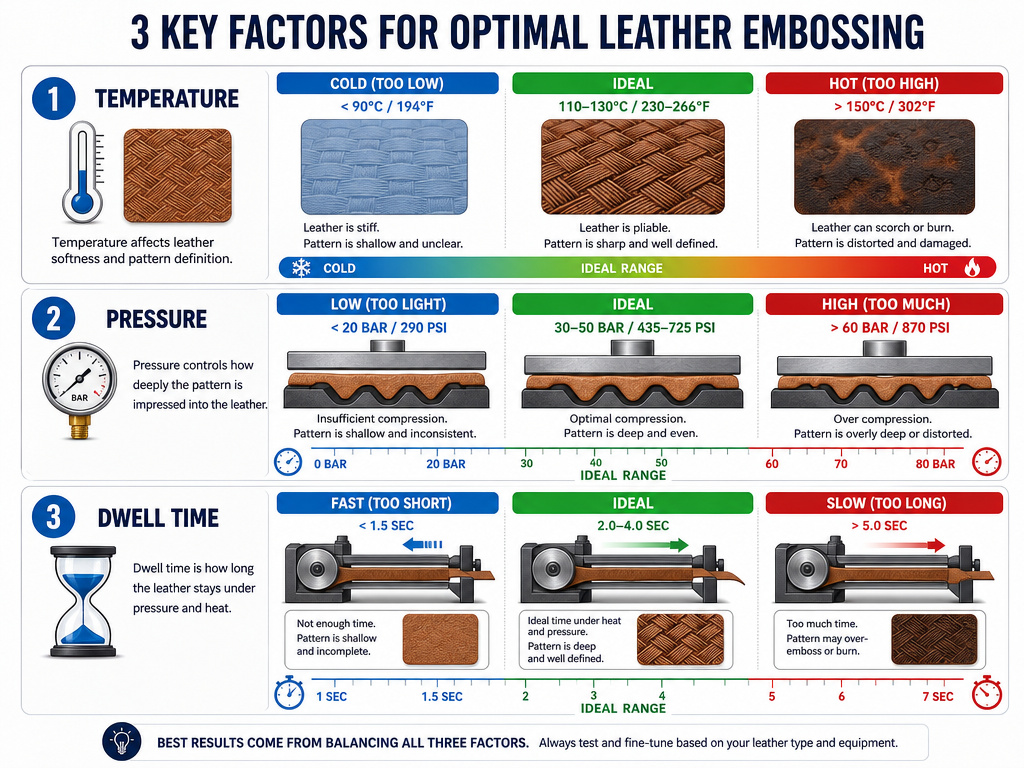
Not all embossing is created equal. The difference between a cheap, blurry crocodile print and a sharp, defined one comes down to three dials on the machine.
- Temperature. The engraved roller must be hot enough to plasticize the leather’s fibers, allowing them to stretch and reform into the new pattern. Too cold, and the pattern won’t hold. Too hot, and you risk scorching the leather or causing excessive thermal discoloration, a factor highlighted in the embossing parameters study.
- Pressure. This is the force that drives the softened leather into every crevice of the engraved mold. Insufficient pressure yields a shallow, weak pattern that will flatten out with wear. Excessive pressure can over-compress the leather, making it stiff and board-like.
- Dwell Time. This is how long the leather is under the heated pressure. On a roller press, it’s a function of machine speed. Too short, and the pattern won’t set. Too long, and you risk damaging the leather’s integrity.
Getting this triad right is where the operator’s skill meets the machine’s calibration. It’s why two tanneries, given the same leather and the same roller design, can produce visibly different results.
What To Look For When Buying Embossed Leather Goods
You’re not buying the machine, you’re buying the outcome. A few visual and tactile checks can tell you a lot about the quality of the embossing and the leather underneath.
First, run your fingers across the pattern. A high-quality emboss should feel integrated. The peaks should be sharp, the valleys deep and clean. The leather should still feel supple, not stiff or plasticky. If it feels like a vinyl coating, it probably is one.
Look at the pattern consistency. On a large item like a sofa or bag, the pattern should be uniform. There shouldn’t be blurred sections, faded areas, or visible seams where passes of a plate press overlapped.
Understand what you’re getting. An embossed corrected-grain leather product will be durable, stain-resistant, and uniform. It’s a practical choice for high-traffic furniture or everyday bags. An embossed full-grain leather product is a luxury decorative item. The embossing is an added art form on an already premium material; expect a higher price and more care requirements.
Finally, check the edges and reverse side. Genuine leather will have a suede-like flesh side. A laminated or heavily coated material might have a fabric or polyurethane backing. Embossing can be done on both, but the performance and aging will be completely different.
Frequently Asked Questions
Is embossed leather real leather?
Yes, embossed leather starts as real leather. The embossing process is a finish applied to the leather’s surface. However, it is often applied to corrected-grain leather, which has been sanded to remove imperfections, so it may not represent the highest grade of hide.
Does embossed leather peel or fade?
The pattern itself should not peel or fade because it is a physical deformation of the leather, not a printed coating. However, the colored finish or topcoat applied over the embossed pattern can wear down, crack, or fade with time and abrasion, which might make the pattern appear less distinct.
What’s the difference between embossed and printed leather?
Embossed leather has a physically raised texture created by pressure. Printed leather has a pattern applied with ink or dye on a flat surface. “Embossed print” or “printed embossed” leather combines both: the leather is first embossed for texture, then printed with color to accentuate the raised pattern.
Can you emboss leather at home?
True industrial embossing with heat and permanent deformation requires a heavy-duty, heated press. However, you can achieve a similar stamped effect at home using manual leather stamps, a maul, and a solid surface. The impression will be shallower and less permanent than machine embossing, but it’s the core technique behind leather stamping.
Before You Go
Let’s be clear about one thing: embossing isn’t a sign of low quality. It’s a technique with a purpose. It can salvage a usable hide from the discard pile, or it can add exquisite decoration to a perfect one. The key is knowing which you’re looking at.
The practical takeaway is in the feel. Next time you see a patterned leather bag in a store, ignore the sales copy about “exotic textures.” Run your thumb over it. Is the pattern part of the leather’s flesh, or does it feel like a layer on top? That simple test, more than any label, will tell you what process you’re dealing with.
And if you’re comparing two sofas, one with a natural grain and one with a deep embossed pattern, remember the trade-off. The embossed one will hide scratches and spills better. The natural one will develop a patina that tells its own story. Neither is wrong. But understanding the leather finishing process means you’re choosing the story you want to live with.
