
Bomber Jacket vs Biker Jacket | The 3 Differences That Matter
This post contains affiliate links. As an Amazon Associate, we earn from qualifying purchases.
A bomber jacket is a casual, insulated outerwear piece built for warmth and mobility, while a biker jacket is a protective, close-fitting garment made from thick leather for abrasion resistance. The bomber’s roots are in aviation, designed for pilots in open cockpits, resulting in features like a ribbed knit waist and cuffs, a relaxed fit for layering, and often synthetic or quilted insulation. The biker jacket’s DNA is motorcycle protection, leading to an asymmetrical zipper, wide lapels, extensive external stitching, and heavy-duty hardware, all serving to shield the rider in a slide.
That distinction between warmth and armor is the line. It’s not about which looks cooler; it’s about which job you’re asking the jacket to do. A Canada Goose Chilliwack bomber uses Arctic Tech® fabric and a Thermal Experience Index to trap heat down to 5°F. A SPIDI Evorider 2 biker jacket uses 1.3mm thick abrasion-resistant leather and meets the EN 17092-3:2020 Class AA certification to survive pavement impact. Choosing wrong means you’re either shivering on a bike or sweating in a bar.
What follows is a breakdown of the three core differences: construction, silhouette, and intended use. We’ll look at the leather specs that matter, the design cues that aren’t just for show, and the specific scenarios where one jacket clearly outperforms the other.
Key Takeaways
- Bombers prioritize insulation and casual comfort, often using nylon, wool, or lighter leather with synthetic fills, while bikers are built from thick, certified leather (1.1mm–1.3mm) for abrasion protection.
- The silhouette tells the story: bombers have a boxy, relaxed fit with ribbed hems; bikers have a tailored, contoured fit with an asymmetrical zipper and external seam detailing. Certifications are required for riding: a legitimate motorcycle jacketcom/motorcycle-jacket-vs-biker-jacket/) will carry a CE certification like EN 17092; most bombers lack any protective rating.
- Hardware quality is a longevity signal: look for YKK zippers on bombers and heavy-duty snaps/zippers on bikers; cheap hardware is the first point of failure.
- Your climate and activity decide: a bomber is for urban winters and casual wear; a biker is for motorcycling or achieving that specific protective aesthetic.
The Core Construction: Leather, Lining, and Hardware
The most immediate difference is in the hand-feel and weight. Pick up a classic bomber jacket like an Alpha Industries MA-1, and it’s surprisingly light, maybe 2.5 pounds. The shell is 100% flight nylon, the insulation is 160g/m² polyester fill, and the lining is often a bright orange satin. Now pick up a Schott NYC Perfecto 613. The weight is immediate, often over 5 pounds for a medium, thanks to its heavyweight steerhide leather and dense nylon quilt lining.
Technical Snapshot: A CE-certified biker jacket like the SPIDI Genesis uses 1.0–1.1mm buffalo leather to achieve EN 17092-3:2020 Class AA certification. In contrast, a fashion-focused bomber might use a 0.8mm lambskin or no leather at all, prioritizing a soft hand and lightweight drape over any protective quality.
Let’s break down why these materials are chosen.
Leather: Thickness and Treatment
For a biker jacket, leather thickness is a safety spec. The SPIDI Evorider 2 uses 1.1mm to 1.3mm abrasion-resistant leather. Dainese’s Racing 5 jacket uses 1.2mm Tutu cowhide. This isn’t arbitrary; these thicknesses are tested to meet CE standards for abrasion and tear resistance. The leather is also often drum-dyed and finished for weather resistance, not just aesthetics.
Bomber jackets, especially leather ones, use thinner hides. A fashion bomber might use a 0.6mm–0.8mm lambskin or calfskin for a softer, more pliable feel. The goal is drape and comfort, not crash protection. Even a shearling bomber like the Cockpit USA B-6 uses a short-sheared sheepskin specifically to reduce bulk while retaining insulation.
Common mistake: Assuming all leather jackets offer the same protection. A 0.8mm lambskin bomber will shred in a slide, while a 1.3mm cowhide biker jacket is designed to hold together.
Lining and Insulation: Warmth vs. Versatility
Here, the paths diverge completely. Bombers are insulated. The Canada Goose Chilliwack uses Arctic Tech® fabric and is designed for “maximum cold-weather protection.” The Benchmark FR Heavyweight Insulated Bomber uses a quilted modacrylic lining for arc-flash protection and warmth. Insulation is the primary goal.
Biker jackets are shells. Their linings, if they have fixed ones, are thin, breathable, and often removable. The SPIDI Genesis has a removable 80g inner vest. The Dainese Iperattiva uses a stretch fabric lining for mobility. The focus is on creating a protective outer layer that can be adapted with separate thermal or waterproof liners for different conditions, not on being a standalone winter coat.
Hardware: The First Thing to Fail
Run the zipper on an Alpha Industries MA-1. It’s a standard plastic or metal coil zip. Now run the zipper on a Schott Perfecto. It’s a substantial, often nickel-plated brass zip with a heavy pull. Biker jackets stress hardware every time you mount a bike, so they use overbuilt components. Bombers, worn in casual settings, don’t face the same mechanical stress, so their hardware can be lighter.
| Component | Typical Bomber Jacket | Typical Biker Jacket |
|---|---|---|
| Primary Zipper | Standard coil or plastic zipper | Heavy-duty metal zipper (often YKK) |
| Closure | Snap or zip-front | Asymmetrical zip with storm flap |
| Pocket Closures | Simple snaps or none | Heavy-duty snaps, often with leather pulls |
| Cuff/Belt Hardware | Simple button or snap | Adjustable buckle with multiple holes |
The practical takeaway? On a biker jacket, the hardware should feel solid, not flimsy. If it feels cheap, the jacket likely is.
Silhouette and Fit: Boxy vs. Contoured
Stand a classic biker jacket on a hanger. The shoulders are defined, the waist is tapered, and the front panels are cut to curve around the ribs. This is a tailored fit, born from the need to keep the jacket from flapping in the wind and to stay in place during a ride. The signature asymmetrical zipper isn’t just a style cue; it’s a functional overlap to block wind.
Now, look at a classic bomber jacket like the CWU-45 from Alpha Industries. The shoulders are dropped, the body is straight, and the hem hits at the waist. This is a relaxed or regular fit, designed to allow layers, like a flight suit or sweater, beneath it. The ribbed knit waist and cuffs are functional, sealing in warmth while allowing flexibility.
The Mobility Solutions
Both jackets solved mobility problems, but differently. Bombers needed to keep pilots warm in cramped, cold cockpits without restricting their reach. The solution was a boxy cut with elastic boundaries.
Bikers needed to move freely on a motorcycle while staying protected. Their solution was strategic paneling. The bi-swing back, a pleated panel across the shoulders, is a hallmark of jackets like the Schott Perfecto. It allows forward reach without the back of the jacket riding up. The underarm gusset (an underrated feature) is a diamond-shaped leather insert that expands with arm movement. These aren’t decorations; they’re engineering.
The Style Translation
This engineering dictates street style. The bomber’s relaxed fit reads as casual, utilitarian, and easy to wear. It pairs naturally with jeans, chinos, and casual layers. The biker’s contoured fit reads as sharp, aggressive, and intentional. It demands a slimmer pant and creates a V-shaped silhouette. Trying to force a bomber’s casual vibe from a biker jacket’s cut just looks strained.
Purpose and Intended Use: Where Each Jacket Excels
This is the deciding factor. Are you looking for protective equipment or versatile outerwear?
The Biker Jacket: For Riding or the Riding Aesthetic
A true motorcycle jacket is personal protective equipment. The Alpinestars Atem V5 is “engineered and optimized for sportsbike and naked sportsbike riders.” The SPIDI Evorider 2 is “developed as a summer track day jacket with no compromises on safety.”
These jackets have a job: to protect skin during an impact. They come with certified armor pockets at the shoulders and elbows (EN 1621-1), and a pocket for a back protector. The leather is thick and often includes stretch panels like Flex Tenax for articulation. If you ride, this isn’t a style choice; it’s a gear choice.
Where this goes sideways: Wearing a fashion leather jacket without certifications on a motorcycle. The jacket will fail catastrophically in a slide, offering no more protection than a long-sleeve shirt.
Even if you don’t ride, a biker jacket commits you to a specific, bold aesthetic rooted in that protective purpose. It’s a statement piece.
The Bomber Jacket: For Insulation and Casual Versatility
The bomber’s purpose is environmental protection, specifically, cold and wind. The Canada Goose Chilliwack Aviator Bomber has a Thermal Experience Index (TEI) of 2, rated for 32°F to 5°F. The original B-6 Shearling Bomber from Cockpit USA was introduced in 1939 for open-cockpit trainer pilots who needed “meaningful insulation without the bulk.”
Today, that translates to a jacket you throw on for a walk in fall weather, a commute, or a casual evening out. Its warmth is built-in, so you don’t need to layer a hoodie underneath. Its style is neutral, making it easier to style a leather jacket in a variety of casual outfits without dominating the look.
The Overlap Zone: Lifestyle and Fashion
This is where most people buy. You want the look of a biker jacket for its edge, but you’ll never ride. Or you love the heritage feel of a bomber but live in a mild climate. That’s fine, just buy with awareness.
For a biker look without the riding specs, seek out jackets that mimic the silhouette but use softer, thinner leather. They’ll be more comfortable for all-day wear. For a bomber, you can choose lighter materials like nylon or cotton if genuine warmth isn’t the priority.
| Use Case | Recommended Jacket Type | Key Feature to Look For |
|---|---|---|
| Motorcycle Riding | Certified Biker Jacket | EN 17092 Certification (Class AA or AAA), armor pockets |
| Urban Winter Wear | Insulated Bomber Jacket | Synthetic or natural insulation (down, wool), windproof shell |
| Casual Fall/Spring Layer | Lightweight Bomber or Fashion Biker | Soft leather or fabric shell, minimal lining |
| Sharp, Edgy Fashion Statement | Classic Biker Silhouette | Asymmetrical zipper, contoured fit, heavy hardware |
How to Choose: A Practical Decision Framework
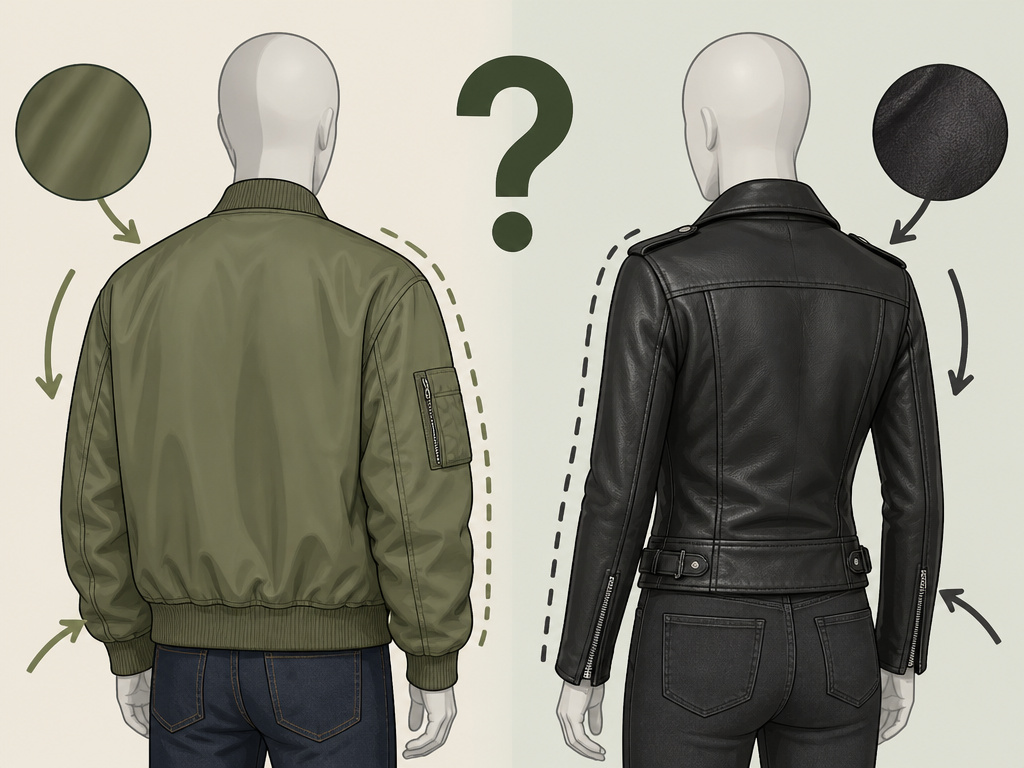
So, bomber or biker? Let’s be clear about one thing: this isn’t a minor style choice. It’s a choice about function first. Ask these three questions in order.
1. What is the primary physical demand?
If the answer is “riding a motorcycle,” the conversation ends. You need a certified biker jacket with the right safety specs. If the answer is “staying warm in cold weather,” a bomber is your starting point. If the answer is “looking a certain way,” move to question two.
2. What silhouette suits your body and style?
Try both on. The bomber’s boxy cut is forgiving and works on most body types. The biker’s tailored fit requires a more specific torso shape to look right, it can be unforgiving across the chest and shoulders if the sizing is off. Your existing wardrobe also matters. A bomber integrates easily; a biker jacket often becomes the outfit’s focal point.
3. What’s your budget for longevity?
A genuine, well-made jacket in either category is an investment. Cheap versions fail at their core promise: a thin bomber won’t be warm, and a thin biker jacket won’t be durable. It’s better to buy one good jacket than three bad ones. For bombers, look at brands like Alpha Industries or Schott NYC’s MA-1. For bikers, entry-level starts with brands like SPIDI or Dainese.
I abandoned using pre-mixed edge paints in small pots because they would skin over and become unusably thick long before the pot was empty. Switching to tubes eliminated this waste and inconsistency. The same principle applies here. Buying a jacket that’s wrong for its core function is waste. A biker jacket that can’t protect you is decorative paint that’s already dried up.
Here’s a straightforward guide. If you want one answer and you’ll wear it three seasons a year in a city: start with a medium-weight leather bomber. It splits the difference. If your life involves two wheels or you’re committed to a specific, rugged aesthetic, lean into a classic men’s biker jacket from a heritage brand.
Frequently Asked Questions
Can a bomber jacket be made of leather?
Absolutely. Leather bombers are common, often using softer, thinner hides like lambskin or calfskin compared to biker jackets. The defining feature isn’t the material but the design: a waist-length, often boxy cut with ribbed knit cuffs and hem. The origin of the bomber jacket is in military flight jackets, which were originally made of leather (like the A-2), then transitioned to nylon (MA-1).
Is a biker jacket good for winter?
Not by itself. True biker jackets are protective shells, not insulated winter coats. They are designed to be paired with separate thermal or waterproof liners. Wearing one in deep cold without layering underneath will leave you freezing. For cold-weather riding, you’d look for a jacket with a waterproof, breathable membrane like Gore-Tex and CE Level 2 armor.com/motorcycle-jacket-vs-biker-jacket/) with a removable thermal liner and windproof construction.
Why do biker jackets have so many zippers?
Many zippers serve both style and function. The chest and sleeve zippers can open for ventilation on a hot ride. Smaller zippers may access pockets for armor or provide entry points to connect the jacket to riding pants (via a “zip-in” liner system), creating a sealed suit. Some are purely stylistic, echoing the functional details of racing gear.
Which jacket is more versatile for everyday wear?
The bomber jacket is generally more versatile for casual, everyday wear. Its neutral, relaxed silhouette pairs easily with jeans, chinos, and sweaters without dominating an outfit. The biker jacket’s more aggressive, tailored look makes a stronger statement, which can limit its daily pairing options unless that aesthetic is central to your personal style.
The Bottom Line
The divide is simple: one is a shield, the other is a shelter. A biker jacket is engineered armor, born from the need to survive asphalt. Its thick leather, certified protections, and contoured fit all serve that end. A bomber jacket is engineered insulation, born from the need to survive altitude and cold. Its fill, windproof shell, and relaxed fit serve that end.
Choosing between them starts by admitting what you actually need. Do you need abrasion resistance, or do you need thermal retention? Once you answer that, the rest, silhouette, material, brand, falls into place. Ignore the marketing copy that tries to blur these lines. A jacket that claims to be both is usually good at neither.
For most people building a wardrobe, a leather bomber from Schott NYC is the more practical first investment. It covers more weather conditions and social situations. But if your world involves a motorcycle, or if your style is uncompromisingly rooted in that rebel aesthetic, then a true biker jacket isn’t just an option, it’s the only option. The leather will tell you what it needs, so listen to it.
