
The Real Difference: Motorcycle Jacket vs. Biker Jacket
This post contains affiliate links. As an Amazon Associate, we earn from qualifying purchases.
A motorcycle jacket is a CE-certified piece of protective equipment designed to mitigate injury in a crash. A biker jacket is a cultural fashion icon, typically made of leather, built for durability and style but lacking modern impact protection. The difference is a public health line with academic implications.
That line is drawn by a European standard called EN 17092. It’s not a suggestion; it’s a pass/fail test for abrasion resistance, seam strength, and tear resistance that determines if a garment can be legally sold as protective motorcycle gear in the EU. A biker jacket never sees that lab. Its pedigree is cinematic, not clinical.
What follows: a breakdown of the three specs that separate a tool from a totem, certification, construction intent, and compatibility with life-saving tech. By the end, you’ll be able to read a product page in ten seconds and know exactly which category you’re buying into.
Key Takeaways
CE EN 17092 certification is essential for protection. Jackets are rated Class A (lowest) to AAA (highest); most street jackets are AA. No certification means it’s fashion, not armor. – The zipper and lining tell the real quality story. A YKK main zipper and a quilted, well-anchored lining outlast cheap hardware and glued-in facades every time. – Modern jackets are designed around airbag systems. Brands like Dainese and Alpinestars engineer jackets to fit over a Smart Air or Tech-Air vest without needing a size up, keeping armor positioned correctly. – Leather type matters less than leather treatment. A thick, vegetable-tanned cowhide often offers a better balance of durability, comfort, and patina potential than the oft-hyped but stiff horsehide. – Fit is functional, not just aesthetic.A proper motorcycle jacket fit is snug but allows full range of motion; a too-loose jacket lets armor shift in a crash, rendering it useless.
The Core Difference: CE Certification
Open the liner of a Schott Perfecto 613. You’ll find a label about materials, maybe a “Made in USA” tag. Now open a SPIDI Evorider 3. Alongside the material tag, you’ll find a clear, standard-mandated pictogram: “PPE” for Personal Protective Equipment, followed by “EN 17092-3:2020 Class AA.” That single label is the Great Divider.
CE certification to EN 17092 involves a battery of lab tests. A sample jacket is mounted on a mechanized arm and dragged across a coarse asphalt belt at speed. The test measures how long the material resists abrasion before a hole forms (Class AAA must last over 6.4 seconds). Seams are tested for burst strength, and the entire garment is assessed for fit to ensure protectors stay in place. This isn’t marketing. It’s verification.
The “CE” mark you see on a real motorcycle jacket.
Why does this matter off the spec sheet? Because the certification dictates the entire construction. To pass, a jacket must have secure pockets for shoulder and elbow armor (EN 1621-1 rated). It must have a connecting zip for pants to prevent ride-up. Its seams must be double-stitched or bonded with a specific strength. A classic biker jacket like the Schott 613 is built to be tough, but its design priorities are aesthetic symmetry, a clean lining, and a iconic silhouette. The SPIDI Genesis leather jacket, while styled for urban use, is built from the inside out to house protectors and pass that drag test. The difference is in the blueprint.
Construction & Materials: Intent is Everything
Let’s be clear about one thing. Both jackets might use beautiful leather. The difference is why they use it.
A traditional biker jacket, like the Schott NYC Perfecto 613, is made from heavyweight steerhide. Schott’s description focuses on the hide’s character, “plump, full-bodied, rich to the touch”, and its evolution from stiff to “butter-soft” with wear. The goal is longevity and a personal patina. The construction celebrates traditional craftsmanship: a bi-swing back for mobility, nickel-plated hardware, and a quilted nylon lining for warmth. It’s a fortress of tradition.
A modern motorcycle jacket starts with a different question: “How does this material perform under slide stress?” The SPIDI Evorider 2 uses 1.1mm to 1.3mm “abrasion resistant leather” specifically chosen for its lab-tested performance. Panels of Flex Tenax nylon are inserted at the arms and shoulders not for style, but to allow a riding position without creating tension points that could tear. The Dainese Iperattiva combines 1.2mm Tutu cowhide with wide S1 bi-elastic fabric and Cordura Comfort stretch panels explicitly to “guarantee maximum wearability and riding comfort” while keeping armor positioned.
Where this goes sideways: Buying a thick, beautiful leather biker jacket assuming it’s “protective.” In a slide, untreated fashion leather can glaze, harden, and transfer more impact energy than a certified, multi-layer textile with an aramid lining. The jacket might survive, but your skin might not.
The lining is the tell. A biker jacket lining is often a single layer of nylon or cotton, sewn in for comfort. A motorcycle jacket liner is a technical component. It might be a removable waterproof H2Out or GORE-TEX membrane, as in the Alpinestars Ketchum. It’s often a thermal layer that doubles as a light jacket. It’s always anchored with robust stitching at stress points, because a liner that tears loose in a crash can become a tangled hazard.
The Modern Motorcycle Jacket: A Wearable Airbag
Here’s the most significant evolution that widens the gap: integrated airbag systems. This technology is available now from Dainese (Smart Air) and Alpinestars (Tech-Air), and it’s reshaping how jackets are designed.
A jacket like the Dainese Racing 5 isn’t just leather and armor. Its product description explicitly states it’s designed to be “worn over the Dainese Smart Air airbag device without the need to purchase a larger size.” Internal loops hold the airbag vest securely against the torso. The sleeves are engineered to be snug enough that, even with the airbag underneath, the elbow and shoulder protectors won’t shift out of position.
This is a fundamental rethinking of the garment’s role. The jacket is no longer the outermost layer of protection; it’s the interface between your body and an active safety system. Compatibility is a core design parameter that affects pattern cutting, gusset placement, and overall volume.
| Feature | Traditional Biker Jacket | Modern Motorcycle Jacket |
|---|---|---|
| Primary Design Goal | Style, durability, cultural authenticity | Impact & abrasion protection, crash survival |
| Certification | None (fashion garment) | CE EN 17092 (Class A-AAA) |
| Armor | None standard | Removable CE EN 1621-1 Level 1 or 2 protectors (shoulders, elbows) |
| Liner System | Fixed, often quilted nylon | Removable, technical (thermal, waterproof, or both) |
| Airbag Compatibility | Not applicable | Often designed for specific systems (Smart Air, Tech-Air) |
| Construction Focus | Aesthetic seams, clean lining | Reinforced stress points, pre-curved arms, armor pockets |
The practical takeaway: If you’re choosing a motorcycle jacket for actual riding, airbag compatibility is a tier-one consideration. It future-proofs your gear investment and adds a layer of protection that standard armor cannot match. For a pure cafe racer jacket worn for style around town, it’s irrelevant.
Fit, Feel, and the “Second Skin” Myth
“How should a leather jacket fit?” The answer splits along the same line.
A biker jacket is meant to fit like a tailored garment, snug through the torso and shoulders, breaking in over time to become a “second skin.” The Schott 613 is famous for its “classic, close-fitting cut.” This fit is about silhouette and attitude.
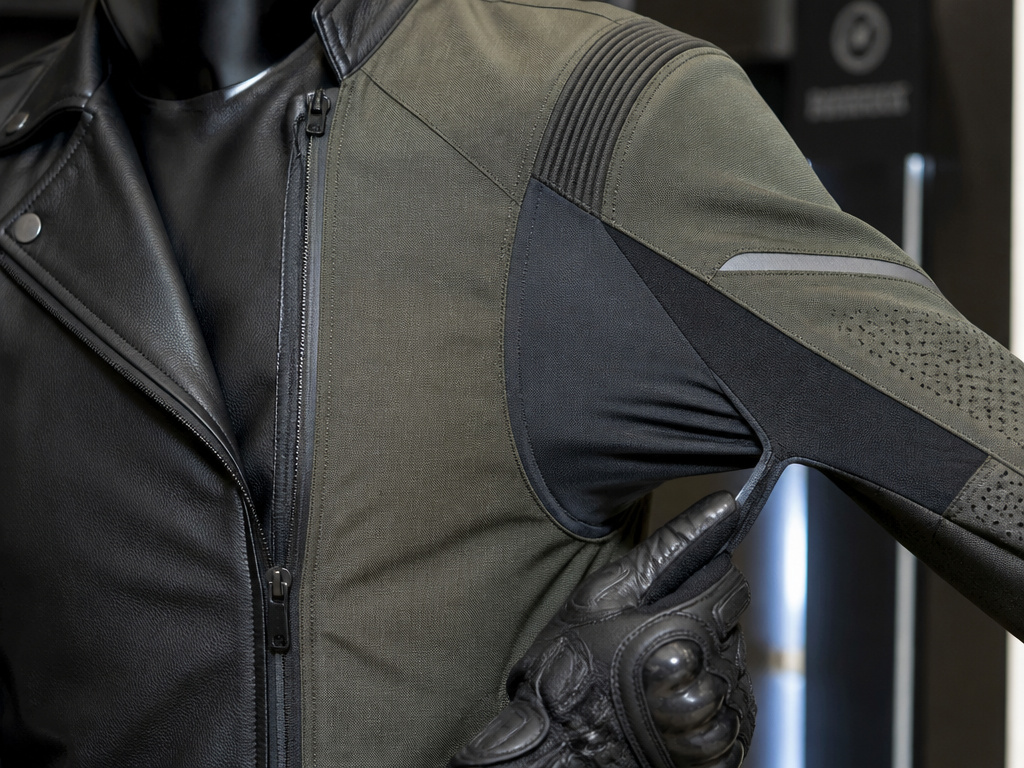
A motorcycle jacket fit is about biomechanics and safety. It must be snug, never loose, so the protectors remain over your elbows and shoulders when you’re in a riding tuck. But it also must allow a full range of motion without binding. This is where features like underarm gussets (a stretch panel hidden in the armpit) and strategic stretch leather or textile panels prove their worth. The Dainese Iperattiva uses its S1 bi-elastic fabric and Cordura stretch panels for this exact reason.
Common mistake: Sizing up in a motorcycle jacket for comfort or to wear over a hoodie. A jacket that’s too large will allow the armor to slide down your arm in a crash, exposing your joint. The thermal liner is for warmth, not bulk accommodation.
The feel is different, too. A high-quality biker jacket leather, like vegetable-tanned steerhide, starts stiff and forms to you. A performance motorcycle leather is often drum-dyed and treated to be supple from day one, like the “extra comfort leather” used in the SPIDI Genesis. It’s designed to provide abrasion resistance without restricting the micro-movements of riding.
The Blurred Middle: Hybrid & Crossover Jackets
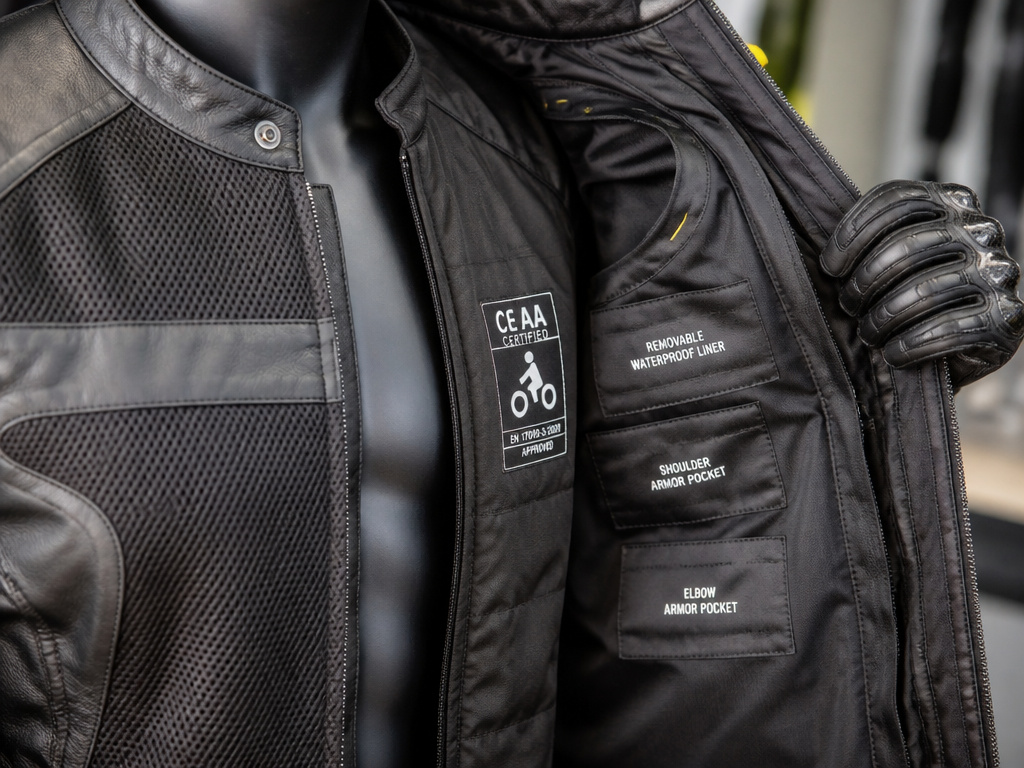
The market isn’t always black and white. A growing category of jackets aims to bridge the gap, offering classic aesthetics with modern protection. These hybrids are where you need to read the spec sheet most carefully.
The SPIDI Rapid H2Out Jacket is a prime example. Its exterior uses full-grain bovine leather and mesh panels for a sporty, classic look. But inside, it holds Warrior Lite Level 2 protectors and is certified CE AA (EN 17092-3:2020). It includes a removable H2Out waterproof liner. This is a motorcycle jacket wearing the clothes of a cafe racer style.
Another approach is the leather-textile blend, like the Dainese Iperattiva mentioned earlier. It uses leather in high-abrasion zones (shoulders, elbows) and breathable, stretch textiles elsewhere. The goal is to merge the protective reputation of leather with the comfort and ventilation of modern materials.
When evaluating a hybrid, apply the motorcycle jacket checklist first: Does it have a CE EN 17092 label? Does it include or have pockets for certified armor? Does it have a pants connection zip? If yes, it leans into the protective category, regardless of its looks. If no, it’s a fashion piece with aspirational styling.
So, Which One Should You Buy?
This is based on years of practical experience talking to riders. Your choice boils down to a single question: Is this for riding or for looking?
For Riding (Primary Use):
Buy a certified motorcycle jacket. Your baseline is CE AA. Look for compatibility with an airbag system you might add later. Prioritize fit and features like ventilation and a removable liner over pure leather mystique. The Alpinestars Ketchum GORE-TEX Jacket or the Dainese Mangen Absøluteshell™ Pro are excellent examples of focused, no-compromise touring gear. If you want leather, the SPIDI Evorider 3 or a Dainese with Smart Air compatibility delivers protection without sacrificing performance.
For Looking (Primary Use):
Buy a biker jacket. Appreciate it as a piece of heritage craftsmanship. Understand that you’re investing in materials, tradition, and a personal patina journey, not crash protection. A Schott Perfecto 613 or a well-made cafe racer jacket from Vanson is a lifetime garment. Enjoy it for what it is.
The compromise choice: A high-end hybrid like the SPIDI Rapid H2Out. You get real protection in a package that turns heads off the bike. But understand you’re often paying a premium for that duality, and the fit may be a tighter, more technical “motorcycle” cut than a pure fashion jacket’s relaxed silhouette.
Frequently Asked Questions
Is a biker jacket the same as a motorcycle jacket?
No. While the terms are often used interchangeably in fashion, they represent different intents. A biker jacket is a style of leather jacket inspired by motorcycle culture. A motorcycle jacket is a piece of certified safety equipment designed to protect a rider in a crash. Many motorcycle jackets borrow the biker jacket aesthetic, but not all biker jackets offer motorcycle-level protection.
Can you use a biker jacket for riding?
You can, but you shouldn’t rely on it for protection. A thick leather biker jacket will offer more abrasion resistance than a denim shirt, but it lacks the impact-absorbing armor, reinforced stitching, and safety-certified materials of a true motorcycle jacket. For casual, low-speed cruising, it’s a risk you might choose. For any serious riding, it’s an unacceptable one.
What does CE certified mean on a motorcycle jacket?
It means the jacket has been tested and meets the European Standard EN 17092 for motorcycle personal protective equipment (PPE). The certification involves rigorous tests for abrasion resistance, seam burst strength, and dimensional stability. Jackets are rated Class A (lowest), AA, or AAA (highest). The CE mark, when applied to motorcycle gear, is a legal declaration of conformity to this safety regulation, not a generic quality stamp.
Are all leather motorcycle jackets safe?
No. “Leather” describes a material, not a safety standard. A leather jacket only becomes a safe motorcycle jacket if it is specifically designed, constructed, and certified to a standard like EN 17092. It must include or have pockets for certified armor at the shoulders and elbows. Many fashion leather jackets are not built to these specifications and will fail under crash forces.
Why are some motorcycle jackets so expensive?
Cost comes from three areas: certified materials (high-spec leathers, waterproof membranes like GORE-TEX), certified componentry (YKK zippers, CE Level 2 armor), and intensive construction (double-stitching, patterning for airbag compatibility, installing multiple liner systems). A jacket like the Dainese Stelvio D-Air D-Dry XT is essentially a life-support system you wear. A Schott Perfecto is a handcrafted heirloom. Both command prices reflective of their very different crafts.
The Bottom Line
Let me share what I’ve learned from tearing down both types of jackets. The difference between a motorcycle jacket and a biker jacket concerns legal liability versus cultural legacy, not leather quality or price.
One is a governed product, its performance verified in a lab and stamped with a code. The other is a story you wear, its value measured in decades and character. Buying the wrong jacket for your needs is a fundamental misallocation of trust, placing faith in tradition where you need engineering, or seeking clinical certification when you really want a classic silhouette.
So, before you buy, open the liner. Check for a CE-certified armor label. If you see “EN 17092,” you’re holding a tool. If you don’t, you’re holding a tradition. Both have their place. Just know which one you’re relying on when the road rises up to meet you.
