
What Oil to Use on Leather? A Guide to Top Conditioners
This post contains affiliate links. As an Amazon Associate, we earn from qualifying purchases.
The best oil for leather is pure neatsfoot oil for reviving dry, stiff vegetable-tanned leather, and a pH-balanced conditioner like Bickmore Bick 4 for maintaining finished or colored leather. Automotive leather often requires a specific cleaner like Motorcraft Premium Leather and Vinyl Cleaner, not a traditional oil. The choice hinges entirely on your leather’s tanning method and current condition.
That distinction between leather types is the whole game. Vegetable-tanned leather, common in belts, wallets, and traditional saddlery, is thirsty and responds to oils like neatsfoot. Chrome-tanned or factory-finished leather, which covers most car seats and modern bags, has a sealed surface that repels heavy oils, they’ll just sit on top and attract grime. Using the wrong product doesn’t just fail; it actively damages the leather by clogging its pores or breaking down its protective topcoat.
What follows: a breakdown of which oil works where, grounded in manufacturer manuals and a century of preservation science that says most “conditioners” do more harm than good. By the end, you’ll know exactly what to reach for, and more importantly, why it’s the right choice.
Key Takeaways
- Pure neatsfoot oil is the single most effective treatment for dry, stiff, vegetable-tanned leather, but it will always darken the leather and should be applied sparingly.
- For chrome-tanned or finished leather (like in cars or most bags), use a pH-balanced, lightweight conditioner like Bickmore Bick 4; heavy oils will not absorb and can damage the finish.
- Avoid silicone-based “conditioners” and petroleum oils; they create a superficial shine but can degrade leather fibers over time, a point underscored by museum conservation research.
- Always test any oil on an inconspicuous spot first; absorption rate and color change are your best guides to compatibility.
- Regular, light conditioning beats infrequent, heavy saturation. Leather, like skin, benefits more from consistent, gentle care.
Leather 101: Why “One Oil Fits All” Is a Recipe for Ruin
You wouldn’t use motor oil on a sunburn. Leather isn’t one material; it’s a category defined by its tanning process. That process dictates everything about what it can and cannot absorb.
Automotive OEMs are explicit: Ford’s manual warns against “oil and petroleum or silicone-based leather conditioners,” Hyundai advises “neutral detergents or low alcohol content solutions,” and Kia cautions that chemicals like perfume or sunscreen “may cause damage or discoloration.”
The factory finish on a car seat is a plastic polymer coating. Its job is to resist stains. Pouring a traditional oil onto it is like waxing a non-stick pan, it doesn’t nourish, it just creates a sticky film. This is why your first step is always identification.
| Leather Type | How to Spot It | Accepts Oil? | Best Product Type |
|---|---|---|---|
| Vegetable-Tanned | Stiff, natural tan color, ages to a rich patina. | Yes, eagerly. | Pure oils (neatsfoot), heavy balms (Obenauf’s). |
| Chrome-Tanned | Soft, supple right away, often dyed uniform color. | No, not really. | Light, pH-balanced conditioners (Bick 4). |
| Finished / Corrected | Perfectly smooth, uniform, plastic-like feel. | No. | OEM-approved cleaners (Motorcraft), mild detergents. |
| Aniline | Shows natural grain, feels like suede but smoother. | With extreme care. | Ultra-light, non-darkening conditioners. |
Here’s the practical takeaway. If your leather item came stiff and pale and has softened and darkened with use, it’s vegetable-tanned. If it arrived soft, uniformly colored, and water-resistant, it’s chrome-tanned or finished. Your oil choice must follow this diagnosis.
Neatsfoot Oil: The Pure Choice for Dry, Stiff Leather
For vegetable-tanned leather that’s lost its suppleness, pure neatsfoot oil is the benchmark. It’s a centuries-old choice because it closely mimics the natural oils in the hide.
I used to think deeply cracked leather was always a lost cause. A stiff, neglected old belt covered in fine lines seemed finished. But a patient, sparing application of neatsfoot oil taught me that many of those cracks are just in the dried-out surface finish, not the hide itself. The oil wicks into the desiccated fibers, swelling them gently and restoring flexibility over a couple of days. The leather will darken significantly, but it comes back to life.
The process isn’t complicated, but it is slow. 1. Clean the surface with a damp cloth to remove dust. Let it dry completely. 2. Apply a few drops of neatsfoot oil to a clean, lint-free cloth. Less is more. 3. Rub it in thoroughly, working against the grain to help penetration. You should see the leather darken as you work. 4. Let it sit overnight, then buff off any excess with a dry cloth. Repeat only if the leather still feels stiff after 48 hours.
Skipping the buffing step leaves a greasy residue that attracts dust. Forcing a second application before the first has fully absorbed can oversaturate the leather, making it limp and weak.
Common mistake: Flooding the leather with oil to speed up the process. Oversaturation weakens the fiber structure permanently. It’s the difference between a hydrated hide and a waterlogged sponge.
This is the core of traditional leather oiling process. The leather tells you what it needs by how quickly it drinks the oil.
Conditioners for Finished Leather: Bick 4 and the Lightweight Rule
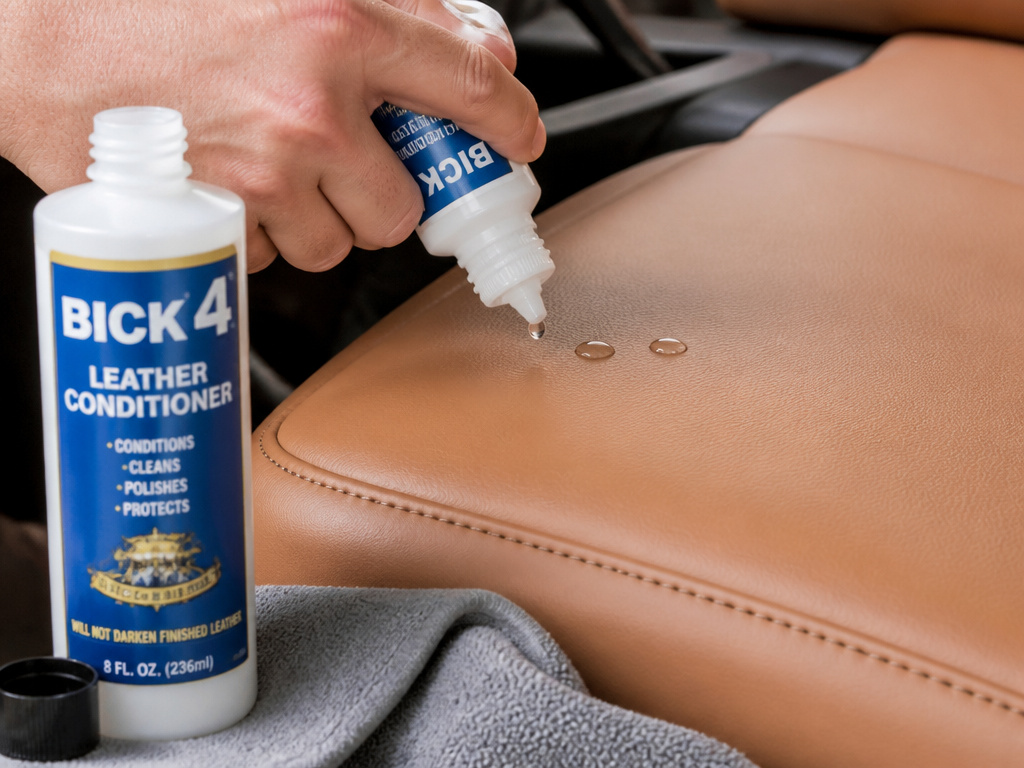 For the vast majority of modern leather goods, car interiors, most handbags, furniture, you are not dealing with raw hide. You’re dealing with a coated surface. Here, the goal isn’t deep nourishment; it’s maintaining the existing finish without damaging it.
Bickmore Bick 4 is the default pick for this category. It’s pH-balanced, doesn’t darken leather, and absorbs cleanly without leaving a greasy film. The reason it works where neatsfoot oil fails is its formulation: lighter carriers and emulsifiers designed to hydrate the finish without penetrating the sealant.
Automotive manuals are your guide here. They don’t recommend oils; they recommend specific, mild cleaners. Ford explicitly points to Motorcraft Premium Leather and Vinyl Cleaner. These products are engineered for the specific polymer finishes used in cars. Using a heavy oil on that finish can cause it to become tacky, attract more dirt, and eventually crack.
The sensory cue is absorption. On finished leather, a conditioner like Bick 4 will seem to disappear into the surface within a minute of rubbing. If you see a lingering wet spot or feel slickness after buffing, the product isn’t absorbing, it’s sitting on top, and you should wipe it all off.
The Oils and Balms to Avoid (and Why)
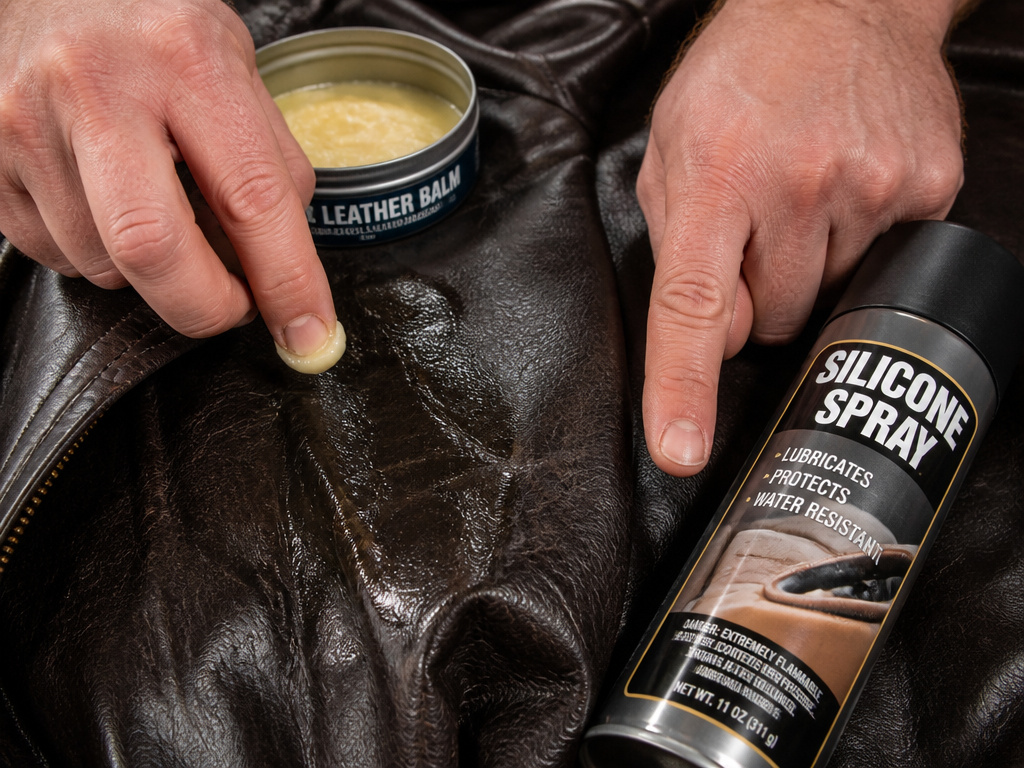 Not everything sold as “leather care” belongs on leather. This is where marketing runs headlong into material science.
Silicone-based sprays and petroleum-derived conditioners are the main culprits. They create an instant, shiny “healthy” look by coating the surface. The problem is twofold. First, they seal the leather, preventing it from breathing and trapping moisture underneath, which can lead to mold or fiber rot. Second, as a National Park Service leather dressings guide points out, such dressings can oxidize over time, becoming acidic and actually accelerating the deterioration they claim to prevent.
Then there’s mink oil. It’s a fine waterproofer for heavy work boots, but it’s too heavy and waxy for most other leathers. On a jacket or bag, it will remain greasy, attract every bit of lint and dust, and eventually turn rancid if over-applied. The mink oil vs neatsfoot oil debate is simple: neatsfoot for nourishment, mink for waterproofing heavy-duty gear. Using mink oil on a delicate aniline leather is like using a firehose to water a bonsai tree.
A 1935 study cited by the NPS found that chestnut-tanned leather treated with a sulphonated cod-liver oil dressing deteriorated faster than untreated leather. The conclusion, reinforced for nearly a century, is that many dressings have no preservative effect.
Your rule of thumb: if the product feels like Vaseline or leaves a permanent glossy film, it’s probably doing more coating than conditioning. Stick with products that name their active ingredients, like pure neatsfoot oil or lanolin, and are marketed for specific, traditional leathercraft.
Special Cases: Boots, Suede, Antiques, and Perforated Leather
Sometimes the leather itself dictates a narrow set of rules.
Leather Boots: Here, you often want both conditioning and some water resistance. Obenauf’s Leather Oil is a heavy-duty blend of beeswax and oils that’s ideal for work boots. For dress boots where you want to preserve the original color, a dedicated oil for boots like Venetian Shoe Cream is better. The key is to match the product to the boot’s duty, not just its color.
Suede and Nubuck: These are the nap side of the leather, and oils will ruin the texture by matting it down. Never use a standard leather oil. Use a dedicated suede cleaner and a silicone-free, nubuck-specific protector spray.
Antique or Historic Leather: The NPS guidance is absolute: “caretakers of leather objects should refrain from dressing leather.” The oils and fats can migrate, cause discoloration, and form a destructive white bloom called fatty acid spew. Conservation focuses on stable temperature and humidity, not additives.
Perforated Leather (like in car seats): Liqui Moly’s product sheet for its leather care explicitly warns, “With perforated leather, make sure that the liquid does not penetrate the leather.” This means using a minimal amount of a very light conditioner and avoiding any liquid pooling around the holes.
A Straightforward Application Guide
Once you’ve matched the oil to the leather, the application principles are universal. Let me share what I’ve learned.
- Test Inconspicuously. The inside of a belt loop, the underside of a seat. Apply a dime-sized amount, wait 24 hours, and check for color change or adverse reaction.
- Clean First. Oil over dirt is a paste that grinds into the grain. Use a damp cloth with a drop of mild soap (like castile), rinse with a water-dampened cloth, and let dry completely.
- Apply Sparingly. Put a few drops on a cloth, not directly on the leather. Rub it in with circular motions, then go with the grain. For a step-by-step guide to oiling leather, the mantra is “less, more often.”
- Buff to a Dull Sheen. Once the oil has soaked in (usually 15-60 minutes), use a clean, dry cloth to buff away any residue. The surface should feel supple, not slick.
- Wait Before Use. Let the item rest for at least a few hours, preferably overnight, before putting it back into service.
Where this goes sideways: Applying conditioner to a cold leather item. Leather is more absorbent when it’s at room temperature. Conditioning a cold wallet or boot results in uneven, spotty absorption that shows up as dark blotches.
Think of it like building a roux. You need low, patient heat and the right fat to build a stable foundation without it turning gummy. Rushing it wrecks the texture.
The Bottom Line
Here’s the one answer you came for. If your leather is dry, stiff, and vegetable-tanned: use pure neatsfoot oil, sparingly. If your leather is soft, colored, and finished (like 95% of modern goods): use Bickmore Bick 4. Avoid anything silicone-based or labeled as a miracle shine product.
This all changes if you’re dealing with a museum piece or a car seat, in those cases, the calculus is different. For everything else, that simple dichotomy will steer you right. The leather will tell you what it needs; your job is to know how to listen.
Frequently Asked Questions
Can I use olive oil or coconut oil on leather?
You can, but you shouldn’t. These plant-based oils can go rancid over time, leading to unpleasant odors and potential degradation of the leather fibers. They also tend to be less stable than traditional leather oils like neatsfoot. Stick with products formulated for leather preservation.
How often should I oil my leather?
There’s no fixed schedule. Condition leather when it starts to feel dry, stiff, or looks dull. For frequently used items like belts or wallets, once or twice a year may be enough. For leather that’s exposed to the elements, like boots, check every few months. Over-conditioning is a bigger risk than under-conditioning.
Why did my leather turn dark and blotchy after oiling?
This usually means you used too much oil, applied it unevenly, or used it on leather that wasn’t meant to absorb oils (like a finished car seat). It can also happen if the leather was cold during application, slowing absorption. Unfortunately, darkening from oil is usually permanent. Blotchiness can sometimes be evened out with a very light, uniform second application after the first fully dries.
Is it okay to use mink oil on a leather jacket?
Generally, no. Mink oil is heavy and waxier than most conditioners designed for garments. It can leave a sticky residue on a jacket that attracts lint and dust, and it may not fully absorb, making the leather feel greasy. Use a conditioner made specifically for leather apparel, like Lexol or a light application of Bick 4.
What’s the difference between leather oil, conditioner, and balm?
Oil (like neatsfoot) is a pure, penetrating liquid for thirsty, unfinished leather. Conditioner (like Bick 4) is a lighter, often lotion-like product for maintaining finished leather with additives for flexibility and UV protection. Balm (like Obenauf’s) is a thick, wax-heavy product for heavy-duty protection and waterproofing, primarily for boots and outdoor gear. Your choice depends on the job.
