
Why Does Leather Peel | The Surprising Chemical Culprit
This post contains affiliate links. As an Amazon Associate, we earn from qualifying purchases.
Leather peels when its top protective layer separates from the structural base, and this is almost always due to a failure in either the material itself (a low-grade composite or flawed base leather) or the environment (excessive heat, dryness, or chemical damage). The fix depends entirely on which failure you have, and mistaking one for the other wastes time and money.
Think of peeling as the leather telling you its story. That story might be about rushed tanning or a thin finish applied over weak fibers. It could also be about a car interior baking in the sun for years. The point is, you need to listen to what’s actually failing.
Let me share what I’ve learned about diagnosing the root cause. We’ll walk through the chemistry of a bond with a tensile strength exceeding 3000 psi, the common manufacturing shortcuts that doom it, and the daily habits that speed up the clock. You’ll leave knowing how to test a piece, what questions to ask before you buy, and how to care for the leather you already own so it doesn’t become another peeling casualty.
Key Takeaways
- The bond between the finish and the leather base is the weak point. Peeling occurs when this adhesive or cohesive bond fails, often due to cheap materials like polyurethane coatings on fibrous splits or insufficient penetration of dyes and finishes.
- Heat and dryness are silent killers. Storing leather in an attic or leaving it in a hot car dries out the collagen fibers, making the leather brittle. This brittleness turns minor flexing into catastrophic cracking and peeling.
- Not all “leather” is created equal. Terms like bonded leather or bicast leather describe materials with a high propensity to peel because they are leather fibers glued to a backing and topped with a plastic coat.
- A simple water drop test can reveal the leather’s type. A drop of water on the surface of genuine, porous leather will darken and soak in slowly. On a plastic-coated fake, it will bead and sit on top. This tells you if you’re dealing with a material prone to peeling.
- Conditioning is preventative, not restorative. Once peeling starts, conditioners cannot re-adhere separated layers. Their job is to maintain the leather’s internal moisture and flexibility to delay the onset of failure.
Understanding the Grain and Corium: The Leather’s Anatomy
Real leather isn’t a single, uniform sheet. It’s a hide with a complex, three-dimensional structure. The outside surface, the part that faced the world on the animal, is called the grain. This layer is dense, tightly woven, and naturally beautiful. Directly beneath it lies the corium, a thicker layer of more loosely woven collagen fibers. Think of the grain as the hardwood floor and the corium as the plywood subfloor. The strength of the leather depends heavily on the bond between these two layers.
In high-quality full-grain leather, the grain layer is left entirely intact, with only the hair removed. Top-grain leather is sanded down to remove imperfections, which slightly thins the grain but leaves it fundamentally strong. Problems start when the grain layer is removed entirely to create a split leather, leaving behind the softer, more fibrous corium. This split layer is weak on its own, so manufacturers often coat it with a plastic layer (polyurethane) and emboss it with a fake grain pattern to create corrected grain leather or bonded leather. That plastic coat has no organic bond to the fibrous base; it’s just glued on. Any flexing, heat, or age stresses that glue, and the coating peels off. It’s not a matter of if, but when.
The Two Primary Culprits: Material and Environment
Peeling is a symptom. You need to find the disease. It generally falls into one of two categories: a flaw in the material’s construction or damage from its surroundings.
Culprit 1: The Material Itself Is Doomed from the Start
This is the most common reason for premature peeling. It’s what you get when you buy based on a label that says “Genuine Leather” without understanding what that really means.
Where this goes sideways: Buying a sofa or jacket made from bonded leather or bicast leather. These materials use a thin layer of leather fibers or a split leather base, then apply a thick plastic polymer topcoat. The plastic has no breathability and a weak mechanical bond to the base. Within two to three years of regular use, the plastic will crack and separate from the backing, especially on high-contact areas like armrests and seat edges.
The peeling you see on car steering wheels in certain models, like some older Mazdas or newer Mitsubishi Outlanders, often stems from a similar issue: an insufficient or flawed finish applied directly over the base leather. The finish isn’t durable enough for the constant friction and oils from hands. Mazda’s own technical bulletins have cited “insufficient wear resistance of the steering wheel surface” as a cause. The fix isn’t a cleaner; it’s a warranty replacement.
Here’s a quick reference to understand what you’re likely dealing with:
| Material Type | Base Layer | Top Layer | Peeling Risk | Why It Peels |
|---|---|---|---|---|
| Bonded Leather | Shredded leather fibers & adhesive | Polyurethane (PU) coating | Very High | Weak bond; plastic cracks and lifts off |
| Bicast Leather | Split leather | Polyurethane (PU) coating | High | Plastic coating separates from weak split base |
| Corrected Grain | Sanded top-grain leather | Pigment & topcoat | Moderate | Finish can chip if low-quality or overly thick |
| Full-Grain Leather | Full, intact grain | Natural oils/wax (often no coating) | Very Low | No artificial layer to separate; may crackle with age but not peel |
Culprit 2: Environmental Assault Dries and Breaks the Leather
Even the best full-grain leather can fail if you abuse it. Leather is skin. It needs moisture and a stable environment. The grain structure relies on collagen fibers that are naturally flexible when maintained but become brittle when dried out.
I see this all the time with car interiors. Someone parks in the sun daily. The dashboard soaks up UV rays and bakes at 140°F (60°C) for hours. This heat drives out the natural oils and moisture from the collagen. The leather doesn’t just fade; it shrinks, tightens, and loses its elasticity. Now, every time you sit down and cause the seat to flex, you’re bending a brittle material. It will crack, and those cracks can lift and peel the finished surface.
The Canadian Conservation Institute notes that a change of just 3°C can alter relative humidity by 10%, and leather reacts quickly to these swings. Storing a leather jacket in a dry attic or placing a bag next to a heating vent subjects it to the same damaging cycle of dry heat. The damage is slow, invisible, and cumulative.
How to Test Your Leather Before It Peels
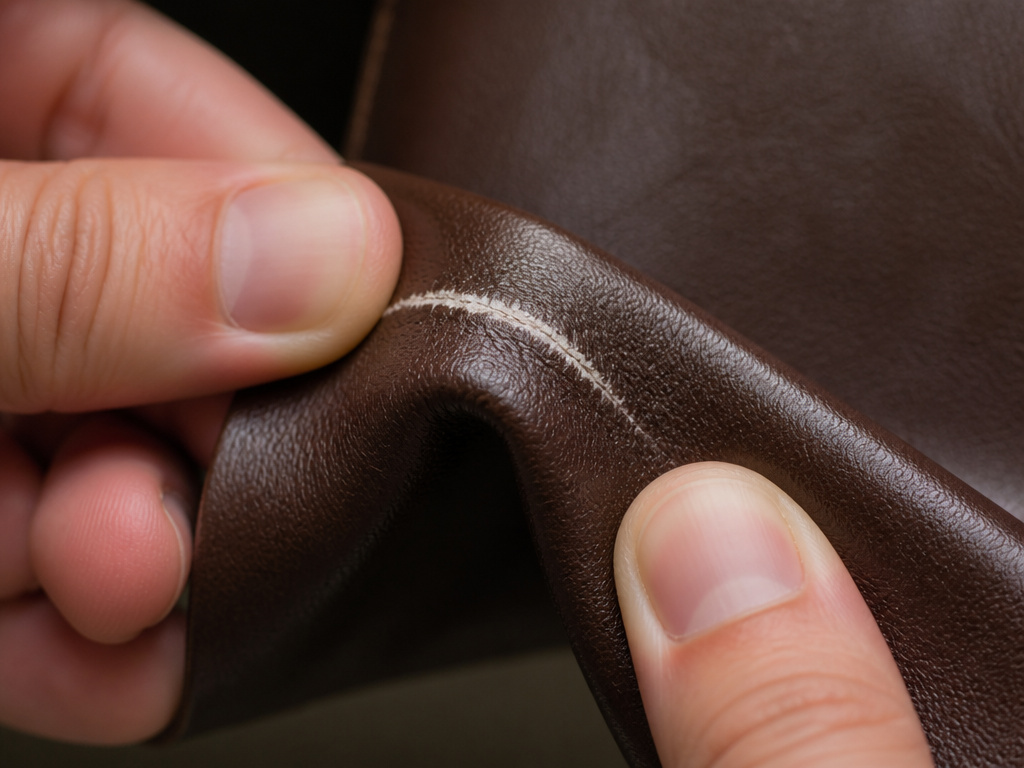
Don’t wait for a disaster to know what you own. A few simple, non-destructive tests can tell you if you’re holding a future problem.
- The Bend Test: Pinch a small, inconspicuous area (like a seam allowance or the back of a belt) and gently bend it. High-quality leather will crease smoothly, like bending a thick piece of paper. Low-quality coated leather or bicast leather will show a stark, white stretch line where the plastic coating is separating from the base. That white line is the warning sign.
- The Water Drop Test: Place a single drop of water on the surface. On porous, full-grain or top-grain leather, the water will darken the spot and slowly be absorbed over a minute or two. On plastic-coated bonded leather or corrected leather, the water will bead up and sit on the surface like it’s on a vinyl tablecloth. A beading surface means a plastic topcoat is present.
- The Smell Test: This is the most straightforward. Bring the item close to your nose and take a deep whiff. Genuine leather has a rich, organic, unmistakable smell. Synthetic or heavily processed leather smells like plastic, chemicals, or nothing at all. Your nose is a powerful tool to tell real leather from fake.
Common mistake: Assuming a “leather” item is high-quality because it feels soft initially. Many cheap items are over-oiled or coated with soft polymers that feel nice in the store but disguise a weak, fibrous split leather base that will fail quickly.
Let me share what I’ve learned from a recurring question. Folks often ask about using strong household cleaners like vinegar to tackle mildew or tough stains on peeling leather. I advise against this shortcut every time. The acidity in vinegar can further disrupt the leather’s already fragile pH balance, accelerating the breakdown of any remaining collagen bonds and making the peeling worse. It also leaves a lingering sour odor trapped in the layers.
The Role of Tanning and Finishing in Longevity
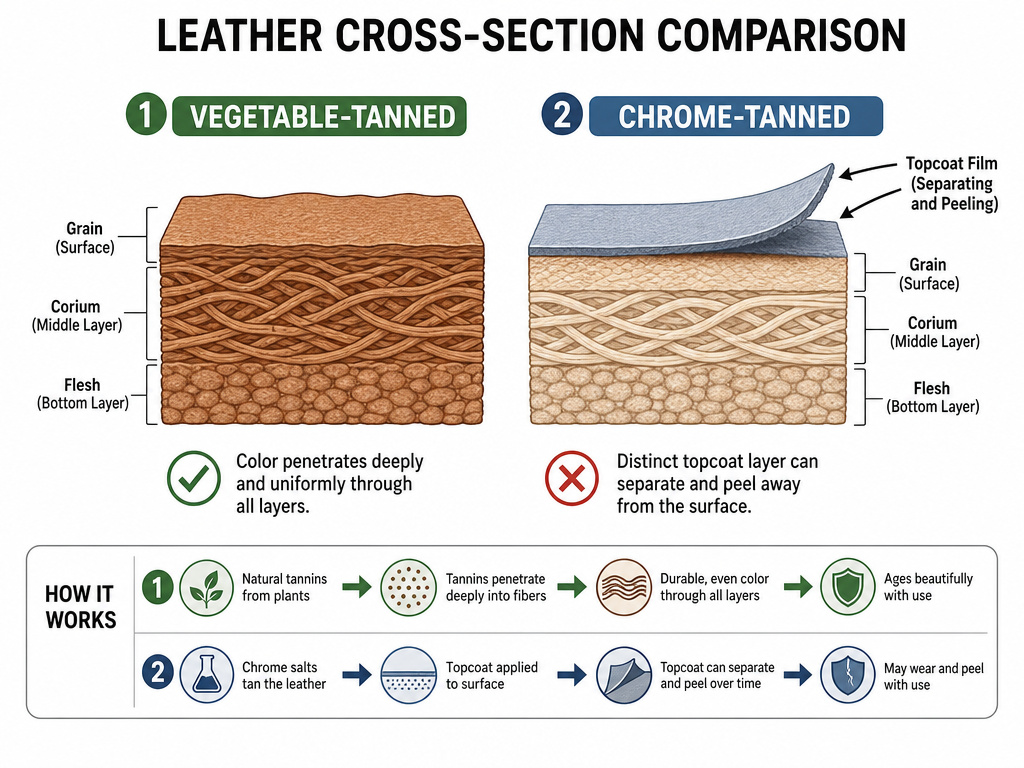
The journey from raw hide to finished leather involves chemistry that directly impacts whether it will peel. Tanning stabilizes the collagen proteins so they don’t rot. How it’s done matters.
Vegetable tanning uses natural tannins from tree bark. It’s a slow process that creates a firm, burnishable leather that ages beautifully, developing a patina. Because the tannins penetrate deeply, the bond between the fibers is strong and uniform. A well-vegetable-tanned piece might develop surface scratches, but it won’t peel because there’s no separate layer to detach.
Chrome tanning uses chromium salts and is faster. It produces a more water-resistant and supple leather. The potential for peeling here lies in the finishing stages. If dyes and topcoats don’t penetrate the tightly chrome-tanned surface properly, they sit on top as a film. A thick, plasticky topcoat on any leather, whether you’re comparing full-grain and top-grain leather or cheaper splits, is a liability.
The science backs this up. Research into leather deterioration, like the methods described in a Heritage Science journal article, uses tools like infrared spectroscopy to analyze the breakdown of collagen’s secondary structure (its alpha-helices and beta-sheets). This kind of failure happens at a molecular level long before you see peeling. It’s why a leather that feels “dry” is already on the path to cracking; the internal structure is losing its flexibility.
How to Care for Leather to Prevent Peeling
Once you have good leather, keeping it from peeling is about respecting its nature. This is based on years of practical experience with what works and what accelerates wear.
- Clean Gently: Dust and dirt act as abrasives. Regularly wipe down leather with a dry, soft cloth. For deeper cleaning, use a product specifically designed for your leather type (aniline, protected, etc.). Avoid all-purpose cleaners or saddle soap, which can strip essential oils.
- Condition Judiciously: Leather conditioner replaces lost oils that keep collagen fibers supple. Think of it like moisturizing your own skin. Use a conditioner from a brand like Lexol (I prefer those with natural oils like lanolin or neatsfoot oil) and apply a thin coat only when the leather feels stiff or dry to the touch—maybe once or twice a year for a frequently used item. Over-conditioning can clog pores and create a sticky surface.
- Control the Environment: This is the most overlooked step. Keep leather out of direct sunlight and away from heat sources. Don’t store it in plastic bags; use a breathable cotton pillowcase. If your home is very dry in winter, consider a room humidifier. Stability is key.
- Address Stains Immediately: Water-based stains can be blotted. Oil-based stains need a specific leather degreaser. Letting a stain sit can force you to use harsher cleaners later, which may damage the finish.
A study in PLOS One on hide preservation found that lowering storage temperature from 23°C to 18°C could slow chemical degradation by half. The same principle applies to your finished goods: cooler, stable storage dramatically extends life.
TL;DR: Prevention is everything. Buy the best grain leather you can afford, avoid plastic-coated composites, and maintain a stable, moderate environment for your items. Conditioning is maintenance for the fibers, not a repair for the finish.
Frequently Asked Questions
Is peeling leather fixable?
It depends on the cause. If a plastic topcoat is peeling from a bonded leather base, the damage is permanent. You cannot re-glue it effectively. If a high-quality leather has a small area of finish lifting due to dryness, a professional might be able to re-adhere and blend it, but it’s often more cost-effective to prevent the damage in the first place.
Does genuine leather peel?
Yes, but it shouldn’t peel quickly or easily. The term “genuine leather” is a broad grade that includes everything from great leather to very poor leather. Low-quality genuine leather, especially from the split leather category with a heavy finish, can absolutely peel. Higher grades like top-grain leather are far more resistant.
How can I tell if my furniture is bonded leather?
Do the bend and water tests in an inconspicuous spot. Also, check the underside or backing material. Bonded leather often has a fabric or non-woven backing, while real leather usually has a woven textile or a second layer of split leather. The smell of plastic is another dead giveaway.
Will leather conditioner stop peeling?
No. Conditioner penetrates the leather to oil the collagen fibers, preventing dryness and brittleness that can lead to cracking and peeling. It cannot re-bond a topcoat that has already separated. It’s a preventative measure, not a cure.
Why is my car leather peeling?
Car interiors face extreme conditions: UV radiation, temperature swings from below freezing to over 140°F, and constant contact with skin oils and friction. If the car manufacturer used a lower-grade leather or a thin, less durable finish to cut costs (as seen in some factory service bulletins), this environment will accelerate the failure, leading to peeling steering wheels, gear knobs, and seat bolsters.
Before You Go
One rule most guides skip: if you’re looking at a piece with early signs of peeling—small lifted edges or a white, creased line when bent—understand that you’re witnessing a terminal failure of the material’s construction. No amount of product will reverse it. Your decision point is whether to replace the item or manage its decline.
For everything else, the formula is simple. Invest in understanding leather grain and structure. Spend more upfront on full-grain or top-grain leather that has no artificial layer to separate. Then, be the stable environment it needs. Keep it clean, condition it sparingly with the right products, and keep it out of the heat. Do those three things, and the leather in your life won’t just survive; it will age with character, telling a story of use and care, not one of neglect and failure.
