
What Is Bicast Leather? The PU Coating That Peels & Cracks
This post contains affiliate links. As an Amazon Associate, we earn from qualifying purchases.
This post contains affiliate links. As an Amazon Associate, we earn from qualifying purchases.
Bicast leather is split leather with a thick polyurethane or vinyl coating, typically 0.15mm to 0.4mm thick, applied to create a smooth, uniform, and embossed surface. It is marketed as an affordable leather-like material, but the heavy coating cracks, peels, and goes sticky with use, often failing within 3-6 months.
Let me share what I’ve learned. That definition isn’t just semantics. The coating thickness is the whole story, it dictates whether a material can legally be called leather in some countries and predicts exactly how it will fail in your home. The process was designed to salvage the lower, fibrous layers of a hide, but the result is a composite with a very short functional life.
Here’s a straightforward guide. I’ll break down the manufacturing steps, explain the British Standard that defines it out of the “leather” category, and show you the physical tests that reveal its weaknesses. By the end, you’ll be able to spot bicast on a showroom floor and understand why a tear in it spreads like a crack in a car windshield.
Key Takeaways
- Bicast leather uses a thick polyurethane layer (often 0.4mm) over split leather, exceeding the 0.15mm limit after which a material is legally “coated leather,” not leather.
- The main failure modes are coating peel and substrate splitting, with documented cases starting within 3-6 months of regular use, making repair impractical.
- Body oils and conditioning products destabilize the plasticizer in the coating, causing a distinct sticky, almost melted feel on headrests and armrests.
- Bicast is often mislabeled as “genuine leather” in markets without strict labeling laws, misleading buyers into thinking they’re purchasing a durable, natural material.
- Flex endurance tests reveal weakness, especially in foamed coatings where internal bubbles split open under repeated bending.
How Bicast Leather Is Made (The Casting Process)
The process doesn’t start with a hide. It starts with a sheet of plastic and a roll of paper.
First, liquid polyurethane is poured onto a release paper, this paper can be smooth or have a texture that will become the leather’s grain pattern. That layer cures to form the top coat. Then, a fast-curing adhesive layer is added. Only then is the split leather backing pressed into the wet adhesive. The whole sandwich cures together, the paper is peeled off and reused, and you’re left with a perfectly uniform sheet.
This “casting” method solves two problems with poor-quality split leather. The separate plastic film doesn’t replicate the roughness of the fibrous split, giving a flawlessly flat surface. It also adds tensile strength; the British Leather Confederation notes that the thick film can make bicast stronger in tear tests than a conventionally finished split. But that’s a bit like saying a plaster cast makes a fractured bone stronger, it’s an external prop, not inherent integrity.
This 50-60 word, third-person technical snippet describes the core manufacturing difference. In bicast leather production, the polymer finish film is created separately from the leather substrate. Liquid polyurethane is poured onto textured release paper to form the top grain, an adhesive layer is added, and then the split leather is laminated onto this wet film. This casting process creates an even surface independent of the leather’s natural imperfections.
The 0.15mm Coating Rule (and Why It Fails)
Here’s the practical takeaway. The British Standard BS 2780 draws a line in the sand: if a surface coating on real leather exceeds 0.15mm thick, the material should be described as a ‘coated leather.’ Not leather. Coated leather.
BLC testing found many bicast products blow past that limit, some with coatings as thick as 0.4mm. That’s a plastic layer you can measure with calipers. This isn’t a finish; it’s a laminate. And that thickness is the root of every failure.
A conventional leather finish is built up in microscopic sprayed layers that move with the hide. A 0.4mm slab of polyurethane does not. It’s a rigid shell glued to a flexible, porous foundation. When you flex it, like sitting on a sofa, the shell must stretch or compress. If the adhesive fails, the shell delaminates and peels. If the shell itself is too rigid, it cracks. And if the plasticizers inside that shell leach out or react with oils, the coating turns gummy.
Common mistake: Assuming a glossy, uniform surface means high quality. On bicast, that perfect surface is the plastic film, not the leather. It’s the first sign you’re looking at a coated product.
Bicast vs. Real Leather: A Side-by-Side Breakdown
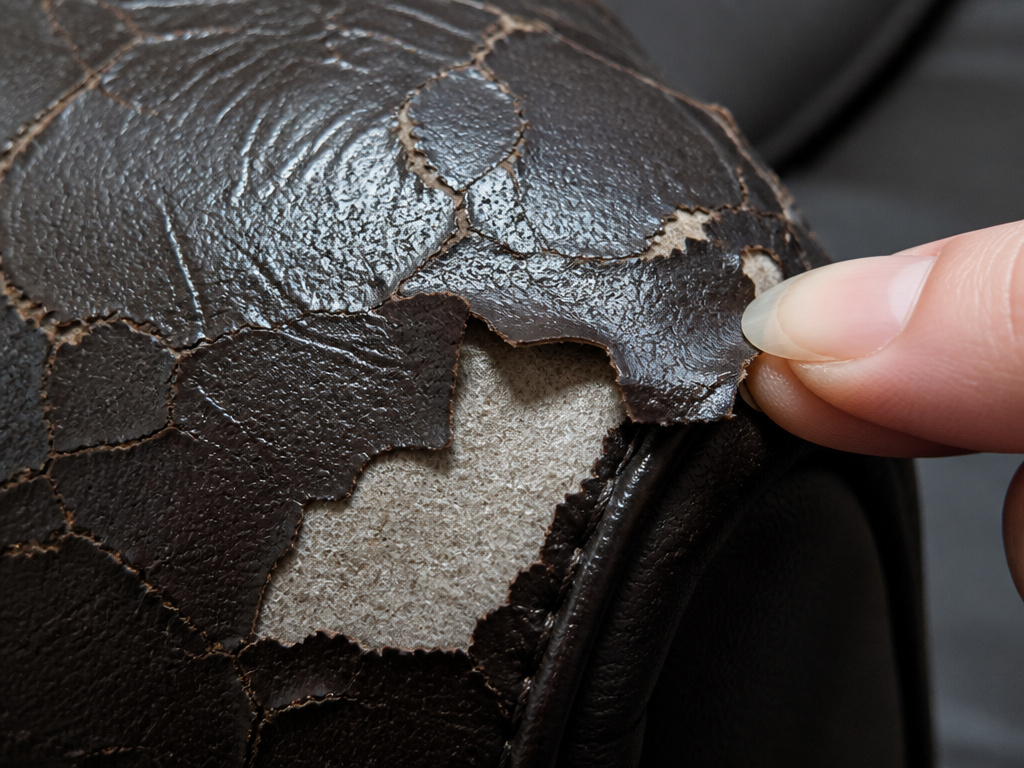 This is a fundamental difference in material category, not a subtle difference in grade. Let’s look at how they compare across key properties.
| Property | Bicast (Coated Split Leather) | Top-Grain or Full-Grain Leather |
|---|---|---|
| Surface | Artificial plastic (PU/vinyl) film, embossed. Uniform and flawless. | Natural protein grain, unique markings and character. Breathes. |
| Core Material | Lower-quality split leather or composite fibers. | Full thickness of the hide’s top layer (corium). |
| Finish Thickness | 0.15mm – 0.4mm (per BLC tests). | Typically <0.1mm of applied dyes and protectants. |
| Aging & Patina | Degrades: coating cracks, peels, or turns sticky. Does not develop patina. | Improves: develops a rich, personal sheen and softens with care. |
| Repairability | Very low. Cannot be re-dyed or refinished once coating fails. Substrate tears propagate. | High. Scratches can be blended, tears can be stitched, color can be refreshed. |
| Breathability | Very low. The plastic film seals the surface. | High. Natural collagen structure allows vapor exchange. |
| Typical Use Case | Low-cost furniture, footwear accents, fashion items where longevity isn’t expected. | Heirloom furniture, high-wear bags, boots, and jackets meant to last decades. |
The comparison shows why repair experts call bicast a “throw-away item.” When the coating goes, the look is destroyed. When the split leather substrate tears, and it will, because those fibers lack the anchoring of a full grain layer, the damage spreads fast. It’s not a question of if it will fail, but when.
Documented Failure Modes and Timelines
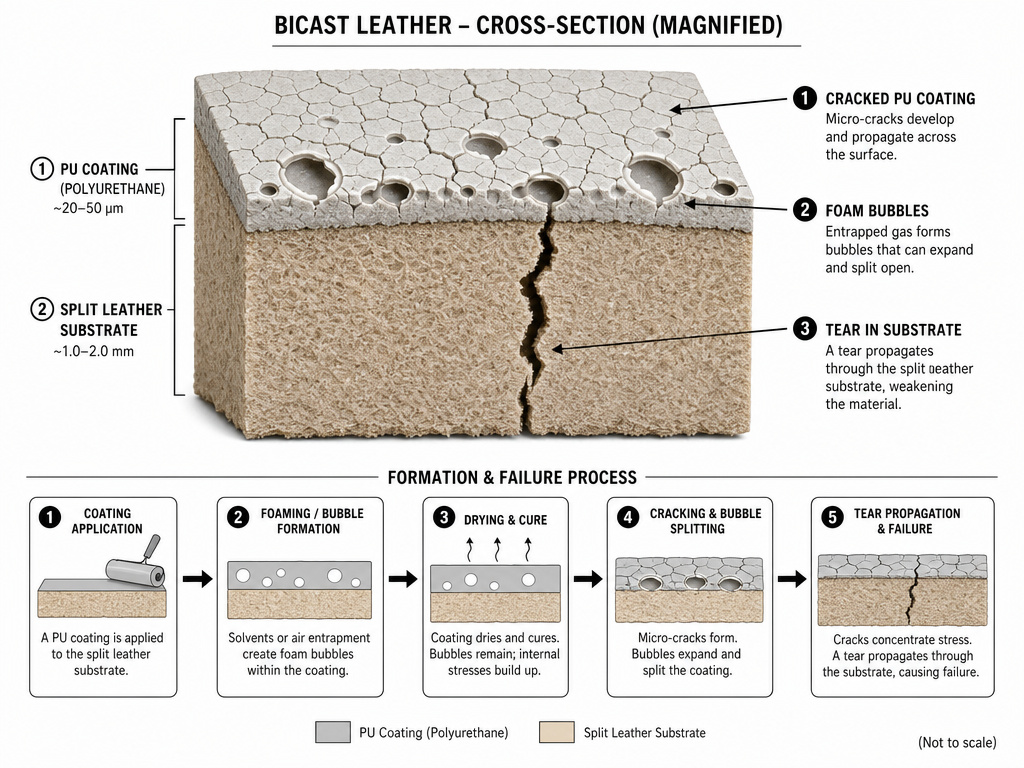 The evidence is documented by testing bodies and recorded by restoration shops. The Wikipedia entry on bicast leather aggregates the consensus: with constant use, the polyurethane layer cracks and splits free from its backing.
But let’s look at the specifics. BLC’s lab observed that the finish can swell and soften when oil is applied. In real homes, this translates to headrests and armrests going sticky. The plasticizers in the polyurethane mix with oils from skin or from misguided applications of “leather conditioner,” destabilizing the film. It looks almost melted in cross-section.
Then there’s flex fatigue. Some bicast uses a foamed finish coat to save material cost. Under a microscope, you see bubbles close to the surface. After 20,000 bending cycles (a test per ISO 5402), those bubbles split open. On your sofa, that’s a crack after six months of sitting down.
Where this goes sideways: Using a leather conditioner on bicast. The oils destabilize the plasticizers in the polyurethane coating, turning it sticky within weeks. The finish doesn’t absorb conditioner; it reacts with it.
I need to be clear about one thing. The timeline isn’t a guess. An archived advisory from AdvLeather bicast leather consumer tips cites a repair expert who has seen the coating peel or the substrate tear in as little as 3-6 months. Once that tear starts in the split leather backing, it runs. Repair is not viable. That’s the shockingly short-lived structural integrity they warn about.
How to Identify Bicast Leather Before You Buy
You don’t need a lab. You need your senses and a keen eye for the marketing copy. Start by understanding the leather grain. If the grain pattern is perfectly repetitive, diamond, pebble, ostrich, across a large area, it’s almost certainly embossed. Real grain has natural variation.
Feel the surface. Run your fingertip across it. A true top-grain leather will have a slight, natural variation in texture and temperature. Bicast will feel consistently cool and plasticky, like a laminated card. The backside is the giveaway. Peel up a corner of a cushion if you can. Real leather’s flesh side is fibrous but consistent. Bicast’s backing will look like a fuzzy, non-woven mat, that’s the split leather or composite layer.
Check the label and the sales pitch. In countries with strict labeling like the UK or New Zealand, bicast must be called “coated leather” or similar. In markets without such laws, it might be deceptively tagged “genuine leather.” If the price seems too good to be true for a large leather item, it probably is. Knowing how to tell real from fake leather starts with skepticism.
Finally, perform a simple leather quality test. Press your thumb firmly into the surface. On real leather, you’ll see wrinkles that slowly relax. On bicast, the thick coating will either show no change or, in low-quality versions, you might hear a faint creaking sound as the plastic film stresses against the adhesive.
The Problem with “Genuine Leather” Labels
This is the heart of the frustration for anyone who cares about materials. The term “genuine leather” is a technical grade indicating the material is real leather, not synthetic. However, it says nothing about the type of leather finishing or the presence of a coating.
Bicast is real leather at its core, it uses a split leather backing. So legally, in many places, it can be called “genuine leather.” This is a classic case of a technically true label being practically misleading. A buyer expects the durability and aging of traditional leather, not the rapid failure of a plastic-laminated split. This confusion is why learning about corrected grain leather and the split leather manufacturing process is so important, it reveals the layers beneath the label.
The pros and cons of genuine leather hinge on this transparency. It can be an affordable, durable choice if you know it’s a full-thickness, lightly finished hide. It becomes a poor choice when the term is used as a cover for bicast or other heavily processed materials.
Caring for Bicast (If You Already Own It)
Maybe you’ve already bought a piece. The care protocol is different because you’re maintaining a plastic film, not nourishing a hide.
Forget oils, creams, or traditional leather conditioners. They will not penetrate the plastic layer and will likely damage it. Use only a dry, soft brush for dust. For spills, a barely-damp cloth with a drop of mild soap, wiped gently and dried immediately, is the limit. The goal is to avoid letting body oils or moisture sit on the surface.
There are specific protectant sprays marketed for bicast or vinyl. These work by creating a sacrificial barrier on top of the existing coating. They won’t revive a damaged finish, but they might slow the accumulation of oils that cause stickiness. Test any product on an inconspicuous area first.
Understand that this care is about damage control, not preservation. You are delaying the inevitable degradation of the plastic coating. When the peeling or cracking starts, there is no effective repair. Re-upholstery or replacement is the only path forward.
Frequently Asked Questions
Is bicast leather real leather?
Technically, yes, because it contains a layer of split leather. Legally, according to standards like BS 2780, if the coating is thicker than 0.15mm, it should be labeled as “coated leather” to distinguish it from traditional leather products. Practically, it behaves more like a plastic-coated fabric than leather.
How long does bicast leather last?
With regular use on furniture, bicast leather often shows significant failure, coating peel, stickiness, or substrate tears, within 1-3 years. Documented cases from repair professionals show failures starting in as little as 3-6 months. Its lifespan is drastically shorter than top-grain or full-grain leather.
Why does my bicast leather feel sticky?
The sticky feel comes from the plasticizers in the polyurethane coating mixing with oils from your skin or from inappropriate cleaning products. This chemical reaction destabilizes the finish. Once sticky, the coating cannot be restored to its original state; it is a permanent degradation.
Can you repair a tear in bicast leather?
Effective, invisible repair is nearly impossible. Glues don’t bond well to the plastic coating, and the split leather substrate lacks the strength to hold a stitch without tearing further. Repair experts generally consider bicast a non-repairable material; replacement of the panel or the entire item is the only solution.
What’s the difference between bicast and bonded leather?
Both are composites. Bicast uses a single layer of split leather backed by a thick polyurethane coating. Bonded leather (or reconstituted leather) is made from shredded leather fibers mixed with latex or PU, then pressed into a sheet and coated. Bonded leather is even weaker and less leather-like than bicast.
Before You Go
Let’s be clear about one thing. Bicast is a specific material for a specific, short-term purpose. If you need a cheap, glossy accent on a piece you don’t expect to use for years, it fits.The problem is the mismatch between expectation and reality, fueled by lax labeling.
The real cost is the replacement cost in two years when the chair is peeling and the sofa is sticky. For anything you plan to use daily and keep for more than a season, choose a full-grain leather or waxed canvas.Look past the perfect, embossed surface. Check the backing, feel the temper, and ask what’s under the finish. The leather, and your wallet, will thank you later.
