
Defining Split Leather: The Coated, Lower Layer of a Hide
This post contains affiliate links. As an Amazon Associate, we earn from qualifying purchases.
Split leather is the lower, flesh-side layer of an animal hide, mechanically separated from the durable top-grain layer. It lacks the tight fiber structure of the surface grain, making it less resilient and more prone to tearing, which is why it’s often coated with polyurethane or pigment to mimic better leathers and used in suede, budget furniture, and automotive interiors.
That definition is the starting point, but the real story is in the industrial process and the consequences of using this material where it shouldn’t be. The splitting machine gives manufacturers two usable sheets from one hide, but they are not equals.
The rest of this guide walks through exactly how a hide is split, the three different grades of split you can get, and the tell-tale signs that the leather sofa or car seat you’re looking at is built on this weaker foundation. You’ll learn why a split feels different, why it fails in predictable ways, and how to care for it if you already own something made from it.
Key Takeaways
- Split leather is not a type of leather but a layer of a hide, specifically the corium or flesh side left after the top grain is removed.
- Its lack of a tight grain structure makes it inherently weaker; you can tear most splits by hand, which you cannot do with a true top grain.
- To make it look presentable, splits are almost always coated with a polyurethane (PU) or pigment layer and often embossed with a fake grain pattern.
- This material is common in areas of low wear on sofas, in non-premium car interiors (steering wheels, door cards), and as the base for suede.
- Cleaning a coated split with aggressive chemicals like all-purpose cleaners (APC) or Magic Erasers will strip the coating and expose the weak, fuzzy flesh side.
The Anatomy of a Hide: Where Split Leather Comes From
A raw cowhide is thick, often between 5mm and 10mm. For almost all leather goods, that’s too bulky. Historically, tanners would thin hides by shaving layers off the flesh side by hand, a slow process akin to planing wood. The invention of the band-knife splitting machine changed everything. This machine slices the hide horizontally into two (or more) sheets.
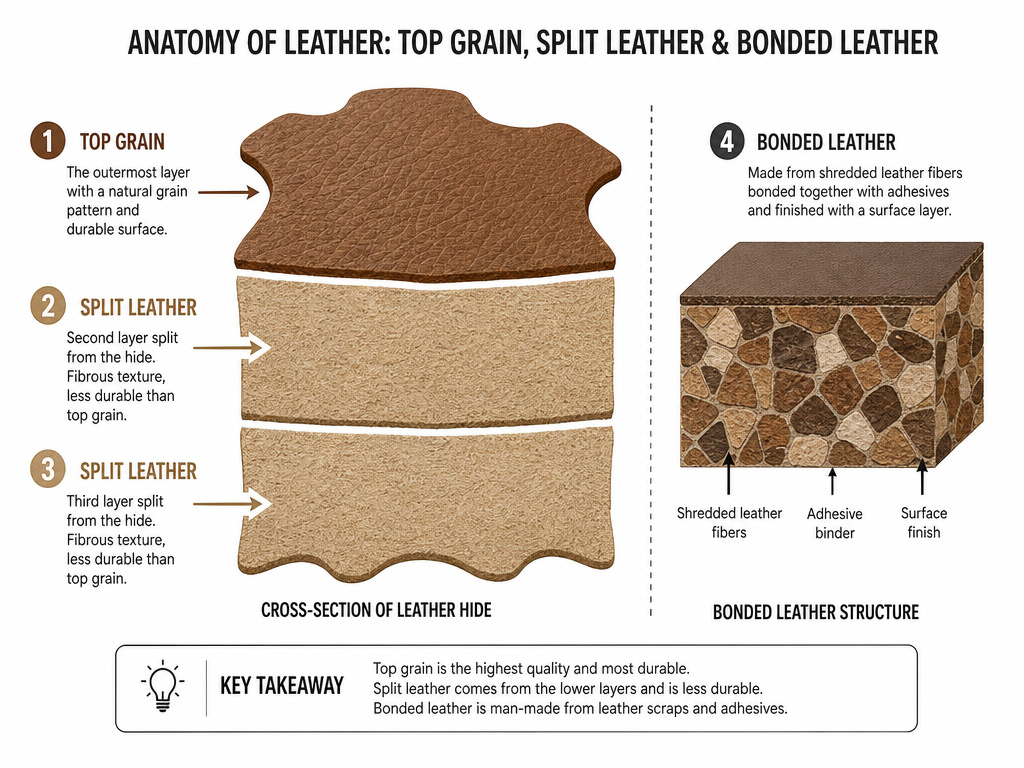
The band-knife splitting machine cuts a hide along its horizontal plane, creating a grain split (the top) and a drop split (the bottom). The grain split retains the dense, weather-resistant fiber structure of the skin’s surface. The drop split exposes the looser, spongier corium fibers.
The grain split becomes what we call top-grain leather. This can be further categorized as full-grain leather (uncorrected surface) or corrected grain leather (sanded and refinished), but both originate from this strong upper layer.
The remaining lower layer is the split. On thicker hides, this drop split can be split again, yielding a middle split and finally a flesh split, each progressively weaker and more fibrous. This is the origin of all split leathers, from the decent suede used in jackets to the cheap, coated material glued to the back of vinyl in budget furniture.
The Three Grades of Split: From Suede to Flesh
Not all splits are destined for the same fate. The initial split yields what’s called the drop split. Its quality and subsequent use depend on how far down the hide it came from.
| Split Grade | Origin in Hide | Common Uses & Treatment |
|---|---|---|
| Grain Split (Drop Split) | First split below the top grain. Still retains some fiber density. | Often coated and embossed for low-wear furniture panels, automotive door cards, or buffed to create a decent quality suede. |
| Middle Split | Second split, further into the corium. Looser, weaker fibers. | Almost always coated with a thicker PU layer to provide structure. Common in budget furniture sides/backs. |
| Flesh Split | Final split, closest to the animal’s flesh. Very spongy and weak. | Frequently used as a backing material, such as in bicast leather, where it provides a cheap leather base for a polyurethane film. |
The visual difference is stark. The flesh side of any split is fuzzy, those are the ends of the corium fibers. The top-grain side is smooth and tight. That fuzz is what gets sanded and buffed to create suede’s signature nap. If a split isn’t destined to be suede, that fuzzy surface must be hidden, which leads to the next step: coating.
Why Split Leather is Inherently Weaker
Pull on a piece of top-grain leather. It resists. The fibers at the skin’s surface are densely packed, a natural barrier against the elements. Now, imagine pulling apart a bundle of cotton balls. That’s closer to the experience of pulling on a split.
The strength of leather comes from the interwoven fiber structure at the grain layer. Once you cut below that, you’re into the corium, a layer of more loosely organized collagen fibers designed for elasticity and cushioning, not abrasion resistance. A top-grain leather is almost impossible to tear by hand. A split can often be torn with steady, firm pressure.
This isn’t a small difference in quality; it’s a fundamental difference in material science. The split lacks the “grain” that gives leather its name and its legendary durability. This weakness dictates everything about how split leather must be used, and disguised.
How Manufacturers Disguise a Split (And Why It Matters)

Because the flesh side is fuzzy and weak, split leather is rarely sold in its natural state for smooth-finish goods. Instead, it undergoes a makeover.
The coating process is straightforward: a layer of polyurethane (PU) or acrylic, often mixed with pigments, is applied to the surface. This coating is then embossed with a grain pattern, maybe a pebbled texture, maybe a subtle pore effect, to mimic full-grain or top-grain leather. The result can look convincing, even up close.
Where this goes sideways: Using generic cleaners on coated automotive splits. People see a smooth surface on a car door panel and assume it’s plastic or vinyl. They hit it with an all-purpose cleaner (APC) or a Magic Eraser. These abrasives strip the PU coating, revealing the fuzzy, unstained split beneath. The damage is permanent and spreads with every clean.
This coating creates two practical issues. First, it turns the leather into a plastic-laminated material. It won’t breathe, it won’t develop a patina, and it feels cooler and less supple to the touch. Second, the coating itself has a finite lifespan. It can crack, peel, or wear off in high-contact areas like the outer edge of a driver’s seat bolster or a frequently touched armrest.
This is a common point of confusion, and sometimes deliberate obfuscation, in the automotive industry. Many mid-range cars use coated drop splits on steering wheels, gear knobs, and door inserts. The sales brochure may simply say “leather trim,” which is technically true but functionally misleading. The wear pattern will be completely different from that of a top-grain leather seat.
Split Leather vs. Other Common Leather Types
It’s easier to understand split leather by seeing what it’s not. Let’s compare it to two frequent points of confusion.
Split vs. Top-Grain Leather: This is the core distinction. Top-grain leather is the layer that includes the grain; it’s the strong, durable half of the hide. Split is what’s left underneath. All top grain is stronger than any split. A comparison of full-grain vs top-grain leather is a debate within the top-grain family; split leather isn’t even in that conversation.
Split vs. Bonded Leather: These are often confused because both are considered lower-tier. Bonded leather is a composite made from shredded leather fibers (often from splits) and polyurethane, pressed into a sheet and coated. It’s essentially leather particle board. A split, however, is still a continuous, intact piece of hide, just from a weak layer. Bonded leather is less durable and often even less breathable than a coated split.
The key is to think in layers. Top grain is the top. Split is the bottom. Bonded leather is a reconstituted mix of the scraps.
Practical Uses: Where You’ll Actually Find Split Leather
Given its limitations, split leather isn’t used for heirloom goods. Its applications are strategic, targeting areas where cost reduction is critical and extreme durability isn’t.
- Suede Production: This is the noble use for a grain split from a tannery like Charles F. Stead. By sanding and buffing the flesh side, manufacturers raise a soft, velvety nap. * Good suede comes from a drop split with a nap of 1.0 to 1.2 millimeters; poor suede comes from lower splits.
- Furniture Upholstery: Check the sides and back of a leather sofa. These low-wear, low-visibility areas are prime real estate for coated splits. They match the color of the top-grain seats but cost far less.
- Automotive Interiors: As mentioned, non-seat surfaces are common spots. Also, some budget car seats use a “leather” face material that is actually a coated split over a fabric backing.
- Fashion Accessories & Work Gear: Belts, wallets, and bags at fast-fashion prices often use it. Conversely, its lack of slickness makes some splits useful for work gloves and protective clothing where grip is needed.
The rule of thumb: if a leather item is surprisingly affordable and has a perfectly uniform, plastic-like surface, you’re likely looking at a coated split.
How to Care for Split Leather Products
Caring for split leather is less about nourishing the leather and more about preserving its cosmetic coating.
- Identify It First. Feel the back. If it’s fuzzy, you have a split (or suede). Look at the edge. A clean, laminated edge often indicates a coating. If you see a fuzzy edge, the coating may have worn off.
- Clean Gently. Use a damp microfiber cloth only. Never soak it. For coated splits, avoid traditional leather cleaners containing oils or solvents, which can break down the PU coating. A mild soap solution is the safest bet.
- Condition the Coating (Not the Leather). Standard leather conditioners are designed to penetrate and feed the leather fibers. They can’t penetrate a plastic PU coat and may sit on top, creating a sticky residue. Use products specifically labeled for “coated leathers” or “finished leather.”
- Keep It Dry. Splits are particularly susceptible to water damage. The coating can bubble, and water can seep into the fibrous base, causing staining and weakening the bond between the coating and the leather.
- Store Properly. Keep items away from direct heat sources (radiators, sun-baked car interiors) and sunlight. Heat accelerates coating cracking and peeling.
The goal is to protect the surface finish. Once that coating is compromised, the underlying split is vulnerable to rapid degradation.
Frequently Asked Questions
Is split leather real leather?
Yes, split leather is real leather. It is a layer of the animal hide. However, it is the weakest layer, lacking the dense grain structure that gives top-grain leather its durability and value.
Why is split leather cheaper?
It’s cheaper because it’s a by-product of making top-grain leather. The splitting machine creates two sheets from one hide; the top grain commands a high price, and the split is the remaining volume. Its inherent weakness also limits its use, keeping demand, and therefore price, lower.
Can split leather be good quality?
“Good quality” is relative. As a material for suede, a high-grade drop split can be excellent, soft, and fit for purpose. As a coated material pretending to be top-grain leather, its quality is inherently lower because the coating will eventually fail, revealing the inferior base. Its quality is functional for its intended, often short-term, use.
How can I tell if my sofa is split leather?
Check the non-primary surfaces. Turn over a cushion or look at the sofa’s back. If the leather feels noticeably different, colder, plasticky, or if the “grain” pattern is perfectly uniform and repeats, it’s likely a coated split. The definitive test is to examine a non-finished edge, but this isn’t always possible.
Before You Go
Understanding split leather removes a major point of confusion in the market. It’s not a scam or fake leather; it’s a specific, industrial-grade material with predictable strengths and very clear weaknesses.
The practical takeaway is this: when buying any leather good, ask not just “is it leather?” but “which part of the leather is it?” For a sofa you want to last a decade, ensure the primary contact points are top-grain leather. For a steering wheel cover, know that a coated split will glaze and peel with sweat and UV exposure. And for cleaning, treat any smooth, budget leather item as if it has a plastic coating, because it probably does. That knowledge alone will save you from the most common damage.
Let me share what I’ve learned: the leather will tell you what it needs if you know how to look. Split leather asks for gentle, surface-level care and realistic expectations about its lifespan. Anything more forceful, and it will show you its fuzzy underside sooner rather than later.
