
Goodyear Welt vs Blake Stitch | The Longevity Trade-Off
This post contains affiliate links. As an Amazon Associate, we earn from qualifying purchases.
This post contains affiliate links. As an Amazon Associate, we earn from qualifying purchases.
Goodyear welt construction joins the upper to a leather strip (the welt), which is then stitched to the outsole, allowing for multiple resoles. Blake stitch construction uses a single stitch that passes directly through the outsole, upper, and insole, creating a sleeker, lighter shoe that is harder to resole. The Goodyear welt is the durable, rebuildable workhorse; the Blake stitch is the elegant, flexible dress option.
The difference is structural, not just cosmetic. One method builds in redundancy and a serviceable fail point; the other integrates everything into a single, direct line. That choice dictates everything from how water reaches your socks to how many times a cobbler can replace the sole before the shoe’s foundation gives out.
What follows is a breakdown of the anatomy, the real-world performance trade-offs, and the specific scenarios where each construction method actually wins. By the end, you’ll be able to look at any pair of shoes and understand not just how they’re made, but how they’re meant to be used.
Key Takeaways
- A Goodyear welt can typically be resoled five or more times; a Blake stitch maxes out at two to three resoles before the insole weakens.
- Blake stitch holes create direct channels for water to wick into the shoe, making them a poor choice for wet climates without extra sealing.
- The canvas rib (gemming) glued inside a Goodyear welt is a known failure point during resoling, a weakness hand-welted construction avoids.
- Resoling a Blake-stitched shoe requires a specialized Blake stitching machine, which many local cobblers do not have.
- For immediate comfort and a sleek profile, choose Blake. For long-term durability and easy repair, choose Goodyear welt.
The Anatomy of Each Stitch
You can’t judge the lifespan of a shoe by its exterior. The real story is in the layers you can’t see and the path of the thread that holds it all together. Let me share what I’ve learned from taking apart more than a few worn-out pairs.
A Goodyear welt is a system, not just a stitch. A strip of leather, the welt, is first stitched to the shoe’s upper and to a canvas rib (called gemming) that’s glued to the insole. Then, the outsole is stitched to that welt. The space created is filled with cork. This creates two separate stitch lines and a cavity that acts as a buffer.
The ideal lock stitch on a Goodyear welt outsole sits one-third into the sole from the welt interface. Positioning it at the interface or too deep in the sole groove risks premature separation under stress.
A Blake stitch is direct and integrated. A single thread on a specialized machine goes straight through the outsole, up through the upper, and into the insole in one continuous loop. There’s no welt, no cork cavity, just those three layers locked together. This is why Blake-stitched shoes lie so flat and close to the ground; they’ve removed the middleman.
Is a Goodyear Welt or Blake Stitch More Durable?
The answer depends on your definition of durability. If you mean surviving a scuff on pavement, both are fine. If you mean maintaining structural integrity over 15 years and multiple sole replacements, the scales tip decisively.
Goodyear welt construction is built for the long haul. The double-stitched structure distributes stress. The welt takes the abrasion, protecting the upper. The cork filler compresses to your foot but the insole remains untouched. This is why sources like fire-service boot analysts note welted boots can undergo one to three resole cycles, with more possible if the welt and upper are sound. The construction anticipates repair.
Blake stitch durability has a ceiling. Every time you flex the shoe, all the stress concentrates on that single line of stitching through the insole. Each resole requires punching new holes through the same insole and upper, progressively weakening them. Most Blake-stitched shoes are limited to two to three resoles before the insole’s integrity is compromised. The thread itself is strong, often 100% high-tenacity polyester, but the material around it isn’t designed for repeated surgery.
Here’s the thing: a well-maintained Goodyear welted shoe isn’t just a purchase; it’s a platform. The uppers and insole can outlive several soles. A Blake-stitched shoe is more of a closed system. It’s durable, but its rebuildability is fundamentally limited by its own elegant design.
Water Resistance and the Direct Channel Problem
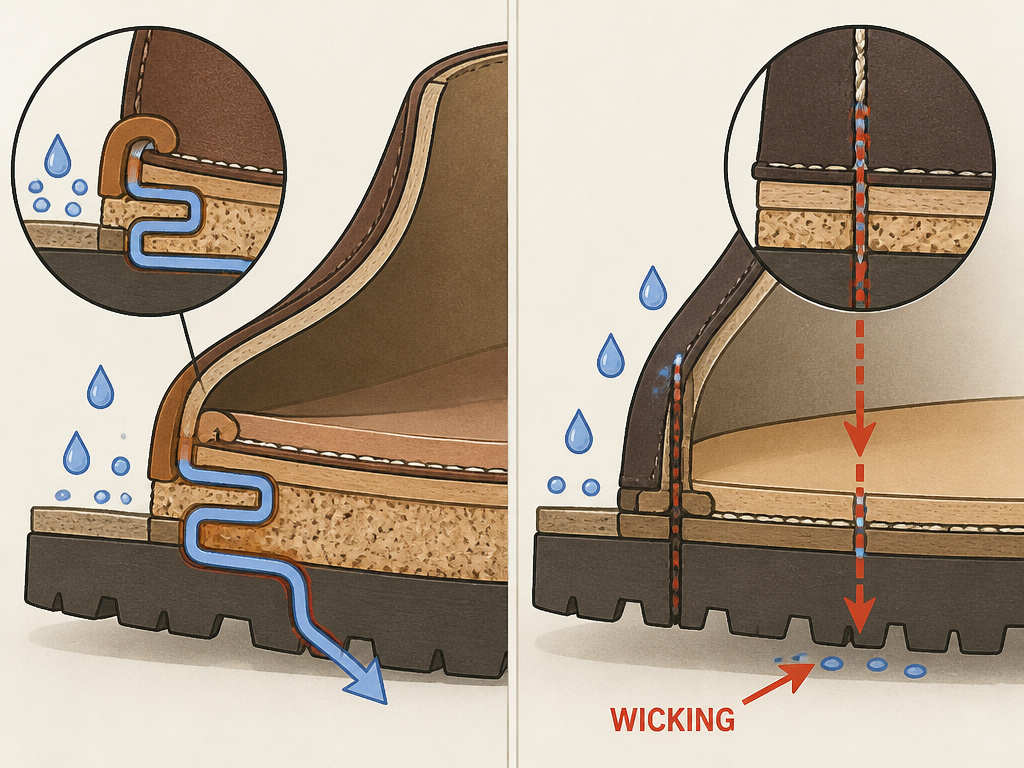 This is where the construction diagrams become real on a rainy day. The difference isn’t academic; it’s the difference between damp soles and wet socks.
The Goodyear welt has a built-in moisture barrier. The winding path from outsole to insole, through the welt, cork, and canvas rib, slows water penetration. The stitching is also often wax-sealed. It’s not submersible waterproof, but it provides solid resistance to rain and splashes.
The Blake stitch has a direct line to your foot. Those stitch holes are literal tunnels running from the wet pavement, through the outsole, through the upper, and right into the insole inside your shoe. Water wicks along the thread via capillary action. In a sustained downpour, moisture transfer is almost guaranteed. This makes standard Blake construction a poor match for wet climates without a fully waterproof membrane or extensive external sealing.
The Resoling Reality: Ease vs. Limitation
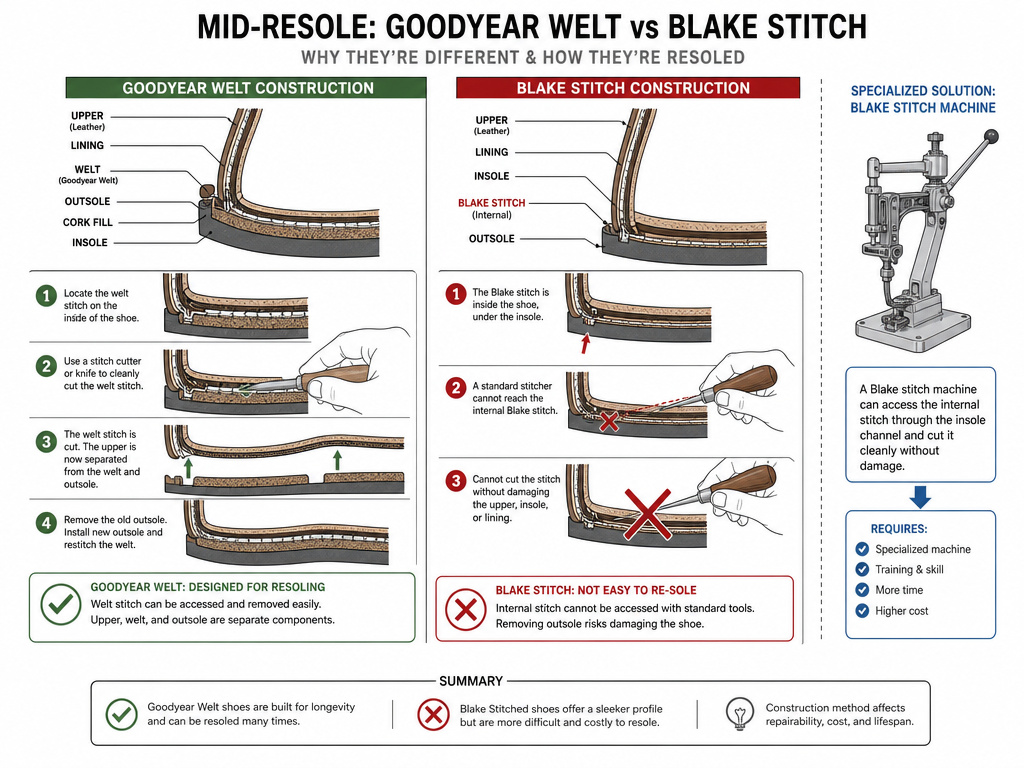 “Resolable” is a term used for both methods, but the practical experience is worlds apart. This is where community discussions and cobbler frustrations come to light.
Resoling a Goodyear welt is standard cobbler work. Because the outsole is stitched only to the welt, a cobbler cuts that stitch, peels off the old sole, and stitches a new one to the existing welt. It doesn’t disturb the upper or the insole’s integrity. It’s a straightforward, widely available service.
Where this goes sideways: Attempting to resole a Blake-stitched shoe without the proper machine. A standard cobbler’s outsole stitcher can’t reach the interior stitch line, leading to botched jobs or refusal of service.
Resoling a Blake stitch is a specialist’s job. It requires a specific Blake stitching machine that can reach inside the shoe to replicate the original stitch path. Fewer cobblers have this equipment. As the CSL Shoes analysis notes, each resole puts new holes into the same insole and upper leather, which is why the resole cycle count is so limited. The shoe becomes weaker with each repair.
Side-by-Side Comparison: Which Construction Wins?
The best choice isn’t universal; it’s situational. This table breaks down where each method excels and where it falls short, so you can match the construction to your actual life.
| Factor | Goodyear Welt | Blake Stitch |
|---|---|---|
| Best For | Long-term ownership, wet weather, rugged or formal boots | Sleek dress shoes, dry climates, immediate comfort |
| Resoling | Easy, common, 5+ cycles possible | Specialist-only, 2-3 cycle limit |
| Water Resistance | Good (barrier path) | Poor (direct channels) |
| Break-in Period | Longer (weeks) | Short (days) |
| Profile & Weight | Heavier, thicker sole edge | Lighter, sleeker, minimal edge |
| Long-term Cost | Higher upfront, lower per year with resoles | Lower upfront, may require full replacement sooner |
The Hidden Failure Point: Glued vs. Sewn
Most comparisons stop at the welt itself. But to understand a key vulnerability in Goodyear welting, you have to look at what the welt is stitched to.
In a true hand-welted shoe, the welt is sewn through a leather “holdfast” that’s carved from the insole itself, a single, solid piece of hide. In Goodyear welted footwear, the welt is sewn through a strip of canvas rib (gemming) that is glued to the insole. This glued canvas is the manufacturing shortcut that made the Goodyear welt machine so efficient.
Common mistake: Assuming all welts are created equal. That glued canvas rib can delaminate, slip, or break down during a resole, making it difficult or impossible for a cobbler to re-anchor the welt properly.
This is a documented compromise. When that glue fails, the structural link between the upper and the sole is compromised. It’s a failure point that hand-welted construction deliberately avoids. It doesn’t mean every Goodyear welt will fail this way, but it’s a inherent weakness in the system that justifies the higher cost of true hand-welting for purists. When you’re evaluating a quality leather boot, understanding this internal detail is as important as admiring the full-grain leather exterior.
How to Choose for Your Needs
This isn’t about which is objectively better. It’s about which is better for you. Let’s be clear about this: your daily environment and style preferences should make the decision.
Choose Goodyear Welt if:
- You prioritize durability and decades of service.
- You live in a rainy or snowy climate.
- You want the option for easy, local resoling.
- You prefer the classic, substantial look of heritage boots or formal shoes.
- You’re investing in a pair of high-quality boots you never want to throw away.
Choose Blake Stitch if:
- Sleekness and elegance are your top priorities (think Italian loafers or oxfords).
- You need immediate, flexible comfort with no break-in.
- Your shoes will live in dry, indoor, or fair-weather environments.
- You accept that the shoes may have a shorter total lifespan despite high initial quality.
- You’re selecting from a list of best boots for a sharp, modern wardrobe.
I once believed darker leather hid wear better, until I saw how light scuffs on a dark bag created shiny high spots that were more noticeable than a deep scratch on a lighter tone. The same principle applies here. Don’t choose the “more durable” Goodyear welt for a shoe you’ll wear ten times a year in an office. That’s overkill. Don’t choose the sleek Blake stitch for your only pair of winter boots. That’s a mismatch. Match the tool to the task.
Frequently Asked Questions
Can a Blake stitch be converted to a Goodyear welt?
Technically yes, but it’s rarely practical or economical. A cobbler would need to add a midsole and a welt, essentially rebuilding the entire bottom of the shoe. The cost often approaches or exceeds buying a new pair of Goodyear welted footwear. It’s usually done only for sentimental reasons on irreplaceable uppers.
Are Goodyear welt boots waterproof?
Not inherently. They are highly water-resistant due to the sealed, indirect construction path. However, prolonged submersion or water pressure can eventually force moisture through the stitch holes. For true waterproof performance, look for boots that combine a Goodyear welt with a waterproof membrane like Gore-Tex.
Why are Goodyear welt shoes so stiff at first?
The stiffness comes from the multiple layers of leather (upper, insole, welt, outsole) and the cork filler. This is by design for stability and longevity. As you wear them, the cork compresses and the leather flexes, molding to your foot for a custom fit. The break-in period is an investment in future comfort.
Is a Blake stitch weaker than cemented construction?
No, it is significantly stronger. Cemented construction relies solely on adhesive, which can dry out and fail completely. A Blake stitch provides a mechanical lock via thread. While it’s less robust than a Goodyear welt over decades, it is far superior to any glued construction for a shoe with a Blake stitch or Blake-rapid construction.
Do I need to worry about the canvas rib failing?
For the average user, no. The glued canvas rib is a known theoretical weakness among craftsmen, but most quality Goodyear welted shoes will deliver multiple resoles without issue. It becomes a concern mainly on poorly constructed shoes or during aggressive, repeated resoling by an inexperienced cobbler. It’s a reason for the price gap between machine-welted and hand-welted, not a reason to avoid Goodyear welts altogether.
The Bottom Line
So, which one should you choose? Practically speaking, if you walk through city rain, value a 10-year horizon, and see a cobbler as a partner in ownership, the Goodyear welt is your answer. Its layered, serviceable design is about the long game. If your world is carpet, fair weather, and a wardrobe that demands razor-sharp silhouettes, the Blake stitch delivers the elegance and comfort you want from day one.
The real takeaway is to look beyond marketing terms like “handcrafted” or “resolable.” Now you know to ask how it’s resolable, and for how long. You know that the leather patina on the surface tells one story, but the stitch path inside tells the story of its future. Use that knowledge to buy with confidence, whether you’re after a rugged boot or a refined dress shoe. That’s how you make a choice that lasts.
