
The Complete Guide to What Goodyear Welt Construction Is
This post contains affiliate links. As an Amazon Associate, we earn from qualifying purchases.
This post contains affiliate links. As an Amazon Associate, we earn from qualifying purchases.
Goodyear welt construction is a shoe and boot manufacturing method where a strip of leather (the welt) is stitched to the upper and insole. A second, separate stitch then attaches the outsole to the welt. This creates a durable, waterproof barrier and allows the outsole to be replaced multiple times without damaging the upper.
The magic isn’t the strip of leather itself. It’s the separation of the two stitches. That separation is what makes the entire system work, and it was a mechanical problem solved by a specific machine in 1869.
What follows is a breakdown of the anatomy: the welt, the cork, the two critical stitches, and the hidden gemming. We’ll also cover how it stacks up against other methods like Blake stitch, the real reason it lasts for decades, and the one material flaw that can break the whole system regardless of craftsmanship.
Key Takeaways
- The defining feature is the double-stitch system: one joins the upper to the welt, a separate one joins the welt to the outsole.
- The cavity created is filled with cork, which molds to your foot for custom comfort and acts as a water barrier.
- This construction allows for multiple resoles, extending a shoe’s life to 20+ years if the upper is cared for.
- Thread quality is critical. Inconsistent or overly stretchy thread can cause the sole to separate prematurely.
- Not all “welted” shoes are Goodyear welted. The term refers specifically to the mechanized process invented by Charles Goodyear Jr.
The Core Components of a Goodyear Welt
A Goodyear-welted shoe is a sandwich. Each layer has a specific job, and skipping one or using the wrong material compromises the entire build.
First, the last. This is the foot-shaped form over which the leather upper is stretched and shaped. Everything else is built around this foundation. The insole is then nailed to the bottom of the last. Here’s where the first trick appears. A canvas or leather rib, called gemming, is cemented to the insole’s perimeter. This rib provides a sturdy anchor point for the first major stitch.
The upper is folded over and tacked down. Now, the welt, a long, narrow strip of leather, is brought in. Using a Goodyear welting machine, a stitch sews through the welt, through the upper, and into that gemming rib on the insole. This is the inseam. It’s hidden from view inside the shoe and is protected from wear.
This critical seam uses a lockstitch. The thread is passed through a hot wax pot which seals the awl holes to prevent water ingress. If this seam fails, the whole shoe is compromised.
You now have a leather cup: the last inside, the insole on the bottom, the upper on the sides, and the welt sewn to the edge. The space between the insole and the ground is a cavity. That cavity gets filled with a moist cork filler. As you wear the shoe, the cork compresses and molds to the unique shape of your foot, creating a custom footbed. It also provides cushioning and is a key part of the shoe’s water resistance.
Finally, the outsole is stitched on. This is the second, separate stitch. It goes through the outsole, up through the welt, and back down. The two stitches never meet. This is the outsole seam, and it’s the one you can see on a finished shoe.
| Component | Material | Primary Function |
|---|---|---|
| Welt | Leather strip | Serves as the intermediary connector for both stitches. |
| Gemming | Canvas or leather rib | Provides a reinforced anchor on the insole for the inseam stitch. |
| Cork Filling | Compressed cork granules | Molds to foot for comfort; provides cushioning and water resistance. |
| Inseam Stitch | Waxed thread (e.g., Coats) | Permanently joins upper, welt, and insole; sealed against moisture. |
| Outsole Stitch | Heavy-duty thread | Attaches replaceable outsole to the welt; visible on finished shoe. |
Why the Double Stitch Matters: Durability and Resoling
The separation of the inseam and outsole stitches is the entire point. It creates a serviceable union. Since the outsole is only attached to the welt, a cobbler can cut that stitch, remove the worn sole, and stitch on a new one without ever touching the stitch that holds the upper to the insole. The integrity of the shoe’s main structure remains intact.
This is why Goodyear-welted footwear can last for decades. The upper and the footbed are the permanent parts. The outsole is a consumable component, like a blade on a plane. I’ve seen multiple bags where the strap attachment points failed not from wear, but from being stitched with thread that was too weak for the load. The same principle applies here with exponentially more stress. The outsole stitch undergoes constant flexing, abrasion, and moisture exposure.
That’s why the specifications for that stitch are so precise. According to technical guides from thread manufacturers like Coats, the ideal lock position, where the top and bobbin threads interlock, is one-third into the sole from the interface of the welt and sole. If that lock sits right at the edge or too deep, the seam fails quickly. You’re relying on that stitch to hold a half-ton of human force against the pavement, step after step.
Goodyear Welt vs. Blake Stitch: A Construction Showdown
Most quality leather shoes use one of two construction methods: Goodyear welt or Blake stitch. The difference isn’t minor, it defines the shoe’s character, maintenance, and ideal use.
A Blake-stitched shoe has only one stitch. It runs directly from the inside of the insole, through the insole, through the upper, and through the outsole, all in one pass. It’s a simpler, more direct construction. The benefits are immediate flexibility and a sleeker profile, as there’s no need for a welt, which reduces the shoe’s overall thickness and weight.
The trade-off is serviceability. To resole a Blake-stitched shoe, the cobbler must stitch through the insole from the inside, which is more invasive and risks damaging the interior lining. It also typically offers less inherent water resistance, as there’s no cork-filled cavity or welt barrier.
| Aspect | Goodyear Welt | Blake Stitch |
|---|---|---|
| Stitches | Two separate stitches (inseam & outsole) | One continuous stitch |
| Profile | Thicker, more robust appearance | Sleeker, closer to the ground |
| Flexibility | Stiffer initially, breaks in over time | More flexible from day one |
| Resoling | Non-invasive; only the outsole stitch is cut | Invasive; must stitch through the insole |
| Water Resistance | Higher (cork filler, welt barrier) | Lower |
| Best For | Boots, hard-wearing dress shoes, wet climates | Lightweight dress shoes, loafers, dry conditions |
So which wins? For boots and shoes you expect to knock around for years, the Goodyear welt vs Blake stitch construction is the clear choice. Its design is about longevity and repair. Blake stitch is for elegance and lightness where extreme durability is a secondary concern. When you’re learning how to choose leather boots, this is the first construction decision to make.
The Resole Advantage: How It Saves Money and Waste
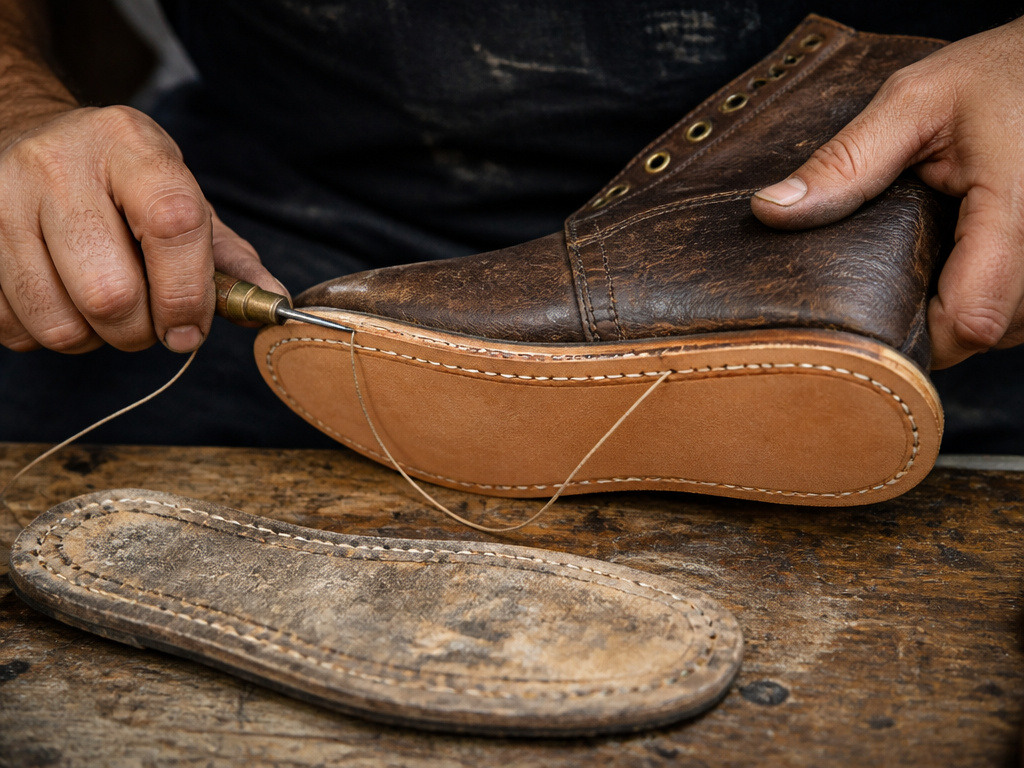
The economics are straightforward. A pair of Goodyear-welted boots from a brand like Red Wing or Allen Edmonds might represent a significant initial investment compared to a cemented alternative. But that cemented shoe is disposable. Once the sole wears thin or the adhesive fails, it’s landfill.
The welted boot is a platform. You might resole it two, three, or four times over 15 years. Each resole costs a fraction of a new pair. More importantly, the upper leather develops a patina, a deep, rich coloration and character that comes only from years of wear and care. That patina is the story of the boot, and it’s something you can’t buy new.
This makes them a cornerstone of a sustainable wardrobe. You’re not participating in a cycle of cheap consumption. You’re maintaining a tool. This philosophy is central to selecting any types of leather boots, from work boots to Chelsea boots. You start with the best construction you can afford, then you maintain it.
Where this goes sideways: Skipping regular heel top-piece replacements. By the time the outsole is thin, the heel stack is often worn unevenly. Replacing both at the same time costs marginally more and ensures the shoe’s balance and geometry are preserved. Letting the heel wear too far strains the welt and can lead to a more complex, expensive repair.
Where Goodyear Welts Can Fail: Materials and Compromises
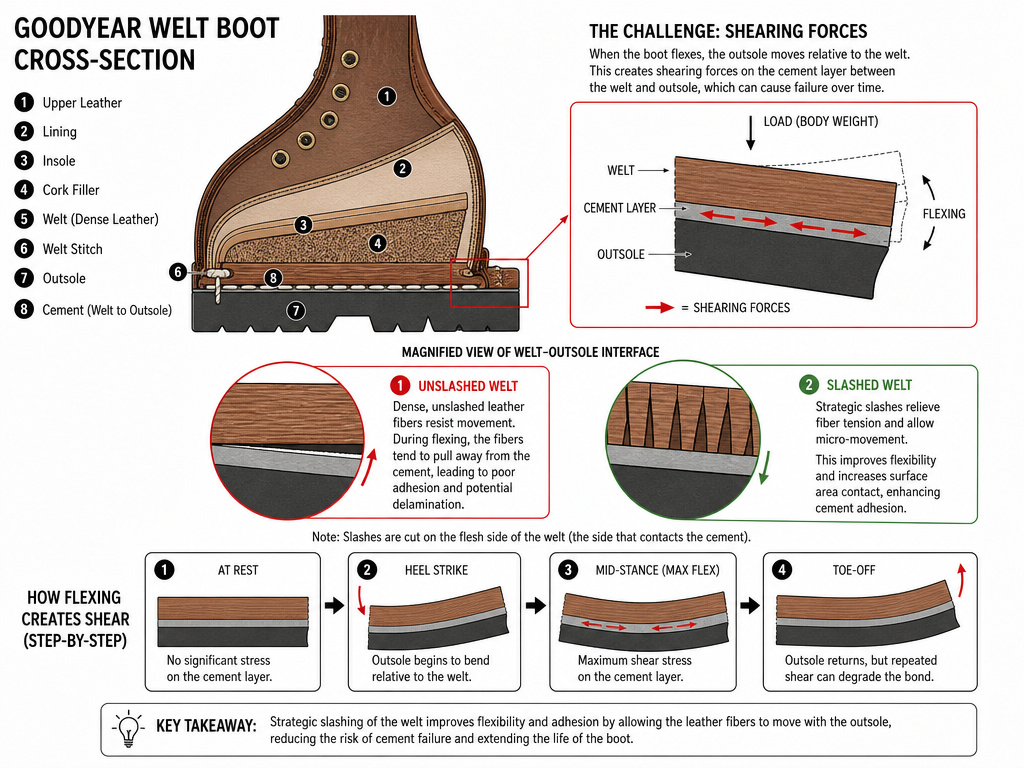
The construction is only as good as its weakest component. A 1937 patent (US2098911A) highlights a specific failure mode in “cemented or Compo shoes” that use a Goodyear welt. The patent describes how flexing the outsole subjects the cement layer to shearing forces. If the welt’s flesh side is too dense, it can’t move with the cement, causing the bond to fail. The proposed fix was to slash the welt to reduce its fibrous density, a clever admission that even this robust system has edges.
This points to the larger truth: material quality dictates lifespan. An old government study, the NBS shoe constructions circular, tested various shoe constructions in the 1930s. It found that while the Goodyear welt method was sound, “lower-grade shoes experienced breakdown of essential parts after 35,000 steps, primarily due to the nature of the materials used.” The thread, the leather, the cork, if any are subpar, the 20-year promise evaporates.
That’s why thread extensibility matters. Thread with inconsistent friction or that stretches too much under load can cause poor stitch balance and premature separation. It’s a spec most buyers never see, but it’s the literal thread holding everything together. This level of detail is what separates a list of best leather boots from a guide on identifying best quality boots.
Frequently Asked Questions
Is Goodyear welt the best shoe construction?
For durability and resoleability, yes. It’s the best common construction for shoes and boots where long-term wear and weather resistance are priorities. For lightweight formal shoes where maximum flexibility is desired, a well-executed Blake stitch may be preferable.
Can Goodyear welted shoes get wet?
Yes, they are highly water-resistant. The cork filling and the welt itself create a barrier that prevents water from seeping up into the insole and footbed. The waxed stitching also seals the needle holes. They are not fully waterproof like a rubber boot, but they handle rain and puddles very well.
How many times can you resole a Goodyear welt shoe?
You can resole a Goodyear welted shoe many times, often 4-5 times or more. The practical limit is the condition of the upper leather. As long as the upper is intact and not rotting, and the gemming on the insole is still secure, a skilled cobbler can attach a new sole.
Are all welted shoes Goodyear welted?
No. “Welted” simply means a strip (welt) is used. Goodyear welting specifically refers to the mechanized process using the double-stitch system invented by Charles Goodyear Jr. Other methods, like hand-welting, exist but are rare and expensive. Many cheaper shoes use a “storm welt” or “fake welt” that is purely decorative and glued on.
Why are Goodyear welted shoes so expensive?
The process involves over 150 individual steps, much of it done by skilled workers rather than fully automated machines. It uses more materials (welt, cork, gemming, more thread) and takes significantly longer to produce than cemented or Blake-stitched footwear. You are paying for time, material, and a structure designed to last.
The Bottom Line
Goodyear welt construction isn’t a marketing term. It’s a specific, mechanically ingenious solution to a simple problem: how to make a shoe that can be taken apart and put back together. The 8mm outsole stitch, the cork bed, the hidden gemming, they all serve that repairable, long-life ideal.
If you’re buying footwear as a one-time purchase, any construction will do. If you’re buying a platform for a decade of wear, the double stitch is the only way to go. Start with a well-made pair from a brand that prioritizes material quality over everything, and you’ll understand why this 1869 invention is still the benchmark. For a broader look at how this fits into the world of fine footwear, our guide to types of leather shoes covers the full spectrum of styles and constructions.
