
How is Leather Made? A Guide to Tanning & Finishing Steps
This post contains affiliate links. As an Amazon Associate, we earn from qualifying purchases.
This post contains affiliate links. As an Amazon Associate, we earn from qualifying purchases.
Leather is made through three distinct chemical and mechanical stages: beamhouse preparation, tanning, and finishing. These stages transform a raw, putrescible animal hide into a stable, durable, and workable material.
Let’s be clear about one thing. The process isn’t magic; it’s chemistry and mechanics. The first stage strips the hide of hair and fats. The second anchors its protein structure permanently. The third gives it color, texture, and a specific feel. What follows is a breakdown of those three phases, with a focus on the ‘why’ behind each step, the chemistry that dictates the machinery. By the end, you’ll be able to look at any piece of leather and trace the manufacturing decisions baked into its surface.
Key Takeaways
- Chrome tanning, used for 80-90% of all leather, requires the hide to be pickled (acidified) first because chromium salts are not soluble in the alkaline conditions left after liming.
- The grain layer, the dense, tight top portion of the hide, is separated during splitting; what’s left underneath is the looser, fibrous split leather, used for suede or bonded materials.
- Finishing can be purely mechanical (buffing, embossing) or chemical (dyeing, adding protective topcoats), and it often happens in a separate facility from the tannery.
- A “wet-blue” hide is one that has been chrome-tanned but not yet dyed or finished; it’s a stable, intermediate product that can be stored or shipped.
- Re-tanning is a common, underrated process where a chrome-tanned hide is later tanned again with vegetable extracts, combining chrome’s softness and water resistance with veg-tan’s structure and burnishability.
The Three Core Stages of Leather Making
Every piece of leather, from a thick bridle strap to a soft suede jacket, follows the same fundamental progression. First, the raw hide is cleaned and stripped in the beamhouse. Second, its collagen structure is permanently stabilized through tanning. Third, it receives its final appearance and protective treatments during finishing. Missing or rushing any stage compromises the final product’s durability or feel.
Think of it like cooking a tough cut of meat. You need to clean it, then break down its connective tissue through slow cooking (tanning), and finally season and sear it (finishing) to make it palatable. The leather making process is similarly purposeful and sequential.
A 1995 EPA report on leather industry emissions outlines the three-stage flow: “preparation, tanning, and finishing.” This separation is not just organizational; it dictates the specialized machinery, chemical vats, and often even the geographic location of each facility.
Stage 1: The Beamhouse – Stripping the Hide Raw
This is where the transformation begins. A raw hide is a perishable, organic material covered in hair, flesh, and natural fats. The beamhouse operations, so named because they were historically done over a curved beam, remove all of this to leave behind only the collagen protein matrix of the skin.
Soaking rehydrates the cured hide. Liming uses an alkaline bath (traditionally milk of lime) to swell the hide and break down the proteins that bind the hair, making it easy to remove. Unhairing and fleshing then mechanically scrape away the hair and remaining flesh. After liming, the hide is in an alkaline state and must be neutralized. Deliming and bating use enzymes to bring the pH down and remove any remaining proteins, making the hide soft and pliable.
The final beamhouse step is pickling. This lowers the pH well below the hide’s isoelectric point, often using sulfuric or formic acid, and adds salt to prevent the acidic solution from causing harmful swelling. This acidic environment is essential for the next stage if you’re using certain tanning agents.
Common mistake: Assuming all hides go through pickling. Vegetable-tanned hides skip this step because the tanning agents (plant tannins) work in a neutral to slightly acidic environment. Pickling is a prerequisite specifically for chrome tanning, which requires a low pH.
How Tanning Permanently Stabilizes Leather
Tanning is the irreversible process that converts the raw hide’s protein (collagen) into a stable, non-putrescible material. It works by forming cross-links between collagen molecules, locking their structure in place. Different tanning agents create different kinds of cross-links, which is why the choice of tanning method is the single biggest determinant of the leather’s final character.
Chrome Tanning: The Modern Standard
Chrome tanning uses basic chromium sulfate. It accounts for roughly 80 to 90 percent of the world’s leather production. The process is fast, efficient, and produces a leather that is very soft, pliable, and water-resistant. The hide emerges with a pale blue color, giving us the term “wet-blue” for chrome-tanned hides that haven’t yet been dyed.
Because chromium salts are not soluble under alkaline conditions, the hide must be pickled first. The chrome solution penetrates the hide in rotating drums, and the cross-links form rapidly. This efficiency is why it dominates the industry, especially for footwear, garments, and upholstery leathers where softness is key.
Vegetable Tanning: The Traditional Method
Vegetable tanning uses natural tannins extracted from tree bark, leaves, and fruits. The process is much slower, often taking weeks, as the tannins slowly diffuse through the hide in a series of pits or vats. The result is a firm, dense leather that ages beautifully, developing a rich patina. It is also more breathable and biodegradable than chrome-tanned leather.
Vegetable-tanned leather is not inherently “organic” or unfinished; it can be dyed and treated like any other leather. Its stiffness makes it the traditional choice for saddlery, belts, holsters, and heavy-duty luggage.
| Tanning Method | Primary Agent | Typical Output | Best For |
|---|---|---|---|
| Chrome Tanning | Basic Chromium Sulfate | Wet-Blue (before dyeing) | Footwear, garments, soft goods |
| Vegetable Tanning | Plant Tannins (e.g., Oak, Chestnut) | Firm, pale brown hide | Saddlery, belts, architectural leather |
| Aldehyde (White) Tanning | Glutaraldehyde or Oxazolidine | Wet-White | Apparel, washable leathers |
| Oil Tanning (Chamois) | Fish or Animal Oils | Ultra-soft, absorbent leather | Cleaning cloths, certain garments |
The leather’s journey doesn’t end with tanning. A tanned hide is stable, but it’s often thick, uneven, and lacks color. The next stages refine it into a usable material.
From Wet-Blue to Finished Leather: Splitting, Re-tanning & Dyeing
After initial tanning, especially chrome tanning, the hide is in an intermediate state. It’s stable and can be stored or shipped as “wet-blue.” But it’s not yet the leather you’d recognize on a store shelf. Three key operations happen next: splitting, re-tanning, and dyeing.
Splitting is a crucial mechanical step. A massive, rolling blade machine slices the tanned hide horizontally into layers. The top layer, which contains the original skin surface and its tight grain pattern, is the grain layer. It’s the most durable and valuable part, used for full-grain leather products. The underlying layers are split leather, which is fibrous and often sanded to create suede or used to make bonded leather.
I once believed a deep scratch on a polished leather desk pad was a permanent flaw. Learning that such marks often only affect the finishing layer taught me that many “scratches” are just surface-level. The process of carefully sanding and re-building the finish with layers of pigment and wax proved that the underlying grain structure was still intact. It’s a good reminder that the final surface is just the last chapter of a long story.
Re-tanning is an underrated but common process. A chrome-tanned hide for a high-end bag might be re-tanned with vegetable extracts. This combines the benefits: the softness and water resistance from the chrome, plus the structure, burnishability, and unique aging character from the vegetable tannins.
Dyeing adds color. This can be done through surface coating (a pigment finish) or by allowing dye to penetrate deeply (aniline dyeing). Aniline-dyed leather shows the hide’s natural markings and feels more natural, but it offers less protection from stains and fading.
The Final Touch: Mechanical & Chemical Finishing
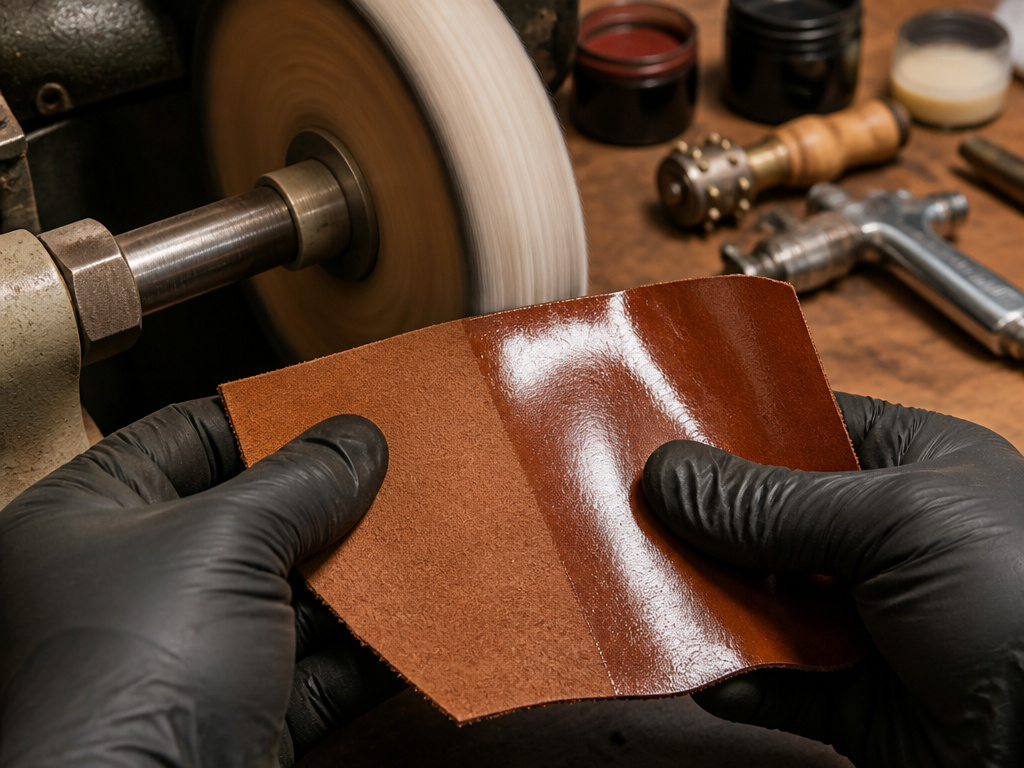 Finishing is where leather gets its final look, feel, and protective qualities. This stage often occurs in a facility separate from the tannery itself. Finishing can be purely mechanical or involve additional chemical applications.
Mechanical Finishes:
- Buffing/Sanding: Smooths the surface or creates a napped finish like suede or nubuck.
- Embossing: Presses a pattern (like ostrich or alligator) into the leather’s surface.
- Glazing/Polishing: A mechanical wheel buffs the leather to a high shine.
Chemical Finishes:
- Pigment Topcoat: A polymer coating sprayed on for uniform color and high abrasion resistance.
- Aniline Topcoat: A light, transparent coating over aniline-dyed leather to offer some protection while preserving the natural look.
- Wax/Oil Impregnation: Adds water resistance and develops a patina over time.
The choice of finish dramatically affects the leather’s performance and care needs. A heavily pigmented, polyurethane-topcoated leather will wipe clean easily but won’t develop a patina. A pure aniline leather will age uniquely with every touch but requires more careful maintenance.
| Finish Type | Process | Leather Look | Care & Aging |
|---|---|---|---|
| Full Aniline | Dye penetrates fully, no pigment topcoat | Natural, shows all hide markings | Ages beautifully, stains easily |
| Semi-Aniline | Aniline dye + light protective topcoat | More uniform color, slight grain masking | Good balance of character and protection |
| Pigmented | Opaque pigment sprayed on, then sealed | Perfectly uniform, grain often embossed | Very durable, wipes clean, won’t patina |
| Corrected Grain | Surface sanded, then heavily pigmented | Uniform “perfect” surface | Highly durable, common for shoes & bags |
Here’s the practical takeaway. When you pick up a leather jacket that feels plasticky and has no visible pores, you’re feeling a thick pigment topcoat. When you see a belt that darkens and shines at the edges over decades, you’re seeing a vegetable-tanned, aniline-finished leather. The finish tells you how the maker expects the piece to be used and aged.
Frequently Asked Questions
Is leather making bad for the environment?
The environmental impact is concentrated in the beamhouse and tanning stages, primarily due to water usage and chemical runoff. Modern tanneries are heavily regulated, and many adopt sustainable leather manufacturing practices, like chrome recovery systems and water recycling. Vegetable tanning has a different profile, using natural extracts but consuming large amounts of water and time.
What is “genuine leather”?
“Genuine leather” is a legal term meaning the product contains some tanned animal hide. It is often the lowest grade of real leather, typically referring to a split leather that has been heavily finished and painted. It’s a far cry from full-grain or top-grain leather in durability and quality.
Can you make leather without chemicals?
No. Tanning, by definition, is a chemical process that permanently alters the hide’s protein structure. Even traditional vegetable tanning uses chemical tannins extracted from plants. “No-chemical” leather does not exist; the distinction is between synthetic metal complexes (chrome) and natural organic compounds (vegetable tannins).
Why is some leather so stiff and some so soft?
The stiffness comes from the tanning method and the hide’s location on the animal. Vegetable tanning creates a firmer leather. Chrome tanning creates a softer, more pliable leather. Leather from the belly of the animal is always looser and softer than leather from the tight, dense back (the “butt”).
What’s the difference between full-grain and top-grain leather?
Full-grain leather is the grain layer that has not been sanded or buffed; it shows the hide’s natural surface and markings. It’s the most durable. Top-grain leather is the same grain layer that has been lightly sanded to remove surface imperfections, then refinished. It’s more uniform but slightly less durable than full-grain.
Before You Go
Understand leather better to make confident choices. The next time you shop for a leather good, ask yourself what you see. Is it a stiff, natural-colored belt that will age? That’s likely vegetable-tanned full-grain. Is it a buttery-soft, perfectly uniform black jacket? That’s almost certainly chrome-tanned with a pigmented finish.
The leather will tell you what it needs. A heavily finished piece just needs occasional cleaning. An aniline-dyed piece wants conditioning to avoid drying out. The process it went through, from the beamhouse vats to the final buffing wheel, is the reason why. Start with that awareness, and you’ll never be disappointed by a leather purchase again.
