How to Dry Wet Leather Boots Without Cracking the Leather
This post contains affiliate links. As an Amazon Associate, we earn from qualifying purchases.
To dry wet leather boots, remove the laces and insoles immediately, stuff them with acid-free paper or a dry towel, and let them air dry at room temperature away from any direct heat source. The process hinges on patience, rushing it with heat cracks the leather and delaminates the soles within two days.
That room-temperature rule is the single most ignored line in every care guide. I get it. You want your boots dry for tomorrow. But the damage from a radiator or a hairdryer isn’t subtle. It’s a permanent, brittle crack that starts at the flex point and works its way around the toe box, and it shows up right around the 48-hour mark after you’ve cooked the moisture out too fast.
What follows is the breakdown of why heat kills boots, the correct sequence that actually works, and what to do when your boots have a waterproof membrane. By the end, you’ll know how to read your boots’ condition and choose a method that adds years instead of subtracting them.
Key Takeaways
- Heat is the enemy. Direct heat from radiators, hairdryers, or car dashboards irreversibly cracks leather and melts adhesives. The damage often appears 1-2 days after the drying attempt.
- Dry soles-up first. For boots with linings or GORE-TEX, place them sole-up initially so trapped water between the lining and upper can drain out before you stuff them.
- Condition while damp. Leather is most receptive to conditioner when it’s slightly damp after cleaning, not bone-dry. This prevents the “boardy” feel that leads to cracks.
- Stuffing matters. Use acid-free paper or a dry towel. Newspaper ink can transfer, and it’s less absorbent than most people think. Patience is essential.** Proper drying takes 24-48 hours. There is no safe shortcut.
The 3-Step Immediate Action Plan
The moment your boots come off wet, follow this sequence. Skipping to step three is how you end up with a musty smell that never leaves.
First, pull out the laces and the removable footbeds or insoles. This opens up the interior for airflow. Dry the insoles separately, flat on a towel.
Next, don’t just grab newspaper. If you have acid-free tissue paper or a clean, dry microfiber towel, use that. Crumple it loosely and stuff the boot firmly, but don’t overpack it. You want to absorb moisture and maintain the boot’s shape, not stretch it. Replace the stuffing every few hours as it becomes damp.
Finally, place the boots in a well-ventilated area at room temperature. A fan circulating air in the room helps, but never point it directly at the boots. This entire process is detailed in our broader guide on proper drying methods.
Where this goes sideways: Using a hairdryer on a cold setting. Even without heat, the forced air drives surface moisture deeper into the leather’s pores, trapping it against the lining. The boot feels dry on the outside but rots from the inside within a week.
Why Heat Destroys Leather in 48 Hours
It’s not just about drying. It’s about how leather loses and regains moisture. Leather fibers shrink as they dry. Apply heat, and the outer layers shrink rapidly while the inner layers are still wet. This creates immense internal stress.
That stress finds the weakest point, usually the flex area at the ball of the foot, and releases it as a hairline crack. You might not see it immediately. But wear the boots once, flex them, and that crack opens up. According to Nikwax, excessive heat is also “harmful to the adhesives used in footwear construction,” which can cause the sole to separate.
The timeline is predictable. A boot dried on a radiator might feel fine that night. Wear it the next day, and the leather feels stiff. By the second day, that stiffness turns into a visible crease that’s lighter in color. That’s the crack forming. Once it’s there, no amount of conditioner will fix it.
The Right Way to Dry Boots with GORE-TEX or Linings
Waterproof membranes change the game. The goal is to get water out from between the leather upper and the inner liner, where it can linger and cause mildew.
The manufacturer FREY daytona has the right idea: “place the boot with the sole facing upwards first so that the water between the lining and upper material can escape more easily.” Do this for an hour or two before you stuff the boot. Let gravity help.
After that initial drain, proceed with stuffing and room-temperature drying. Care is different here, too. As they note, “use little oil-based agents as otherwise the breathability can be considerably reduced.” Heavy conditioners can clog the microscopic pores of the GORE-TEX laminate. Stick to water-based products like Nikwax Footwear Cleaning Gel.
| Boot Type | Critical First Step | Conditioner Warning |
|---|---|---|
| Standard Leather | Stuff immediately | Oil-based conditioners are fine |
| GORE-TEX / Lined Boots | Place sole-up for 1-2 hours first | Use water-based products only |
| Suede/Nubuck | Brush while damp, never saturate | Use spray conditioners only |
This specialized care is part of a complete leather boot care routine that extends their life for years.
What to Use for Stuffing (It’s Not Just Newspaper)
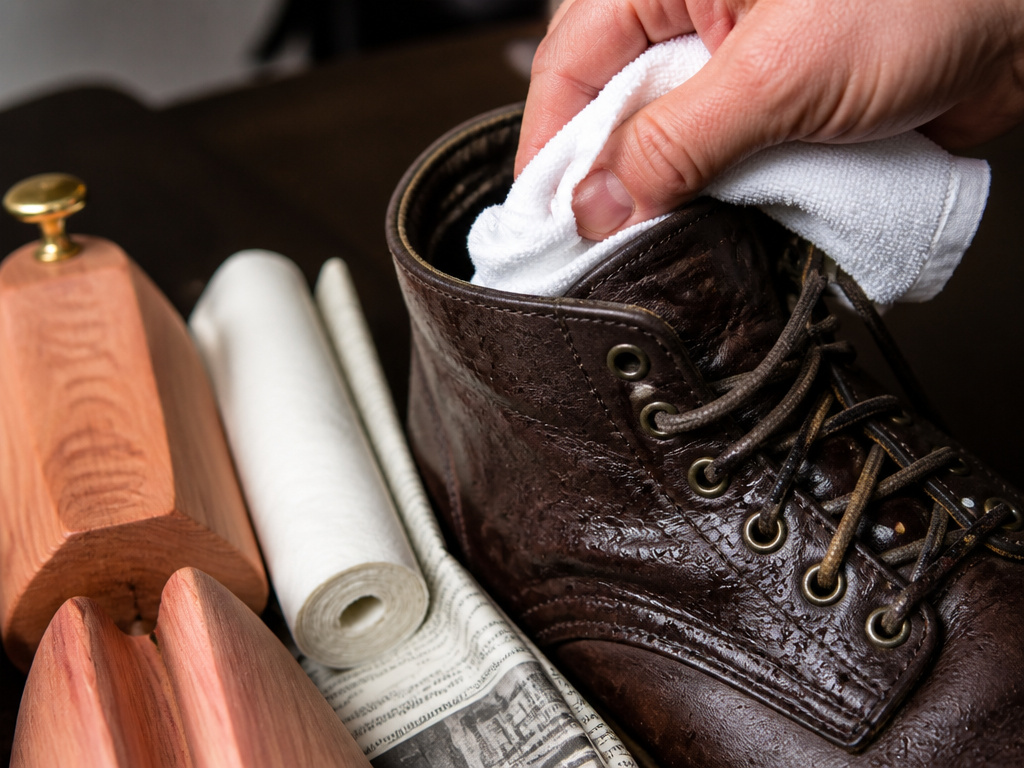 Newspaper is the classic tip, but it’s the third-best option. The ink can transfer onto light-colored leather linings, and it loses absorbency quickly.
Here’s a better ranking, from best to worst: 1. Boot trees or shoe stretchers: The gold standard. They maintain perfect shape and are often made of absorbent cedar. 2. Acid-free tissue paper: My go-to. It’s highly absorbent, won’t transfer dyes, and is cheap. I use it for cleaning leather boots and storage. 3. Clean, dry microfiber towels: Readily available and very absorbent. Crumple them loosely. 4. Newspaper: A fallback option. Change it frequently, at least every three hours. 5. Nothing (leaving boots empty): The worst choice. The leather will collapse and crease as it dries, permanently deforming the toe box.
The right stuffing supports the entire drying process, which is the first step before any talk of boot conditioning.
When to Use a Boot Dryer (and When to Run)
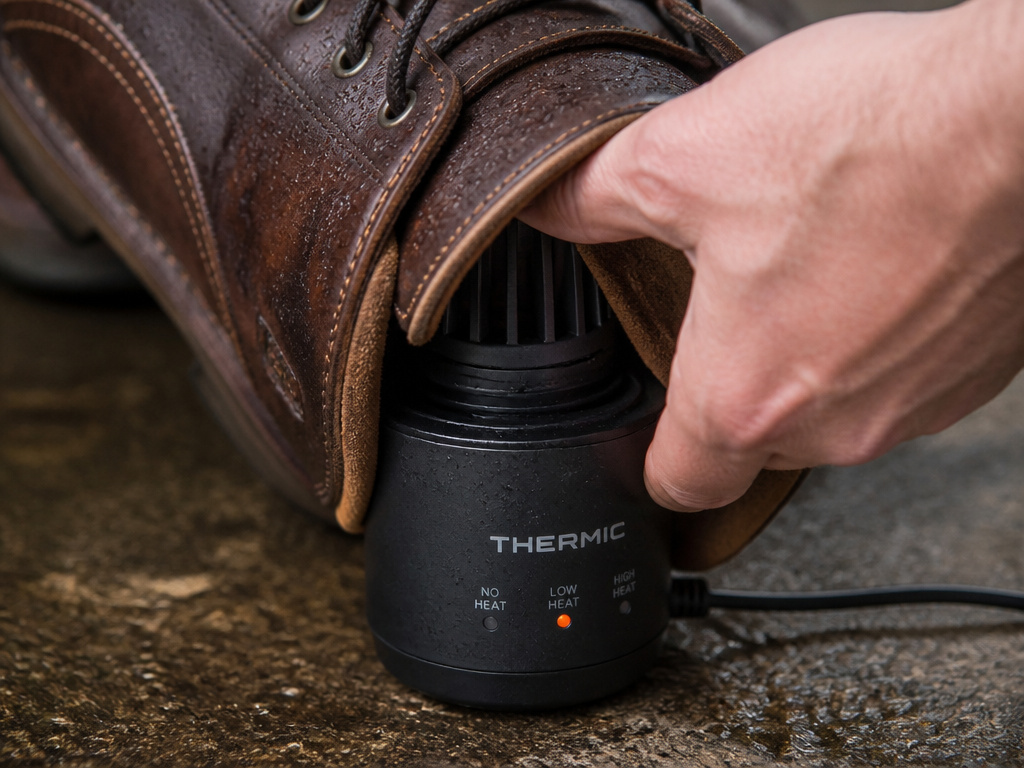 Dedicated boot dryers like Peet Dryers are a contentious topic. Manufacturers are cautious. LOWA states, “devices specifically designed to dry boots from the inside of the boot (such as Peet Dryers) can be used. Although we still recommend letting your boots air dry!”
Here’s the distinction. A gentle, warm-air dryer designed for boots is a tool for maintenance, not emergency drying. Use it on its lowest setting after the boots have air-dried for 12 hours, just to ensure no dampness remains in the toe area. Never use it on sopping wet boots. The constant, low heat can still over-dry the leather over time, leading to the same “boardy” feel.
Hair dryers, space heaters, and radiators are never acceptable. The heat is too intense and too direct. They are a guaranteed way to shorten your boot’s lifespan.
The Crucial Next Step: Conditioning After Drying
A boot that’s just been dried is vulnerable. The cleaning process, even with just water, opens the leather’s pores. This is the perfect time to nourish it.
Apply conditioner while the leather is still slightly damp to the touch. This helps the conditioner penetrate deeply, restoring suppleness and preventing the leather from becoming brittle.
The goal is to avoid what LOWA describes: “If the leather gets too dry… The flex-point at the front of the boot will take on a ‘boardy’ feel. This means the leather will start losing its flexibility and eventually crack.Chamberlain’s Leather Milk is a quality conditioner.amazon.com/dp/B01FR38N6C?linkCode=osi&th=1&psc=1&tag=test-20) or Saphir Medaille d’Or, applied in a thin, even coat to damp leather, stops this cycle. For help picking one, our guide on the best leather conditioner breaks down the options.
This conditioning step is a core part of knowing how to protect leather boots from future water damage.
Common Drying Mistakes That Crack Boots
Let’s be clear about the errors that lead to a ruined pair. These aren’t minor oops moments, they’re endpoint failures.
Mistake 1: The “Quick Bake” on a Car Dashboard. Summer heat inside a parked car can exceed 140°F. This bakes the leather, frying its natural oils and causing it to shrink and harden overnight. The sole adhesive also softens and fails.
Mistake 2: Pointing a Fan Directly at the Boot. This causes one side of the boot to dry much faster than the other, leading to uneven tension and misshapen leather. Airflow should be in the room, not on the boot.
Mistake 3: Storing Wet Boots in a Bag or Closet. This is a recipe for mold. LOWA warns, “Never store wet boots in damp rooms or the car. They will get mouldy!” Mold stains are permanent and often come with a foul odor.
Mistake 4: Using Saddle Soap as a Drying Aid. Saddle soap is a harsh cleaner for heavily soiled, oil-tanned leather. Using it on damp dress boots or hiking boots strips far too much natural oil, accelerating the drying damage you’re trying to avoid. Save it for cleaning work boots that are caked in grime.
Frequently Asked Questions
Can I use rice to dry my leather boots?
No. Rice is ineffective for large volumes of water and can leave dust and starch inside the boot, creating a sticky mess. Stick to absorbent paper or towels.
How long does it take for leather boots to dry completely?
For a thoroughly soaked pair, expect 24 to 48 hours at room temperature with proper stuffing. Lightly damp boots may dry in 8-12 hours. The thicker the leather and lining, the longer it takes.
Should I apply waterproofing before or after drying?
Always after. Apply waterproofing spray or wax only after the boots are completely dry and have been conditioned. Applying it to wet boots traps moisture inside. For a deep dive, see our review of the best waterproofing methods.
My boots feel stiff after drying. Did I ruin them?
Not necessarily. Stiffness is often a sign the leather has dried out its natural oils. Condition them immediately with a product like Bickmore Bick 4. If deep cracks have formed, the structural damage is done, but conditioner can still improve flexibility.
Is it okay to dry boots in direct sunlight?
Never. Direct sunlight is a source of intense heat and UV rays, which degrade and fade leather. LOWA explicitly warns it can cause the toe box to collapse.
Before You Go
The single most important rule is the simplest: patience cannot be shortcut. If you remember one thing, let it be that heat is a destroyer, not a dryer. Your boots are an investment in time and money. Treat the drying process as a necessary, slow ritual.
When they’re finally dry, that’s your cue to nourish them. A simple, water-based conditioner applied to still-damp leather does more to prevent future cracking than any miracle product applied later. And if you’re dealing with a premium pair with a waterproof liner, remember the sole-up trick, it’s the small, manufacturer-recommended step that prevents big problems. From there, a solid guide to waterproofing boots will help you prepare them for the next outing. Good boots get better with care, not just age.
