
Discover the Essential Types of Leather Handbags & Styles
This post contains affiliate links. As an Amazon Associate, we earn from qualifying purchases.
The main types of leather handbags are defined by their structure and strap configuration: the tote, crossbody, shoulder bag, satchel, and hobo. Your choice should start with how you carry things daily, not just the look. The leather, full-grain, top-grain, pebbled, or suede, then decides durability, weight, and how it ages. A study of 1,743 bags found the most common construction methods are ‘cut, sewing, and edge painting’ and ‘cylinder arm sewing,’ techniques that directly affect a bag’s longevity more than its brand name.
Let’s be clear about this. Choosing a handbag means matching a physical object to your body and your routine, not chasing a trend photo. The wrong strap drop will dig into your shoulder by noon.A bag that’s too structured won’t fit under your arm on a crowded train. A leather that’s too delicate will show wear in weeks, not years.
What follows is a breakdown of the five universal bag shapes, the leathers built to last in each one, and the construction details that separate a ten-year companion from a two-season disappointment.
Key Takeaways
- Choose the shape for your hands, not your closet. A tote is for hauling, a crossbody is for moving, and a clutch is for holding. Picking the wrong category guarantees frustration. Leather thickness is essential.** A tote needs 1.8–2.2mm leather to hold its shape under load; a crossbody can use 1.4–1.8mm to save weight. Ignoring this spec is why bags sag or crack.
- Construction beats brand name every time. Look for reinforced stitching at stress points, metal hardware, and sealed edges. These are the signs of a bag built for use, not just display.
- “Genuine leather” is a red flag. In industry terms, it describes the lowest tier of real leather. For durability, you want full-grain or top-grain leather specified clearly.
- Your climate decides your material. Humid environments can delaminate PU leather coatings within a couple of years. In variable climates, high-maintenance leathers like lambskin or suede are a poor choice for daily use.
The 5 Core Handbag Shapes (And What They’re Actually For)
Forget the dozens of trendy names. From a production standpoint, almost every bag falls into one of five families. Each family requires different factory setups, hardware, and labor. More importantly, each solves a different carrying problem.
The tote is your pack mule. It’s defined by an open top, two handles, and a focus on raw capacity. Its simplicity is deceptive. A tote needs a base at least 12 inches wide to prevent tipping and strong, well-attached handles. The common mistake is choosing one made from leather that’s too thin; an unstructured tote in sub-1.8mm leather will lose its shape and strain at the seams when you actually fill it. This is where a tough, slightly thicker full-grain leather or a durable pebbled leather earns its keep.
The crossbody is for mobility. The defining feature is a long, adjustable strap meant to be worn diagonally across the torso, keeping your hands free. The critical detail is the strap attachment. Look for metal D-rings or loops that are reinforced with a leather patch on the inside of the bag. Without that reinforcement, the attachment point will tear. Because it’s worn against your body, the leather should be lighter, 1.4mm to 1.8mm top-grain is ideal, to avoid fatigue.
The satchel is structured organization. Think of a briefcase with a softer demeanor. It typically has a flat bottom, a top handle, and often a flap closure with a buckle or turn-lock. This structure demands a leather that can hold a shape. Vegetable-tanned full-grain leather or a firmer top-grain leather around 2.0mm thick is standard here. The hardware is a major cost driver; a custom magnetic closure or metal lock adds expense but also defines the bag’s character and security.
The hobo is soft and slouchy. Its crescent shape molds to your hip, and it usually has a single, shorter shoulder strap. The goal is comfort and a casual drape. This means the leather must be soft and pliable from the start. Drum-dyed leathers or supple Nappa leather work perfectly here. Avoid stiff leathers; they’ll fight the intended silhouette and never break in properly.
The clutch is for ceremony. It’s handheld, small, and often lacks a strap. Because it carries little weight and is used intermittently, manufacturers can use more delicate, expressive materials. This is where you’ll see patent leather, exotic embosses, or delicate suede. Durability matters less than immediate visual impact.
Where this goes sideways: Choosing a bag for a single special occasion rather than your daily grind. You’ll get a beautiful object that sits in your closet 360 days a year. Buy for the commute, the errands, the daily carry first.
Leather Types: From Workhorse to Weekend
Not all leather is the same hide. The tanning process, the part of the hide used, and the final finish create materials with entirely different personalities. Matching the leather to the bag’s job is what separates a practical choice from an expensive lesson.
Full-Grain Leather is the top cut. It includes the hide’s outermost layer, complete with natural grain and markings. It’s the most durable and develops a rich patina over time. It’s also the most expensive and requires no surface correction, meaning scars and variations are part of its character. This is the gold standard for heritage bags, satchels, and any item where longevity is the primary goal.
Top-Grain Leather is the most common premium leather. The outermost layer is sanded to remove imperfections, resulting in a more uniform surface that accepts dyes and finishes consistently. It’s slightly less rugged than full-grain but more supple and often used for crossbody bags and structured shoulder bags where a balance of durability and polished look is needed.
| Leather Type | Best For Bag Types | Key Characteristic | Feels Like |
|---|---|---|---|
| Full-Grain | Totes, Satchels, Briefcases | Develops a patina, most durable | Firm, substantial |
| Top-Grain | Crossbodies, Shoulder Bags | Uniform finish, balanced durability | Smooth, pliable |
| Pebbled | Everyday Totes, Hobos | Textured surface hides scuffs | Bumpy, soft |
| Saffiano | Structured Satchels, Work Bags | Cross-hatched pattern, scratch-resistant | Waxy, hard |
| Nappa | Slouchy Hobos, Luxury Crossbodies | Incredibly soft, often full-grain | Buttery, thin |
| Suede | Casual Hobos, Evening Clutches | Napped finish from hide’s underside | Velvety, fuzzy |
Saffiano Leather is a patented finish popularized by Prada. It’s characterized by a subtle cross-hatch texture pressed into a wax-coated leather. This coating makes it highly resistant to scratches, stains, and water, making it a low-maintenance choice for structured bags. The feel is distinctly waxy and firm.
Nappa Leather refers to a particularly soft, supple full-grain or top-grain leather, often from lamb or goat. It’s exceptionally smooth and drapes beautifully. It’s a premium choice for bags where softness and a luxurious hand-feel are priorities, but it shows scratches more easily than textured leathers.
Suede is made from the inner layer of the hide, which is sanded to create a soft, napped surface. It’s porous, absorbs color deeply, and has a rich, tactile quality. It’s also high-maintenance, vulnerable to water stains, and requires regular brushing. It’s a material for dry climates and occasional use, not a daily workhorse.
I’ve relied on the same brand of beeswax-based conditioner for a decade because it protects without clogging the leather’s pores. That principle guides my leather choices: let the material breathe. A heavily plastic-coated PU leather might look fine new, but in a humid climate, that coating can delaminate from its fabric backing in a couple of years, leaving you with a peeling mess. That’s not aging; it’s failing.
Construction: What to Look For When the Price Seems Right
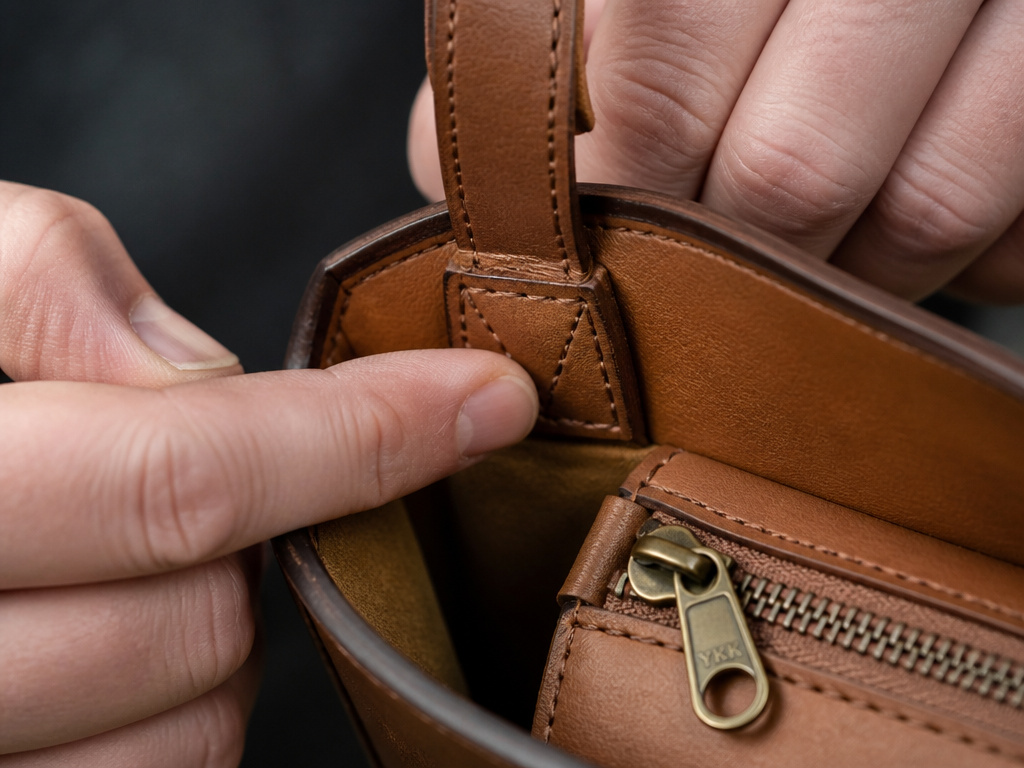 A beautiful hide can be ruined by poor assembly. The construction is what translates material potential into daily performance. You can learn to spot quality in sixty seconds.
First, examine the stitching. Thread should be thick, even, and consistent. On stress points, where straps meet the body, at corners, along zippers, look for double or even triple rows of stitching. This reinforcement is non-negotiable. Pull gently at a seam; the thread should not loosen or show gaps.
Second, test the hardware. Zippers should glide smoothly. Metal buckles, D-rings, and feet should feel solid and substantial, not light or hollow. Plastic hardware is a guaranteed point of failure on a leather bag meant for regular use. Coach will often stamp its logo on the hardware.
Third, inspect the edges. Raw, cut leather edges will fray and unravel. Look for edges that are painted, burnished (polished to a smooth finish), or folded and stitched under. This “edge finishing” is a time-intensive step that cheaper manufacturers skip. It’s a clear sign of attention to detail.
Finally, consider the lining. A bag’s interior isn’t just for looks. A cheap, loosely woven polyester will snag and tear. A sturdy twill, canvas, or smooth microfiber lining protects your belongings and the leather interior from abrasion. Internal pockets should be fully lined and securely stitched, not just glued in place.
Here are the three details I check immediately, in order: 1. The strap attachments. Is there a leather reinforcement patch on the inside? 2. The zipper. Is it a brand name like YKK or Riri, or is it unmarked? 3. The smell. Does it smell like rich, organic leather, or like chemicals and plastic?
Common mistake: Judging a bag by its exterior leather alone. A perfect hide stitched with weak thread to flimsy lining is a beautiful shell destined to fall apart. The interior construction holds the whole project together.
Matching the Bag to Your Reality (A Decision Framework)
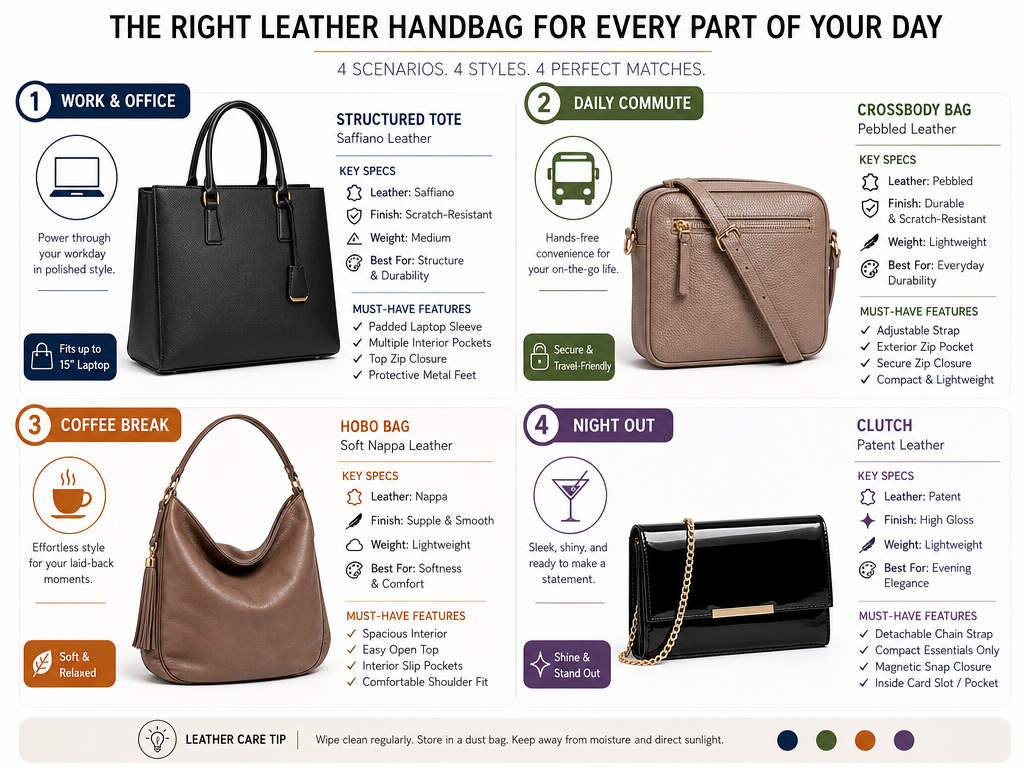 This is where theory meets your hallway, your car, and your schedule. Let’s match the types of leather handbags to actual lives.
For the commuter carrying a laptop: You need a structured tote or satchel. Prioritize a wide, flat base so it stands upright under your desk. Leather thickness should be at least 1.8mm. Check for a dedicated, padded laptop sleeve built into the lining, not just a large compartment. A Saffiano leather or sturdy pebbled leather will resist scuffs from being set on floors and under seats. This is not the place for a slouchy hobo or delicate leather.
For the parent or traveler running errands: Your tool is the crossbody. The strap must be widely adjustable. Focus on lightweight leather (1.4-1.8mm top-grain) and multiple secure compartments, zippered pockets for keys and phone, open slots for transit passes. A dark-colored, textured leather like pebbled will hide the inevitable spills and scrapes. Avoid light-colored suede or smooth Nappa; they’ll look tired before the trip is over.
For weekend casual and personal carry: The hobo or soft shoulder bag shines. This is where you can enjoy softer, more luxurious leathers like Nappa or a grainy full-grain that will develop a personal patina. Since the load is lighter, structure matters less. Focus on a comfortable strap shape and a closure that’s easy to manage one-handed, like a magnetic snap.
For formal events and evenings: The clutch is your only choice. This is the arena for expressive materials: patent leather for shine, embossed leather for texture, or even exotic leather accents. Construction is less about durability and more about precise craftsmanship, perfect seams, flawless hardware. Since it’s used sparingly, you can prioritize aesthetics over ruggedness.
| Your Daily Scenario | Recommended Bag Type | Priority Leather Spec | One Feature You Must Have |
|---|---|---|---|
| Office Commute (Laptop) | Structured Tote / Satchel | 1.8mm+ thickness, structured | Padded, built-in laptop sleeve |
| Urban Errands / Travel | Crossbody | 1.4-1.8mm, lightweight | Adjustable strap & multiple zippered pockets |
| Casual Weekends | Hobo / Soft Shoulder Bag | Soft, supple leather (Nappa, soft grain) | Comfortable, rounded strap |
| Formal Events | Clutch | Expressive finish (Patent, Embossed) | Secure, easy-to-use closure |
The Luxury Tier: When Name and Technique Collide
At the highest end, brands like Hermès don’t just use different leathers; they pioneer them for specific silhouettes. This is material science applied to design.
Hermès Togo leather is a grained calfskin known for being soft, durable, and scratch-resistant. Its slight texture and weight make it the house’s default for the Birkin bag, it’s substantial enough to hold the structure but soft enough to develop a slouch over decades. Epsom leather is a pressed, grained leather that’s extremely lightweight and scratch-resistant. Its rigid nature makes it ideal for the structured, sharp lines of the Kelly Sellier style. Swift leather is a smooth, fine-grained leather prized for its soft, almost spongy feel and its exceptional ability to hold vibrant dyes.
A 2026 study in the Journal of Fashion Business analyzing 1,743 handbags from luxury brands found that “cylinder arm sewing” was a dominant method for bag bodies, especially when using narrow, hard leathers. This isn’t a random choice. This specific machine creates incredibly strong, consistent seams suitable for the tension a structured bag endures. The study also noted that brand signatures like prominent quilting aren’t just aesthetic; they provide structural cushioning and volume effects.
The lesson here is that premium bags earn their price through intentional, often labor-intensive, pairings of material and construction method. The leather is chosen for its beauty and for how it behaves under a specific needle and thread.
Frequently Asked Questions
What is the most durable type of leather for a handbag?
Full-grain leather is the most durable type for a handbag. It retains the hide’s complete grain layer, making it resistant to wear and tear. It develops a patina over time instead of simply wearing out. For high-stress bags like totes or satchels, full-grain leather in the 1.8mm to 2.2mm thickness range provides the best long-term resilience.
What’s the difference between pebbled leather and Saffiano leather?
Pebbled leather has a natural, bumpy texture created by tumbling the hide. It’s soft, pliable, and excellent at hiding minor scuffs. Saffiano leather has a man-made, cross-hatched pattern pressed into a wax-coated surface. It feels firmer and waxy, and its finish provides superior scratch and water resistance. Pebbled is more casual and forgiving; Saffiano is more structured and formal.
Genuine leather is a good choice for a handbag if you prioritize a natural patina over water resistance. In industry terminology, “genuine leather” describes the lowest grade of real leather, made from the fibrous layers left after the top splits are removed. It is often heavily coated and lacks durability. For a bag you plan to use regularly, it is not a good choice. Always look for specifications of full-grain or top-grain leather instead.
Can suede handbags be used daily?
Suede handbags are not ideal for daily use, especially in variable or wet climates. Suede is porous, stains easily from water and oils, and requires careful maintenance with regular brushing and protective sprays. It’s best reserved for dry-weather, occasional use where its luxurious texture can be appreciated without being subjected to daily wear.
How can I tell if a leather handbag is well-made?
Check four points: 1) Stitching should be even, tight, and doubled at stress points. 2) Hardware should be metal, not plastic, and operate smoothly. 3) Edges should be neatly painted, burnished, or folded, not left raw. 4) Lining should be a sturdy fabric like twill, securely stitched in, not glued. The bag should also have a rich, organic leather smell, not a strong chemical odor.
Before You Go
Start with your dominant hand. Seriously. If you’re right-handed, a crossbody strap slung from your left shoulder will feel natural for accessing the bag. If you drive to work, a top-handle tote you can lift from the passenger seat is more practical than a backpack. The best bag is the one that disappears into your routine, not the one that forces you to adapt to it.
Look past the surface color. Run your fingers over the leather’s texture, test the weight of the zipper pull, and peer inside at the seams. The brands that care about those hidden details are the ones building for the long term. They understand that a handbag is a tool you break in and a companion that softens with your life, not an accessory you buy once.
So, choose the shape your life demands first. Then find it in a leather tough enough for the job. Everything else is just background noise.
