
What Is Saffiano Leather | The Patent That Changed Handbags
This post contains affiliate links. As an Amazon Associate, we earn from qualifying purchases.
This post contains affiliate links. As an Amazon Associate, we earn from qualifying purchases.
Saffiano leather is a specific type of leather finish defined by its machine-embossed diagonal cross-hatch pattern and a final protective wax coating. Patented by Mario Prada in 1913, the process creates a structured, rigid leather prized for its scratch resistance, water repellency, and ability to hide everyday wear. It’s not a type of leather hide, but a treatment applied to a base leather, most often calfskin.
That waxed, textured surface is the whole point. It trades the soft, developing patina of an untreated leather for a durable, uniform finish that resists the marks of daily life. The result feels slightly stiff and papery to the touch, a world away from the buttery softness of aniline leather.
What follows is a breakdown of how that finish is made, the hard numbers behind its durability, and the straightforward care it requires. You’ll also see where its famous toughness has limits, and how to spot the difference between a piece made with genuine Saffiano leather and a cheap imitation.
Key Takeaways
- Saffiano is a finish, not a leather type. It starts with a base leather (traditionally calfskin) that is embossed and wax-coated.
- Its signature scratch and water resistance come from the wax coating, not the leather itself. This coating can degrade and flake over years.
- Sharp objects are its weakness. The cross-hatch pattern hides scuffs, but a deep cut will go right through the protective layer.
- Cleaning advice is contradictory. Some makers say baby wipes are fine; professional restorers warn they strip the wax. A dry, soft cloth is the universal safe choice.
- Quality varies wildly. Real Saffiano uses a full-grain leather base. Knock-offs use corrected-grain hides or even plastic, which cracks instead of aging.
The Three Layers of a Saffiano Finish
To understand Saffiano, you need to peel it back layer by layer. It’s not one material but a composite system.
The first layer is the leather base. Historically, this was calfskin for its fine, tight leather grain. Today, it can be any quality of bovine leather, though the best examples still use a full-grain hide. This base is dyed, usually in a drum with aniline dyes, which penetrate the hide rather than sitting on top.
A technical spec sheet from Italian manufacturer Raniero F.lli Srl lists their Saffiano leather as 1.3–1.5mm thick, made from South American bovine leather, chrome-tanned, and capable of withstanding 30,000 flex cycles without visible damage.
The second layer is the texture. The dyed leather is fed into an embossing machine heated to about 75°C. A metal plate with the precise cross-hatch pattern is pressed into the surface with significant force for 10–15 seconds. This isn’t delicate embossed leather for decoration; it’s a deep, permanent deformation that creates the raised lines.
The third and most important layer is the wax coating. A polyurethane-based wax is applied over the embossed pattern. This is what provides the scratch resistance, the slight sheen, and the water-repellent properties. The coating also locks in the color, which is why Saffiano is available in such vibrant, saturated shades. The leather underneath is never truly exposed during the item’s usable life unless the coating fails.
That’s the straightforward guide to its construction. The wax coating is the hero and the eventual point of failure. It’s also the reason Saffiano feels so distinct, it has a dry, crisp hand-feel, not a warm, oily one.
How It’s Made: From Patent to Production
Mario Prada didn’t just pick a pattern he liked. The 1913 patent for Saffiano was a solution to a practical problem: how to make elegant luggage and handbags that could survive the rigors of travel. The cross-hatch pattern wasn’t merely decorative; it added structural rigidity to the leather, much like corrugation strengthens cardboard.
The process remained a Prada exclusive for decades, a key part of their identity. When the patent eventually expired, the technique spread. It became a hallmark of “affordable luxury” brands in the 2000s and 2010s. However, Prada still holds the trademark on the name “Saffiano,” which is why you’ll see other brands use terms like “textured leather” or “cross-hatch leather” instead.
Modern production follows the same basic steps, but the devil is in the details. A high-end maker like Aspinal of London sources full-grain calfskin, uses precise embossing for a deep, clear pattern, and applies a high-quality wax. A fast-fashion brand might start with a heavily corrected grain leather base, use a shallow, blurry stamp, and top it with a thin, plastic-feeling coat.
You can feel the difference. The good stuff feels substantial and crisp. The cheap version feels plasticky and stiff in a brittle way. One will develop a fine, hazy patina on the high points over a decade; the other will crack at the stress points within a couple of years.
The Common Misconception: Scratch-Proof
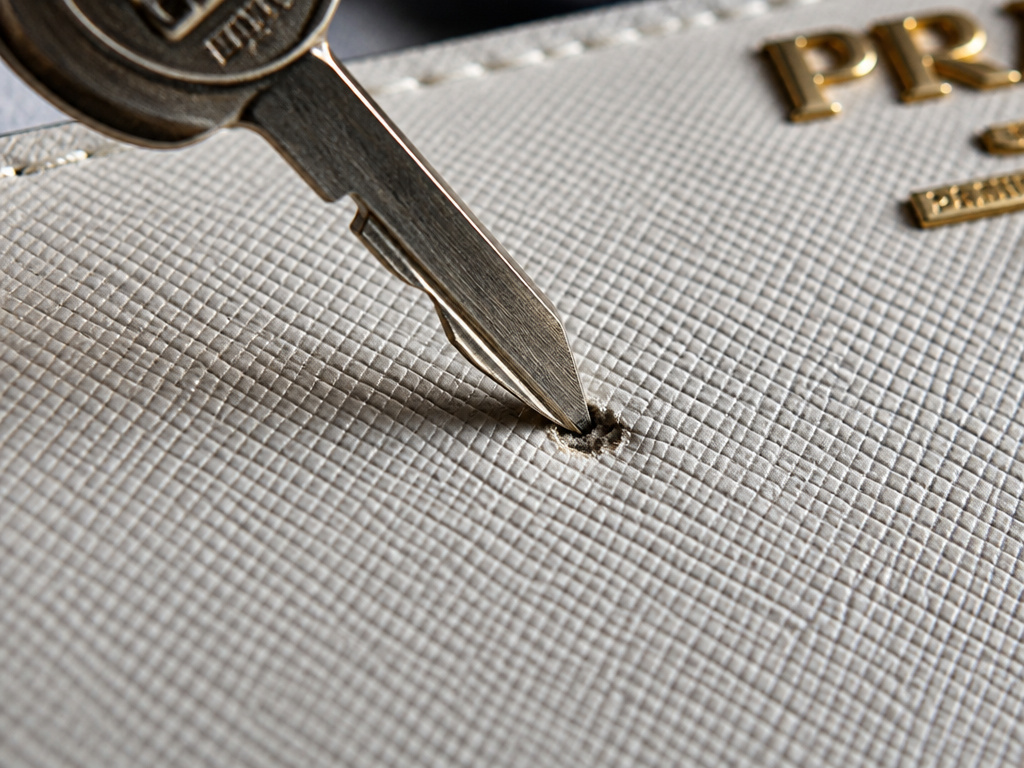
The marketing says “scratch-resistant.” Your eyes might tell you it’s scratch-proof because fine marks seem to disappear. Let’s be clear about one thing: the leather isn’t defying physics.
The cross-hatch texture is a visual trick. Fine scratches don’t create a smooth, continuous line across the surface. They catch on the raised ridges of the pattern and become fragmented, scattering the light so they’re much harder to see. It’s brilliant engineering for everyday scuffs from keys or brushing against a wall.
But take a sharp point, a nail, a corner of a metal buckle, a pet’s claw, and press with intent. That point will go through the wax coating and into the leather beneath. The damage is permanent. The coating can’t “heal” a puncture. This is why corners and edges, which see the most contact, are the first places the coating wears thin and begins to flake.
Where this goes sideways: Assuming the wax coating makes it invincible. A sharp gash will breach the finish immediately, and the underlying leather is then exposed to stains and moisture. The flaking at corners starts around the 3–5 year mark with daily use.
So, it’s highly scratch-resistant, not scratch-proof. Understand the distinction, and you’ll handle your bag with appropriate respect, avoiding sharp countertops and overstuffing that stresses the corners.
Saffiano vs. Other Finishes

Saffiano doesn’t exist in a vacuum. It sits on a spectrum of leather finishes, defined by how much of the natural hide is altered or covered.
On one end, you have aniline and semi-aniline finishes. These let the natural grain of leather shine through, with minimal pigment or coating. They feel soft, develop a rich patina, and are more vulnerable to stains and scuffs. On the opposite end, you have heavily pigmented leather and patent leather, which are completely coated for maximum uniformity and protection.
Saffiano occupies a middle ground. It’s more protected than aniline but less synthetic-feeling than patent leather. Its closest cousin might be pebbled leather, which also uses an embossed texture for visual interest and added scuff-masking. The difference is in the pattern and the final coat, pebbled is often softer and may not have the wax layer.
| Finish Type | Surface Feel | Scuff Resistance | Water Resistance | Aging Character |
|---|---|---|---|---|
| Aniline | Soft, warm, natural | Low | Low | Develops a rich, personal patina |
| Saffiano | Crisp, dry, slightly stiff | Very High (coating-dependent) | High (water-repellent) | Coating may haze or flake; color stays even |
| Pebbled | Soft, textured | High (texture masks scuffs) | Medium | Texture softens, color may fade |
| Patent | Smooth, glassy, synthetic | High (plastic-like layer) | High | Can crack or peel; no patina |
The practical takeaway? If you want a bag that looks new for years with minimal care, Saffiano is a top contender. If you want a bag that tells the story of your life through its changing surface, look at aniline. This is the core of the pigmented vs aniline decision.
How to Care for Saffiano Leather (And What to Avoid)
The care routine is simple, mostly because the wax coating does the heavy lifting. But that simplicity hides a point of contention.
Dust and dry dirt are the main enemies. A soft, dry microfiber cloth is your first and best tool. Wipe the surface gently following the direction of the grain. For slightly more stubborn marks, barely dampen the cloth with cool water and wipe again. Always let it air dry away from direct heat.
Now, here’s the conflict you won’t see in the manual. Some retailer guides suggest baby wipes for quick cleaning. Professional restoration clinics explicitly warn against them. Why? Many baby wipes contain mild alcohols or surfactants designed to break down oils. Over time, these can degrade the wax coating itself, leading to a dull, patchy appearance. The safe rule is: don’t use them.
Common mistake: Cleaning with baby wipes or household cleaners. The chemicals can strip the wax coating over multiple uses, leaving the leather underneath vulnerable to stains and causing the color to look uneven.
For conditioning, less is more. The leather base is sealed off by the wax. Pouring conditioner on top won’t penetrate; it will just sit on the surface and attract dirt. If the bag ever feels unusually dry or the coating appears cracked, consult a professional. They have the solvents and techniques to remove and reapply the coating properly.
Storing it correctly is the other half of care for leather. Keep it in its dust bag, stuffed with tissue to hold its shape, and away from radiators or sunny windowsills. Prolonged heat is a silent killer, it can soften the wax and cause the structured leather to warp permanently.
How to Spot Quality (And Avoid Fakes)
Not all cross-hatch leather is created equal. With Saffiano’s popularity, the market is flooded with imitations. Your nose and eyes are the best tools for test leather quality.
First, smell it. Real leather, even with a coating, should have a faint, organic leather smell. A strong chemical or plastic odor is a red flag for a synthetic base material.
Look at the pattern. High-quality embossing is deep, sharp, and consistent across the entire piece. The lines are straight and the intersections are clean. On a cheap imitation, the pattern might be shallow, blurry, or misaligned at the seams.
Feel the weight and flexibility. Good Saffiano has a substantive heft and a crisp flex, it shouldn’t feel like a stiff cardboard box. The Raniero F.lli spec of 30,000 flex cycles is a benchmark for high-grade material; a cheap version will crease permanently after a few dozen bends.
Check the edges and stitching. Quality construction uses finished or painted edges and tight, even stitching. Rough, frayed edges or sloppy stitching are signs of corner-cutting, regardless of the material.
Finally, be wary of the label “genuine leather.” In the grading system, it’s a specific term that often means a lower-quality, heavily processed split leather. A brand proud of its Saffiano will usually specify “calfskin” or “full-grain leather.” When in doubt, knowing how to tell real leather from fake is more valuable than any marketing term.
Frequently Asked Questions
Is Saffiano leather real leather?
Yes, authentic Saffiano starts with a real leather base, traditionally calfskin. The cross-hatch pattern and wax coating are finishes applied to that leather. However, some low-cost products may use a synthetic material with a Saffiano-like pattern printed on, so checking the label and the smell is crucial.
Does Saffiano leather peel?
The wax coating can peel or flake over time, especially on high-contact areas like corners and edges. This is a natural failure of the coating after several years of use, not a sign of it being “fake.” Quality of the initial coating and how the item is cared for greatly influence how long this takes to happen.
Can you get Saffiano leather wet?
Saffiano leather is water-resistant, not waterproof. The wax coating will repel light rain or spills for a short period, giving you time to wipe it dry. Prolonged exposure or submersion will allow water to seep through the coating, potentially staining the leather underneath and weakening the adhesive bonds in the item’s construction.
How do you restore Saffiano leather?
Minor scuffs can often be buffed out with a soft cloth. For a dulled coating, a professional leather restorer can use specialized solvents to carefully remove the old wax layer and reapply a new one. Do not attempt to use standard leather conditioners or creams, as they will not absorb and can damage the finish.
The Bottom Line
Saffiano leather is a pragmatic choice. It was invented for a reason: to look sophisticated while surviving the chaos of daily use. The wax-coated, cross-hatched finish delivers on that promise better than almost any other.
But it’s a trade. You gain remarkable scratch resistance and easy cleaning. You lose the soft, evolving character of an uncoated leather. The bag won’t mold to your life; it asks your life to fit its durable, structured form.
If your priority is a low-maintenance piece that holds its shape and color for years, it’s an excellent option. Just respect its limits, sharp objects and heat are its enemies. And when you shop, let your senses judge. The heft, the sharpness of the pattern, and the smell of the leather underneath are the truest tests of what you’re actually buying.
