
Full Grain Leather: The Complete Pros and Cons Breakdown
This post contains affiliate links. As an Amazon Associate, we earn from qualifying purchases.
This post contains affiliate links. As an Amazon Associate, we earn from qualifying purchases.
Full grain leather is the strongest, most durable grade of leather, defined by its untouched grain surface. Its pros include extreme longevity (20-30+ years), a unique patina that improves with age, superior breathability, and unmatched tensile strength. Its cons are a higher upfront cost, visible natural imperfections, a stiffer initial feel, and a need for periodic, mindful conditioning to prevent drying.
The definition isn’t marketing. It’s a structural fact from the ISO 15115:2019 standard: leather is only “full grain” if the surface layer is not thicker than 0.15 mm and the grain layer is completely intact. That intact layer is a dense network of fibers, and keeping it whole is what delivers the legendary performance. The trade-off is that you see every scar and wrinkle from the animal’s life, and you become the caretaker of a material that outlasts trends.
What follows is a breakdown of what those pros and cons mean in practical terms, how a wallet lasts 25 years, why a bag breathes, and the one conditioning mistake that can ruin the leather’s temper. We’ll also cut through the noise on grades like “genuine leather” and show you how to inspect a piece yourself.
Key Takeaways
- Full grain leather isn’t just durable; it’s heirloom-grade. With basic care, expect 20-30 years from bags and belts, and 10-20 years from resoleable boots.
- The patina is a feature, not a bug. The leather darkens and softens uniquely based on your use, creating a one-of-a-kind piece. Scratches often blend into this character.
- Breathability is a hidden pro. The intact, dense grain layer allows moisture vapor to pass through better than sanded or coated leathers, making it more comfortable for footwear and gloves. “Genuine leather” is a descriptive term, not a grade like top-grain or full-grain. It legally applies to everything from full grain to the weakest split leather, which is why it’s a poor indicator of value.
- The biggest con isn’t the price, it’s the maintenance commitment. Neglect conditioning for years and the leather will dry and crack; over-condition it and you’ll clog the pores and soften it too much.
What “Full Grain” Actually Means (And What It Doesn’t)
Let’s be clear about one thing. “Full grain” describes a hide’s preparation, not a guarantee of quality. It means the outermost layer of the hide, the grain, has been left completely untouched after tanning. No sanding, no buffing, no embossing to hide imperfections.
This matters because the grain layer is the densest, toughest part of the hide. It’s where the hair follicles were, and the fiber structure is incredibly tight. A study on the properties of full grain leather noted that this intact structure is why it performs so well in tests for tensile strength and abrasion resistance. When a tannery sands that surface away to create a uniform look (making top-grain or corrected grain leather), they remove that defensive layer. Think of it like the outer bark on a tree. The tree can live without some bark, but the intact bark offers the best protection.
ISO 15115:2019 defines leather and specifies that if the grain layer has been completely removed, the term “leather” must be further qualified (e.g., as split leather). For a surface to be full grain, any applied layer must not exceed 0.15 mm.
The flip side is that you see the hide’s true history. Vein marks, bug bites, stretch marks, they’re all there. Some people love this character; others want a pristine, uniform look. Neither is wrong, but knowing this lets you choose. If you want a flawless, consistent black leather for a corporate briefcase, a high-quality corrected grain leather might be the right technical choice, even if it’s not full grain.
The Core Advantages of Full Grain Leather
Why pay more? The answer isn’t a vague promise of “quality.” It’s a set of measurable, long-term benefits that change how you own things.
Durability That Resets Your Timeline. This is the headline. A well-made full grain leather bag isn’t a 5-year purchase; it’s a 20-year companion. Belts can last 30. The reason is the intact fiber matrix. There’s no thin, sanded top layer to wear through. Instead, the surface ages slowly, developing a protective patina that actually shields the leather underneath. Compare that to bonded leather, which is leather fibers glued to a mesh backing; it delaminates and cracks often within 2-5 years.
The Patina Paradox. This is the magic. Unlike a painted finish that scratches and looks damaged, full grain leather absorbs oils, light, and the traces of your hands. Scratches and scuffs don’t stay stark white, they darken and become part of a deeper, richer, overall color and sheen. This patina is personal. It’s why a 10-year-old pair of vegetable-tanned boots can look more beautiful than the day they were bought. It’s not getting worn out; it’s getting broken in.
Breathability and Comfort. This is an underrated pro, especially for footwear and gloves. The natural grain layer has a microscopic structure that allows moisture vapor (sweat) to pass through. When leather is coated with a thick pigment or plastic layer to make it “easy-care,” that breathability drops to zero. A full grain leather boot liner will keep your foot drier and more comfortable over a long day than a synthetic-lined boot ever could.
The Cost-Per-Year Argument. The math is straightforward. A $60 genuine leather wallet that cracks in 3 years costs you $20 per year. A $150 full grain leather wallet that lasts 25 years costs $6 per year, and looks better every year. The initial investment is higher, but the long-term value is undeniable. This is the economic case for heirloom goods.
| Advantage | What It Means | Compared to Genuine/Bonded Leather |
|---|---|---|
| Longevity | 20-30+ year lifespan for bags, belts, furniture. | 2-5 years before cracking or delamination is common. |
| Patina Development | Scratches and oils create a unique, richer surface over decades. | Surface coatings chip or wear away to reveal a dull underlayer. |
| Material Strength | Highest tensile and tear strength due to intact grain fibers. | Significantly weaker; split layers have less structural integrity. |
| Breathability | Natural grain allows moisture vapor transfer, increasing comfort. | Plastic coatings or heavy pigments create a non-breathable barrier. |
The Honest Drawbacks and Considerations
It’s not all patina and praise. Full grain leather has real trade-offs, and ignoring them is how people end up disappointed.
The Price Tag. You are paying for the most selective part of the hide and the least efficient processing. Tanneries yield less usable full grain leather per hide because they can’t sand away imperfections. That cost is passed on. For a small maker like JK Boots, using 8-ounce full grain bison hide is a core reason for their premium price, that thickness is almost double what most mass-market boots use.
It Demands Your Attention. This is the biggest practical con. Leather is skin. It dries out. The standard advice of “condition every six months” is a starting point, not a rule. I learned this the hard way with a client’s bag in a coastal, humid climate. Following the six-month schedule made the leather greasy and overly soft. We pulled back to a yearly check, letting the environment guide us. The leather will tell you what it needs, if it looks dry or feels stiff, it’s time. If it’s supple and rich, leave it alone.
Imperfections Are Guaranteed. You are buying a natural material. If you demand a perfectly uniform, blemish-free surface in a light color, full grain might frustrate you. Those character marks are proof of authenticity, but they aren’t for everyone. For a sleek, modern look, a premium top-grain leather that’s been lightly corrected might be the better aesthetic fit.
The Break-In Period. Full grain, especially vegetable-tanned leather, starts life stiff. A new bag has structure, a new belt stands up on its own, and new boots can feel like armor. This is a sign of density and quality. They will mold to you, but it requires patience. The break-in is the process of the fibers loosening and conforming to your use. It’s a commitment.
Where this goes sideways: Using a harsh, alkaline cleaner like saddle soap on a delicate full grain leather. It strips away natural oils far too aggressively, leaving the leather parched and prone to cracking. Reserve those for heavy work boots only.
How to Spot It: The 3-Point Inspection
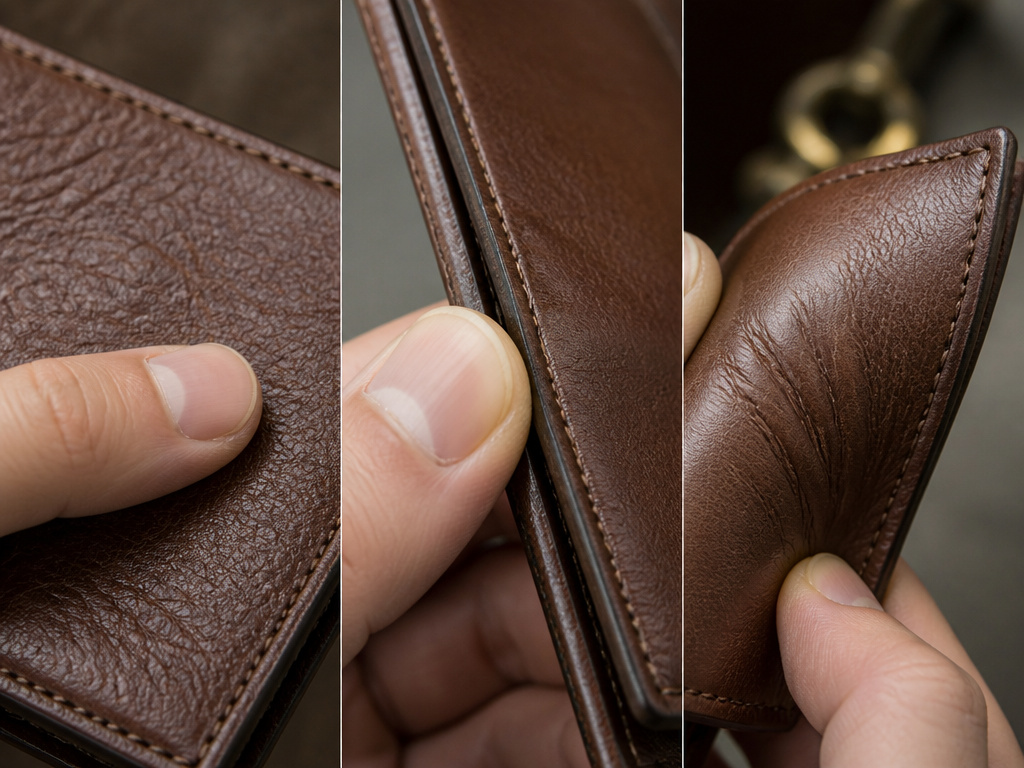
Don’t trust the tag. Tags can say anything. Your eyes and hands are the best tools to identify full-grain leather.
1. Look at the Surface. The grain should be irregular and natural. You should see pore patterns that vary across the piece. Run your fingernail lightly across it, you should feel subtle texture variations, not a perfectly smooth, plastic-like finish. An embossed, repeating pattern (like a perfect pebble grain) is a sign of corrected grain leather.
2. Examine the Edge. This is the most reliable test. Cut edges on full grain and high-quality top-grain leather are smooth and dense, with tight, consistent fiber structure. The edge should look like a solid, compact mat. If the edge is rough, fuzzy, or looks like pressed cardboard, you’re likely looking at split leather or a bonded material.
3. Perform the Bend Test. Gently bend the leather. Full grain will show fine, tight wrinkles that resemble human skin. The surface may lighten slightly along the crease (a pull-up effect from oils). A painted or plastic-coated leather will show larger, wider cracks in the finish, and the color won’t change. This is also a great way to test leather quality for pliability and finish adhesion.
Full Grain vs. Other Leather Grades: A Quick Guide
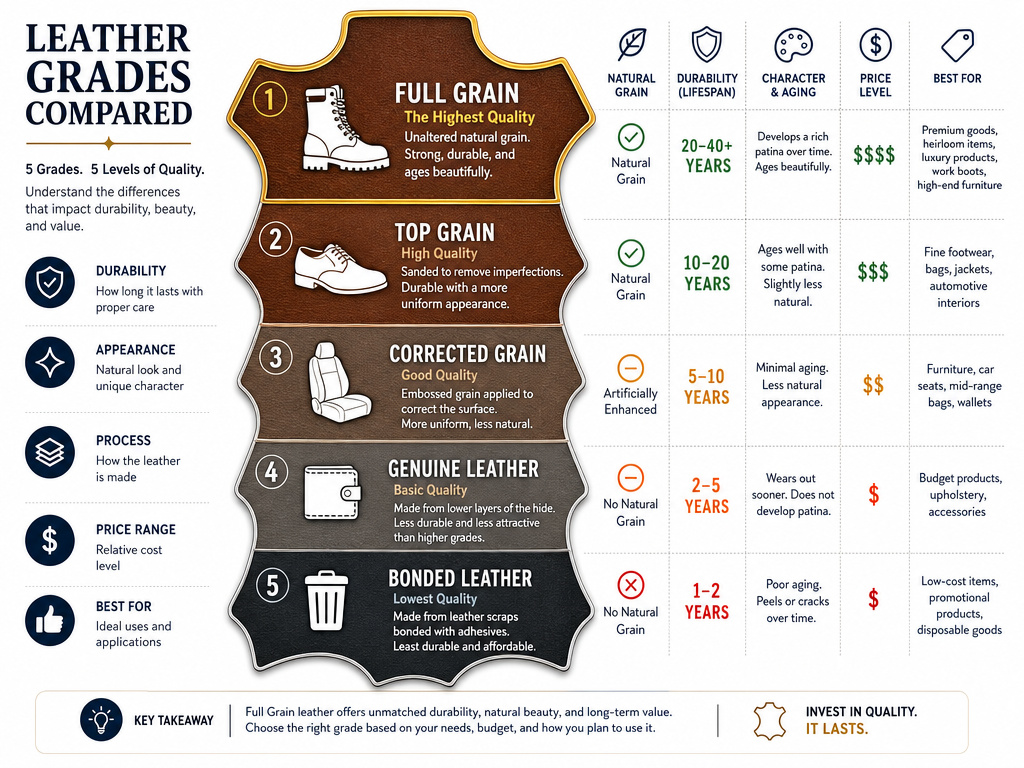
The “grades” are really a map of how much of the hide’s surface is left alone. Knowing the differences from top-grain and others clarifies your choice.
| Leather Type | Surface Treatment | Best For | Typical Lifespan |
|---|---|---|---|
| Full Grain | None. Natural grain fully intact. | Heirloom goods, boots, bags, belts where patina and max durability are wanted. | 20-40+ years |
| Top Grain | Lightly sanded (0.05-0.1mm) to remove imperfections, then refinished. | High-quality furniture, dress shoes, luxury accessories where a uniform look is key. | 10-20 years |
| Corrected Grain | Heavily sanded (0.3-0.5mm) and embossed with an artificial grain, then thickly painted. | Automotive interiors, commercial furniture, budget-friendly fashion items. | 5-15 years |
| Genuine Leather | A misleading term that refers to the split leather layer beneath the grain. Often sanded and coated. | Low-cost belts, wallets, mass-market goods. Not a mark of quality. | 2-7 years |
| Bonded Leather | Shredded leather fibers bonded with plastic onto a fabric backing. | The cheapest “leather” products. Should be avoided for any item meant to last. | 1-3 years |
The pros and cons of top-grain leather balance uniformity and good durability. It’s an excellent choice, but it won’t develop the same deep patina. The pros and cons of genuine leather are almost all cons for the buyer, it’s the weakest real leather layer, marketed with a name that sounds positive.
Caring for Full Grain Leather: The Maintenance Mindset
Care isn’t complicated, but it’s specific. The goal is to support the leather’s natural state, not fight it.
- Clean Gently. Use a soft, damp cloth to wipe away dirt. For deeper cleaning, use a pH-balanced leather cleaner. Never drench it.
- Condition Judiciously. This is the key. Apply sparingly, let it absorb fully (overnight), then buff off the excess. Over-conditioning is real, it can darken leather dramatically and oversoften its temper.
- Protect from Extremes. Keep it away from direct heat sources and prolonged, direct sunlight. Don’t let it stay soaking wet; if it gets drenched, let it dry at room temperature, away from heaters.
- Use It. The best thing for full grain leather is regular, gentle use. The oils from your hands and the flexing from movement keep the fibers supple and feed the patina.
The importance of leather grain is central to care. Because the grain is open, conditioners and oils can penetrate effectively to nourish the fibers from within. A heavily corrected grain with a plastic coating simply can’t be nourished the same way.
Frequently Asked Questions
Is full grain leather waterproof?
No, it is water-resistant due to its dense grain, but not waterproof. A heavy rain will soak through. You can apply wax-based conditioners (like Huberd’s Shoe Grease) for heavy-duty water resistance, but this will darken the leather and change its finish.
Does full grain leather scratch easily?
Yes and no. It can show surface scratches more readily than a thickly painted leather. However, on quality full grain, these scratches are often superficial and will blend into the patina over time, becoming less visible. This is very different from a coating that scratches off to reveal a different color underneath.
Is full grain leather the best for every product?
Not necessarily. It’s the strongest and most durable, but it’s also the stiffest and shows the most character. For a sleek, formal dress shoe where a flawless, shiny appearance is key, a premium corrected grain leather might be the technically correct choice for the designer’s intent. The “best” leather is the one most suited to the product’s function and desired aesthetic.
How can I tell if my “genuine leather” item is actually good quality?
Examine the edge and the back. If the edge is rough and fibrous, and the back looks like suede or a rough fabric, it’s made from split leather and will have limited durability. If the edge is clean and the back has a consistent, fibrous texture, it might be a better-quality split or even a thin top grain. The term itself tells you almost nothing.
Can full grain leather be repaired?
Yes, and this is a massive advantage. Scratches can be minimized, edges can be re-burnished, and dried leather can often be revived with conditioning. Because the damage is usually to the leather itself and not a superficial coating, a skilled restorer can work with the material. A peeling plastic coating on a bonded leather item, however, is not repairable.
Before You Go
The real question isn’t “Is full grain leather worth it?” It’s “Do you want to own things that last?” If you’re tired of replacing cracked belts and disintegrating bags every few years, the shift to full grain is a logical one. You’re not just buying a material; you’re opting out of a cycle of disposable goods.
Understand that your first premium piece might feel stiff and look imperfect. That’s the point. Give it a year of use and proper care. Watch as the color deepens, the scratches soften into character lines, and the leather molds to become uniquely yours. That transformation, from a new item to a personal possession, is what you’re really investing in. Everything else is just a consumable.
