
Types of Leather Shoes | The Anatomy of Every Classic Style
This post contains affiliate links. As an Amazon Associate, we earn from qualifying purchases.
This post contains affiliate links. As an Amazon Associate, we earn from qualifying purchases.
Leather shoes are classified by two parallel systems: the type of leather used for the upper (full-grain, corrected grain, suede, patent) and the construction method that joins the upper to the sole (Goodyear welt, Blake stitch, cemented). The construction method often dictates long-term durability and repairability more than the leather grade alone.
That’s the foundation. The leather gives you character and patina, but the hidden architecture, the stitches, the welts, the glue, is what decides whether those shoes are with you for three seasons or thirty years.
What follows is a breakdown of both systems. We’ll start with the leather itself, from the top layer of the hide down to the splits. Then we’ll walk through the major construction types, using official standards to cut through the marketing. By the end, you’ll be able to read a shoe’s spec sheet and know exactly what you’re buying into.
Key Takeaways
- Construction beats leather grade for longevity. A well-made cemented boot can outlast a poorly constructed Goodyear welt. The thread, glue, and sole attachment are the real load-bearers.
- “Full-grain” isn’t a finish; it’s the hide’s surface. It shows natural markings, breathes well, and develops a unique patina. Any coating thicker than 0.15mm turns it into a coated leather, not a “treated” full-grain.
- Official standards provide measurable benchmarks. Documents like the NIST Circular and Chinese standard QB/T 1002-2015 define minimums for tensile strength (20-25 N/mm²) and flex endurance (as low as 30 cycles for suede).
- The interior tells the truth. Look at the insole stitching, the lining seams, and the heel reinforcement. Exterior beauty is easy; interior integrity is where failures start.
- Suede is not delicate. Quality suede (1.4–1.6mm thick) has a tensile strength on par with other leathers. Its nap can be brushed clean, and it’s a stable choice for casual and vulcanized shoes.
The Leather Itself: From Hide to Shoe
Let’s start with the raw material. All shoe leather begins as an animal hide, usually cow. The hair and flesh are removed, and the hide is tanned to preserve the fiber structure. This is where the first major split happens, literally.
The top layer, just beneath the hair, is the full-grain leather. This is the strongest, most breathable part of the hide because the dense, interwoven fiber structure is intact. It shows natural imperfections like scars and insect bites. That’s not a defect; it’s proof of authenticity. A full-grain leather shoe will develop a rich, dark patina over years because the pores are open to absorb oils and respond to wear.
Common mistake: Calling any smooth, high-quality leather “full-grain.” If the surface has been sanded or buffed to remove those natural markings, it’s not full-grain. That sanding process creates a new, artificial surface layer.
Beneath the full-grain layer is the split leather. When the top-grain is sliced away, the remaining inner layers are “split.” These fibers are looser and less dense. The most common type of split leather is suede, created by raising the nap on this inner flesh. Good suede is stable and comes in standard thicknesses, 1.2mm to 1.8mm, with 1.4–1.6mm being the workhorse for casual shoes. Lower-quality splits can be laminated with a polyurethane (PU) or PVC coating to create “action leather” or “coated leather,” which behaves like a synthetic in manufacturing but is still classified as leather for import purposes.
Then there are the finishes. Corrected grain leather is full-grain or top-grain that has been sanded and then embossed with a uniform grain pattern and coated heavily with pigment and polymer. It’s uniform and scratch-resistant, but it doesn’t breathe or age like untreated leather. Patent leather is any leather (often lower-grade splits) coated with a shiny varnish, lacquer, or plastic sheet. The official threshold is clear: the coating must not exceed 0.15 millimeters to be classified as patent leather. Anything thicker pushes it into a different regulatory category.
Why does this taxonomy matter when you’re just trying to buy a pair of boots? Because the leather type dictates care. You wouldn’t use a heavy wax on a nubuck shoe, you’d ruin the nap. Knowing you have a coated leather tells you that “conditioning” it is largely futile; you’re just polishing the plastic topcoat. This is straightforward advice: match your maintenance to the material you actually have.
The Two Systems: Leather Type vs. Shoe Construction
Here’s where most guides get tangled. They talk about leather types and shoe types as one list. They’re not. They are two separate classification systems that operate on different axes. One describes the material of the upper. The other describes the method of assembly.
Government and trade bodies care deeply about this distinction for customs and labeling. The Footwear Customs Definitions document from the Footwear Distributors and Retailers of America (FDRA) exists precisely to untangle these definitions for importers. Is it a “shoe” or a “slipper”? Does a rubber foxing strip change its classification? This bureaucratic precision is what prevents a container of goods from being held at port.
For you, the buyer, the practical takeaway is this: the construction method is often a better predictor of lifespan and reparability than the leather grade. You can have a beautiful full-grain upper attached with cheap glue that fails in two years. Conversely, a sturdy suede upper built on a Goodyear welt can be re-soled almost indefinitely.
| Construction Method | How It Works | Best For | Repairability |
|---|---|---|---|
| Goodyear Welt | A leather strip (welt) is stitched to the upper and insole, then a second stitch attaches the welt to the outsole. | Boots, dress shoes, any long-term footwear. | Excellent. The welt can be cut and the sole replaced repeatedly without damaging the upper. |
| Blake Stitch | A single stitch runs directly through the insole, upper, and outsole. | Sleeker dress shoes where a close sole-edge is desired. | Good, but requires a specialist. The stitching channel is inside the shoe. |
| Cemented (Glued) | The upper is lasted and glued directly to the outsole. | Casual shoes, sneakers, fashion boots. | Poor. Once the adhesive bond fails, the shoe is often not worth rebuilding. |
The historic NIST footwear circular, published by the National Bureau of Standards, classifies shoes not by leather but by how these parts are joined. It names eight main classes: welt, McKay, Littleway, turn, stitchdown, nailed, cemented, and moccasin. This 1930s document found that shoes of different constructions, made with the same materials, could withstand over a million steps in testing. The variable wasn’t the blueprint, it was the quality of the materials executing that blueprint.
So when you see “Goodyear welted,” you know the repair path. When you see “cemented,” you’re buying a disposable product, regardless of the leather’s pedigree. This is the reality behind the sales tag.
Decoding the Specs: What the Numbers Actually Mean
Let’s talk about what holds up. When a standard like China’s QB/T 1002-2015 for leather shoes references test methods for flexing resistance (GB/T 3903.1) and abrasion resistance (GB/T 3903.2), it’s pointing to measurable, repeatable benchmarks. These aren’t marketing terms.
The Ethiopian standard CES 49-2021 gives us hard numbers. For shoe upper leather, it mandates a minimum tensile strength of 20-25 Newtons per square millimeter. That’s the force needed to start tearing the material. It also sets a range for elongation at break (40-80%), how much it can stretch before failing. Then there’s flexing endurance: the number of times a leather sample can be bent back and forth before the finish cracks or layers separate. The minimum required flexes vary wildly: * Patent leather: 100 flexes * Full-grain aniline & others: 60 flexes * Suede: 30 flexes
A shoe’s flex point is at the ball of the foot. Every step is one flex. Thirty flexes sounds low, but that’s a laboratory test to destruction. In practice, quality suede withstands daily wear for years because the nap hides micro-tears and the leather isn’t under full tensile load in a shoe.
These specs explain why certain leathers are chosen for certain jobs. Patent leather’s high flex count is due to its plastic coating, which resists cracking. Suede’s lower number reflects its napped surface, which is more prone to surface abrasion than catastrophic failure. You don’t need patent leather’s flex rating for a loafer, but you might want its waterproof shine.
The thickness standards are just as pragmatic. Women’s shoe leather: 1.0–1.4mm. Men’s: 1.4–2.2mm. Thicker isn’t automatically better; beyond 2.2mm, leather becomes stiff and difficult to last smoothly over a shoe form. This is a timeless material, but its application is governed by very modern engineering.
The Hidden Details That Signal Quality
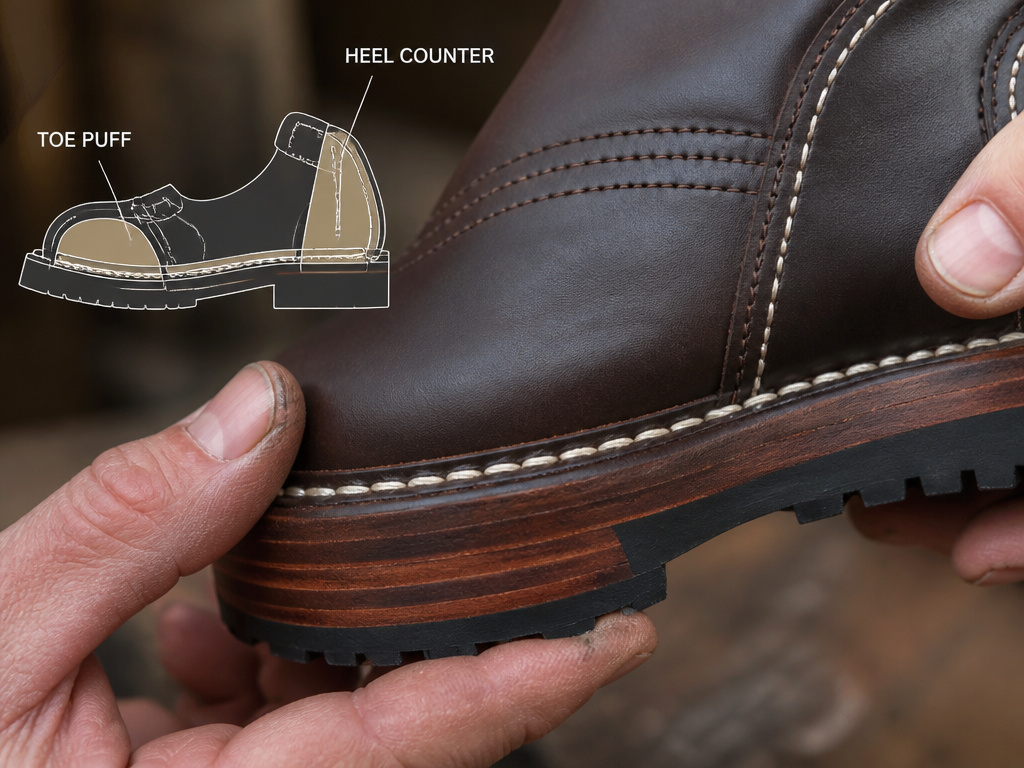
You’ve assessed the leather and identified the construction. Now, look closer. The details that don’t feature in the product description are where the maker’s intent becomes clear.
First, the thread. I’ve seen multiple bags where the strap attachment points failed not from wear, but from being stitched with thread that was too weak for the load. For footwear, polyester or bonded nylon thread offers superior strength and weather resistance compared to traditional linen. The stitch density (stitches per inch) matters too. Too sparse, and the stress is concentrated; too dense, and you perforate the leather like a stamp, creating a weak line.
Next, the edge finishing. A clean, painted or burnished edge on the sole and upper layers shows care. A ragged, unfilled edge absorbs water and dirt, speeding up decomposition. Look at the interior, the lining seams should be finished, not raw. The insole should be firm and smoothly integrated, not a floppy piece of cardboard glued in as an afterthought.
Where this goes sideways: Ignoring the heel counter and toe puff. These are the internal plastic or leather reinforcements that give a shoe its shape. A weak heel counter collapses, causing the back of the shoe to dig into your Achilles tendon. A missing toe puff lets the leather crumple over your toes. You can’t see them, but you’ll feel their absence within a month of wear.
Finally, consider the sole’s attachment beyond the main construction. Is it just glued, or is it also stitched or screwed? A Dainite studded rubber sole or a Vibram lug sole are often stitched or screwed through a welt, creating a mechanical lock that glue alone can’t provide. This is the kind of detail highlighted in academic reviews of sustainable footwear materials, which analyze every component for its lifecycle and failure points.
These hidden elements are the true signature of quality. They’re why two shoes can look identical on a shelf but feel, and last, completely different on your feet.
How to Choose and What to Avoid

Armed with this anatomy lesson, how do you pick? Let’s be clear about this: your choice should start with the shoe’s purpose, not its leather type.
For daily business wear where you’ll be walking on pavement, a Blake-stitched or Goodyear-welted dress shoe in calfskin (a type of full-grain) is the benchmark. It’s durable, takes a shine, and can be re-soled. For rugged outdoor or work boots, look for a Goodyear welt with a storm welt for weather sealing and a thick full-grain or oiled nubuck upper. The construction handles the abuse; the leather protects your foot.
For casual sneakers or summer loafers, cemented construction is standard and acceptable. Here, leather choice is about aesthetics and feel. Suede offers a soft, matte look. Action leather provides uniform color and easy cleaning. Just know you’re buying for style, not decades of service.
Avoid these common traps: 1. Paying a premium for “exotic” leathers on a cemented sole. The construction is the limiting factor, not the python skin. 2. Assuming “hand-stitched” is superior. Machine stitching, with heavy-duty thread, is often more consistent and stronger. The romance isn’t worth a blown-out seam. 3. Neglecting interior care. Conditioning the outside of your leather dress shoes is good, but sweat and salt degrade the lining and insole faster. Let them dry fully on shoe trees.
Your first step should always be to learn how to clean leather shoes properly. It’s the most fundamental act of maintenance. From there, you can learn to shine leather shoes for a formal finish or condition leather shoes to keep the leather supple. The goal is informed ownership.
Frequently Asked Questions
What is the most durable type of leather for shoes?
Full-grain leather is generally the most durable because it retains the hide’s intact, dense fiber structure. However, durability equally depends on construction. A full-grain upper on a poorly cemented sole will fail long before a quality suede upper on a Goodyear welt.
Are leather shoes better than synthetic?
Leather shoes are better than synthetic for breathability, moisture-wicking, and long-term moldability to your foot. Synthetic materials (PU, PVC) can be more consistent and cheaper, but they don’t develop a patina and often have poorer breathability, which can lead to a less comfortable microenvironment for your foot.
What does “genuine leather” mean on shoes?
“Genuine leather” is a technically accurate but largely meaningless term. It legally indicates the product contains some real leather, but it often refers to the lowest-quality splits or heavily processed layers. It tells you nothing about thickness, durability, or the part of the hide used. Look for more specific terms like “full-grain,” “top-grain,” or “suede.”
How can I tell if my shoes are Goodyear welted?
Look for a visible stitching channel running along the perimeter of the sole, attaching a raised strip (the welt) to both the upper and the sole. You can often see two distinct rows of stitches. Alternatively, gently pry the sole away from the upper at the heel; a Goodyear welt will show a gap with a strip of leather (the welt) in between, not direct glue.
Can suede shoes be worn in the rain?
Yes, quality suede shoes can handle rain if properly treated with a silicone-free suede protector. The water will bead up. Afterward, let them dry at room temperature away from direct heat, then brush the nap with a suede brush to restore the texture. The key is to not let them stay saturated.
The Bottom Line
Forget the idea of a single “best” type of leather shoe. The right pair is a specific intersection of material and method, chosen for a specific job. Start with the construction that matches the shoe’s intended lifespan and repairability. Then, select the leather that delivers the look, feel, and care routine you want.
Here’s some straightforward advice: your next purchase should be a pair of shoe trees. They’re the single most effective tool for prolonging the life of any leather shoes, regardless of type or construction. They maintain the shape, absorb moisture, and slow the breakdown of the interior. Everything else, cleaning, polishing, conditioning, comes after that fundamental act of preservation.
The goal isn’t to buy a museum piece. It’s to choose a tool that gets better with use. When the materials are honest and the construction is sound, that’s exactly what happens.
