
What Is Stingray Leather? Its Durability, Crafting & Species
This post contains affiliate links. As an Amazon Associate, we earn from qualifying purchases.
Stingray leather is the tanned skin of a stingray fish, instantly recognizable by its surface covered in hard, pearl-like calcium nodules. This structure makes it one of the most durable, scratch-resistant, and water-resistant natural leathers available, though those same nodules make it notoriously difficult to cut, punch, and sew.
That durability comes with a trade-off in craft. The material is hard to the touch, stiff to work with, and its small hide sizes make large projects an exercise in precision. Understanding this balance, between legendary toughness and real-world handling, is the key to choosing and using stingray leather correctly.
What follows is a look past the exotic sheen. We’ll break down where it comes from, the science behind its strength, the gritty details of working with it, and how to pick a skin that matches your ambition without breaking your tools or your budget.
Key Takeaways
- The signature bumps are calcium nodules; they’re harder than most tool steel and are the source of the leather’s armor-like durability and crafting difficulty.
- Raw stingray skin requires extensive chemical processing, depigmentation, tanning, and fiber opening, to become workable leather; an untreated skin is useless for manufacturing.
- Available hide sizes are small, typically under 3 square feet, making large items like furniture or bags a puzzle of paneling and seam work.
- For crafting, polished (sanded) finishes are smoother and slightly more flexible, while unpolished (pearl) finishes offer deeper color and more pronounced texture.
- Its performance in lab tests is documented: high abrasion resistance (over 8000 cycles), significant blade cut resistance (75N average), and strong tear strength (94 ± 6 Kg/cm).
Where Stingray Leather Comes From: The Dasyatis Species
Stingray leather starts with fish from the Dasyatis genus, among others. These aren’t farmed; they’re typically bycatch from commercial fishing operations, which adds a layer of sustainability to their use. The skin is a byproduct that would otherwise be discarded.
The raw skins are small. A full hide usually measures between 5 to 16 inches wide and 12 to 34 inches long, with a thickness of 0.8 to 1.5mm. Only about 5% of harvested skins reach the larger end of that scale, around 15 inches wide, which makes those panels rare and more expensive. This size constraint immediately dictates the leather’s primary uses: watch bands, wallets, knife handles, inlays, and other small luxury goods. For a bag or a piece of furniture, you’re looking at stitching multiple skins together, a process that requires careful color and grain matching.
Technical Snapshot: A 2021 study published in the Mehran University Research Journal tested processed stingray leather for protective gear, recording an abrasion resistance greater than 8000 cycles (Level 4), a blade cut resistance requiring an average force of 75 Newtons, and puncture resistance between 100–150N (Level 3). These numbers validate its historical use as armor.
This isn’t a leather you buy by the side. You buy it by the skin, and the size of your project directly determines the size, and cost, of the skin you need. It shares this boutique, panel-based nature with other exotic leathers like snakeskin leather and lizard leather.
What Does Stingray Leather Feel and Look Like?
Close your eyes and run your fingers over it. You don’t feel soft grain. You feel a field of hard, tightly packed beads. These calcium nodules are part of the stingray’s skeletal structure, evolved for protection, and they remain intact through the tanning process. They’re often compared to the hardness of tooth enamel.
Visually, the “crown” or central cluster of these pearls is the most prized and recognizable feature. The leather can be dyed virtually any color, from classic black and navy to vibrant blues, reds, and even metallics. The finish decides the final character. An unpolished finish (also called pearl, single crown, or standard) leaves the nodules fully raised and textured, with dye settling deeply into the valleys for a rich, dimensional color. A polished finish (sanded, jewel crown) is buffed smooth and lacquered. This makes it slightly softer and smoother to the touch, but it can mute the color and flatten the pearlescent effect.
The hand-feel is unambiguous. It’s a 3 out of 10 on softness, according to reference tables from suppliers like Liberty Leather Goods. It’s not supple. It doesn’t drape. What you gain in durability you sacrifice in pliability. When people call it “armor,” they’re not being poetic, they’re being literal. Samurai used it to guard against sword strikes. That legacy is felt in every rigid inch.
The Science of Its Strength: More Than Just Bumps
It’s easy to say “it’s tough because of the bumps,” but the real strength is in the fiber structure underneath. The chemical processing, the tanning, is what allows that potential to be realized. Research into converting raw stingray skins into workable leather highlights how finicky this is. One academic journal leather production study detailed a multi-trial process to perfect depigmentation and fiber opening. Trials failed because of stiffness, poor handle, damaged beads from over-exposure to sulphide paste, or visible veins.
When done right, the resulting leather has measurable, impressive specs. Let’s look at the numbers that move this from marketing talk to materials science.
| Property | Test Method | Reported Value | What It Means for You |
|---|---|---|---|
| Tear Strength | IUP 8 | 94 ± 6 Kg/cm | The leather resists ripping once a cut or puncture starts. |
| Grain Crack Load | Lastometer (SLP 9) | 33 ± 2 Kg | The surface finish can withstand significant bending force before showing stress lines. |
| Distension at Grain Crack | Lastometer (SLP 9) | 5.1 ± 0.2 mm | It flexes further than you’d expect before the finish gives way. |
| Abrasion Resistance | EN 388 (Klingspor PL 31B) | >8000 cycles (Level 4) | It will outlast most other leathers under repetitive rubbing or wear. |
These figures come from peer-reviewed sources. They tell you a stingray skin performance textile study](https://doi.org/10.22581/muet1982.3181) isn’t just theory; it’s a blueprint for why this material works for high-wear items. This level of documented performance is rare in the leather world, putting stingray in a category with engineered textiles, not just traditional hides. It’s a different beast altogether from soft leathers like deerskin or even the rugged but flexible kangaroo leather.
How Stingray Leather is Made and Processed
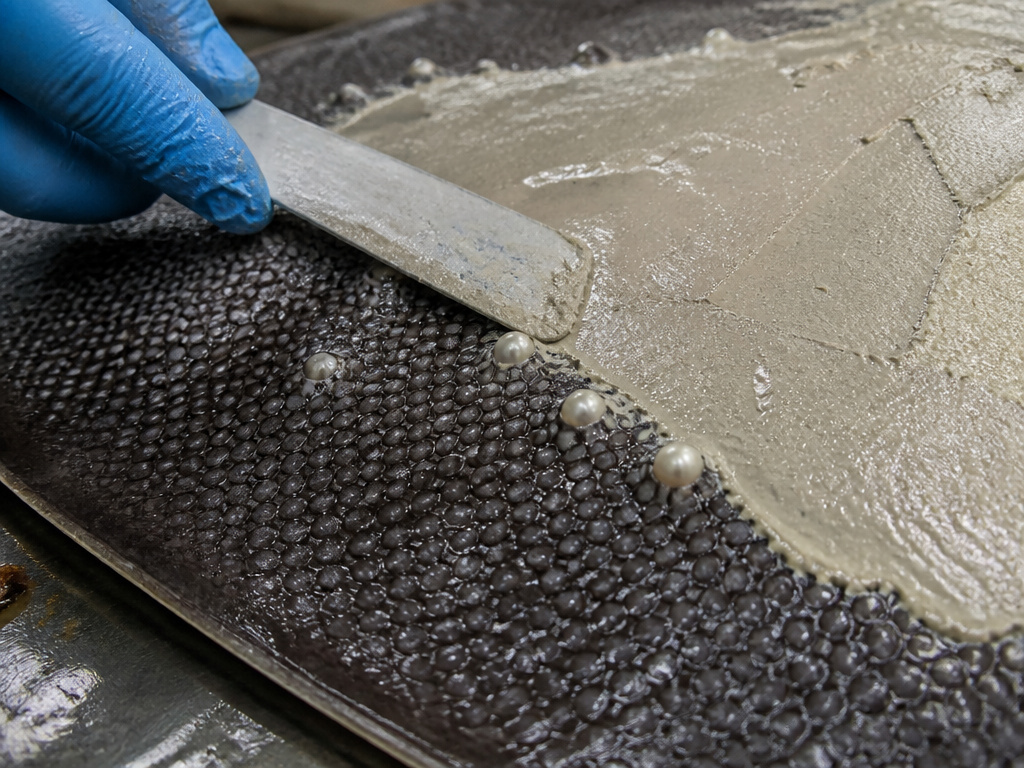
Turning a raw, scaly stingray skin into that beautiful, durable leather is a chemical marathon, not a sprint. The process is why you can’t just buy a dried stingray skin and start crafting. Here’s the straightforward breakdown:
- Curing & Storage: Fresh skins are salted and stored between 4–7°C to prevent decay before they reach the tannery.
- Depigmentation: This is the most critical and delicate step. The dark, rough outer layer must be removed without destroying the precious calcium nodules. Studies show this often involves sulphide-based pastes, and the timing is everything, too long, and the beads dissolve.
- Tanning: Most stingray leather is chrome-tanned. This method efficiently penetrates the dense fibers and results in a leather that can accept a wide spectrum of dyes. It’s more about color versatility and processing speed than the aging characteristics of vegetable tanning.
- Sanding/Polishing (Optional): For a polished finish, the tanned hide is buffed with abrasives to smooth the nodule peaks. This step requires skill to avoid sanding through the thin skin.
- Dyeing & Finishing: The leather is drum-dyed. Because it’s chrome-tanned, it holds color brilliantly. A topcoat lacquer is usually applied, especially on polished finishes, to enhance shine and provide a protective layer.
Where this goes sideways: Skipping or rushing the depigmentation step. The research trials are clear: improper chemical application leaves patches, visible veins, or, worse, damages the bead structure. A skin ruined here is either sanded down to nothing or discarded.
The complexity of this process is why so few tanneries handle stingray. It’s a specialty operation, which contributes to its exotic status and price. It’s a world away from the large-scale processing of bovine leather, and even differs from the treatment of other reptile leathers.
The Crafting Reality: A Love-Hate Relationship
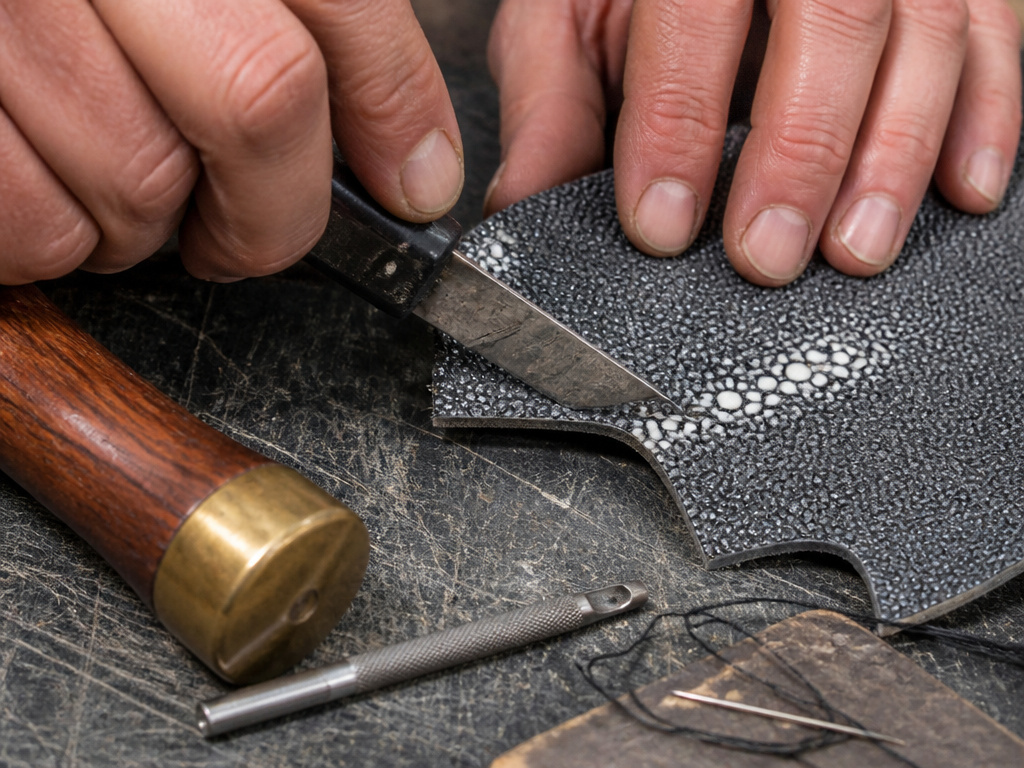
This is where the rubber meets the road, or more accurately, where the blade meets the nodule. I’ll be clear about one thing: stingray leather is a 2 out of 10 for ease of crafting, according to industry tables. Here’s what that means on the bench:
- Cutting: Scissors are useless. You need a razor-sharp utility knife or a rotary cutter, and you’ll go through blades. The calcium nodules are harder than the steel in most hobbyist blades, causing rapid dulling.
- Punching Holes: Your standard rotary punch will struggle. You need drive punches and a mallet, or an awl with significant hand pressure. The nodules can create micro-serrations around the hole that can fray thread.
- Sewing: This is the biggest hurdle. Hand-sewing requires pre-punched holes and a heavy-duty needle. Machine sewing is risky, the hard surface can deflect needles, break threads, or damage the machine’s feed dogs. Many crafters resort to gluing for construction and using stitches purely for decoration.
So why bother? Because the end product is virtually indestructible. A well-made stingray leather wallet won’t just last years; it will look nearly new for decades with minimal care. The trade-off is upfront pain for long-term gain. It’s the opposite experience of working with a forgiving, supple leather like Shell Cordovan, where the pleasure is in the making as much as the owning.
Polished vs. Unpolished: Choosing Your Finish
Your project’s purpose should dictate your finish choice. This isn’t an aesthetic whim; it’s a functional decision.
| Finish Type | Also Known As | Key Characteristics | Best For |
|---|---|---|---|
| Unpolished | Pearl, Single Crown, Standard | Texture is pronounced. Color is deep and rich. Nodules are fully raised. Most authentic, rustic look. | Watch straps, knife handles, men’s accessories, items where grip and texture are desired. |
| Polished | Sanded, Jewel Crown, Art Deco | Surface is smoother to the touch. Color can be slightly muted. Nodules are flattened and lacquered. More refined, elegant appearance. | Women’s handbags, jewelry inlays, furniture accents, items that will come into contact with clothing. |
The unpolished finish offers the fullest, most dramatic expression of the material. The polished finish makes it more wearable and user-friendly. There’s no “better” option, only the right one for your design. This level of choice in texture is a hallmark of working with luxury exotic leathers, where the finish radically alters the character.
Grading and Selecting a Quality Skin
Not all stingray skins are equal. Grading is primarily about the presence of natural flaws, scratches, bite marks, or discolorations from the ray’s life in the ocean.
- Grade 1: No defects within the central square surrounding the crown. This is for projects where a large, flawless panel is needed, like the front of a clutch or a visible watch strap section.
- Grade 2: May have minor flaws outside the central crown area. Perfect for smaller items where you can cut around imperfections, like keychains, card slots, or belt strips.
When selecting a skin, look for: 1. Uniform Bead Size: The calcium nodules should be consistently sized across the hide. 2. Intact Crown: The central cluster should be complete and undamaged. 3. Even Color: For dyed skins, ensure the dye penetration is uniform with no blotches. 4. Supple Hand: Despite its hardness, the leather should bend without cracking or creasing sharply. A brittle feel indicates overtanned or poorly processed stock.
Remember the story from my bank? I used to think cracked leather was always a death sentence. Working with stingray taught me that lesson in reverse. With most leathers, a crack goes deep. On stingray, because the color and finish sit atop those rock-hard nodules, what looks like damage is often just in the lacquer. Sometimes, a gentle rub with a soft cloth is all it takes. The hide underneath is usually fine.
Stingray Leather Care and Maintenance
The good news is its toughness makes it low-maintenance. The hard, lacquered surface resists stains and scuffs.
- Cleaning: Wipe with a damp, soft cloth. No soaps or harsh cleaners needed.
- Conditioning: Rarely required. If the leather seems dry, use a tiny amount of a non-oily leather conditioner on a cloth and apply lightly. Avoid products with silicone or waxes that can cloud the finish.
- Storage: Keep it away from extreme heat and direct sunlight, which can dry out the backing and cause the lacquer to crack over time.
- What to Avoid: Abrasive cleaners, soaking in water, and excessive bending along the same line.
Its water resistance is a key feature. Water beads up and rolls off. It’s not waterproof, prolonged submersion will damage it, but for rain or spills, it’s more than capable. This makes it a practical choice for items like watch straps or exterior bag accents that see daily use.
Frequently Asked Questions
Is stingray leather ethical?
Stingray leather is generally considered a byproduct of existing food fisheries. The rays are often caught accidentally (bycatch) in Southeast Asia and other regions. Using the skin provides an economic use for an otherwise discarded part, which many view as an ethical form of utilization. Always source from reputable suppliers who can provide transparency.
How does stingray leather compare to shark leather?
They are similar, both are fish leathers known for durability and a textured grain. Shark skin has a more sandpaper-like texture from dermal denticles, while stingray has distinct, separate nodules. Stingray is often considered more decorative, while shark is more abrasion-resistant. Both are challenging to craft.
Can stingray leather be repaired?
Surface scratches on a lacquered finish can sometimes be minimized with a very light application of the original finish. However, deep cuts or damage to the calcium nodules cannot be repaired without a trace. The structural integrity is so tied to those nodules that damaging them is a permanent flaw.
Is it more durable than cowhide?
For scratch, tear, and abrasion resistance, yes, by a significant margin. A full-grain cowhide will develop a patina and show wear; stingray leather will resist those marks. However, cowhide is far more flexible, easier to work with, and better for large, structured items.
Why is stingray leather so expensive?
The cost comes from limited supply (small hides, only 5% are large), labor-intensive processing (specialized tanning), and high waste during crafting (due to small sizes and difficulty cutting). It’s a luxury material due to scarcity and craftsmanship, not just branding.
Before You Go
Stingray leather isn’t a substitute for cowhide or goat. It’s a specialist material. Its value lies in a specific set of properties: unmatched durability in small formats, striking texture, and unique water resistance. The practical takeaway is this: if you need a small item that must withstand decades of harsh use and still look sharp, it’s a phenomenal choice. Think knife grips, watch bands, cardholders.
If your project requires large panels, soft drape, or complex shaping, look elsewhere. The crafting barrier is real, and the size limitation is absolute. Understand that balance, and you can use its strengths instead of fighting its nature. It sits in that fascinating category of alternative leathers like fish leather, materials that rewrite the rules of what leather can be, for better and for worse.
