
What Is Lizard Leather: The Ultimate Guide to Its Texture
This post contains affiliate links. As an Amazon Associate, we earn from qualifying purchases.
Lizard leather is the tanned skin of certain lizard species, prized for its distinctive tile-like scale pattern, thin yet durable construction, and surprising pliability. It typically measures between 0.4mm and 0.6mm thick and lacks calcium in its scales, which keeps it flexible and soft from day one.
You’ll find it primarily from the Ring Lizard (Varanus salvator) and the Teju Lizard. The material’s unique biology gives it a set of properties that make it a standout choice for specific leather goods, especially wallets, cardholders, and small accessories where a slim, structured, and detailed look is the goal. Let’s look at the mechanics of those scales and why this leather behaves differently from other exotic skins like alligator or ostrich.
What follows: the biological and chemical reasons behind its “armored silk” feel, a breakdown of how it’s processed and graded, a direct comparison with other exotics, and the specific, non-negotiable rules for keeping it in top shape for decades. By the end, you’ll know exactly when lizard leather is the right, or wrong, choice for your project or purchase.
Key Takeaways
- Lizard leather’s flexibility comes from scales that contain no calcium, unlike stiffer crocodile or alligator skin.
- The thickness (0.4mm–0.6mm) is a key spec, making it ideal for ultra-slim accessories but unsuitable for heavy-duty bags or belts.
- High, direct heat (from hair dryers or heaters) will permanently shrink lizard leather and curl its scales, blot water dry, never apply heat.
- In performance tests, properly finished lizard skin meets specific industry standards (like SNI 06-4362-1998) for tensile strength and rub fastness.
- For daily-use items where you want exotic detail without bulk, lizard often out-performs flashier alternatives like alligator.
The Science Behind Lizard Leather’s Flexibility
The phrase “armored silk” isn’t just marketing poetry. It describes a real physical contradiction. The scales look like they should be rigid, yet the leather bends easily in your hand. The secret is in the chemistry of the scales themselves.
Reptile scales often contain calcium, which acts as a natural stiffener. Crocodile and alligator skins have a lot of it. That’s part of why they feel so substantial and structured. Lizard scales, particularly from the Ring and Teju species used in leathercraft, contain very little to no calcium. Without that mineral reinforcement, the scale structure remains inherently pliable. The leather gets its durability from the density and overlap of the scales, not from rigidity. You get a material that’s tough enough to resist scratches but soft enough to bend comfortably straight from the craftsman’s bench.
This isn’t just an observation; it’s quantified. A study published in the Media Komunikasi Teknik dan Pengembangan Industri journal tested Varanus salvator (monitor lizard) skin tanned with vegetable extracts and finished with a natural casein binder. The resulting leather wasn’t just flexible, it met the requirements of the Indonesian Standard SNI 06-4362-1996 for shoe upper leather. The study recorded a tensile strength of 207.43 kg/cm² and an elongation at break of 37.52%. That elongation number is important. It tells you how much the leather can stretch before it fails, and for a thin, scaly skin, 37% is a sign of remarkable give.
A 2023 study in the IOP Conference Series tested protein-based binders on lizard skin and found that all tested variations met the chemical and organoleptic (sight, touch, smell) requirements of SNI 06-4586-1998 for chrome-tanned snake finished leather. The research also noted that a higher ratio of protein binder to water yielded a smoother final surface morphology.
So when you feel a piece of quality lizard leather, you’re feeling a biological structure that evolved for mobility, translated through a tanning process that preserves its natural grace. It’s not soft like suede or floppy like thin calf. It’s a soft snap, a definite, textured fold with no crackle or protest.
From Reptile to Refined: How Lizard Leather is Made
The journey from raw skin to finished leather is where the potential of those scales is either realized or ruined. The process follows the same broad stages as other leathers, curing, tanning, drying, finishing, but with a jeweler’s attention to detail because of the delicate scale structure.
First, let’s be clear about one thing. Not all lizard leather is equal, and the species matters. The high-end craft industry focuses on Ring Lizard (Varanus salvator) and Teju Lizard. Ring Lizard tends to have more defined, geometric scale patterns, while Teju offers a slightly different texture. Knowing your source is the first step in identifying leather quality.
Tanning is the transformative step. You’ll find both vegetable and chrome tanning methods used. Vegetable tanning, using natural tannins from tree bark, is a slower process that often yields a firmer temper and richer patina potential. Chrome tanning is faster and produces a softer, more pliable leather right off the bat. That peer-reviewed study on Varanus salvator used a vegetable tanning approach coupled with a casein (milk protein) finish, proving it can achieve a high standard.
The finishing stage is critical. A heavy, plasticky topcoat would hide the scale detail and crack. Artisans use light finishes, often acrylic or protein-based, that protect without obscuring. Research like the IOP Science lizard skin leather study explores using hydrolyzed protein binders from tannery shaving waste for this very purpose, creating a sustainable, effective finish that meets industry specs.
Common mistake: Assuming a glossy finish means better protection. On lizard leather, a thick glaze can fill the recesses between scales, making the surface look plastic and killing the natural texture. A quality finish enhances the grain, doesn’t mask it.
Finally, the crafting. Cutting lizard skin requires precision to align patterns and avoid scale damage. And because the cut edge is a jagged line of scale ends, creating a smooth, painted edge, a hallmark of fine work, demands hours of careful sanding and polishing. It’s a testament to the skill involved in the leather production of luxury goods.
Lizard Leather vs. The Competition: Where It Wins and Loses
Lizard leather occupies a unique niche. To understand its value, you have to see it beside the other giants in the exotic leather arena. It’s not about “best,” but about “best for what.”
| Leather Type | Key Characteristic | Best For | The Trade-Off |
|---|---|---|---|
| Lizard | Thin (0.4–0.6mm), detailed scales, naturally pliable. | Slim wallets, cardholders, watch straps, accent pieces. | Not for heavy-load items; requires careful cutting/crafting. |
| Alligator/Crocodile | Thick, pronounced tile scales, rigid due to calcification. | Statement bags, shoes, belts—items where structure is key. | Can be stiff initially; often the most expensive option. |
| Ostrich | Distinctive quill bumps, soft and supple, durable. | Handbags, jackets, portfolios where a soft, pebbled texture is desired. | The quill pores can collect dirt; texture isn’t for everyone. |
Look at thickness. Lizard’s 0.4mm to 0.6mm profile is its superpower for minimalism. You can’t make a slim-fold wallet from 1.2mm alligator belly without it becoming a brick. But you’d never use lizard leather for a weight-bearing backpack strap, it simply doesn’t have the substance.
Durability is different from toughness. A lizard scale can deflect a key scratch that would gouge a smooth calfskin. Its dense pattern hides minor wear. But it won’t withstand the same abrasion as the thicker, harder scales of an alligator. Think of it as a precision tool, not a blunt instrument.
Here’s the practical takeaway. If you want a wallet to flash at a dinner to show status, go for alligator leather. But if you want a daily driver that stays slim in your pocket and takes daily abuse in stride, lizard is the smarter choice. It’s tougher than ostrich for scratch resistance and slimmer than alligator for comfort. For a deeper dive on evaluating these materials, our guide on how to test leather quality breaks down the methods.
The Care and Keeping of Armored Silk
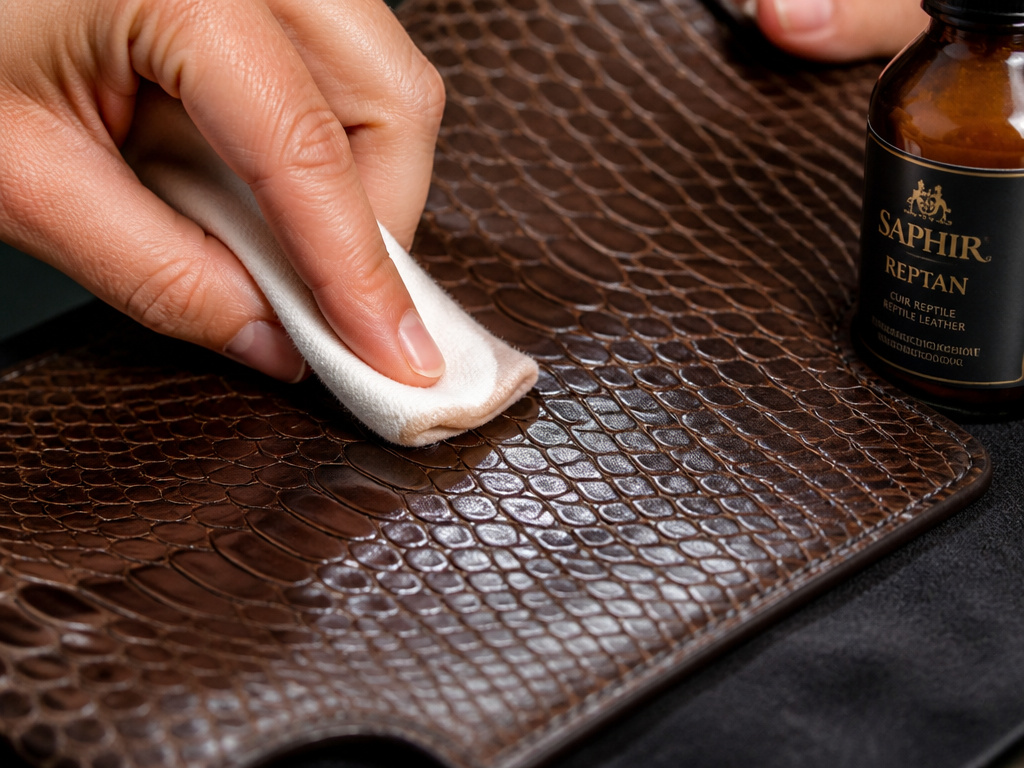
Lizard leather is low-maintenance, but it’s not no-maintenance. The rules are few but non-negotiable. Break them, and the damage is often permanent.
First, water. Lizard skin is more water-resistant than suede, but it is not waterproof. If it gets wet, blot it dry immediately with a clean, absorbent cloth. Do not rub.
Where this goes sideways: Using a hairdryer or placing the item near a heater to dry it. High heat will cause the leather to shrink irreversibly and the scales to curl. You’ll see the distortion within minutes, and no conditioner will fix it.
For cleaning, never use heavy waxes or saddle soap. These clog the detailed grain and can leave a cloudy residue. Use a conditioner specifically formulated for reptile skins, like Saphir Reptan, every 3 to 6 months. Apply a tiny amount to a soft cloth and work it in gently, following the scale pattern. For dirt, a slightly damp cloth is usually sufficient. Always test any cleaner in an inconspicuous area first.
Storage is simple: keep it in a breathable dust bag away from direct sunlight and heat sources. Sunlight can dry and fade the leather over time.
Remember, this is a natural material that ages gracefully. Unlike some embossed leather that relies on a uniform printed pattern, lizard’s authentic scales will develop a gentle sheen with use. That’s character, not wear. Your goal isn’t to keep it looking factory-new, but to ensure it ages evenly and beautifully, much like the development of a rich leather patina.
Who Should (and Shouldn’t) Choose Lizard Leather
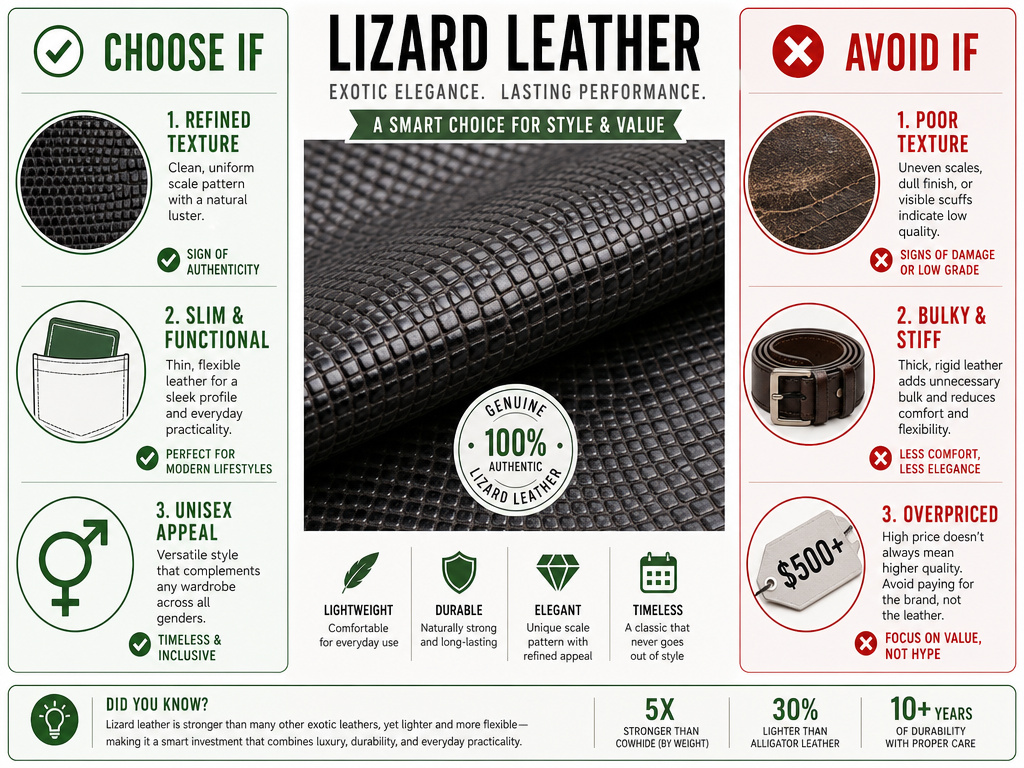
Lizard leather isn’t for every person or every project. Its strengths are incredibly specific.
Choose lizard leather if you are:
- The detail-oriented minimalist: You appreciate symmetry and fine geometry. The natural pattern of Ring Lizard is mesmerizing under close inspection.
- The daily carry enthusiast: You need a wallet or cardholder that disappears in your pocket but stands up to keys, coins, and constant handling.
- The “unisex” design seeker: Lizard has a neutral, sophisticated appeal that works equally well in a men’s bi-fold or a women’s clutch.
Avoid lizard leather if you:
- Love the “rugged” patina journey: If you crave the dramatic, ever-changing scuff-and-darken story of vegetable-tanned cowhide, lizard will feel too stable. Its glazed finish stays consistent.
- Need a heavy-duty material: For belts, straps, or bags that will carry real weight, the thinness of lizard is a liability. Step up to a thicker bovine or alligator hide.
- Are on a tight budget: The cost of the skin, combined with the intensive labor to work it, makes lizard a premium product. There are no budget-friendly versions that retain its true qualities.
For those who fit its niche, there’s no substitute. It delivers exotic texture without the bulk, durability without the stiffness, and detail without being loud. It’s the leather for people who notice the specifics.
Frequently Asked Questions
Is lizard leather ethical?
The ethics of any exotic leather depend on sourcing. Reputable tanneries and brands source lizard skins from regulated, sustainable operations, often where the lizards are monitored species or byproducts of other industries. Always look for transparency from the manufacturer regarding the origin of their skins. The industry group Leather Naturally publishes resources on reptile skin sourcing and use that address common concerns.
How can I tell real lizard leather from fake?
Imitation lizard is usually a pebbled leather or Saffiano leather stamped with a scale pattern. Look for these tells: genuine lizard scales are individual, slightly raised plates that often have a subtle color variation between the scale and the groove. The pattern will not be perfectly uniform, real skin has natural asymmetries. The back will show a sueded flesh side, not a fabric or polyurethane backing.
Is lizard leather durable?
Yes, but within its design limits. Its scale structure provides excellent scratch and scuff resistance for a thin leather, making it highly durable for small accessories like wallets. It is not, however, as structurally robust as thicker leathers for heavy-load applications. With proper care, a lizard leather item can last for decades.
Can lizard leather get wet?
It can tolerate minor moisture if blotted dry immediately. It is not waterproof, and prolonged wetness can stain and damage the skin. Never saturate it.
How do I clean lizard leather?
Dust it regularly with a soft, dry cloth. For light soil, use a cloth barely dampened with distilled water. For conditioning, use a product specifically designed for reptile leathers (like Saphir Reptan) sparingly every few months. Avoid all-purpose leather cleaners and waxes.
Before You Go
Lizard leather’s value proposition is precision. It’s for the person who has decided that “exotic” doesn’t have to mean “bulky” or “ostentatious.” You’re choosing a specific combination of thinness, texture, and resilience that other skins can’t match.
If you’re considering it, your first question shouldn’t be about price or prestige. It should be about thickness. Is 0.5mm enough structure for what you’re making or buying? If the answer is yes, lizard leaps to the front of the line. Its unique biology, those calcium-free scales, and the skilled manufacturing process required to honor it, result in a material that truly stands apart.
Understand that its care is defined by one absolute rule: no heat. Every other guideline follows from that. Treat it with that respect, and this armored silk will be a detail you appreciate every single day for years to come.
