
Why Does Leather Crack | The Real Reason in Plain English
This post contains affiliate links. As an Amazon Associate, we earn from qualifying purchases.
This post contains affiliate links. As an Amazon Associate, we earn from qualifying purchases.
Leather cracks when moisture escapes its fibrous protein structure, causing the fibers to shrink, harden, and stick together. The loss of internal lubrication from fatliquoring oils accelerates this process. The crack appears at the weakest point under stress, usually a bend or a repeated flex.
Let’s be clear about one thing: cracking isn’t just cosmetic. It’s a structural failure. The leather dries out from the inside, not just on the surface you polish. Understanding this distinction stops you from blaming conditioners and starts you on real solutions.
What follows: the molecular reason leather shrinks when dry, the three places your gear will crack first, and a simple test to check if your favorite piece is already at the edge.
Key Takeaways
- Cracking is a moisture issue first, a flex issue second. Maintaining a stable humidity around 40-50% does more than any bottle of conditioner.
- Look for cracks at stress concentrators: the inside of belt holes, the toe box crease on shoes, and the folded corners of bags.
- A stiff, almost plastic-feeling leather is already on the path to cracking. Supple leather bends; brittle leather snaps.
- Never use saddle soap on general leather goods, it strips the essential oils that keep the fibers lubricated and accelerates drying.
- Store leather away from heat sources and direct sunlight. Attics and car dashboards are the fastest routes to a cracked wallet or steering wheel cover.
The Main Culprit
Leather is skin, not plastic. Its strength comes from a woven matrix of collagen protein fibers. Those fibers need a certain amount of moisture to stay supple, think of them as microscopic ropes that slide against each other when you bend a belt. When the air gets too dry, that moisture evaporates.
The fibers don’t just dry out. They shrink. And as they shrink, they pull tighter against each other. Research on leather’s dimensional stability under alternating climate conditions shows that dry heat causes permanent area loss and fiber sticking. The collagen’s triple-helix structure compresses axially, breaking the hydrogen bonds that give it spring. That’s the molecular snap you can’t see.
A dry, brittle piece of leather has already lost the internal moisture that allows its fibers to slide. Applying conditioner then is like oiling a rope that’s already frayed, it might look better, but the structural weakness remains.
The result is a material that can’t flex. It can only break. You’ll feel this long before you see a crack. The leather turns stiff and loses its hand-feel. It might even feel warm to the touch in a dry room because the desiccated fibers conduct heat differently.
Where Cracks Start (And Why)
Cracks don’t appear at random. They follow the stress. Look at any cracked leather item, and you’ll find the failure at a point of concentrated mechanical load.
Belt holes are the classic example. Every time you tighten the buckle, you’re pinching and stretching the leather radially away from that hole. The hole is a built-in flaw, a tear in the fiber network. In a dry, brittle state, that repeated stress focuses on the weakest fiber bundles. A fine, spider-web crack appears, then deepens with each wear.
Shoe toe boxes and bag corners follow the same rule. The leather is folded and creased thousands of times. The outer surface of the bend is under tension, while the inner surface is compressed. If the fibers can’t slide to distribute that stress, the tension side gives way. You get a crack along the crease line.
This is why the ASTM standard test for leather cracking resistance specifically bends leather around a mandrel or gives it a sharp double-fold. The test replicates the exact conditions of a buckle frame or a seam. It’s not arbitrary; it’s a simulation of real-world failure points.
Vegetable vs. Chrome: A Durability Split
Not all leathers crack the same way. The tanning process, how we turn perishable skin into stable leather, writes the rulebook for its aging.
Vegetable-tanned leather uses natural tannins from tree bark. This process leaves the fiber structure more open and hydrophilic, it loves water. That’s great for developing a patina, but it also means veg-tan leather is more sensitive to humidity swings. It can lose moisture faster in a dry room, stiffening up sooner. However, a well-maintained veg-tan piece develops character, not just cracks. Its failure is gradual.
Chrome-tanned leather uses chromium salts. This process is faster and fills the fibers more, making the leather more water-resistant and initially more supple. You might think that means it cracks less. The catch is in the plasticizers and fatliquors. When these additives dry out or migrate, the leather can become brittle in a different way, sometimes feeling almost like cheap plastic before it splits.
| Tanning Type | How It Ages | Cracking Warning Sign |
|---|---|---|
| Vegetable-Tanned | Gradual stiffening, patina development | Leather feels board-stiff, loses all pliability |
| Chrome-Tanned | Can become brittle as additives degrade | Surface develops a plasticky sheen, creases become sharp and white |
The NIST study on atmospheric moisture impact on leather noted distinct differences in how chrome- and vegetable-tanned calf leathers absorbed moisture and reacted in tests. The takeaway isn’t that one is universally better, but that you must know what you’re caring for.
The Care Mistakes That Accelerate Cracking
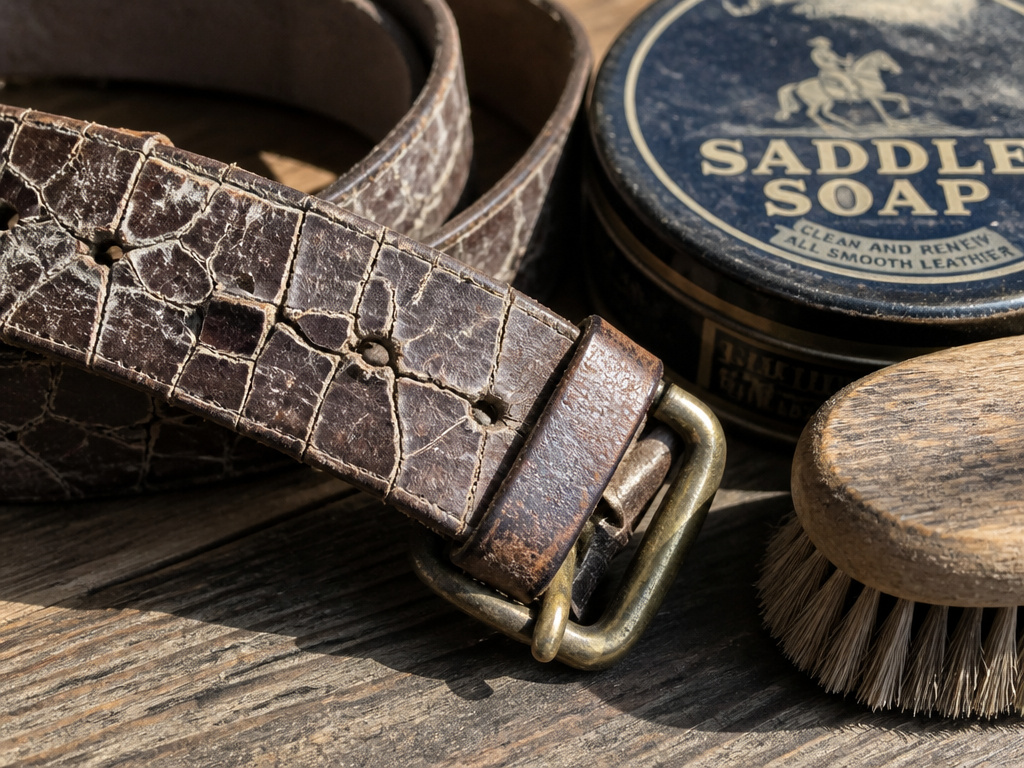
Most leather care advice is about adding something. The real damage often comes from taking something away, or from creating the wrong environment.
Using Saddle Soap as a Cleaner
Saddle soap is for saddles, thick, oil-rich harness leather designed for work. On a dress shoe, wallet, or bag, it’s too aggressive. It strips away the leather’s natural oils and the fatliquors added during tanning. The leather is left clean, dry, and hungry. It will absorb the next thing you put on it too fast, often unevenly. I’ve seen belts turn into cardboard strips after a few overzealous cleanings.
Storing in Hot, Dry Places
This is the single most damaging habit. An attic in summer or a spot near a heating vent creates the perfect conditions for rapid moisture loss. The leather doesn’t just dry; it heat-ages. The fibers undergo a partial denaturation, setting in a shrunken, stiff state. A wallet left on a car dashboard for a season will be a goner.
Over-Conditioning in Panic
Seeing a dry spot, many people douse it in conditioner. This creates a saturated, gummy area that attracts dirt and blocks the leather’s breathability. The surrounding, still-dry areas then pull moisture from the oversaturated spot, creating internal stress. Condition like you’re making a roux: low, patient heat and the right fat, built up in thin layers with time to absorb in between.
Common mistake: Stacking heavy leather items in a closet. The weight creates permanent pressure marks and creases, which become the starting points for cracks when the leather dries out. Store bags stuffed with acid-free paper and shoes with cedar shoe trees.
How to Test Your Leather’s Health
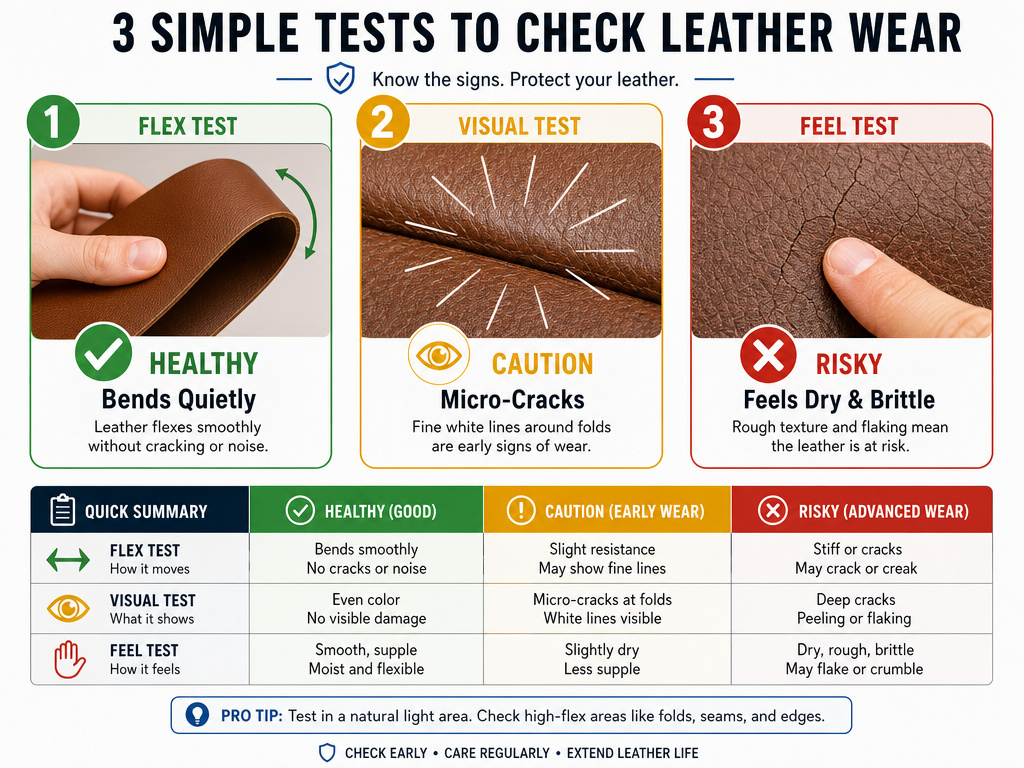
You don’t need a lab. Your hands and eyes are good enough tools. Run through this quick check before you decide on a treatment plan.
- The Flex Test: Gently bend the leather in an area that doesn’t normally get flexed, like the back of a bag or the inside of a strap. Listen and feel. Healthy leather bends silently with a soft resistance. Leather on the verge of cracking will feel stiff, and you might hear a faint, dry creaking sound, the sound of dry fibers resisting each other.
- The Visual Crease Check: Look at the primary crease or bend point (the toe of a shoe, the folded flap of a bag). Bend it open gently. Do you see many fine, white lines running parallel to the crease? Those are micro-cracks in the grain, the first visible sign. A deep, single crack is a later-stage failure.
- The Surface Feel: Run your finger across the grain. Does it feel dry and rough, like paper? Or does it have a slight, waxy suppleness? Now press the leather between your fingers. Can you feel a slight give, or is it rigid? Rigidity means the moisture is gone.
| Test | Healthy Leather | Leather at Risk |
|---|---|---|
| Flex Test | Bends quietly, soft resistance | Stiff, faint creaking sound |
| Crease Check | Smooth bend, no white lines | Fine white lines parallel to crease |
| Surface Feel | Slight waxy suppleness, some give | Dry, rough, rigid |
If your item fails two of these, it’s time for intervention, not just conditioning, but a reassessment of its storage environment.
The Right Way to Prevent Cracks
Prevention is about managing the environment and applying the right stuff at the right time. It’s a system, not a one-time task.
Control Humidity, Not Just the Leather
Aim for a stable relative humidity between 40% and 50% in your storage space. Avoid places with wild swings, next to a frequently opened window or a heat vent. For a single precious item like a vintage bag, a simple sealed plastic tub with a Boveda humidity control pack is a far better investment than an expensive conditioner.
Use the Correct Conditioner for the Job
For general maintenance of top grain leather items like jackets and bags, a light, absorbent conditioner like Lexol Leather Conditioner works. For dense, vegetable-tanned belts and saddles, a heavier oil-based product like Obenauf’s Leather Oil is appropriate. The key is to match the conditioner’s viscosity to the leather’s porosity.
Support and Store Properly
Never let leather slump under its own weight. Use cedar shoe trees for shoes, they absorb moisture and hold the shape. Stuff bags with acid-free tissue paper or a pillow. Hang jackets on broad, padded hangers. This prevents sharp, permanent creases that become crack incubators.
Clean Gently
For dust, use a soft horsehair brush. For light stains, a barely damp microfiber cloth is enough. Reserve saddle soap for the thickest, oiliest work gear. For everything else, less is more. You can always clean a little more; you can’t un-strip a fiber.
Frequently Asked Questions
Does cracked leather mean it’s fake?
Not necessarily. While low-quality bonded leather can crack and peel easily, even high-quality full grain vs genuine leather can crack if severely neglected. The location and pattern of the crack often tell you more than its mere presence.
Can you fix already cracked leather?
You cannot truly repair a deep crack. The separated fibers are broken. You can, however, mask it and prevent it from spreading. Specialized leather fillers and dyes can blend the crack visually, and heavy conditioning of the surrounding area can restore some flexibility to stop the propagation. For a valuable item, consult a professional restorer.
Does conditioner prevent cracking?
Conditioner mitigates cracking by replacing some of the lost oils that lubricate the fibers. It is not a force field. If the leather is stored in a 0% humidity attic, conditioner will lose the battle. Think of conditioner as part of a system that includes proper humidity and storage.
Why does my new leather crack?
This is a red flag. It often points to poor-quality leather that was improperly tanned or fatliquored. The leather may have left the tannery too dry, or with unstable coatings. It could also be a sign of corrected grain leather where a heavy topcoat has restricted the natural flex of the grain beneath.
The Bottom Line
Leather cracks because it dries out. That’s the core of it. All the conditioners in the world are just a holding action against a bad environment.
If you take one step this week, make it this: move your favorite leather bag or jacket out of that dry closet corner or sunny room spot. Put it somewhere with stable, moderate humidity. That single change does more long-term good than the most expensive balm applied in a desert.
Understand that vegetable-tanned leather pros and cons include a need for more attentive humidity control, while chrome-tanned pieces might fail differently. The leather will tell you what it needs, your job is to listen for the creak, spot the white lines, and feel for that unsettling rigidity before the first crack even appears.
