
How to Identify Full Grain Leather | The Microscope Method
This post contains affiliate links. As an Amazon Associate, we earn from qualifying purchases.
This post contains affiliate links. As an Amazon Associate, we earn from qualifying purchases.
To identify full grain leather, you need a microscope. Official standards like FILK-QMA-1201 define it as “not corrected” leather where the natural grain’s porous structure remains intact under 200x magnification after finish removal. Corrected grain shows removed top layers. Short of a lab, your best at-home clues are uneven natural pores you can feel, a water drop that absorbs within 30 seconds on unfinished leather, and a smell of warm leather, not plastic.
Let me share what I’ve learned. The label “full grain” is a structural claim, not a promise of tightness or durability. It describes a hide where the outermost layer hasn’t been sanded or buffed away. That matters because the grain is the hide’s toughest, most breathable part, and the only layer that develops a deep patina. Without a microscope, you’re identifying by process of elimination, spotting the tells of correction, not the perfection of the grain.
Here’s a straightforward guide that skips the marketing fluff. This guide explains the official lab method, the simple tests you can do anywhere, and the exact physical clues that separate the real thing from a buffed and printed imitation. By the end, you’ll be able to read the leather itself, not the tag.
Key Takeaways
- A loupe or microscope is the only definitive tool. Full grain means uncorrected grain; the official test uses 200x magnification to see intact hair follicle openings.
- Your fingers don’t lie. Real full grain feels subtly uneven, with natural pore variation you can catch a fingernail on. Perfectly smooth, uniform surfaces are machine-made.
- Water tells a story. A drop on the unfinished flesh side absorbs in under 30 seconds for vegetable-tanned full grain; plastic-coated leather beads it up.
- “Pebble grain” isn’t a guarantee. Many heavily textured leathers are corrected grain that’s been embossed with a pebble pattern.
- Patina is the long-term proof. Only full grain develops a rich, deep color shift with use. Corrected grain’s color sits on top and scratches off.
The Only Lab Standard That Counts
Forget “highest quality” or “most durable.” The leather industry’s own technical papers define full grain by what it isn’t: corrected.
The FILK-QMA-1201 standard operation procedure is the go-to method for tanneries and testing labs. It defines “full grain” as “not corrected” leather. The natural, porous grain structure must be clearly visible after the finish is chemically removed without damaging the leather underneath. Slight scars or bug bites from the animal’s life don’t count as correction, those are part of the story. Correction means the top layer has been mechanically abraded, usually with a sanding wheel, because the natural grain was too marred or inconsistent for the product.
Under 200x magnification, technicians look for sickle-shaped pellicles and the complete, curved walls of hair follicle openings. Corrected grain shows these openings as tapered where material was removed, and the boundary between the finish and the grain layer is often blurry because finish soaks into the abraded surface.
This is a measurement, not a visual guess. A thin grain layer paired with a thick finish coating is a red flag.The standard exists because before its development, about half of all assessments were uncertain, removing the finish often damaged the leather, making it impossible to tell if the damage was from the test or the original buffing.
So when a brand says “full grain,” they are making a specific, verifiable claim about the hide’s surface. The problem is you need a lab to verify it. The rest of this guide is about building a case from evidence you can actually gather.
The 3-Step Touch & Sight Test
You don’t have a lab-grade microscope. That’s fine. You have hands, eyes, and a brain built to detect patterns. This three-part check uses physical clues to spot correction, which is how you identify full grain by elimination.
First, run your fingertip across the surface. Close your eyes. Full grain leather has a living topography. You’ll feel the gentle rise of natural grain peaks and the tiny valleys of pores. It’s never perfectly smooth like a smartphone screen. Now, gently drag a fingernail across it. You should feel a subtle, uneven catch, the nail will snag on the larger pores. A corrected grain surface, especially one with a heavy pigment or plastic coating, feels like a painted tabletop. Your nail glides.
Second, look for a brand like Horween or Wickett & Craig.** Find an edge or a seam. Examine the cross-section. You’re looking for layers, like a cake. Full grain will show a dense, tight grain layer on top, often slightly darker, then a transition to the fibrous middle layer (the corium). Corrected grain might show a very thin, pale top layer or, in severe cases, a visible line where a polymer coating sits on top. The flesh side (the back) is a giveaway. Full grain’s flesh side is a soft, fibrous suede. Corrected grain often has a fabric backing or a uniform, paper-like feel glued on to stabilize the sanded hide.
Third, check for the “too perfect” pattern. Leather is skin. Skin has unique patterns of pores, like a fingerprint. If you see a perfectly repeating pebble, ostrich, or crocodile pattern, that’s an embossing plate. It’s a decorative finish applied to leather, often corrected grain leather. A true full grain with a natural pebble texture (like on a football) will have variations in the size and depth of the pebbles across the surface.
What Your Nose and a Drop of Water Know
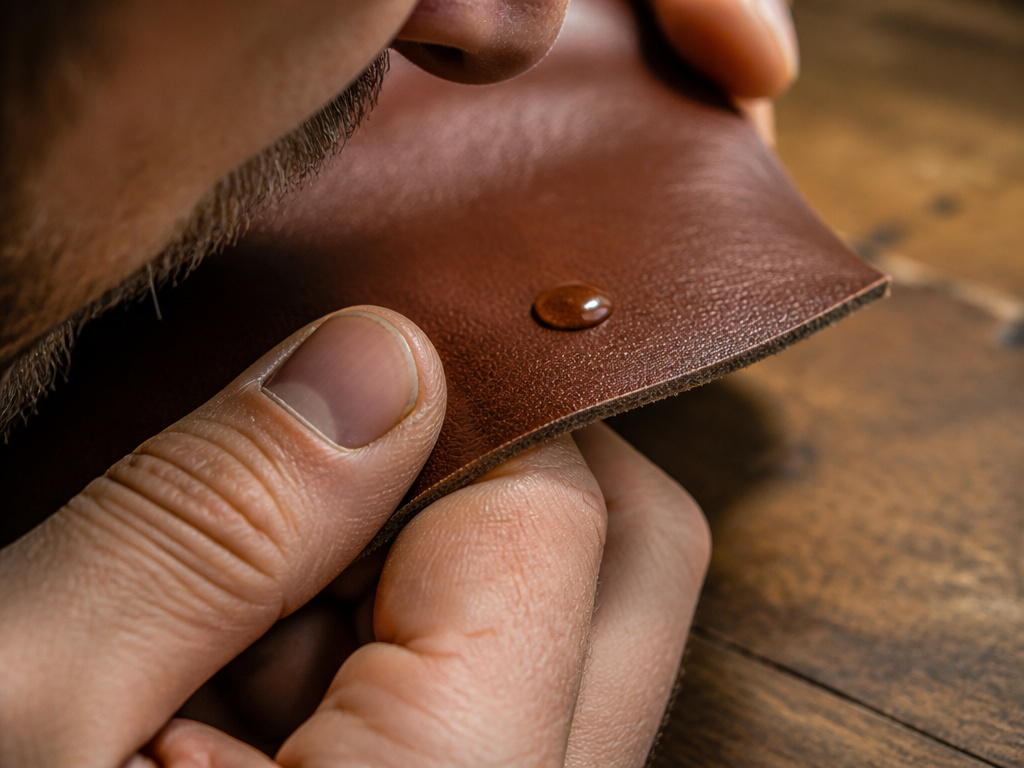 Science happens at the molecular level. Two simple tests, smell and water absorption, probe the chemistry of the surface in a way your eyes can’t.
The smell test is immediate. Bring the leather close to your face and take a deep breath. Full grain, especially vegetable-tanned, smells warm, rich, and organic, like a tack room or a woodshop. It’s the smell of tannins and natural fibers. Corrected grain that’s been coated with a heavy acrylic or polyurethane finish smells like plastic, paint, or vinyl. There’s a flat, chemical note that overpowers any leather scent. Your nose is detecting the polymer topcoat.
The water drop test is about porosity. This test is best performed on the unfinished flesh side or a protected edge to avoid damaging the item. Place a single drop of water on the surface. * On vegetable-tanned full grain, the drop will darken the spot and be fully absorbed within 20-30 seconds. The leather is breathing. * On chrome-tanned full grain, absorption might be slightly slower but still happens within a minute or two. * On heavily corrected and coated leather, the water will bead up like on a waxed car and sit there. After five minutes, you can wipe it away, and the surface will look unchanged. The plastic coating has sealed the pores.
Common mistake: Judging leather by its finish. A beautiful, uniform aniline dye on top of full grain leather can look similar to a thin pigment on corrected grain. The difference is underneath. The finish should enhance the grain, not create it.
The Tools That Don’t Lie (And One That Does)
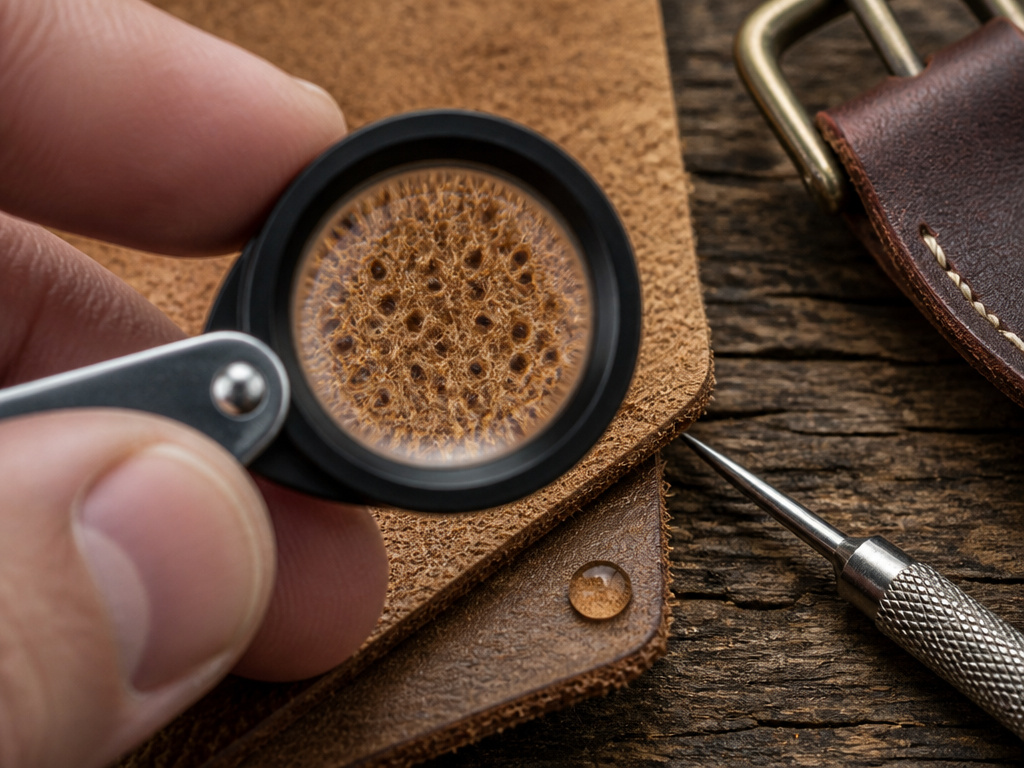 You can upgrade your inspection from fingers to a few inexpensive tools that get you closer to the truth.
**A jeweler’s loupe (10x to 30x magnification) is your best friend.For under twenty dollars, it changes how you conduct a sight test. Look for the hair follicle openings. In full grain, they look like tiny, deep craters with distinct, curved walls. In corrected grain, they appear shallower, wider, or smeared, as if the edges were sanded down. You’re looking for the loss of that sharp, three-dimensional structure. It won’t be 200x, but it’s enough to see the difference between natural texture and a sanded, printed one.
A simple metal probe or a stout pin (used gently) can test surface hardness. Press the blunt end firmly into an inconspicuous spot. Full grain leather will depress slightly and spring back, showing its density. A heavily coated corrected leather might show no give, or worse, the coating might crack or flake. This is a destructive test, only do it if you’re willing to risk a small mark, like on the inside of a belt.
| Tool | What It Reveals | Red Flag Result |
|---|---|---|
| Jeweler’s Loupe | Integrity of hair follicle openings. | Openings are shallow, wide, or missing; a perfectly repeating pattern. |
| Metal Probe | Density and coating integrity. | No indentation (plastic-like) or coating cracks/flakes under pressure. |
| Fingernail | Surface texture and grain relief. | Nail glides perfectly smooth; no microscopic catch. |
| Water Drop | Porosity and finish penetration. | Water beads and doesn’t absorb after 2+ minutes on flesh side. |
Ignore the “genuine leather” stamp. Here’s the practical takeaway. This term is the most misunderstood in the industry. Legally, it just means the product contains some real leather. That leather could be a beautiful full grain strip or a paper-thin layer of heavily corrected suede glued to a fabric backing. It is not a grade or a measure of tannage quality. Relying on it is how you buy a wallet that falls apart in a year. The FTC leather labeling guides require disclosure if a product isn’t all-leather, but they don’t define quality tiers.
Full Grain in the Wild: A Case Study
Let’s apply this to something real. I compared a worn-in Wilson NFL Official football to a brand-new one under a loupe.
The leather on these balls is a specific, tight pebble grain. On the new ball, each pebble was sharp and distinct. On the ball used for a full season, the pebbles in the primary grip areas were visibly polished smooth and flattened from thousands of hand contacts. The grain had worn, but it hadn’t been removed, it had transformed. This is a key point. Full grain changes character with use; it doesn’t delaminate or have its color rub off because the dye penetrates the grain layer. A corrected grain leather football would show the colored coating wearing away to reveal a paler, different layer beneath.
This wear pattern is a form of patina, and it’s unique to the top grain layer. When you’re looking at an older bag, jacket, or belt, check the high-wear areas like edges and straps. Is the color changing evenly and getting richer, or is it fading and rubbing off to something lighter? The former suggests full grain; the latter screams a surface coating on a corrected or split leather base.
When the Grain is Gone: Corrected & Embossed Leather
Understanding what full grain isn’t completes the picture. Corrected grain leather has had its surface sanded or buffed to remove imperfections. A new, uniform surface is then created on top. This is often a two-step process: first a base coat of pigment to even out the color, then an embossing plate is heat-pressed into the surface to imprint a pattern, maybe that pebble grain, maybe an exotic look like ostrich.
Where this goes sideways: Buying a “pebble grain leather” bag assuming it’s full grain. Most are corrected grain embossed. The pattern is perfect and repeats every few inches. Real, natural pebble grain varies across the hide.
This leather is often more consistent, cheaper, and can be very durable. However, it is a different material with different aging characteristics.The process of corrected grain leather creates a sealed surface. It won’t absorb conditioners well, and it won’t develop a patina. It will eventually crack when the coating fails, unlike full grain, which simply wears thinner.
This is why the full-grain vs top-grain leather distinction matters. “Top grain” includes both full grain and corrected grain. It’s a broader category. A label saying “top grain” tells you it’s the top layer of the hide, but it doesn’t tell you if that layer is intact or has been re-surfaced. You need your tests to know.
The Long-Term Giveaway: Patina vs. Wear
The final, most reliable test happens over months and years. Full grain leather ages. Corrected grain leather deteriorates.
Put simply, full grain integrates wear into its character. A scratch can often be rubbed with your thumb to lessen its appearance, as the oils redistribute. The color deepens and becomes more complex because you’re seeing light interact with the dyed fibers beneath the surface. It tells the story of its use.
Corrected grain suffers wear. A scratch goes through the printed topcoat and reveals a lighter layer underneath. It looks damaged, not seasoned. The color doesn’t evolve; it just fades or gets scuffed off. There’s no depth to develop.
If you’re looking at a second-hand item and wondering, ask: does this look loved, or just used up? The difference is usually in the grain.
Frequently Asked Questions
Is full grain leather always the best?
No. “Best” depends on the use. Full grain is best for durability, breathability, and developing a patina. For a uniform, colorful, stain-resistant, or budget-conscious item, a well-made corrected grain or even a high-quality synthetic might be the better choice. It’s about matching the material to the need.
Can you identify full grain leather by price?
Not reliably. A high price can reflect branding, craftsmanship, or exotic materials, not just leather quality. Conversely, some excellent full grain leather goods are affordably priced by direct-to-consumer brands. Use price as a signal, not proof. The practical leather quality testing methods matter more.
Does full grain leather scratch easily?
It marks easily, but it doesn’t scratch like plastic. Surface scuffs on full grain are often just displaced oils and waxes in the top layer; they can be minimized by rubbing the area. Deep scratches are permanent, but they become part of the leather’s character. A scratch on corrected grain is often a permanent color loss.
Is pebbled leather always full grain?
Almost never. The vast majority of pebbled, ostrich, crocodile, or other textured leathers on the market are corrected grain leather that has been embossed with a pattern. True full grain with a natural pebble texture exists but is rare and will show natural variation, not perfect repetition.
Before You Go
Ignore the marketing copy. The leather will tell you what it needs, and what it is.
Start with your hands. The next time you’re in a store looking at a leather item, run the touch test. Feel for that living, uneven texture. Find a seam and examine the edge. Look for a single, consistent layer of leather. That simple act will teach you more than a hundred product descriptions.
If you take one thing from this, let it be this: full grain is a structural fact, not a promise of perfection. It’s defined by an untouched grain layer, verified by a research institute leather analysis standard. Your job is to gather the physical evidence, the sight, the feel, the smell, the absorption, and build your case. The difference between that and a sanded, printed substitute is the difference between a piece that gets better with age and one that just gets old.
