Derby vs Oxford Shoes | The Lacing System That Defines Them
This post contains affiliate links. As an Amazon Associate, we earn from qualifying purchases.
The difference between derby and oxford shoes is one specific construction detail: the lacing system. Oxfords have a “closed” system where the eyelet panels are stitched under the vamp, creating a sleek, fixed V. Derbys have an “open” system where the panels are stitched on top of the vamp, creating adjustable flaps. This dictates their formality, oxfords are more formal, and fit, as derbys accommodate higher insteps and wider feet more easily.
Let me share what I’ve learned. That single stitch line placement changes everything about the shoe’s character, its lifespan, and who it fits well. Most guides stop at “oxfords are formal, derbys are casual,” but that’s surface-level. The real story is in the tension between elegance and accommodation, between a rigid ideal and the reality of human feet.
What follows is a breakdown of that lacing system, why it dictates construction choices like the Goodyear welt, and how to match each style to your wardrobe and your foot shape. You’ll be able to spot the difference from across a room and know exactly what you’re buying.
Key Takeaways
The lacing system is the only essential difference: oxfords have closed lacing (panels under the vamp), derbys have open lacing (panels on top). – Fit dictates choice more than fashion: if you have a high instep or wide foot, a derby’s open system will almost always be more comfortable than an oxford. – Construction trumps leather grade: a well-made derby with a Goodyear welt will outlast a cheaply cemented oxford, regardless of the leather’s marketing claims. – “Formality” is a spectrum you control: a plain cap-toe oxford is for boardrooms, but a heavily brogued derby in suede is firmly casual. – Ignore “genuine leather” labels: focus on the construction method (welted vs. Cemented) and leather type (full-grain, calf) listed in the spec sheet.
What is the single defining difference?
This isn’t about looks. It’s about architecture. The entire identity of an oxford or derby shoe hangs on one mechanical decision: where the shoemaker attaches the quarters, the pieces with the eyelets, to the vamp, the main body of the shoe.
The single, non-negotiable characteristic of an Oxford shoe is its closed lacing system. On an Oxford, the pieces of leather where the eyelets are punched are sewn underneath the vamp. On a Derby, these eyelet facings are stitched on top of the vamp, creating flaps.
That’s the atomic fact. Everything else, formality, fit, style variations, flows from this structural choice.
Closed Lacing (Oxford): The quarters are sewn under the vamp. This creates a continuous, sleek silhouette with a tight, narrow “V” when laced. The opening is fixed and minimal.
Open Lacing (Derby): The quarters are sewn on top of the vamp. This creates visible seams and flaps that can be opened wide. The “V” is broader and more adjustable.
Why does this stitch matter so much? It dictates the shoe’s flexibility. A closed system is rigid and elegant, hugging the foot in a predefined shape. An open system is accommodating, allowing the flaps to spread apart to let a foot in that doesn’t match the last perfectly. This is why the derby is often recommended for beginners buying quality leather dress shoes online, it’s simply more forgiving.
The Lacing System: A Visual and Functional Divide
Let’s be clear about this. You can’t unsee this difference once you know it. It’s the first thing I look for, and it tells me more about the shoemaker’s intent than any brand name.
Spotting an Oxford: The Sleek, Fixed “V”
Look at the front of the shoe where the laces are. Trace the leather strip with the eyelets down to where it meets the toe section. On an oxford, that strip disappears beneath the main leather of the shoe. The seam is horizontal and hidden. The resulting laced-up face is neat, uninterrupted, and forms a sharp, narrow V. It looks like one continuous piece of leather from toe to ankle.
This closed throat is restrictive by design. It’s meant to create a clean, formal line. The downside is immediate if your foot doesn’t conform: pressure on the instep, tightness across the top, and a break-in period that can feel more like a negotiation. This rigid structure is why the finest men’s dress shoes in the oxford style often use a supportive leather insole and a snug last.
Spotting a Derby: The Adjustable, Open Flaps
Now, look at a derby. The eyelet panels are sewn on top of the vamp. You’ll see a vertical seam on each side where the flap attaches. When the laces are loose, these flaps can be pulled wide apart, you could fit a fist in there. When laced, they form a wider, more relaxed V.
That adjustability is the whole point. It accommodates a higher instep, a wider forefoot, or simply the need for a less constrictive feel. The open lacing system is why boots and more casual leather shoes for men frequently use this construction. It’s practical. The visual trade-off is a busier, less streamlined silhouette, which is why it reads as less formal.
| Feature | Oxford (Closed Lacing) | Derby (Open Lacing) |
|---|---|---|
| Eyelet Panel Attachment | Stitched underneath the vamp | Stitched on top of the vamp |
| Silhouette When Laced | Narrow, tight “V”; sleek and continuous | Wider, more open “V”; visible seams and flaps |
| Adjustability | Low; fixed opening | High; flaps can spread wide |
| Best For | Standard to low-instep feet; maximum formality | High insteps, wider feet, or preference for easier on/off |
| Visual Formality | Higher (clean, minimalist) | Lower (more detail, seams) |
Formality & Style: How Lacing Dictates the Dress Code
The lacing system sets the base formality, but it’s not the whole story. Think of it as the chassis. The body style, the toe decoration, leather, and color, is built on top. A derby can be dressed up, and an oxford can be dressed down, but they start from different points on the spectrum.
Oxford Styles: Built on a Formal Foundation
Because the oxford begins with that sleek, closed base, its styles are variations on a formal theme. The plainer the toe, the more formal the shoe.
- Wholecut Oxford: The pinnacle. Made from a single piece of leather with only one seam at the back. The absence of seams maximizes the clean, formal look the closed lacing system creates. It’s often seen in black-tie settings.
- Cap-Toe Oxford: The workhorse. A separate piece of leather (the “cap”) is stitched over the toe. This is the default business shoe. The cap adds a slight visual break but maintains a crisp line. A black cap-toe is the most versatile leather dress shoes for men for interviews and suits.
- Plain-Toe Oxford: No toe cap, but still made from multiple pieces. Slightly less formal than a cap-toe but still firmly in the business and smart-casual range. A brown plain-toe is a great bridge shoe.
- Brogue Oxford: Here, decorative perforations (broguing) are added to the cap-toe or plain-toe pattern. The broguing adds visual interest and reduces formality. A “quarter-brogue” (perforations along the cap seam) is still office-appropriate; a “full-brogue” (wingtip pattern) leans casual.
Where this goes sideways: Assuming all oxfords are equal. A full-brogue wingtip oxford in tan suede is a country casual shoe, not a boardroom shoe. The lacing is formal, but the style details override it.
Derby Styles: Inherently Flexible
The derby’s open lacing gives it a casual foundation. Its styles often embrace more texture, color, and decorative elements.
- Plain-Toe Derby: A clean, versatile casual shoe. In smooth calf leather, it can work with chinos and a blazer. In grainy leather or suede, it’s firmly weekend wear.
- Brogue Derby: The most common type. The open lacing pairs naturally with the decorative broguing. A wingtip derby (a “longwing” if the wing extends to the heel) is a classic smart-casual staple. This is where you’ll find some of the most comfortable and characterful options among best men’s leather shoes.
- Boot Derivatives: Most lace-up boots (like the classic six-eyelet boot) use a derby construction because the open flaps are essential for getting your foot in and out and adjusting for thicker socks.
The short version: Start with the lacing to gauge base formality, then let the toe style and material finish the job. A plain oxford is always more formal than a brogued derby.
Construction & Fit: Why the “How” Matters More Than the “What”
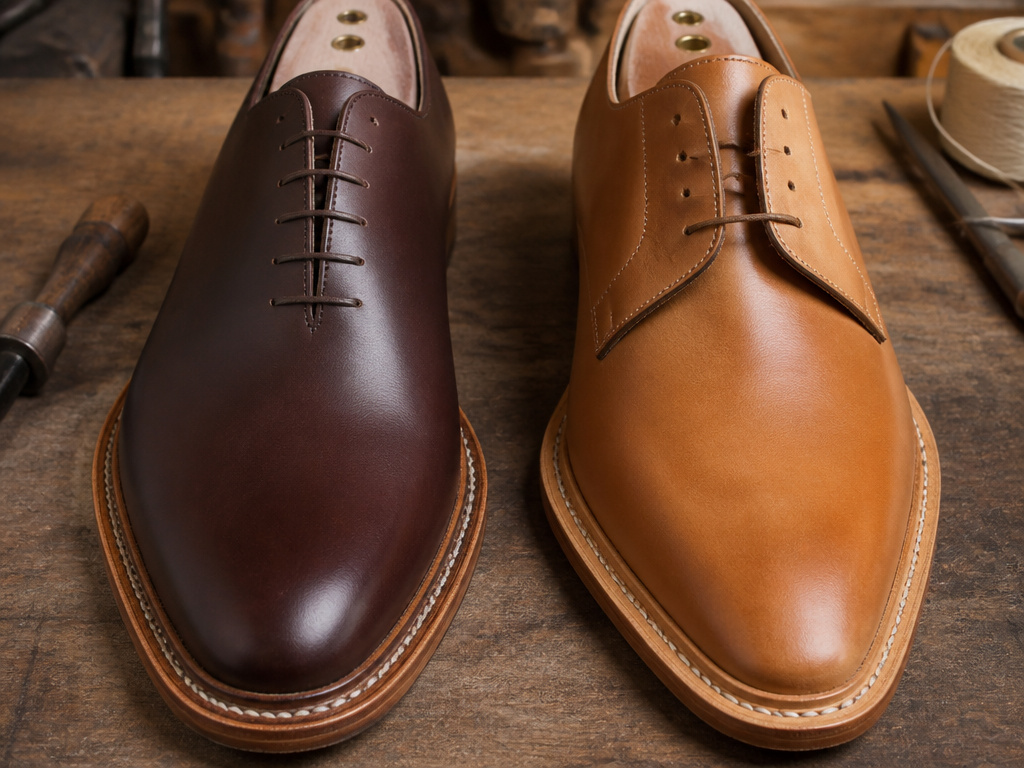
Here’s the thing. You can find both oxfords and derbys built with cheap cemented construction or durable welted construction. The style name doesn’t guarantee quality. The construction method does.
Goodyear Welt vs. Blake Stitch: The Longevity Game
Most quality dress shoes use one of two main construction methods. This is where your money should go.
- Goodyear Welt: A leather strip (the welt) is stitched to the insole and the upper. The outsole is then stitched to the welt. This creates a cavity that can be filled with cork, which molds to your foot. It’s durable, water-resistant, and, crucially, resoleable. Both oxfords and derbys from brands like Barker and Cheaney use this. It’s an investment.
- Blake Stitch: A single stitch runs directly through the insole, upper, and outsole. It creates a sleeker, closer-to-the-ground profile and is often more flexible out of the box. It’s also resoleable, but by a specialist. Many Italian-made shoes use this.
I stopped using aerosol leather paints after they created a plasticky, non-breathable layer that cracked on a pair of boots. That same principle applies to shoe construction. A cemented sole, where the outsole is just glued on, is the “aerosol paint” of footwear. It’s a disposable shortcut. When it fails, the shoe is trash. A welted shoe is built for decades.
Fit Implications: Matching Shoe to Foot
The lacing system directly impacts fit, and it’s the main reason to choose one over the other.
- Choose an Oxford if: You have a standard or low instep and a relatively narrow to medium foot. The closed system provides a secure, locked-in feel. It’s the choice when the priority is a sharp, elegant silhouette.
- Choose a Derby if: You have a high instep, a wide forefoot, or simply value easy adjustability. The open flaps provide relief and space. This is my straightforward advice for anyone new to quality footwear or with fit concerns.
This is why trying on both styles is non-negotiable. Your foot will vote immediately. A tight oxford isn’t something you just “break in”; it’s a mismatch. A proper break in leather shoes process should be about softening leather, not reshaping your bones against an ill-fitting last.
Derby vs Oxford: A Direct Comparison by Use Case
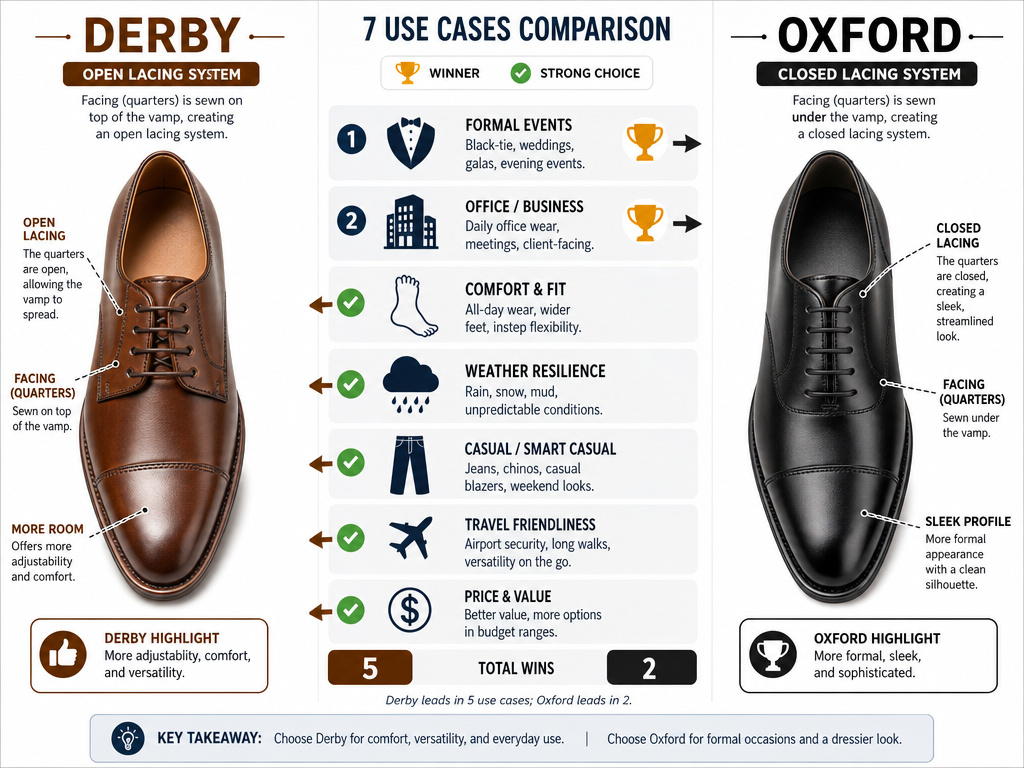
Let’s commit. Which one wins, and when? This isn’t a “depends on your needs” cop-out. A real recommendation picks a winner per scenario.
| Use Case / Priority | Winner & Why |
|---|---|
| Black-Tie Event / Wedding | Oxford. The closed lacing is the formal standard. A plain or wholecut oxford in polished black is correct. |
| Daily Business Suit (Office) | Oxford. A cap-toe oxford in black or dark brown is the professional uniform. It projects polish. |
| Smart Casual / Blazer & Chinos | Tie. A plain-toe derby in brown or a brogue derby in suede works perfectly. A less-formal oxford (like a brogue) can also work here. |
| High Instep or Wide Feet | Derby. No contest. The open lacing system is mechanically better suited to provide comfort and accommodate volume. |
| First Quality Dress Shoe Buy | Derby. The fit forgiveness of the open system makes it a safer purchase if you’re unsure of your exact fit in a brand’s last. |
| Maximum Versatility | Derby. A dark brown plain-toe derby can bridge smart casual and business-casual settings more easily than an oxford of similar style. |
| Long-Term Value & Resoleability | Neither. This is a construction win. Prioritize a Goodyear-welted shoe in either style over a cemented one. |
Common Misconceptions and Mistakes to Avoid
The noise around dress shoes is loud. Let’s untangle some of it.
Common mistake: Choosing based solely on “oxford = formal, derby = casual.” This misses the fit component entirely. A painful, ill-fitting oxford you never wear is less “formal” than a sharp, comfortable derby you own and shine regularly.
Myth 1: “Genuine Leather” means high quality. In footwear marketing, “genuine leather” is a specific, low-grade classification (a split leather with a polyurethane coating). It tells you nothing good. Look for terms like full-grain leather or calfskin in the specifications of your quality leather shoes.
Myth 2: Hand-stitched is always better. Hand-stitching in the welt is a mark of artisanal quality. But hand-stitching on the upper can be inconsistent. A precise, strong machine stitch with bonded nylon thread is often more durable for seams that bear stress.
Myth 3: You need different shoes for every outfit. You don’t. You need a system. A black cap-toe oxford and a brown plain-toe derby will cover 90% of a man’s shoe needs. Invest in care, proper leather shoe care with the right products and regular polish leather shoes sessions, and those two pairs will outlast a closet full of neglected, cheap shoes.
Frequently Asked Questions
Can derby shoes be formal?
Yes, but with limits. A plain-toe derby in sleek, dark calf leather with minimal broguing can work in business-casual and some business-formal environments. However, for strict business formal (dark suit, tie) or black-tie events, an oxford remains the correct and expected choice. The derby’s open lacing inherently introduces a visual detail that reduces formality.
Why are oxfords considered more formal?
The closed lacing system creates a clean, minimalist, and uninterrupted silhouette that aligns with formalwear’s principles of restraint and uniformity. It presents a smooth, controlled appearance. The derby’s open flaps and visible seams introduce visual complexity and a sense of practicality, which codes as less formal.
Which is better for wide feet?
Derby shoes are almost always better for wide feet or high insteps. The open lacing system allows the quarters to spread apart independently of the vamp, providing more adjustable width and volume across the top of the foot. An oxford’s closed system has a fixed, non-adjustable opening that can create painful pressure points.
Are all lace-up dress shoes either derby or oxford?
For men’s classic footwear, essentially yes. The lacing system is the primary differentiator. However, there are niche variations like the “Blucher” (a specific type of open-laced shoe often used in American military parlance) and the “Monk Strap” (which replaces laces with a buckle). But if it has laces, it will use either a closed (oxford) or open (derby) system.
How should I care for my derby or oxford shoes?
The care is identical and based on construction and leather, not lacing style. Use shoe trees to absorb moisture and maintain shape. Clean with a damp cloth. Condition with a quality cream (like Saphir Médaille d’Or) to nourish the leather. Polish with wax-based polish for protection and a shine leather shoes finish. Always store leather shoes in a cool, dry place away from direct heat.
What is a “Gibson” shoe?
Gibson is a specific style of derby where the facing (the eyelet panel) is made from the same single piece of leather as the vamp. It creates a particularly clean look for an open-laced shoe. It’s a subtype, not a third category.
Before You Go
So, the derby vs. Oxford debate isn’t about which is objectively better. It’s about matching a tool to a task. The oxford is a precision instrument for formal occasions and standard feet. The derby is the adaptable, reliable workhorse for daily wear and difficult fits.
Your first filter should always be your foot. Let comfort guide the lacing system choice. Your second filter should be the construction. Let the welt guide your budget. The style, cap-toe, brogue, plain-toe, is the final, personal touch you layer on top of a sound foundation.
Choose the one that fits, built in a way that lasts. Everything else is just decoration.
