
Learn What the Leather Tanning Process Is and How It Works
This post contains affiliate links. As an Amazon Associate, we earn from qualifying purchases.
The leather tanning process is a series of chemical and mechanical steps that stabilize raw animal hides, mostly collagen protein, by bonding tanning agents (like chromium salts or vegetable tannins) to the collagen fibers. This prevents bacterial decay and adds desirable properties like water resistance and flexibility.
That definition gets you the headline. The real story is in the pivots. A hide fresh from an animal is a biological time bomb. Without intervention, it will rot in days. Tanning steps in and rewrites the chemistry, moving the collagen from a perishable state to a permanent one. It’s not just preservation. It’s transformation.
What follows: the three-stage breakdown of beamhouse, tanyard, and finishing; the two dominant chemical methods and why you’d pick one; and the final steps that turn a tanned hide into usable leather.
Key Takeaways
- Beamhouse operations are about cleaning, not tanning. They remove everything non-collagen, preparing the hide for the chemical reactions that follow.
- Pickling is a mandatory step for chrome tanning, creating the acidic environment chromium needs, but it’s optional for vegetable tanning.
- Chrome tanning uses chromium(III) ions to form strong cross-links with collagen, making a soft, water-resistant leather used in 90% of shoes and garments.
- Vegetable tanning uses plant polyphenols that bond to collagen via hydrogen bonding, resulting in a stiffer, malleable leather favored for saddles and belts.
- The tanned, semi-finished state after chrome tanning is called “wetblue”, it’s stable, but still needs color, oils, and surface treatments to become finished leather.
The Core Goal: Stop the Rot, Start the Life
If you’ve ever left raw meat out, you know the timeline. Decay starts fast. A raw hide is a thick slab of protein and fat, and without preservation, it will putrefy within a week.
Tanning stops that clock. But drying isn’t enough. Simply drying a hide gives you rawhide, brittle, inflexible, and still susceptible to moisture damage. True tanning alters the collagen protein at a molecular level, locking the fibers into a new, stable configuration that resists bacteria, heat, and water. A properly tanned hide can even withstand boiling water. This isn’t just about making something last; it’s about creating a new material with its own set of properties.
The Three-Stage Framework: Beamhouse, Tanyard, Finishing
Most guides list eight or ten steps. That’s fine, but it misses the architecture. Every tannery, from a small artisanal shop to a massive industrial plant, follows a three-stage logic. Get this framework, and the individual steps slot into place.
Stage 1: The Beamhouse (Pretanning Preparation)
The beamhouse is where the hide gets stripped down to its collagen skeleton. No tanning happens here. Its sole job is to remove everything that isn’t collagen: dirt, blood, salt, hair, fat, and non-structural proteins.
This stage generates the most waste. According to the EPA, beamhouse processes can account for 40 percent of a tannery’s wastewater volume and 60 percent of its pollutant load. That’s a clue to its intensity.
Common mistake: Thinking liming or unhairing is part of the tanning. They’re just aggressive cleaning steps to expose the collagen fibers for the chemicals that follow.
The sequence usually runs: 1. Soaking: The preserved hide is rehydrated in water for 8-20 hours, washing out salt, blood, and dirt. 2. Fleshing: A machine with rotating blades scrapes excess flesh and fat from the flesh side. This trim is often recycled. 3. Liming & Unhairing: The hide is soaked in an alkaline bath of lime and sulfide. This swells the hide, dissolves the hair and epidermis, and breaks down some proteins. 4. Deliming & Bating: The alkaline hide is neutralized. Enzymes are added to digest remaining hair roots and pigments, leaving the collagen soft and clean.
Stage 2: The Tanyard (The Chemical Transformation)
This is where the actual tanning, the chemical stabilization, occurs. The cleaned hide meets the tanning agents. The two main chemical paths are chrome tanning and vegetable tanning, and the journey diverges here based on the method chosen.
Stage 3: Finishing (From Stable to Usable)
A tanned hide is now rot-proof, but it’s not yet leather you’d want to use. This stage is about refinement and aesthetics. * Splitting & Shaving: The hide passes through a machine that slices it horizontally into layers. The top layer is the tight, prized “grain” layer. The lower layers become suede or bonded leather. * Retanning, Dyeing & Fatliquoring: The hide is often tanned again with a different agent (like vegetable over chrome) to modify its feel. It’s dyed, and oils are reintroduced in a process called fatliquoring, this replaces the natural fats lost earlier and lubricates the fibers for flexibility. * Drying, Staking, Finishing: The leather is dried, softened by mechanical “staking,” and given a surface coating (aniline, semi-aniline, or pigmented) for protection and appearance.
The Two Main Chemical Paths
The chemistry is the non-commodity heart of the answer. It explains why your leather jacket feels buttery and your leather belt is stiff.
Chrome tanning involves pickling the hide in acid, then adding soluble chromium(III) salts that form cross-links with carboxyl groups on the collagen helix. Vegetable tanning skips the acid pickle, instead immersing the hide in vats of increasing tannin concentration, where plant polyphenols form hydrogen bonds with the protein chains.
Let’s be clear about one thing. Neither method is inherently “better.” They produce different materials for different jobs.
Chrome Tanning: The Modern Workhorse
If you’re wearing leather shoes or a leather jacket, it’s almost certainly chrome-tanned. This method dominates about 90% of the world’s leather production. It’s fast, taking a day versus weeks for vegetable tanning, and it’s consistent.
The key is the chromium(III) ion. After the beamhouse, the hide is pickled in an acid bath (usually sulfuric acid and salt) to drop the pH to around 3.0. At this acidity, the chromium salts are soluble and can penetrate every fiber. Once inside, the pH is slowly raised with a base like sodium bicarbonate. This causes the chromium to hydrolyze and form stable, multi-point cross-links with the collagen molecules.
- Result: A hide that is extremely supple, water-resistant, and excellent for garments.
- The “Wetblue” State: After this single-day process, the chrome-tanned hide emerges a pale blue color, this is “wetblue.” It’s shelf-stable, has about 40 percent dry matter, and is often sold in this state to other tanneries for finishing.
- Environmental Note: The concern with chrome tanning is in the wastewater, which must be carefully treated to prevent chromium pollution, as detailed in the EPA leather tanning guidance manual. The final leather product itself contains only the benign trivalent chromium (Cr3+).
Vegetable Tanning: The Traditional Craft
Think of a hefty saddle, a tool belt, or a heritage-style briefcase. That’s the domain of vegetable tanning. It’s slower, more variable, and yields a distinctly different character.
Tannins are extracted from plant matter, bark, leaves, fruits, and woods like chestnut, oak, or mimosa. These polyphenolic compounds don’t form the same strong cross-links as chromium. Instead, they attach to collagen via vast networks of hydrogen bonds, a gentler but still effective stabilization.
The process is a patience game. Hides are moved through a series of vats or drums over several weeks, with the tannin concentration increasing each time. This gradual infusion prevents the hide from becoming overly hard on the outside while the inside remains raw.
- Result: A leather that is firmer, more malleable (it can be tooled and molded), and develops a rich patina over time. It’s also more breathable and biodegradable.
- Pickling? Often skipped. The acidic pickle bath is not required because the vegetable tannins work in a slightly acidic to neutral environment, as outlined in guides on small-scale tanning techniques.
| Aspect | Chrome Tanning | Vegetable Tanning |
|---|---|---|
| Primary Agent | Chromium(III) salts | Plant polyphenols (tannins) |
| Time | ~1 day | 4 weeks to several months |
| Primary Bond | Ionic cross-links | Hydrogen bonding networks |
| Resulting Feel | Soft, pliable, stretchy | Firm, moldable, stiffens when dry |
| Water Resistance | High | Low to moderate (absorbs water) |
| Typical Uses | Shoes, garments, upholstery, gloves | Saddlery, belts, luggage, tooled goods |
| Environmental Footprint | High-impact wastewater; closed-loop systems can mitigate | Biodegradable inputs; high water and land use for tanning materials |
From Wetblue to Finished Leather
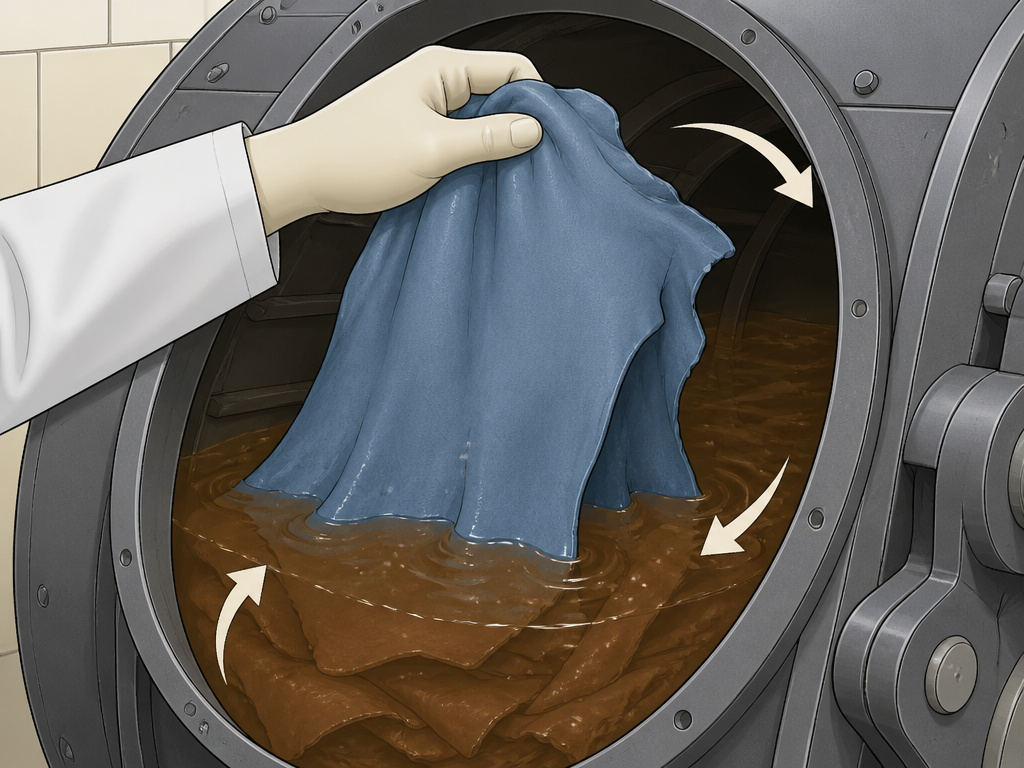 A tanned hide, whether chrome-blue or vegetable-brown, is just a midpoint. This is where the art of leather making truly becomes customizable.
Retanning is the unsung hero here. A chrome-tanned hide (wetblue) might be retanned with vegetable extracts to add body and a natural feel. A vegetable-tanned hide might get a touch of synthetic tanning agent for specific performance traits. This blending is how tanneries engineer leather for precise applications.
Fatliquoring is the step that determines hand-feel. After all the alkaline and acidic baths, the fibers are starved of natural lubrication. Oils, natural or synthetic, are emulsified in water and drummed into the hide. They coat the fibers, allowing them to slide past each other. Too little, and the leather is dry and cracks. Too much, and it feels greasy and stains. It’s a balancing act, similar to building a roux: patience and the right fat matter.
Finishing is the final coat. It can be as minimal as a light aniline dye that lets the natural grain show through (and marks and scars with it), or as heavy as a full pigment and polyurethane topcoat that creates a uniform, waterproof, and scuff-resistant surface. The finishing process for a delicate, exotic hide like crocodile leather is vastly more involved than for a standard cowhide.
Beyond Cowhide: Tanning for Specialty Leathers
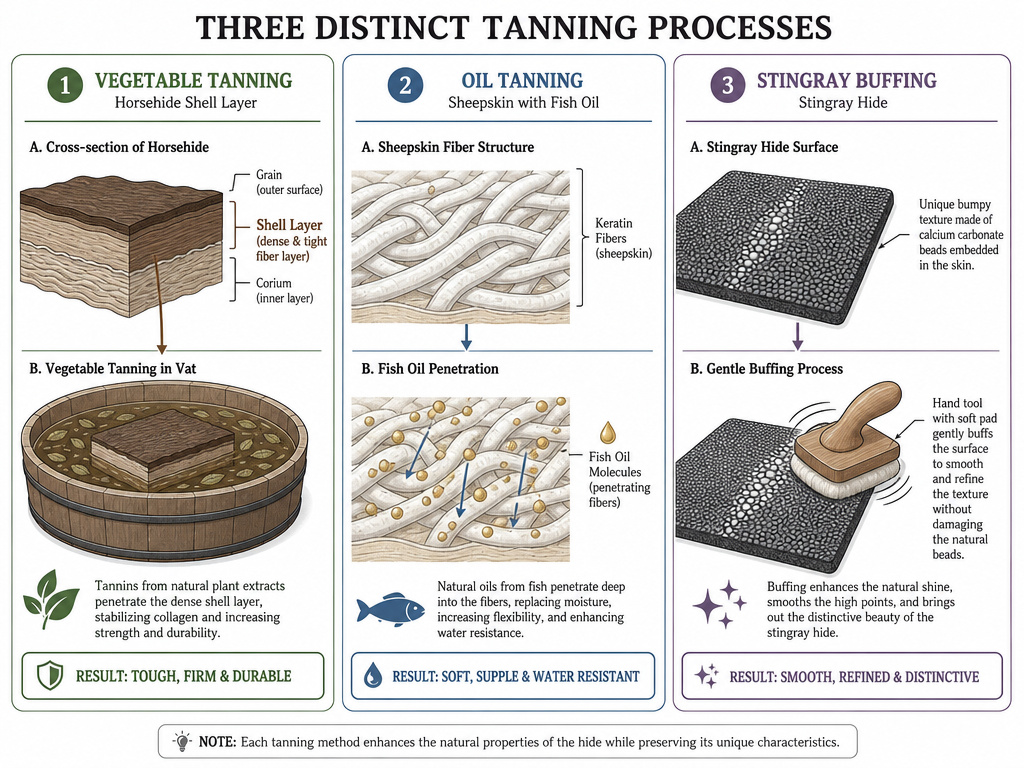 The core principles hold, but exotic hides demand adaptation.
Take Shell Cordovan. It comes from a specific muscle layer in a horse’s rump. Its dense, tight fiber structure requires a unique, multi-week vegetable tanning process, followed by lengthy curing and laborious hand-finishing with hot glass and oils. The process is the product.
Chamois leather, traditionally made from oil-tanned sheepskin, uses fish oils that oxidize within the fibers, a completely different chemical pathway (oil tanning) from chrome or vegetable. For fish leather or stingray leather, the tiny scales and unique structures require gentler handling and specialized finishing to highlight their natural texture without making them brittle.
The rule is simple: the more unique the raw material, the more customized the tanning process must be to preserve its desirable qualities. A one-size-fits-all approach ruins the very thing that makes the leather special.
The Environmental and Chemical Landscape
Modern tanning is an industrial process, and its impact is regulated. The main issues are wastewater (high in salts, sulfides, and potentially chromium) and solid waste (fleshings, trimmings, shavings).
The industry has responded. Closed-loop chrome recycling systems capture and reuse up to 95% of chromium. Waste shavings and trimmings are processed into bonded leather, gelatin, or biofuels. The romanticized view of traditional vegetable tanning isn’t automatically greener, it requires vast amounts of water and plant material, and its waste streams are high in organic tannins that are difficult to break down.
Newer “chrome-free” metal tanning (using aluminum, zirconium, or titanium) offers a middle ground, aiming for the softness of chrome with a lower environmental profile, though they can lack the same level of hydrothermal stability. The quest for a truly sustainable, high-performance tanning agent is still ongoing, a topic covered in depth by resources on industrial leather processing methods.
Frequently Asked Questions
Is vegetable-tanned leather more “natural” or organic?
Not necessarily. “Vegetable-tanned” only specifies the tanning agent. The hide can still come from a conventionally raised animal, and the leather can be dyed with synthetic dyes and finished with acrylic coatings. The term describes the tanning method, not an overall production standard.
Why does some leather have a strong chemical smell?
That’s usually the smell of residual solvents, dyes, or finishing coatings, not the tanning agents themselves. Well-processed and aired-out leather should have a mild, neutral, or slightly sweet organic smell. A persistent, harsh chemical odor often indicates poor finishing or inadequate rinsing.
Can you tell if leather is chrome or vegetable tanned by looking?
Sometimes. Vegetable-tanned leather often starts a pale, creamy brown and darkens with age and sunlight. Chrome-tanned leather comes in any color from the dye vat. The feel is a bigger tell: chrome is soft and drapey right away; vegetable-tanned is firm and needs breaking in. The edge is a dead giveaway, chrome-tanned edges are often painted or sealed, while high-quality vegetable-tanned edges are often burnished to a dark, glossy finish.
What’s the difference between tanning and curing?
Curing is temporary preservation, usually with salt, to prevent rot during transport from the slaughterhouse to the tannery. Tanning is the permanent chemical stabilization that follows curing and the beamhouse clean-up.
Is all leather tanned?
Yes, by definition. An animal skin that has not been tanned is either a fresh “green” hide, a salted “cured” hide, or dried “rawhide.” The tanning process is what turns it into the durable, flexible material we call leather.
The Bottom Line
The leather tanning process is a bridge between biology and material science. It takes a perishable byproduct and engineers it into a functional, beautiful material.
When you pick a leather item, you’re choosing the outcome of one of these chemical stories. The soft jacket is a product of modern chrome tanning. The heirloom-quality bag is a testament to slow vegetable tanning. The wallet that molds to your pocket and the shoes that shrug off rain are both victories over decay.
Understand the process, and you stop seeing leather as a uniform commodity. You start seeing the chemistry, the choices, and the craft in every stitch. That knowledge lets you buy, and care for, leather with confidence.
