
What Is Crocodile Leather? Scales, Grades & Cost Explained
This post contains affiliate links. As an Amazon Associate, we earn from qualifying purchases.
Crocodile leather is the tanned and finished skin of a crocodile, valued for its distinctive, raised scale pattern, natural durability, and extreme rarity, which places it among the most expensive luxury leathers in the world. Its quality is formally graded by belly width, length, and the number of cuts or holes per international standard ISO 11396:2012, with Grade 1 skins representing the largest, most flawless hides.
That grading system is what separates a $10,000 bag from a $1,000 wallet. The numbers are precise: a belly width under 30cm for a saltwater crocodile means a Grade 4 reject. A single Category 2 defect (up to 20mm wide) can drop a skin’s value by half. This isn’t abstract luxury; it’s a measurable commodity traded against a published standard.
What follows: a breakdown of where this leather comes from, how it’s made, and how the market grades it. You’ll learn why a Nile crocodile skin costs differently than a caiman, what “wet blue” means at the tannery, and how to spot the visual tells of a high-grade hide versus a bargain-bin substitute.
Key Takeaways
- Crocodile leather’s value is determined by a three-part formula: species (Saltwater and Nile are premium), size (measured in belly width against ISO 11396:2012), and grade (based on flawless scale coverage).
- The most common lower-cost substitute is caiman leather; it’s stiffer, has more bony osteoderms, and its scale pattern is less uniform compared to premium crocodile.
- Chrome tanning is the industry standard for crocodile because it produces a more uniform, stable, and moldable leather, whereas vegetable tanning is rarer and yields a firmer, patina-prone hide.
- Over 90% of “crocodile” products under $500 are actually made from caiman or lower-grade, heavily corrected skins where the natural scale pattern has been sanded off and re-embossed.
- The back and horn sections of the skin are often discarded or sold at a deep discount; a truly premium product uses only the flawless belly and flank scales.
Where Crocodile Leather Comes From
Forget wild hunting. Today’s market runs almost entirely on farms. Annual global production sits around 1.5 million crocodile and alligator skins combined. That sounds like a lot until you compare it to the hundreds of millions of cowhides processed yearly. This scarcity is the first layer of the cost.
The species matters intensely. Not all crocodilians make equal leather.
Saltwater crocodiles (Crocodylus porosus), primarily farmed in Australia and Southeast Asia, yield the most prized hides. Their bellies are wide, their scale patterns are large and well-defined, and the skin itself is relatively soft and pliable. This makes it the default choice for high-end, pliable goods like handbags.
Nile crocodiles from Africa are the workhorses of the industry. Their skins are durable, moderately scaled, and tan consistently. They’re the go-to for belts, watch straps, and footwear where flexibility is less critical than sheer toughness.
Then there’s caiman, the common budget substitute. Farms in South America produce these in higher volumes. The leather is stiffer, often with visible bony deposits (osteoderms) under the scales, and the pattern can be irregular. It’s not bad leather. It’s just different, and cheaper.
A farmed animal’s life is managed for hide perfection. Paddings on enclosure walls, controlled diets, and segregated animals minimize fighting scars. A single deep scratch across the belly can downgrade a three-year-old animal’s hide from Grade 1 to commercial waste.
The Crocodile Leather Grading System (Size & Defects)
This is where the commodity becomes a numbered science. The industry doesn’t trade on “nice-looking” skins; it trades on measurements against ISO 11396:2012. This standard sets the language for quality.
Grading happens along three axes: width, length, and defects.
| Grading Criteria | Grade 1 (Premium) | Grade 4 (Reject) |
|---|---|---|
| Belly Width | Saltwater: 30-51 cm Freshwater: 35-51 cm |
Saltwater: < 30 cm Freshwater: < 35 cm |
| Length | Aligns with standard sizes (e.g., 95-105cm, 120-170cm) | Irregular, outside standard sizes |
| Allowed Defects | Very few, minor Category 1 marks | Multiple Category 2 defects, scale slip, putrefaction |
Belly width is king. It’s the first measurement any buyer takes. A wider belly means larger, uninterrupted panels for cutting bag fronts or watch straps, which means less waste and higher value. The ISO standard provides the brackets: a saltwater crocodile skin under 30cm belly width is automatically a Grade 4, regardless of how pretty it looks.
Defects are categorized with clinical precision. A Category 1 cut is up to 10mm wide and 20mm long, perhaps a small claw mark. A Category 2 defect doubles that to 20mm by 40mm, a significant scar. The presence and count of these defects directly correlate to the grade and price.
The grading standard also calls out specific failure states. Putrefaction from improper curing gives the hide a spongy feel and an ammonia smell. Over-cured skins become boardy and inflexible; under-cured skins risk rotting later. Both land you in Grade 4 territory.
Where this goes sideways: Assuming a large skin is a high-quality skin. A massive hide covered in deep scar tissue from farm crowding is worthless. The grade depends on flawless scale coverage, not overall dimensions.
How Crocodile Leather Is Made: From Farm to Finish
The journey from reptile to retail is a marathon of specialized steps. It starts with harvesting at the farm, where the age is carefully chosen, usually between two and four years. Older animals have bigger skins, but they’ve also had more time to acquire scars. It’s a risk-reward calculation for the farmer.
Preservation is immediate. The skins are salted or chilled to halt decay. They’re then shipped to specialist tanneries as “wet-salted” goods, a form any experienced buyer prefers because they can see the raw material, warts and all.
The tanning process itself is where the leather’s fundamental character is set.
Chrome tanning is the dominant method. It uses chromium salts to stabilize the collagen fibers in the skin. The process is fast (two to three days to “wet blue” stage), consistent, and yields a leather that is soft, moldable, and excellent at accepting dyes. Almost all crocodile leather for fashion accessories is chrome-tanned. As noted in the Food and Agriculture Organization’s technical guide, this process creates a chemically stable base leather ideal for further finishing.
Vegetable tanning is the traditional, slower alternative using plant-based tannins. It’s far less common for crocodile because it can be harder to control uniformly across a stiff hide. The result is a firmer, more natural-feeling leather that ages and develops a patina over time, much like a high-quality vegetable-tanned cowhide from Horween Leather Company or Wickett & Craig. You might find it on heirloom-quality small goods, but rarely on a supple handbag.
After tanning, the skin is shaved to a uniform thickness, often under 1.0mm for smaller skins destined for wallets or watch straps. Then comes dyeing and finishing.
The finish can be glossy, matte, or incrust (a raised, domed effect on the scales). A 2025 study published in Veterinary Anatomy and Histology using scanning electron microscopy found measurable thickness differences between these finishes, which can affect the leather’s final hand and durability.
What Does “Quality” Mean for Crocodile Leather?
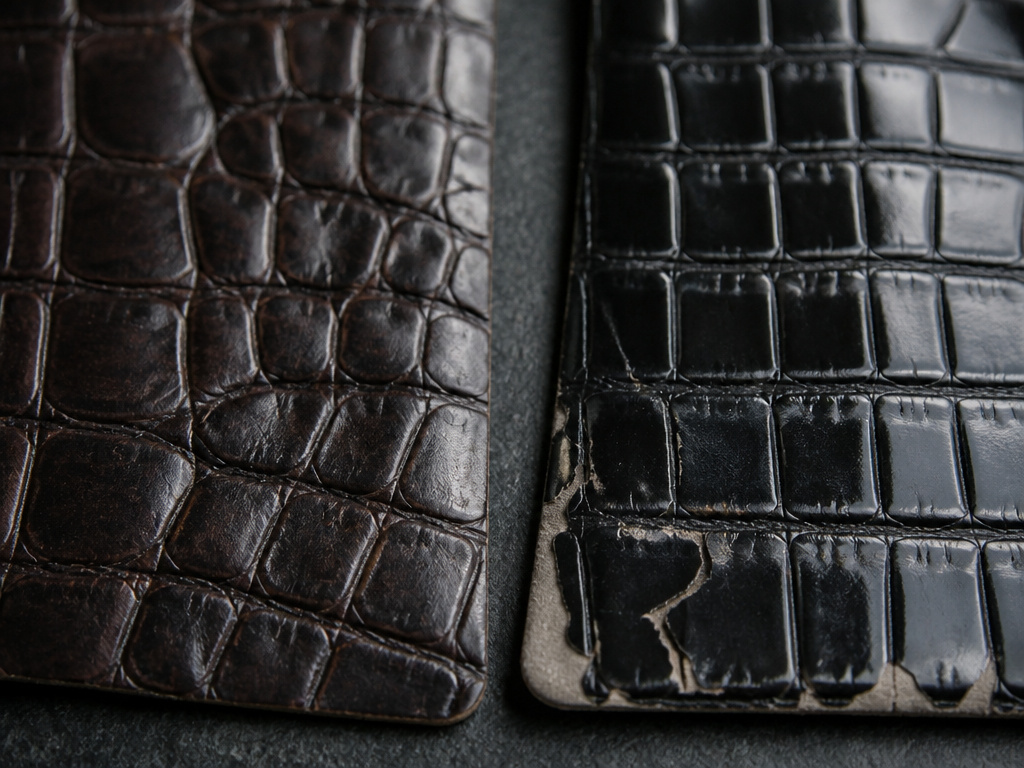
In most leathers, we talk about leather grain and tensile strength. With exotics, the conversation shifts. Quality here is about authenticity, uniformity, and craftsmanship in the finishing.
First, is it real crocodile? The LC-MS method for leather certification described in Analytical Chemistry can detect species-specific collagen peptides from a 100μg sample, about the size of a pinhead. This level of verification is for scientific authentication, but your best practical test is a combination of touch and sight.
A high-quality crocodile skin will have:
- Uniform Scale Pattern: The scales should be consistent in size and shape across the belly panel, with no sudden jumps or awkward mini-scales.
- Clean Transitions: The lines between scales (the “valleys”) should be deep, crisp, and free of tears or unfinished gaps.
- Supple Hand Feel: It should bend without cracking or revealing a stiff, cardboard-like core. The finish should feel integrated, not like a plastic layer on top.
- Consistent Color: Dye penetration should be even, with no blotchy patches or pale spots, especially in the scale valleys.
Low-quality or fake crocodile often shows:
- A Perfectly Repetitive Pattern: Nature isn’t that uniform. Stamped or embossed leather will have a robotic, repeating sequence.
- A Plastic-like Feel: Polyurethane “croc-print” feels warm and artificial to the touch, not cool and fibrous like real leather.
- Peeling or Cracking: Low-grade finishes chip and peel, especially on the raised edges of the scales.
The back and horn sections of the skin are a giveaway for lower-tier products. These areas have smaller, irregular scales and are much stiffer. A maker using only prime belly scales is signaling a higher level of investment, and charging for it.
Crocodile vs. Caiman vs. Alligator: The Buyer’s Guide
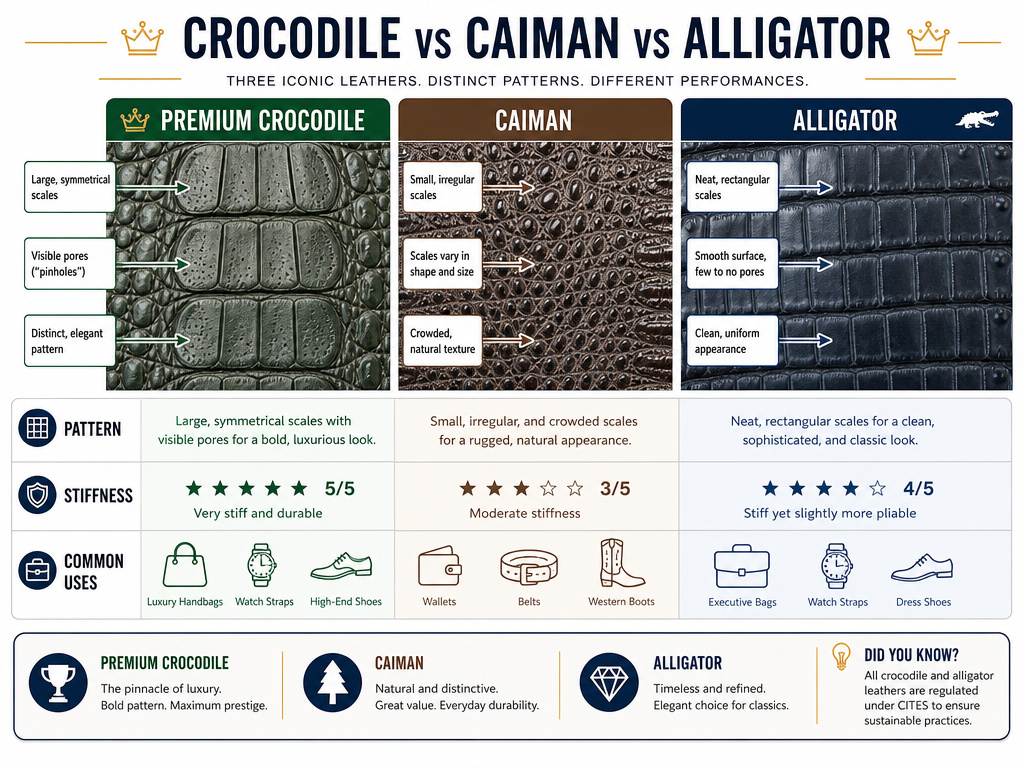
Let’s be clear about one thing: most retail labels just say “crocodile.” The burden is on you to know what you’re probably getting at different price points. Here’s a straightforward guide.
| Feature | Premium Crocodile (Saltwater/Nile) | Caiman (Common Substitute) | Alligator |
|---|---|---|---|
| Scale Pattern | Large, symmetrical belly scales. Porous “dots” (follicles) often visible. | Irregular, often smaller scales. Can have a crowded look. | Rectangular, blocky scales near the belly center. No follicles. |
| Stiffness | Relatively supple, especially after tanning. | Noticeably stiffer; may have bony osteoderms you can feel. | Similar stiffness to crocodile, but with a distinct drape. |
| Common Uses | Luxury handbags, high-end watch straps, shoes. | Budget belts, wallets, mass-market accessories. | Luxury luggage, upholstery, high-end shoes. |
| Price Driver | Size, grade, flawless belly. | Volume, lower farming costs. | Brand prestige, specific rectangular scale pattern. |
For more detail on the visual and structural differences, our guide on alligator vs crocodile leather breaks it down side-by-side.
A student once showed me a wallet they thought was “bad crocodile.” The scales were tiny and uneven, and the leather had a hollow, plasticky sound when flexed. It was caiman, and not even good caiman. They had paid a “crocodile” price for a bottom-shelf product. That tactile lesson stuck: the pattern is just the cover. The quality of leather is underneath.
Caiman is a durable, exotic leather, not inherently bad. However, it is a different product, marketed opaquely.Alligator, primarily from the American alligator, is a separate category again, often valued for its unique, more geometric scale layout.
The Real Cost: Why Is Crocodile Leather So Expensive?
The price tag reflects the sum of a precarious, years-long production chain with high attrition.
1. Farming & Rarity: Raising a crocodile to a usable size (3-4 years) is a constant risk. The animal must be kept in near-perfect condition. A fight, a scrape against a concrete wall, or a skin infection can render a multi-year investment worthless. Only a tiny fraction of the global leather supply is exotic, and crocodile is a fraction of that fraction.
2. Tanning & Craftsmanship: Tanning a crocodile skin is not like running a cowhide. It requires specialist knowledge, slower processing, and hand-work, especially during the shaving and finishing stages to accentuate the scale pattern without tearing the skin.
3. Yield & Waste: A single crocodile skin might only yield one or two usable belly panels for a small handbag. The rest, the back, the horny tail sections, the scarred flanks, is waste or sold for pennies to make key fobs or patchwork items. Contrast that with a cowhide, where nearly every square inch can be used.
4. Market Grading: As we saw, the ISO grading is ruthless. A 29cm belly width instead of 30cm can cut the price by 60%. Two Category 2 defects instead of one can halve it again. By the time a skin reaches a tanner, its price per square foot is already set by these objective measures.
So, when you see a crocodile leather good for $300, you are almost certainly looking at caiman, or a heavily corrected Grade 4 crocodile skin where the natural surface has been sanded off and a scale pattern re-embossed onto a pebbled leather or corrected-grain base. The genuine article, from a Grade 1 or 2 skin, commands four-figure prices for a reason.
Frequently Asked Questions
Is crocodile leather durable?
Yes, but with a caveat. The scaly surface is naturally abrasion-resistant. However, the leather underneath is thin and can be delicate. It’s durable against scuffs but vulnerable to punctures, over-bending, and drying out. It requires more careful maintenance than bovine leather.
How can you tell real crocodile leather from fake?
Check the pattern first. Real scales will vary slightly in size and shape; fakes are perfectly uniform. Feel the transition between scales, it should be a deep, clean groove, not a shallow stamp. Finally, look at the backside. Genuine crocodile will have a fibrous, suede-like backing, while synthetic often has a fabric or uniform foam layer.
What’s the difference between crocodile and alligator leather?
The scale pattern is the biggest visual cue. Alligator scales are more rectangular and uniform, especially in the center belly, and lack the tiny pore marks (follicles) often seen on crocodile scales. Alligator tends to be slightly softer and more pliable in premium grades. For a complete comparison, see our resource on the differences between alligator and crocodile leather.
Can crocodile leather get wet?
It has some natural water resistance, but it is not waterproof. Prolonged exposure to water can seep through the seams and scales, potentially staining the leather or causing the skin to stiffen as it dries. Always use a protector spray designed for exotic leathers.
How do you care for crocodile leather?
Use a clean, damp cloth for dust. Condition it sparingly (once or twice a year) with a cream specifically made for exotic leathers; avoid oils that can darken and soften the scales unevenly. Store it away from heat and sunlight in a breathable dust bag. Never use saddle soap or universal leather cleaners.
Before You Go
Crocodile leather is a graded raw material whose value is locked in a three-number code: species, belly width, defect count. Understand that code, and the market makes sense.
The practical takeaway is this: if you’re buying for the status of the word “crocodile,” you’ll find caiman at every discount retailer. If you’re buying for the specific combination of beauty, rarity, and craftsmanship, you need to look past the label. Ask about the species. Ask if it’s belly cut. Check for uniform scale spacing and sharply defined valleys.
And remember the mentor’s rule: the leather will tell you what it needs. A dry, stiff feel means it’s been under-conditioned or is of lower quality. A perfect, plastic-like uniformity means it’s probably not the real thing. Your best tool for identifying real leather from an imitation is an educated touch.
So, appreciate crocodile leather for what it is: a remarkable natural material with a price tag built on risk, rarity, and a very strict report card. Just know the answers before you sit for the test.
