
How to Tell Real Leather From Fake – The Definitive Guide
This post contains affiliate links. As an Amazon Associate, we earn from qualifying purchases.
To tell real leather from fake, use a three-step field test. Smell it, real leather has a distinctive, earthy, slightly musky odor, while faux leather smells like chemicals or plastic. Burn a tiny piece from an edge, real leather will char and smell like burning hair, while synthetics melt, bead up, and smell acrid. Look at an unfinished edge, real leather shows a cross-section of dense, fibrous grain transitioning to a spongier flesh side. Fake leather reveals a uniform plastic or fabric base.
Those tests work because they target the biology of an animal hide versus the chemistry of a plastic-coated textile. Most guides tell you to feel for softness or look for grain variation, but that’s unreliable, high-quality synthetic leather can mimic both. The real differentiators are in the material’s fundamental response to heat, its smell, and its layered internal structure.
Let me share what I’ve learned. What follows is a straightforward guide to the hands-on field tests anyone can do in a shop, followed by the official laboratory methods that define “real leather” for manufacturers and regulators. By the end, you’ll understand leather better to make confident choices.
Key Takeaways
- Smell is diagnostic: Real leather has an organic, earthy scent that persists; faux leather smells of plastic or chemicals.
- The flame test is definitive: A tiny sliver from an edge that chars and smells like burnt hair indicates real animal hide. Melting, beading, and an acrid smell signal plastic.
- Inspect the edge: A fibrous, layered cross-section with a distinct transition from grain to flesh confirms leather. A uniform, smooth edge or visible fabric backing means it’s fake.
- Labels are not guarantees: The term “genuine leather” is legally permissible for a wide range of materials, including corrected and bonded leather, under the FTC leather labeling guides.
- Understand the ‘nap’: The fuzzy underside revealed when you scratch the flesh side of real leather won’t appear on vinyl or PU leather.
The Three-Step Leather Field Test (Smell, Flame, Edge)
You don’t need a lab coat to spot an imitation. The simplest method uses your senses and a basic tool, a lighter.
First, the smell test. Bring the item close to your nose and take a deep breath. Real leather has a complex, organic odor. It’s earthy, slightly musky, and a bit sweet. That’s the scent of tanned animal proteins.
Faux leather, on the other hand, smells of its origin: a chemical factory. You’ll get sharp notes of plastic, vinyl, or sometimes a faintly acrid, rubber-like smell. This is the most immediate clue.
Second, the flame test. This is where you need permission, especially if you’re in a store. Find an unobtrusive spot, like the backside of a belt loop or the underside of a flap. Use your fingernail or a key to scrape off a tiny, pinhead-sized sliver of material from the very edge.
Hold a lighter flame to it for a second. Watch and smell.
Apply an open flame to a tiny sliver of material scraped from the edge. Real leather will smolder and char into a dark ash, producing a smell similar to burnt hair. Synthetic leather will melt, often curling into a hard plastic bead, and release a sharp, acrid smoke.
Real leather chars. It smolders into a dark ash that crumbles easily, and the smoke smells distinctly like burnt hair or fingernails. Synthetic leather behaves like any plastic: it melts. It will often curl away from the flame, form a hard bead, and give off a sharp, chemical smoke. This test is nearly foolproof.
Third, examine an unfinished edge. This is the visual confirmation. Real leather is a cut of skin. Its edge will show a cross-section. Look for a distinct, dense top layer (the grain) with a clear transition to a looser, more fibrous, spongier layer (the flesh or corium).
If the edge looks perfectly uniform, smooth, and plastic-like, it’s fake. If you see a fabric mesh or woven backing peeking through, you’re looking at a coated textile, the definition of faux leather.
Where this goes sideways: Testing the surface instead of the edge. A high-quality PU leather or vinyl can have a convincing painted grain on top, but its edge will always give it away. Go straight to the cut.
Official Definitions: When Is It Actually Leather?
Your field test is practical, but the law has its own definitions. In the United States, the Federal Trade Commission sets the rules.
Under FTC Part 24 regulations, a product can be labeled “leather” if it is “composed in all substantial parts of leather.” That’s a broad standard. It allows for bonded leather (shredded fibers glued together) and corrected-grain leather (sanded and embossed) to carry the same “genuine leather” tag as a pristine full-grain hide.
The guide states it’s deceptive to use an unqualified “leather” term on something that’s not. If a material appears to be leather but isn’t, it must be labeled with terms like “Not leather,” “Imitation leather,” or “Vinyl.” The problem is, you rarely see those clear disclaimers on a finished handbag tag.
This is based on years of practical experience. I’ve seen wallets labeled “genuine leather” disintegrate into cardboard-like layers within a year. The label wasn’t lying, technically, the product contained leather fibers. But it wasn’t the durable, repairable material you imagined. The official government leather labeling document is precise, but its precision creates a marketing loophole a truck could drive through.
Internationally, standards like ISO 17131:2012 provide the laboratory method for identifying leather. It involves cutting a 10mm square, examining its fibrous structure under a microscope, and confirming the “more or less intact original fibrous structure” of an animal skin. That’s the gold standard, but it’s not something you can do at the mall.
| Material | Can Be Labeled “Genuine Leather”? (Per FTC) | Key Identifying Feature (Field Test) | Typical Use |
|---|---|---|---|
| Full-Grain Leather | Yes | Natural, un-sanded grain; fibrous edge | High-end bags, boots |
| Corrected-Grain Leather | Yes | Uniform grain pattern (embossed); fibrous edge | Mid-range furniture, belts |
| Bonded Leather | Yes (if substantial part) | Paper-like edge; may delaminate | Cheap goods, book binding |
| PU / PVC Leather (Faux) | No (must be disclosed) | Plastic smell; melts with flame; fabric edge visible | Fast-fashion items, car interiors |
| Bicast Leather | Yes (with disclosure) | Thin plastic coating over split leather; edge shows two layers | Budget furniture |
The Detailed Inspection: What Your Eyes and Hands Can Reveal
Beyond the quick tests, a more patient inspection will confirm your findings. Start with the visual.
Look for natural imperfections. Real leather comes from an animal, so it has a life story. Look for natural variations in color, subtle scars, insect bites, or vein marks. These aren’t defects; they’re authenticity marks. A perfect, repeating grain pattern is a sign of an embossing plate used on corrected leather or synthetic material.
Next, check the weight and drape. Pick the item up. Good leather has a substantial, dense feel for its size. It shouldn’t feel hollow or feather-light. Bend it gently. Real leather will resist slightly, then crease with a soft fold. Stiff, board-like resistance or a feeling of thin plastic cracking are bad signs.
Finally, do the touch and temperature test. Press the back of your hand or your cheek against the surface. Leather is a poor conductor of heat. It will feel room-temperature or slightly cool, never clammy or warm like plastic can. Run your finger across the grain, it should have a slight, waxy drag, not the squeaky-slip of vinyl.
The part nobody mentions: The “nap” test. Find an unfinished edge or the flesh side (the rough back). Scratch it firmly with your fingernail. On real leather, you’ll raise a fine, fuzzy suede-like texture, the leather’s “nap.” On vinyl or pleather, you’ll just make a scratch mark on a smooth plastic surface.
This detailed look works best when you can compare two items side-by-side. The differences become unmistakable.
Common Fakes and How They Try to Fool You
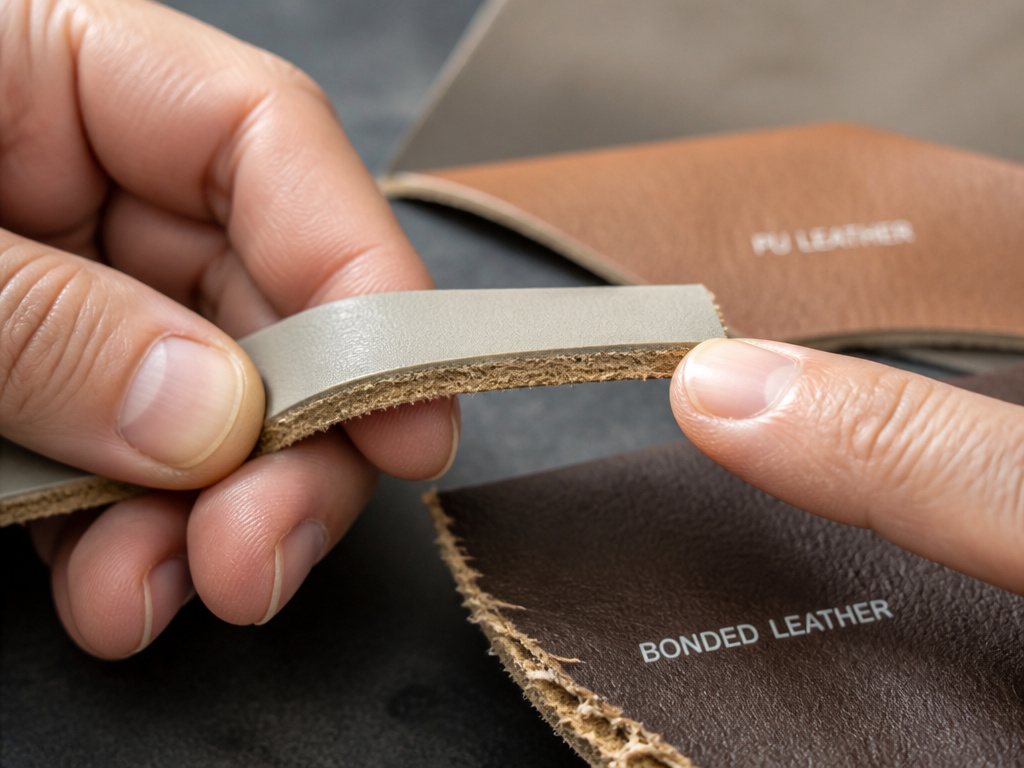 Not all imitation leather is the same. Understanding the common types helps you spot their specific weaknesses.
PU Leather (Polyurethane): This is the most common high-quality fake. It’s a fabric base coated with a polyurethane film that can be embossed with very realistic grain patterns. It’s often soft and pliable. The giveaways are the uniform backing fabric visible on edges, the chemical smell, and its tendency to peel or crack along fold lines over time. A synthetic PU leather jacket might feel great in the store but won’t develop a patina, it’ll just degrade.
PVC Leather (Vinyl): The older cousin, often stiffer and with a more pronounced plastic smell. It’s less breathable and can feel sticky in heat. The flame test works perfectly here.
Bonded Leather: This is the trickster. It contains real leather, but it’s shredded leather fibers mixed with latex or polyurethane binders, pressed into sheets, and topped with a polyurethane coating. The edge looks like pressed cardboard. It might initially smell like leather, but it lacks strength and will flake apart. Its composition of bonded leather is fundamentally weak.
Bicast Leather: A split leather base (the lower, fibrous part of the hide) coated with a thick layer of polyurethane or vinyl to make it look like top-grain. The edge clearly shows two distinct layers: a thin leather base and a thick plastic top. It’s common in low-cost furniture. Identifying bicast leather is about spotting that sandwich-like edge.
Knowing these categories helps you ask the right questions and know where to look for failure.
Beyond the Basics: When Field Tests Aren’t Enough
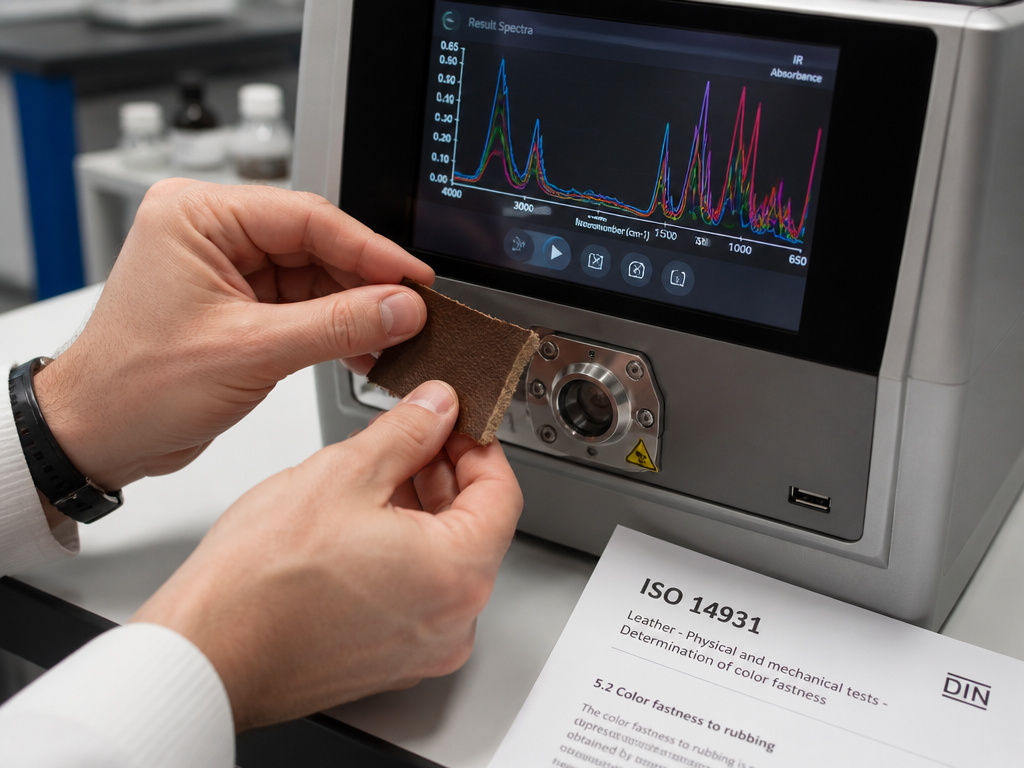 Sometimes, you’ll encounter a material that passes the basic tests but still feels off. The grain looks real, the edge is fibrous, but something’s not right. You might be dealing with a highly processed leather or a specialized synthetic.
Look for the ISO 9001 certification or equivalent official standard. For apparel, ISO 14931:2021 lays out the physical and chemical requirements for something to be sold as leather clothing. It specifies a minimum tensile strength (12 N/mm²), tear load (15 N), and flexing resistance (20,000 to 50,000 cycles). A lab would test for chromium VI content (must be <3 mg/kg) and formaldehyde levels. You won’t have this gear, but knowing these thresholds explains why a cheap “leather” jacket tears so easily.
The Chinese standard GB/T 30695-2014 details how to use infrared spectroscopy to tell if an imitation leather coating is PVC or PU. This matters because PU generally outperforms PVC in flexibility and longevity. Again, it’s lab territory, but it shows that faux leather material science is its own complex field.
For the everyday buyer, if your inspection and simple tests leave you in doubt, the safest assumption is caution. A seller with nothing to hide will often provide a sample swatch or be transparent about the materials. If they’re evasive, walk away.
Frequently Asked Questions
Is the water drop test reliable?
Not really. The idea is that real leather absorbs a water drop while faux leather beads it. In practice, heavily waxed or finished leather can bead water, and some treated synthetics can absorb it. It’s an inconsistent method. The flame and edge tests are far more dependable.
What does real leather smell like?
It smells organic and complex, earthy, slightly sweet, and musky, like a rich, tanned hide. It’s never a single, sharp chemical note. If it smells like a new shower curtain or a plastic toy, it’s fake.
Can “vegan leather” be high quality?
Yes, but understand the terms. Vegan leather is by definition not leather, it’s a synthetic alternative. Modern versions like cactus, pineapple, or mushroom leather are bio-based materials that aim for sustainability. They are their own category with distinct properties and care needs, not direct replacements for animal leather’s durability and aging characteristics.
Why does my “real leather” item have a fabric backing?
You’re likely looking at a synthetic leatherette. Real leather can have a fabric backing for reinforcement in thin garments, but it’s not the main structural base. If the front layer is thin and the fabric is clearly the primary material holding the piece together, it’s a coated textile, not leather.
How can I test leather quality if I can’t burn or scratch it?
Focus on the senses you can use. Inspect the craftsmanship. High-quality leather goods typically feature higher-quality construction, neater stitching, more substantial hardware, and neatly finished edges. Press the surface; better leather will depress slightly and slowly spring back, showing its density. Ask the seller detailed questions about the leather type (full-grain, top-grain) and tanning method.
Before You Go
Let’s be clear about one thing: telling real leather from fake isn’t about snobbery. It’s about value, longevity, and knowing what you’re buying. A faux leather bag for a season is a valid choice if you know that’s what it is. The problem is paying a “real leather” premium for plastic that will crack in a year.
The practical takeaway is this three-step drill: Smell, Flame, Edge. Commit it to memory. Use it before any significant purchase.
The leather will tell you what it needs. Real leather asks for occasional conditioning and develops a richer character with age. Fake leather demands nothing and dies looking tired. Your job is to listen before you buy. Now you know how to hear the difference.
