
What is Snakeskin Leather | The Materials, Myths & Legal Trade
This post contains affiliate links. As an Amazon Associate, we earn from qualifying purchases.
Snakeskin leather is genuine leather made from the tanned hides of snakes, prized for its distinctive scale patterns, lightweight durability, and exotic appearance. It is a niche material governed by international wildlife trade regulations (CITES), and its properties, like water vapor permeability and tensile strength, vary significantly based on the finishing method, be it natural, aniline, or semi-aniline.
Let’s be clear about one thing. That answer covers the textbook definition, but the real story of snakeskin leather lives in the details most glossaries skip: the two-to-four-year clock ticking on raw skins before they degrade, the 30% of identifying information that survives the tanning vats, and the specific finish that determines whether a python skin breathes or seals shut. The difference between a luxury heirloom and a fast-fashion casualty often comes down to those specifics.
What follows is a straightforward guide that moves past the exotic veneer. We’ll break down the material’s core properties, trace its journey from a regulated trade to your wardrobe, and look at how to identify and care for the real thing. By the end, you’ll understand snakeskin leather not just as a pattern, but as a material with its own rules.
Key Takeaways
- It’s not just cowhide with scales. Snakeskin’s unique, non-overlapping scale structure creates a distinct, often directional texture and affects how it reacts to tension and moisture.
- The legal supply chain is narrow and documented. Legitimate snakeskin leather, especially from pythons, requires CITES permits to prove it’s sourced from captive-bred or regulated wild populations, illegally sourced skins are laundered into the market.
- The finish decides performance. An academic study found an aniline finish on python leather offered a balanced mix of good breathability (11.63 mg/cm².h WVP) and high durability, while semi-aniline finishes can drastically reduce permeability. Care is essential and specific.** Condition oils must penetrate between the lifted scales, and using the wrong product (like heavy waxes) can clog the leather’s natural breathability and lead to premature drying and cracking.
- Authenticity requires a keen eye. Real snakeskin pieces are small and will have seams; genuine scale patterns are irregular and will reflect light differently across each scale, while faux prints are perfectly uniform.
The 4 Defining Properties of Snakeskin Leather
Forget thinking of it as just patterned cowhide. The physical structure of a snake’s skin imparts a completely different set of rules. The scales are made of keratin, like our fingernails, but they’re anchored into a softer, flexible dermis. This isn’t a uniform surface; it’s made of individual, non-overlapping plates.
This scale structure creates four key traits you won’t find in bovine leather. First is the directional grain. Run your hand one way, it’s smooth. Run it back against the scale growth, and you’ll feel a distinct, gritty resistance. This isn’t a defect; it’s the signature of the material. Second, it’s exceptionally lightweight and thin. A snakeskin is naturally thin, which allows for incredible pliability but also demands expert craftsmanship during the tanning process to maintain strength.
Third, it possesses a unique tensile strength. The skin is remarkably strong along its length but has less cross-grain strength, a fact any pattern cutter must respect. I learned this the hard way with a holster project. A piece I’d cut without accounting for the leather’s directional stretch relaxed during molding, becoming too loose to hold its shape securely. The practical takeaway? You must align your pattern with the grain’s strength, building in a slight tension allowance.
Finally, there’s the natural luster. Each scale acts like a tiny, faceted mirror. On a well-finished piece, light doesn’t just reflect; it plays across the surface, creating a depth and shimmer that embossed or printed leather can’t replicate. This is the grain pattern](https://leathergenesis.com/what-is-leather-grain/) in its most authentic, unedited form.
A 2023 peer-reviewed study measured the Water Vapor Permeability (WVP) of finished python leather. The “Aniline I” finish type achieved a WVP of 11.63 mg/cm².h, balancing breathability with a rub fastness rating of 4/5 and an adhesive strength of 350 g/cm, demonstrating that a specific finish can optimize both durability and comfort.
How Snakeskin Leather is Made: From Skin to Finish
The journey from shed skin to luxury bag is a tightly controlled sequence. It starts with sourcing, a point covered next, but once a legal hide arrives at a tannery, it undergoes a specialized version of the standard leather making.com/how-is-leather-made/) pipeline.
The raw skin is first rehydrated and cleaned. Fleshing is a delicate operation here; the thinness of the hide leaves zero room for error. Tanning stabilizes the protein structure. While chrome tanning is faster, many high-end tanneries opt for vegetable or hybrid methods to preserve the natural hand-feel and luster of the scales. This stage is critical because, as a CITES regulatory document on python trade notes, tanning and dyeing can obscure up to 70% of the biometric information used to identify a skin’s origin. It literally changes the evidence.
After tanning comes the finish, which is where the leather’s personality is defined. This isn’t just about leather color; it’s about performance. | Finish Type | Primary Characteristic | Best For | | :— | :— | :— | | Natural/Full-Aniline | Transparent dye, scale texture fully felt, highest breathability. | Collector pieces, items where natural beauty is paramount. | | Semi-Aniline | Light pigment layer, more uniform color, slightly reduced breathability. | Daily-use accessories where a balance of durability and looks is needed. | | Pigmented/Coated | Opaque topcoat, high abrasion resistance, texture can feel plasticky. | High-wear areas on footwear, budget-friendly fashion items. |
The dyeing leather process for snakeskin is often a spray or dip application, as the scales can resist penetration. Some tanneries will even hand-paint scales for bespoke effects. Finally, the hide is graded, measured, and shipped to craftsmen who must skillfully work around the natural shape and size constraints, a full skin might only yield a single small handbag front.
Legal & Ethical Sourcing: The CITES Framework
This is the most critical, and most glossed-over, aspect of snakeskin leather. You can’t discuss the material without acknowledging the legal framework that makes its trade possible. Most commercial snakeskin, particularly from reticulated pythons (Python reticulatus), comes from Southeast Asia and falls under the Convention on International Trade in Endangered Species (CITES).
These species are listed on CITES Appendix II, which means trade is permitted but strictly controlled. Every single skin in a legal shipment must have a permit. The goal is to ensure trade doesn’t threaten wild populations, favoring skins from monitored captive-breeding programs. An International Trade Centre python trade report highlights the scale: since 2000, Singapore alone has re-exported over 377,000 captive-bred python skins.
Where this goes sideways: Illegally sourced wild skins are laundered into the legal supply chain. The same report notes it’s virtually impossible to verify the actual origin of every skin once it’s in processing, which is why the paper trail of CITES permits is the buyer’s only real assurance.
For you, the end consumer, this translates to one rule: buy from transparent, reputable brands. A legitimate company should be able to trace its exotic leathers back through the supply chain. If a price seems too good to be true for a “genuine snakeskin” item, it probably is. You might be looking at a convincing faux, or worse, leather from an illegal source that undermines conservation efforts.
Snakeskin Leather vs. Other Exotics & Faux Alternatives
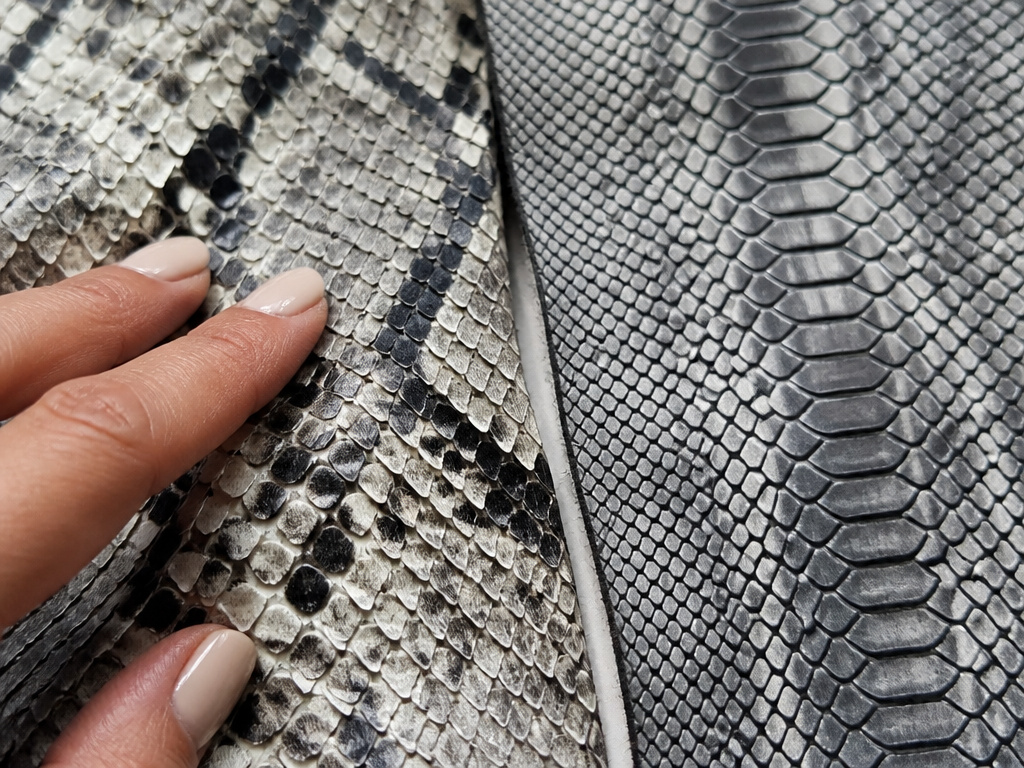
How does it stack up against other materials? Let’s put it in a head-to-head context. Compared to alligator or crocodile, snakeskin is lighter and more pliable, but its thinner scales are less resistant to deep scratches. Against ostrich, it lacks the distinctive quill bumps but offers a smoother, more consistent texture.
The real comparison, however, is between real snakeskin and its faux counterparts. This is where knowledge protects your wallet.
| Aspect | Real Snakeskin Leather | High-Quality Faux Snakeskin |
|---|---|---|
| Texture & Feel | Scales are distinct, slightly lifted, cool to the touch. Directional grain is palpable. | Texture is stamped/embossed. Can feel uniformly rubbery or plasticky, often warmer. |
| Scale Pattern | Irregular, natural. Each scale varies slightly in size, shape, and reflectivity. | Perfectly uniform, repetitive. The pattern repeats exactly across the material. |
| Edges & Seams | Pieces are small, so items will have multiple seams. Edges show a fibrous leather core. | Can be made in large, seamless panels. Edges often show a clean, homogeneous synthetic cut. |
| Aging | Develops a soft patina. Scales may lift slightly with wear, adding character. | Wears uniformly; coating may crack or peel with age, revealing a base fabric. |
The faux option has its place, it’s vegan, consistent, and affordable. But it will never develop the lived-in character of the real thing. Understanding this difference is key to distinguishing real from fake leather in the wild.
Proper Care & Maintenance for Longevity
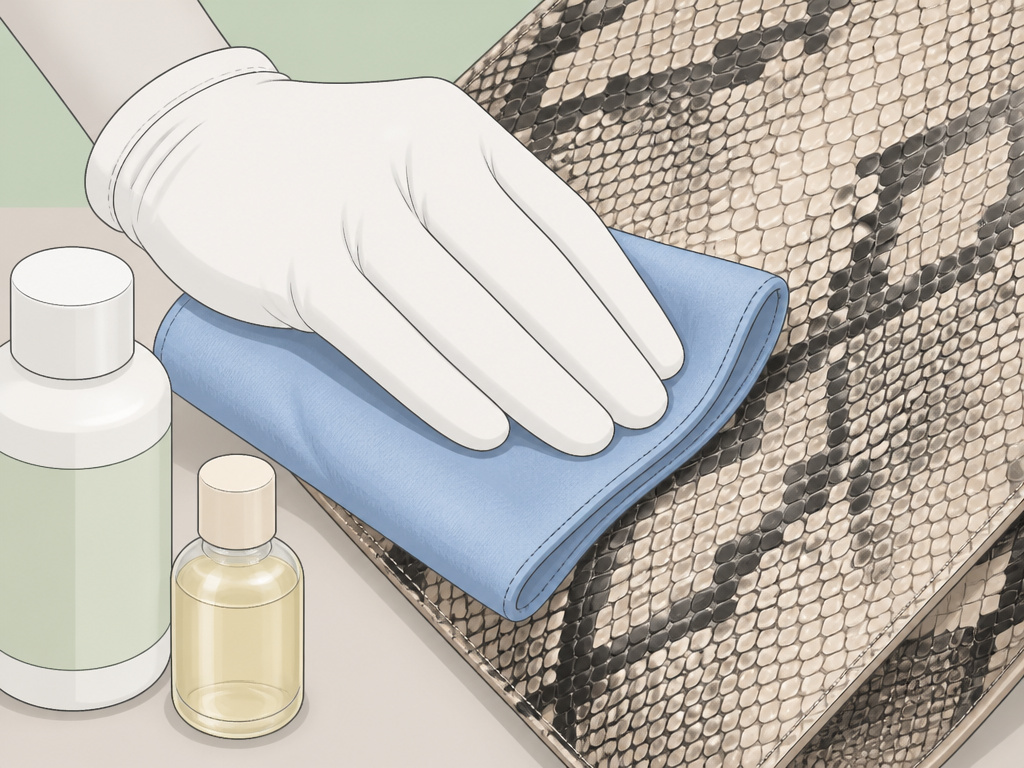
The leather will tell you what it needs. Snakeskin care hinges on one principle: you’re maintaining two materials at once, the protein leather beneath and the keratin scales on top. Getting it wrong doesn’t just dirty the piece; it can permanently damage its structure.
First, clean gently. Use a soft, slightly damp cloth and wipe with the grain of the scales, never against. For deeper cleaning, a pH-neutral leather cleaner is the only safe choice. Harsh chemicals or saddle soap will dry out the delicate skin and can discolor the scales.
Second, condition specifically. This is the most important step. You need a conditioner light enough to penetrate the gaps between scales but nourishing enough for the leather base. Heavy oils like mink oil or beeswax will sit on top, clogging the surface and trapping moisture. Think of it like making a roux: you need the right fat and patience. Apply a tiny amount of a dedicated reptile leather conditioner or a light, oil-based leather milk, let it absorb fully, then buff gently with a dry cloth.
Third, store it correctly. Never store snakeskin in plastic; it needs to breathe. Use a breathable cotton bag and keep it in a cool, dry place away from direct heat or sunlight, which can cause the scales to dry out, curl, and lift. Stuff handbags with tissue to maintain shape.
Common mistake: Using a generic leather protector spray. These silicone-based sprays can create a film that prevents the leather from breathing, leading to rot from the inside out on a humid day. For snakeskin, breathability is part of its function; sealing it shut is a shortcut to failure.
How to Identify Quality Snakeskin Leather
Judging quality here is an advanced skill. You’re moving beyond just spotting real vs. Fake into assessing grade and craftsmanship. Start with the back. Turn the item inside out if you can. High-quality leather will have a clean, neatly finished back, often with a thin lining. Sloppy edges or a rough, suede-like backing can signal a lower-grade skin or rushed production.
Next, examine the embossing, or lack thereof. Top-tier snakeskin will have a natural, un-embossed finish. The scales should have a subtle, three-dimensional lift. If the pattern looks perfectly deep and uniform, it might be a lower-grade skin that’s been machine-embossed to simulate better texture. This embossing technique can mask flaws but also flattens the natural luster.
Look at the seams and pattern matching. Because skins are small, a maker like C-THRU or Seirus will take the time to match the scale patterns at the seams, creating a continuous, flowing design. Misaligned patterns are a sign of cost-cutting. Finally, trust the hand-feel. It should feel supple but substantial, not stiff or papery. A specific test is the pinch test: gently pinch a small area. It should slowly spring back, not immediately snap back (too coated) or stay creased (poor tannage).
These are the same principles of assessing leather quality you’d use on calfskin, just applied through the lens of an exotic. It separates a lasting investment from a disposable trend.
Frequently Asked Questions
Is snakeskin leather durable?
Yes, but with caveats. Its tensile strength is high, making it resistant to tearing. However, the thinness and raised scale structure make it more susceptible to abrasion and scratches than thicker bovine or alligator leather. Durability is heavily dependent on the finish, a pigmented coat will protect more than a natural aniline one, and, crucially, on proper care. A neglected snakeskin item will dry out, crack, and lift scales long before a neglected cowhide belt would fail.
What snakes are commonly used for snakeskin leather?
The vast majority of commercial snakeskin leather comes from pythons, specifically the reticulated python (Python reticulatus) and the Burmese python. Other sources include various species of boa constrictors, anacondas, and cobras. The choice depends on regional availability, scale pattern size (larger pythons yield bigger, more dramatic scales), and the regulations governing their trade.
Can snakeskin leather get wet?
It can tolerate minor, brief exposure to moisture, but it is not waterproof. Getting it soaked is a major risk. Water can seep between the scales, saturating the leather base and causing it to stretch, distort, or even rot as it dries. If it gets wet, blot, don’t rub, immediately with a dry cloth and let it air-dry at room temperature, away from direct heat. Never use a hairdryer.
How do you tell if snakeskin leather is real?
Use a multi-sense check. Look: Real scales are irregular in size and spacing; faux prints are perfectly uniform. Feel: Real scales are slightly lifted and cool; faux is often flat and warm. Flex: Genuine leather will have a fibrous, porous backing; synthetic backing looks like cloth or uniform foam. Smell: Real leather has a distinct, organic smell; faux often smells of plastic or chemicals. For a deep dive, our guide on identifying real leather covers all the methods.
Is it ethical to buy snakeskin leather?
This is a personal decision that hinges on the source. From a conservation standpoint, the legal trade in CITES-regulated, captive-bred python skins is designed to be sustainable and provide economic incentive for habitat conservation. However, the industry is not immune to illegal laundering of wild-caught skins. If you choose to buy, your most ethical path is to purchase from brands that provide full transparency and CITES documentation, and to avoid suspiciously cheap products that likely circumvent these controls.
The Bottom Line
Snakeskin leather is more than a pattern, it’s a commitment. A commitment to understanding a material that behaves by its own rules, to verifying a supply chain with real conservation stakes, and to executing a care regimen that’s as specific as the scales on its surface.
If you’re looking for one answer, here it is: for a responsible buyer who values craftsmanship and is willing to maintain it, a natural or aniline-finished python leather accessory from a transparent brand is the pinnacle. It’s the choice that acknowledges the material’s complexity. For everyone else, or for high-wear applications, a high-quality faux or a different exotic like ostrich might be the more practical, and frankly, more honest fit.
Ultimately, snakeskin leather asks you to look closer. Look past the exotic marketing at the leather tanning method, at the permit paperwork, at the seams in the craftsmanship. What you’ll find is a material that rewards that attention with unparalleled character, and a purchase that carries the weight of its own story.
