
How Leather Gets Its Color Explained: The Chemical Process
This post contains affiliate links. As an Amazon Associate, we earn from qualifying purchases.
This post contains affiliate links. As an Amazon Associate, we earn from qualifying purchases.
Leather gets its color through a chemical dyeing process where colored molecules, called dyestuffs, form ionic bonds with the charged collagen fibers of the tanned hide. The specific hue, depth, and evenness are controlled by the type of tanning (vegetable or chrome), the dye chemistry, the pH of the dye bath, and the temperature during application.
That chemical bond is what separates a dyed hide from a painted one. If the dye just sits on top, it rubs off. When it bonds properly, the color becomes part of the leather’s structure. The process isn’t magic; it’s a predictable reaction between the dye’s electrical charge and the hide’s surface charge, which is set by everything that happened to the skin before the dye ever touched it.
What follows is a breakdown of that chemistry, the practical steps tanners use to control it, and the real-world reasons your blue jacket and brown belt can look so different even though they started with the same basic material.
Key Takeaways
- Color is a chemical bond, not a coating. Dyes fix to leather through ionic attraction, not by soaking in like a stain.
- pH is the master control. A higher pH (less acidic) lets dye penetrate deep before a final acid drop locks it in place.
- The tanning method sets the rules. Vegetable-tanned leather dyes warmer and duller due to its pale brown base and has a much lower safe dyeing temperature than chrome-tanned leather.
- “Wet blue” isn’t a final color. It’s the pale blue-green result of chromium tanning, which provides a neutral, consistent base for applying any final dye color.
- Uneven dyeing usually traces back to three things: poor hide preparation, rushing the fixation step, or ignoring the temperature limits of the leather.
The Chemical Bonding of Color
Forget paint. Leather coloration is a partnership between chemistry and time. The dyestuff molecules used today are complex organic structures based on benzene rings. Their design makes them sensitive to specific light wavelengths, which is what gives them color in the first place. More importantly, these molecules are engineered with functional groups that carry an electrical charge.
The fixation of dye onto leather is primarily an ionic process. Anionic dyes carry a negative charge and are attracted to the positively charged collagen fibers under acid conditions. Controlling the pH of the dye bath allows the tanner to manage penetration first, then trigger a rapid, permanent fixation.
This is the core mechanism. Under a microscope, collagen fibers in a tanned hide have a net positive or negative charge depending on the tanning agent and the current pH. Match a negatively charged dye to a positively charged hide, and they snap together. Get it wrong, and the dye slides right off.
The isoelectric point, the pH at which the hide has no net charge, is the pivot. For chrome-tanned leather, it’s around pH 6.5. For vegetable-tanned, it’s closer to pH 3.5. Dyeing always happens on one side of this point to ensure attraction. Anionic (negatively charged) dyes fix onto chrome leather around pH 3.7, where the hide is positively charged. Trying to use a cationic (positively charged) dye on standard chrome leather gives you only a faint tint because the charges repel each other.
Let me share what I’ve learned. A hide’s journey through soaking, liming, and bating isn’t just cleaning; it’s systematically modifying the collagen’s charge and openness to prepare it for this moment. Skip or rush these steps, and the dye can’t bond uniformly. The leather will tell you what it needs, usually by coming out splotchy.
Wet Blue and Chromium’s Role
Before any final color is applied, most leather today goes through a stage called “wet blue.” This is the result of chromium tanning, and it’s crucial for understanding modern leather coloration.
Chrome tanning produces a pale blue-green hide because the chromium complexes themselves have a slight color. More importantly, chromium tanning creates a hide with a consistent, neutral base. Think of wet blue as a blank, pre-stabilized canvas. It’s not the final art. This neutral canvas is why a tanner can successfully dye chrome-tanned leather to a vibrant red, a deep black, or a pastel yellow, the base isn’t fighting the dye.
The darkness of the wet blue is actually an indicator of a high indigo concentration. Research in the TLR Journal showed that the depth of the blue-green color correlates with chromium uptake. A darker, more even wet blue typically means more chromium has bonded to the fibers, leading to a higher shrinkage temperature and a more stable leather. Rotary drum tanning produces a darker, more even blue than static soaking, which often leads to paler, uneven patches where the hides were folded.
So when you see a brilliantly colored leather jacket, remember it started as a sheet of wet blue. The chromium did the heavy lifting of preservation and stabilization; the dye provided the personality.
The Dyer’s Toolbox: Penetration vs. Fixation
Achieving the right color is a balancing act between two goals: getting the dye deep into the leather and then making it stay there permanently. A tanner controls this balance through the choice of dyestuff and, most directly, the pH of the dye bath.
Penetrating Dyestuffs are formulated with lower secondary valency forces. They’re designed to travel. To use them, a tanner raises the pH of the dye bath, often by adding a dash of ammonia, to around 6.0. At this less-acidic level, the ionic attraction between the dye and the hide is weak. The dye molecules drift deep into the leather’s structure over 30 to 60 minutes in a slowly rotating drum.
Then comes the fix. The tanner adds acid to the drum, dropping the pH to around 3.7. The hide’s charge flips, the ionic attraction skyrockets, and the dye molecules permanently lock onto the collagen fibers throughout the thickness. The water in the drum often clears of color, a sign of near-total exhaustion and fixation.
Surface or Top-Dyeing flips this script. Here, the goal is a rich color on the surface without full penetration, saving on expensive dye. The process might start at a lower pH, or use a different class of dye that fixes instantly. It’s common for suedes or garment leathers where a deep, solid color is less critical than the hand-feel.
Where this goes sideways: Adding acid too soon. If you acidify the bath before the dye has penetrated, it all fixes to the outer surface. The center stays pale, and you get a two-tone leather that will show the white core when bent or cut. This mistake is visible the first time you skive the edge.
Vegetable vs. Chrome: Different Rules
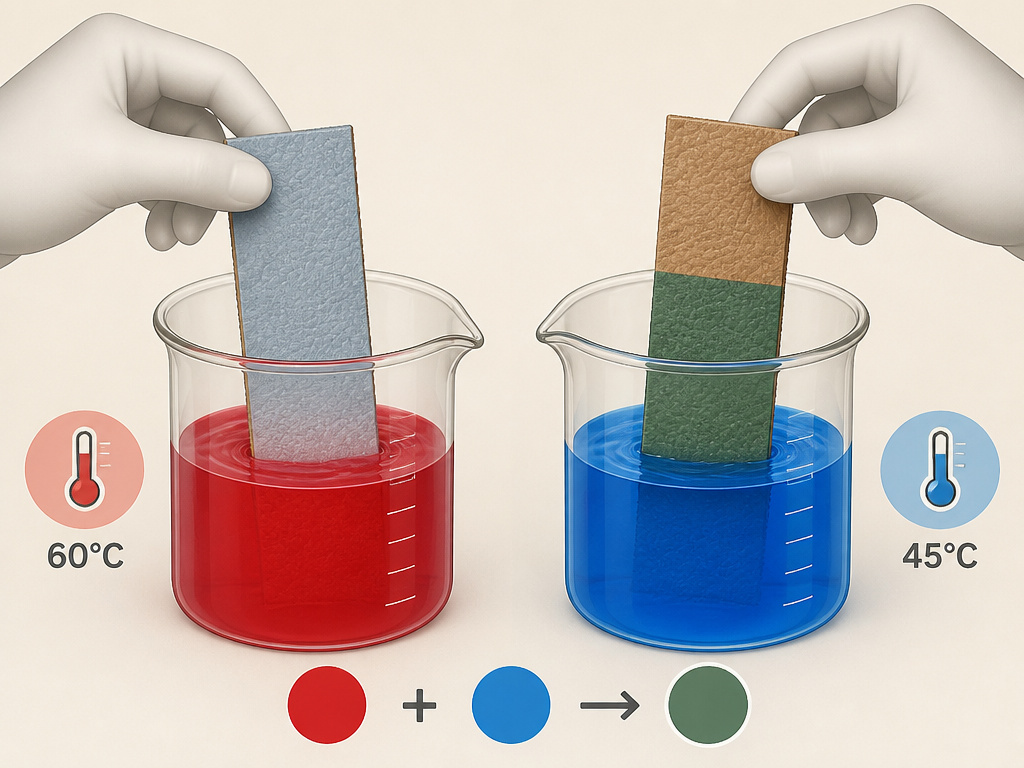
The type of tanning doesn’t just change the leather’s properties; it changes the entire rulebook for dyeing. This is based on years of practical experience comparing the two.
Chrome-Tanned Leather is the more forgiving student. Its isoelectric point near neutral pH gives a wide working range. It can handle higher dyeing temperatures, often up to 60°C, which speeds up penetration. The resulting wet blue base is a consistent pale grey-blue, offering minimal interference with the final dye color. A vibrant red dye on chrome leather will yield a vibrant red product.
Vegetable-Tanned Leather is the temperamental artist. Its naturally pale brown base color is always part of the final equation. Because dyestuffs are transparent, the final color is a mix of the dye and this underlying brown. This is why vegetable-tanned leather rarely yields a pure, bright green or blue, the brown dulls and darkens the shade. You get forest green, not emerald.
| Factor | Chrome-Tanned Leather | Vegetable-Tanned Leather |
|---|---|---|
| Base Color | Pale blue-grey (wet blue) | Pale brown |
| Safe Dyeing Temp | Up to 60°C | Max 45°C |
| Isoelectric Point (pH) | ~6.5 | ~3.5 |
| Color Outcome | True, vibrant dye expression | Warmer, muted, mixed with base brown |
| Dye Affinity | High for anionic dyes | Variable; can be mordanted for cationic dyes |
The temperature limit is a deal-breaker. A lab test might say vegetable-tanned leather shrinks at 62°C, but under the mechanical agitation and hour-long duration of drum dyeing, 45°C is the real safe maximum. Exceed that, and the leather stiffens and shrinks irreversibly.
Here’s a straightforward guide: if you want a specific, bright color, you’re almost always looking at a chrome-tanned leather. If you want a leather that will age and develop a rich patina, embrace the warmer, evolving tones of a vegetable-tanned leather.
Modern Methods and Measuring Results
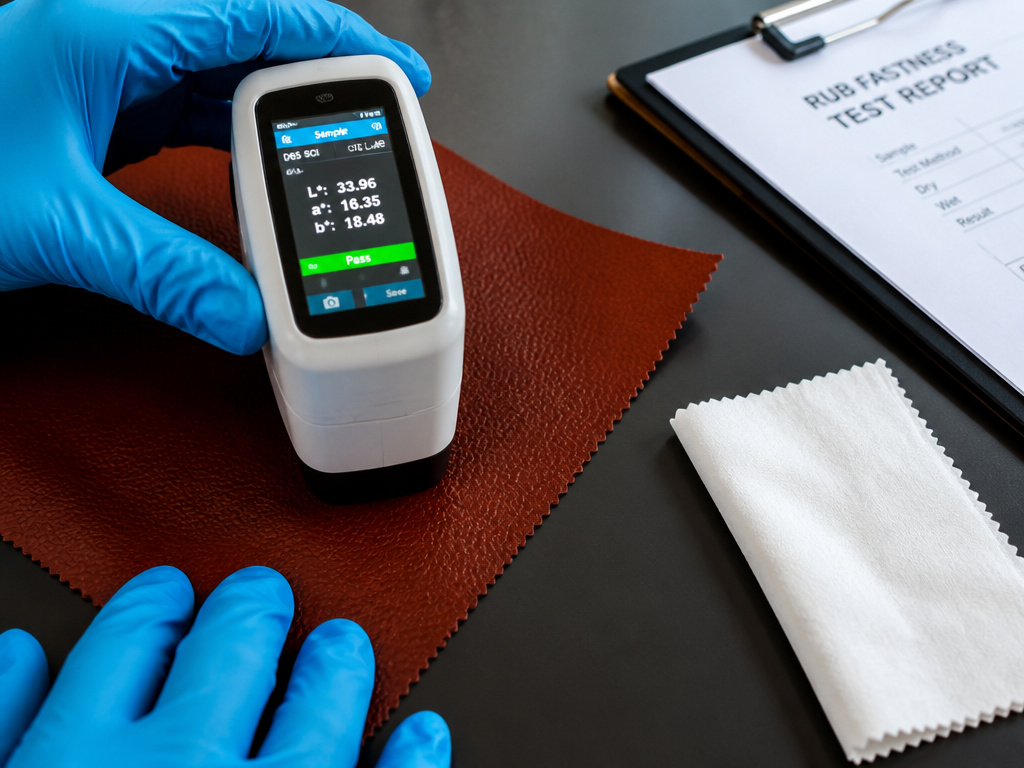
The science of leather coloring doesn’t stop at traditional drum dyeing. Modern research is pushing the field toward more efficient and eco-friendly methods, and the industry has strict standards for judging the results.
A 2026 study in Coloration Technology detailed a simultaneous tanning and dyeing process using reactive colorants that achieved near-complete exhaustion and fixation. This kind of ScienceDirect review on collagen dyeing points toward a future with less waste and more integrated production. Similarly, a 2021 PMC plant-derived leather colorants study explored using natural colorants with additives like chitosan to improve dye uptake and color stability, offering a botanical alternative to synthetic dyes.
Once the leather is colored, how do you know it’s good? This is where standards like ISO 7906:2022 come in. This international standard specifies how to test for color fastness, the leather’s resistance to fading from light, rubbing, or perspiration. It dictates the lighting conditions for assessment, the methods for testing change in color, and even how to check if the dye stains adjacent materials. Professional tanners use colorimeters to measure these values objectively, moving beyond “it looks fine” to data-backed quality assurance.
For the rest of us, the test is simpler and more tactile. A well-dyed leather should not transfer color onto a white cloth rubbed firmly against it. The color should be consistent across the piece, with no sudden shifts in shade. And when you bend it, the core shouldn’t reveal a starkly different, lighter color. These are the real-world signs the tanning process and dyeing stages were in sync.
Application: From Professional Drum to Home Care
Understanding how color gets into leather demystifies how to care for it, and when you can change it.
Professional techniques for coloring leather in a tannery rely on total immersion in a controlled dye bath. This ensures wrap-around, uniform coloration. For touch-ups or recoloring leather at home, the principles are the same but the scale is different. You’re still working with the leather’s surface charge, applying dye in thin, controlled layers, and allowing proper fixation time.
The biggest home-dyeing mistake is applying a new color over old, unstable finish or contamination. Just like in the tannery, preparation is everything. The surface must be clean, deglazed, and ready to accept the dye. Products like a good leather color restorer can blend and revive faded areas, but for a full color change, you need dedicated leather dyes designed to chemically bond.
And sometimes, the goal isn’t to add color but to reveal it. That’s the magic of pull-up leather. This leather is dyed normally, then stuffed with oils and waxes. When you stretch or “pull up” the leather, the oils temporarily move, allowing more light to reflect off the embedded dye particles. This lightens the color momentarily, creating a dynamic, changeable effect that’s built right into the leather’s grain.
Frequently Asked Questions
Why does some leather dye rub off?
If dye rubs off, it didn’t form a covalent chemical bond. This is usually a fixation failure. The pH during dyeing might have been wrong, the dye might be a cheap surface coating instead of a penetrative type, or it was applied over a sealed surface like a pigmented leather finish without proper preparation.
Can you dye any type of leather?
You can dye any unfinished, porous leather. Leather with a sealed pigment finish must have that finish removed through sanding or deglazing first, as the dye cannot penetrate the plastic-like topcoat. Oily leathers like chamois may also resist dye.
Does the type of dye affect leather softness?
Generally, no. The dye molecules are minuscule compared to the collagen structure. The dyeing process itself, the heat, time, and subsequent washing, has a far greater impact on the hand-feel than the dye chemicals.
Why is black leather so common?
Black dye is often the most lightfast and colorfast. It also provides excellent coverage, hiding natural markings and imperfections in the hide more effectively than lighter, translucent dyes. From a production standpoint, it’s a reliable, consistent result.
How is patent leather colored?
Patent leather is first dyed a standard color. Then, multiple layers of a high-gloss lacquer are applied on top. The color you see is the dye underneath the clear lacquer coats, which is why scuffs on patent leather often appear as a lighter color, you’re seeing through the damaged lacquer to the dye layer.
Before You Go
The story of leather’s color is a lesson in controlled chemistry. It’s not a passive soak but an active, engineered bond. The next time you pick up a leather bag or run your hand over a jacket, you’re feeling the outcome of pH adjustments, temperature checks, and charge interactions.
Understand leather better to make confident choices. If you love deep, uniform blacks and radiant jewel tones, thank chrome tanning and the anionic dyes that bond to it. If you’re drawn to the warm, evolving honey tones of a natural belt, you’re appreciating the subtle interference of vegetable tannins beneath the dye.
One practical takeaway: when a deeply colored leather item loses its hue, it’s often the protective topcoat that’s worn, not the dye itself. A quality color restoration focuses on rebuilding that protective layer, letting the original, chemically-bonded color shine through again. The color was never just on the leather. It became part of it.
